Key Takeaways:
- Pentest findings stall in backlogs because reports lack reproduction steps, context, and proof, so developers close them without fixing anything.
- A reasoning trace is the agent’s own step-by-step record of an attack: what it observed, what it hypothesized, why it acted, the evidence it gathered, and how it proved exploitation.
- Where a traditional report lists findings, a trace shows the whole attack path with proof inline, so a developer can replay any step and see the same behavior.
- A demonstrated exploit ends the usual debates over reproduction, severity, and false positives before they start.
- Chained findings expose the real business impact that isolated, pattern-matched severity scores miss.
Security findings are often forgotten in engineering queues. When a pentest report is added to Jira, it is assigned a low priority and remains in the backlog while new features, bug fixes, and refactorings are prioritized.
Developers check the ticket and close it because they are unable to replicate the problem, there is no business-related information, and they do not understand how the attacker reached that point. This leads to a high mean time to remediate, frustration on both teams, and an open risk for weeks.
Autonomous pentesting reporting transforms this scenario. Beyond just identifying vulnerabilities, the exact process used to exploit them is detailed step by step, and the agent’s internal logic is provided in a decision log.
The final product is no longer a report, but a trace of reasoning that guides the developer through the attack in the same way the AI agent executed it, providing evidence at each stage.
Why Developers Push Back on Security Findings
Developers tend to push back on security findings because the report lacks essential details, context, and convincing evidence. The 5 most common complaints are:
- I can’t reproduce this issue: The report lacks the necessary information for the developer to replicate the problem.
- I don’t understand the attack path: The report fails to connect the dots between low-severity issues and potential critical impacts.
- The severity feels exaggerated: The report flags a potential risk as critical without demonstrating a realistic scenario.
- This might be a false positive: The engineer doubts the validity of the finding if it is based on a generic pattern-matching scanner.
- I don’t know where to start fixing it: The suggested remediation is too generic and doesn’t help in the specific context of the codebase.
Traditional scanner reports create these reactions almost by design. They are pattern-match outputs. They flag where a signature matched, not how an attacker would actually move through the system. OWASP’s Web Security Testing Guide has spent years pointing out that without evidence and context, even accurate findings get treated like noise.
What is a Pentesting Reasoning Trace?
A reasoning trace is the attack debugging log itself from the agent. It records every action the AI took, in the order they occurred, along with the evidence it used to support those actions. The nearest comparison is the stack trace a backend engineer scans when receiving an exception in production. It is not a well-rounded summary but rather a primary source.
A complete reasoning trace records five things:
- What the agent observed about the target (endpoint, role, response shape).
- What hypothesis it formed about a possible weakness.
- Why it chose the next action rather than another.
- What evidence validated or invalidated that hypothesis.
- How it ultimately proved exploitation, with the request and response captured.
The key benefit of this format is that you can reproduce it by design. Using this design, a developer can replay any step, change a single parameter, and see the exact same behavior the agent saw.
All vendors operating in this space converge on the same shape, including Astra Security, contributors to the OWASP APTS, and academic groups working on agent observability. It is like how a human pentester would write notes during an engagement, just continuously generated by the AI agent in real time as it works.
Traditional Security Reports vs Reasoning-Trace Reports
A reasoning-trace report is not a summary of activities. It is like a storyboard, illustrating how the various activities interrelate and giving the reader the big picture.
| Traditional Report | Reasoning Trace Report |
|---|---|
| Lists findings | Shows the attack journey |
| Requires manual validation | Includes proof inline |
| Isolated vulnerabilities | Connected attack chain |
| Limited context | Full decision context |
| Difficult prioritization | Risk-based prioritization |
| CVSS-only severity | Business-impact severity |
| Generic remediation advice | Specific, code-aware guidance |
The Anatomy of an Autonomous Pentesting Reasoning Trace
A typical reasoning trace is divided into six sections. They all represent different stages of the agent’s work process. Together they allow a reader to follow the same route the agent followed rather than relying on someone to write an account based on what happened afterward.
Discovery
The agent will map out the surface it can see, including endpoints in scope, user roles, technologies fingerprinted in each response, and relationships between resources. This goes beyond asset discovery. The agent builds a mental map of how the app is organized, which allows later steps to form informed hypotheses.
Hypothesis
The agent makes a guess that can be tested based on its observations. If a response to the /api/v1/orders/1234 request returns order data without a server-side ownership check, the agent assumes that the endpoint does not implement object-level authorization. The hypothesis is documented before attempting any exploit, making subsequent reasoning auditable.
Validation
The agent takes a small targeted action to test the hypothesis. It logs in as a second user, sends the same request with a new object ID, and logs the response. If the server responds with a 403 or 401, the hypothesis is wrong. The hypothesis is confirmed if the server returns a 200 with someone else’s data.
Exploitation
Upon successful validation, the agent enumerates object IDs, chains the finding into a larger attack, such as privilege escalation, or dumps a dataset that shows the true impact. It wants to demonstrate what an attack will do, not only that a flaw exists.
Evidence
Each of the actions above is captured with its raw artifacts. That means the entire HTTP request and response, screenshots of the DOM when it loads, JWTs or session tokens pre- and post-decode when relevant, and timestamps between each step. The trace is reviewable by a developer who was not present in the room when the test ran.
Risk Assessment
Lastly, the agent correlates the exploit with its potential impact on the business. A BOLA exposing just one additional order is a different severity level than a BOLA that exposes all payment instruments for every customer, and the trace makes that very explicit. The risk section converts the technical exploit into the language a CTO, CISO, or product owner speaks.
Together, these six sections form the core of Astra’s autonomous pentest workflow and are reflected in the structure required by APTS Tier 2 conformance for verifiable findings.
5 Ways Reasoning Traces Remove Developer Friction
Reasoning traces eliminate certain friction points that prolong remediation. Here are five effects that consistently appear across teams that take this approach to reporting.
Instant Reproducibility
Since every step is logged with its corresponding request and response, a developer can reconstruct the attack path in their environment. They know exactly which payload, headers, cookie, and session were used.
Proof Eliminates Severity Debates
Nothing removes severity arguments faster than a demonstrated exploit. A CVSS calculator is no match for a working exploit. If the trace shows a normal user reading another customer’s invoice, there is nothing left to debate. You can see the exploit, not theorize about it.
Root Cause Becomes Obvious
When a developer reaches the exploitation step, they have often witnessed a failed authorization check in context. The reason itself can often be seen in the trace, like a missing ownership check, a stale token validation, or misconfigured middleware. It compresses the diagnostic work from hours to a few minutes.
Faster Prioritization
Actual business impact is revealed by attack chains rather than pattern-matched severity. Two findings that appear almost identical on a scanner dashboard can be miles apart in terms of impact. The reasoning trace indicates which one is exploitable and leads to a successful account takeover.
Reduced False Positive Investigation
A demonstrated exploit validates itself. After data extraction has been successfully demonstrated, nothing remains to be checked. This eliminates the longer tail of security tickets compared to engineering tickets. Teams that use validated, continuous penetration testing report recouping hundreds of engineering hours per quarter.
Example: How a Reasoning Trace Helps Fix a BOLA Vulnerability
The top risk in the OWASP API Security Top 10 is Broken Object Level Authorization (BOLA). It is also the cleanest place to demonstrate why a reasoning trace beats a flat finding. The following trace is representative of the workflow of autonomous pentesting.
- Step 1. The agent logs in as User A and lists their resources. It captures the response and notes that orders are referenced by sequential integer IDs (/api/v1/orders/4521).
- Step 2. While exploring, the agent notices that the order ID appears in the URL path but does not appear to be bound to a session-side ownership check in the response headers. It forms a hypothesis.
- Step 3. The agent switches identity to User B, a separate account it has provisioned for testing. It keeps User B’s session token but requests User A’s order ID directly: GET /api/v1/orders/4521.
- Step 4. The server returns a 200 OK with User A’s full order data, including customer name, shipping address, and the last four digits of a payment card. The agent records the full request and response as evidence.
- Step 5. The agent now has a working BOLA exploit. It maps the root cause: the controller checks authentication but skips authorization. It writes that conclusion into the trace.
- Step 6. The agent attempts to chain the finding. It iterates through order IDs and confirms that User B can read orders across the whole customer base. The severity is escalated from “information disclosure” to “mass PII exposure”.
The evidence the agent captures is verbatim, with recorded raw HTTP captures. You need to add an ownership check in the service layer so that every entry point inherits it. That is the output that Astra’s autonomous pentesting agents and API security platform are trained to generate.
Why Attack Chains Matter More Than Individual Findings
Single findings can mislead. An error message that is verbose and low-risk in isolation appears to be completely harmless. When coupled with a login endpoint that exposes valid usernames, it becomes a credential-stuffing primitive.
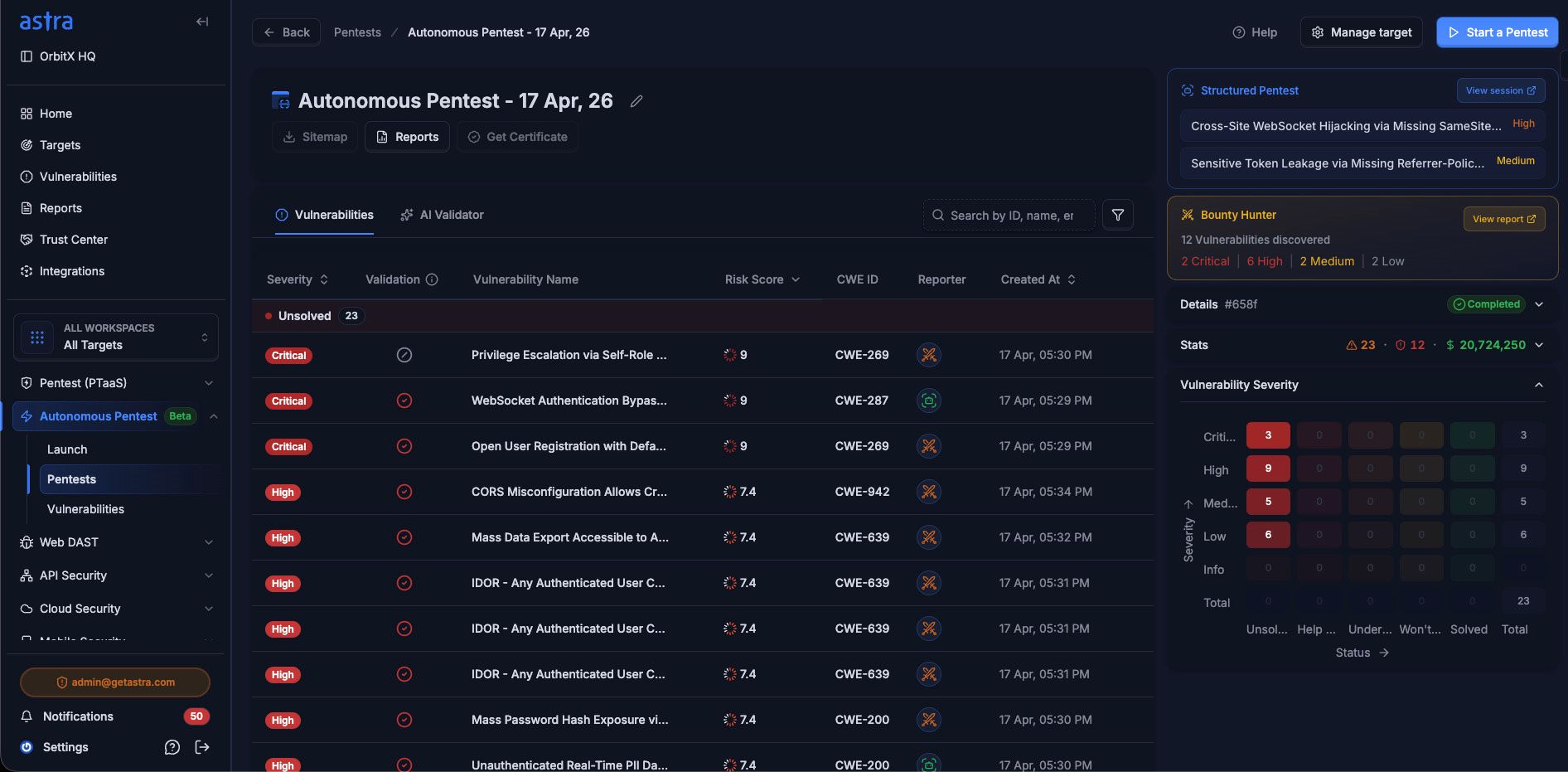
Autonomous pentesting excels at discovering these chains simply because it traverses the application as true users (and thus attackers) do, rather than one signature at a time. Astra’s research on the State of Continuous Pentesting makes the same point with data.
Severity-weighted dashboards routinely under-rank chained findings because each link looks small in isolation. A reasoning trace fixes this by representing the chain as one connected story, not five disconnected tickets.
From Security Ticket to Code Fix: The New Workflow
The traditional remediation workflow has excessive handoffs. Security discovers something, security writes it up, security forwards it to engineering, engineering asks questions, security verifies, engineering resolves, security retests, both teams bicker about whether or not the retest was sufficient.
With a reasoning trace attached to the ticket, the autonomous pentester conducts its own evidence gathering. The Jira or GitHub ticket inherits the full attack path, including the failing request. The developer commits a fix that targets the exact code path shown in the trace. The same agent then reruns the same trace, and either confirms remediation or shows where the fix fell short.
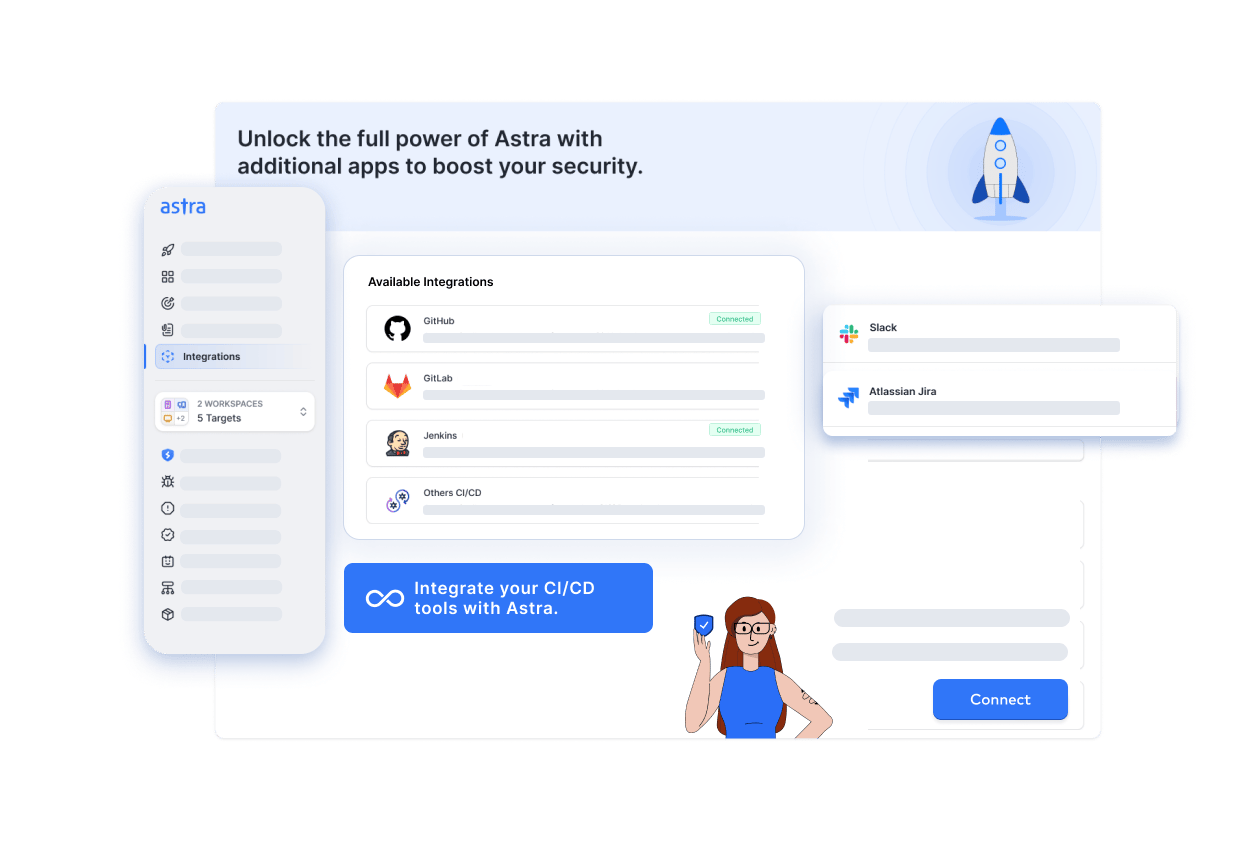
Astra’s PTaaS workflow and its native integrations with Jira, Slack, GitHub, and Jenkins are built around this collapsed loop, which is also the structure recommended by APTS for verifiable remediation.
What Makes a Good Reasoning Trace?
Not every AI pentest report is a reasoning trace. Most are still just flat lists with fancy marketing language around them. When it comes to evaluating autonomous pentesting vendors, use this checklist:
- Clear attack objective: The trace states what the agent was trying to achieve, not just what it scanned.
- Step-by-step actions: Each action is logged in order, with the agent’s hypothesis and reasoning attached.
- Evidence at each step: Raw HTTP requests, responses, and screenshots, not summarized prose.
- Business impact explanation: Translation of the technical exploit into the consequence a CTO or CISO would describe.
- Root-cause identification: The trace points at the specific code path or configuration, not a vulnerability class.
- Fix recommendations: Guidance specific to the application’s stack, ideally as a code diff or framework-aware patch.
- Retest instructions: A repeatable way to confirm remediation, usually a one-click rerun of the same trace.
The Future of Explainable Autonomous Pentesting
Continuous pentesting is replacing annual pentesting because development velocity no longer waits for a once-a-year report. Developer-centric reporting is moving findings into the surfaces where engineers already work, like pull requests, IDE plugins, and Cursor or Claude Code prompts. Security findings that arrive as proven exploits, with root cause and a suggested fix attached, become immediately actionable.
Astra’s research team has worked with the OWASP community to help shape the APTS standard, particularly around accountability and audit trails. This direction is also supported by emerging academic work in reasoning provenance and agent observability. The shared idea across all of it is that an autonomous pentest is only as good as the trace it leaves behind.
Final Thoughts
Autonomous pentesting is not valuable because it finds more vulnerabilities. Scanners have been finding “more vulnerabilities” for two decades, and remediation backlogs have only grown. It is valuable because reasoning traces show developers exactly what happened, why it matters, and how to fix it. When evidence, exploit paths, and root causes are delivered together, security findings move from debate to remediation.
The shift in autonomous penetration testing reporting is from finding vulnerabilities to proving them, and from listing issues to telling the story of the attack. Teams that adopt this style of reporting recover engineering hours, close findings faster, and stop running the same argument with their security team every sprint. That is the real return on autonomous pentesting, and it sits inside the report, not the scan engine.
FAQs
What is a reasoning trace in autonomous pentesting?
A reasoning trace is the AI agent’s own step-by-step log of an attack. It captures what the agent observed, what it hypothesized, why it chose each action, what evidence it gathered, and how it proved exploitation.
How is a reasoning trace different from a traditional pentest report?
A traditional report lists findings. A reasoning trace shows the attack journey with proof attached. The traditional format requires the reader to trust that the finding is genuine, whereas the trace lets the reader replay it and observe the same behavior the agent observed.
Why do reasoning traces reduce developer friction?
They remove the most common reasons developers push back on security tickets. There is no question about reproduction, because the request is in the trace. There is no question about severity, because the exploit is demonstrated.
Do reasoning traces help reduce false positives?
Yes. A finding that includes a validated exploit cannot be a false positive in the traditional sense, because the exploitation step is the validation. The trace eliminates the entire category of “this looks like a vulnerability but is not actually exploitable in our environment”.
How do reasoning traces improve vulnerability prioritization?
They surface business impact, not just CVSS severity. Two findings with the same technical rating can have very different consequences depending on which data they expose and which downstream actions they enable.
What should a high-quality reasoning trace include?
At minimum: a clear attack objective, step-by-step actions, evidence at each step, business impact, root-cause identification, fix recommendations specific to the stack, and a way to retest. If any of these are missing, the report is still a finding list, not a reasoning trace.
Explore Our Autonomous Penetration Testing Series
This post is part of a series on autonomous penetration testing. You can also check out other articles below.
- Chapter 1: Autonomous Pentesting: How it Works, Benefits, Tools (2026)
- Chapter 2: Autonomous vs Traditional Pentesting: What’s More Secure in 2026?
- Chapter 3: Top 10 Autonomous Pentesting Tools in 2026
- Chapter 4: How to Evaluate Autonomous Penetration Testing Security Vendors in 2026
- Chapter 5: OWASP APTS: A Complete Guide to Autonomous Penetration Testing Standard
- Chapter 6: Agentic AI in Cybersecurity: The Complete Guide for Security Teams
- Chapter 7: Autonomous Penetration Testing as a Growth Lever for Startups
- Chapter 8: 5 High-Impact Autonomous Pentesting Capabilities That Traditional Scanners Ignore
- Chapter 9: Autonomous Pentesting vs. Red Teaming: Do You Still Need Both?
- Chapter 10: How Autonomous Penetration Testing Kills False Positives
- Chapter 11: How a Modern Autonomous Penetration Testing Framework Differs from Legacy DAST
- Chapter 12: Autonomous AI Agents for Penetration Testing: A Complete Guide
- Chapter 13: Autonomous Pentesting for Lean Security Teams: The 2026 Guide
- Chapter 14: Will an Autonomous Pentest Satisfy SOC 2, PCI, & ISO Auditors?
- Chapter 15: How Reporting with Autonomous Pentesting Reasoning Traces Eliminates Developer Friction
- Chapter 16: A Guide to Continuous Autonomous Pentesting
- Chapter 17: Autonomous Pentesting for SaaS Companies in 2026: The Complete Guide