This guide breaks down the 21 best web application penetration testing tools of 2026: PTaaS platforms, scanners, proxies, and open-source staples, with an honest take on what each does well, where it falls short, and who it’s for, so you can pick the right one for your stack and threat model.
Why Trust Us with This List
This guide is written by our pentesters and security engineers, who run tools like these in live client engagements, not from vendor spec sheets. Across 1,000+ customer environments, we’ve used scanners and frameworks like the ones below to uncover 2M+ real vulnerabilities, and our methodology is externally audited (CREST-accredited; PCI DSS, ISO 27001, and CERT-In empanelled). So when we call a tool accurate or flag it for false positives, it comes from hands-on results.
We judged every tool against the same criteria we use to decide what belongs in our own workflow, which are detection accuracy, devSecOps fit, audit-readiness, and scalability.
Top Web App Pentest Tools of 2026
DAST Scanners
1. Astra Pentest
2. Intruder
3. Detectify
4. Acunetix
5. Probely
6. Indusface WAS
7. StackHawk
8. Nessus
9. Rapid7 InsightAppSec
Manual Testing & Intercepting Proxies
10. Burp Suite
11. Caido
12. Open VAS
13. OWASP ZAP
Specialized & CLI Tools (Targeted Testing)
14. SQLMap
15. Nuclei
16. ffuf
17. Nikto
Recon & Attack-Surface Mapping
18. OWASP Amass
Exploitation & Validation
19. Metasploit
Shift-Left / Code-Level Companions (SAST)
20. Veracode
21. Semgrep
Top 21 Web Application Penetration Testing Tools
By now, you have formed a general idea about the different kinds of tools generally used by Penetration Testers. Now let us learn about the best web services pentest tools. The tools we list here are all loaded with great capabilities; however, you have to choose the right ones according to your needs.
DAST Scanners
1. Astra Pentest [Get Started]
Key Features:
- Platform: Online
- Scanner Capacity: Offers manual, automated, and autonomous pentesting across web apps, APIs, mobile apps, and cloud infrastructure
- Accuracy: Zero false positives
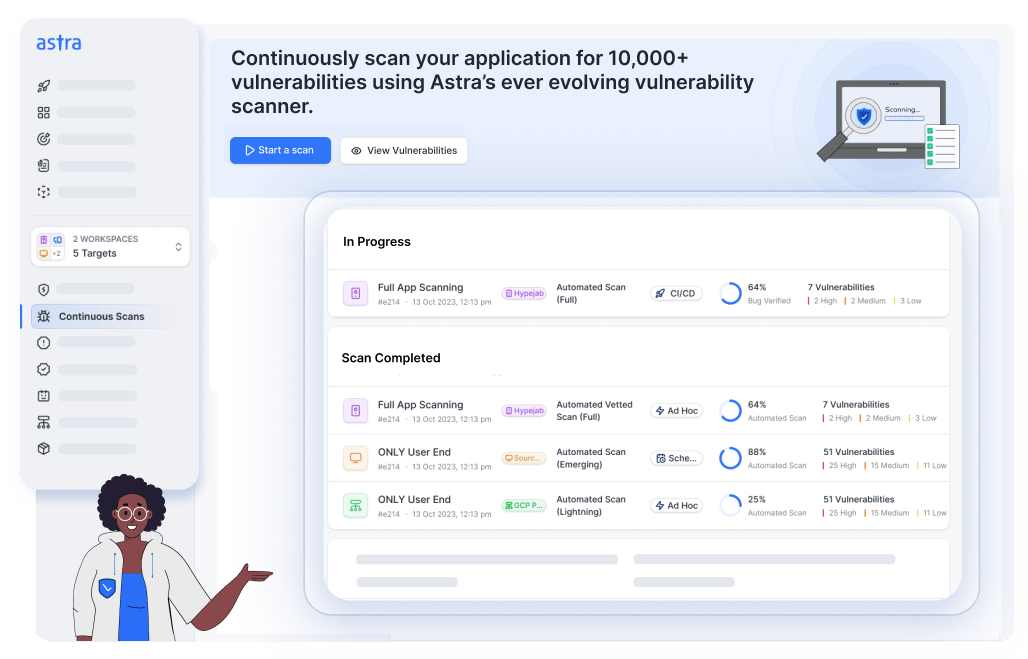
- Vulnerability management: Comes with a dynamic vulnerability management dashboard
- Compliance: Helps you stay compliant with PCI-DSS, HIPAA, ISO27001, and SOC2
- Price: Starts at $199/month. Better pricing, tailored to you. Book a call to unlock it
Astra Pentest is one of the few platforms in this category that ships true autonomous pentesting, an AI-powered DAST scanner, and a PTaaS platform. Our DAST scanner runs 15,000+ test cases across your assets.
Built for engineering teams shipping AI-assisted code at 2026 velocity, Astra plugs directly into your CI/CD pipeline, triggers diff-aware scans on every PR, and syncs confirmed findings to Jira or Linear with reproducible request/response evidence.
Under the hood, Astra performs both authenticated and unauthenticated scans against modern frameworks (Next.js, Django, Rails, FastAPI, Express, Spring), and its detection coverage extends well past the OWASP Top 10 and API Top 10 into business logic flaws, broken authorization chains, mass assignment, SSRF, and verb tampering.
Pros
- Native CI/CD integration with configurable pipeline exit strategies.
- Ensures zero false positives through thorough manual vetting of scan results.
- Autonomous exploit chaining that verifies impact end-to-end rather than reporting isolated CVEs
- Helps with cloud and API vulnerability management.
- Provides round-the-clock customer support.
Limitations
- Free trial starts at $7.
Customer Review
“I appreciate Astra Pentest for their professionalism and expertise. Their pentesters are highly knowledgeable … The reports are detailed yet easy to understand, providing clear insights and actionable recommendations.” – Shudhanshu S
Best For
Continuous pentesting + PTaaS with manual validation and DevSecOps integration.
2. Intruder
Key Features
- Platform: Online (cloud-based SaaS)
- Scanner Capacity: Continuous automated vulnerability scanning across external and internal attack surfaces, web apps, and APIs
- Accuracy: Noise-filtered results with intelligent prioritization.
- Vulnerability Management: Attack surface monitoring dashboard with change detection, exposure tracking, and issue lifecycle management
- Compliance: Reporting support for SOC 2, ISO 27001, and Cyber Essentials
- Price: Starts at $172/month (Essential tier), with Pro and Premium tiers scaling with target count. Custom pricing for enterprise.
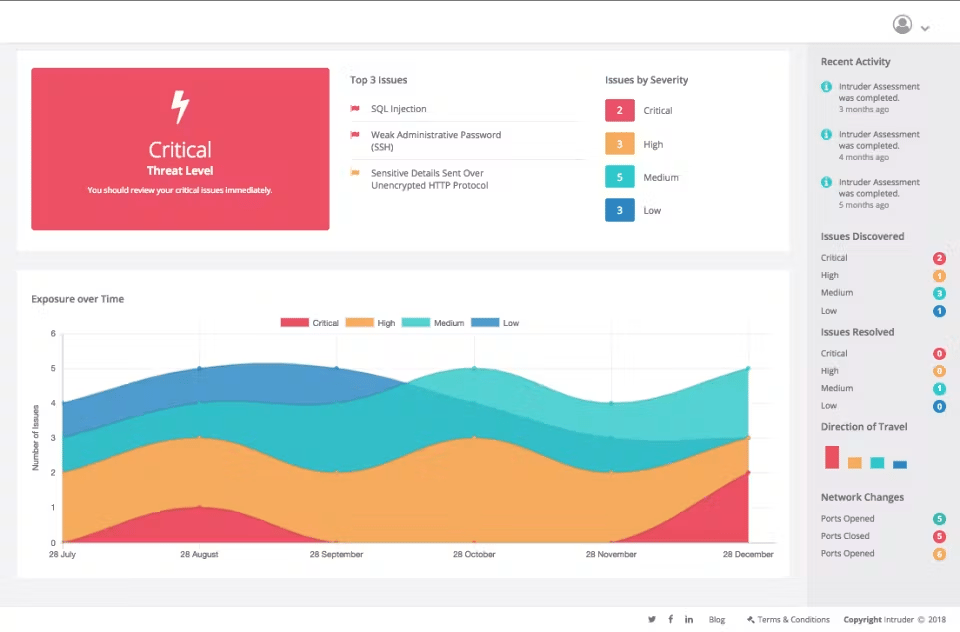
Intruder is a continuous vulnerability scanning platform that sits at the network and infrastructure end of the DAST spectrum. Its core strength is external attack surface monitoring, with automated scans running against every internet-exposed asset and alerting on new services, open ports, or expired certificates as they appear.
Under the hood, Intruder wraps commercial scanning engines (Tenable, OpenVAS) with its own prioritization layer and change-detection logic, giving smaller security teams enterprise-grade infrastructure scanning without the tuning overhead.
Where Intruder is thinner is on the deep application-layer testing side. It does not have the capabilities to detect multi-identity BOLA testing or business logic validation, which limits its coverage on the class of API vulnerabilities dominating 2026 breach reports.
Pros
- Excellent external attack surface monitoring with continuous asset discovery
- Rapid Response feature ships emerging-threat checks within hours of disclosure
- Clean, opinionated UI that works well for lean security teams
- Native cloud integrations (AWS, Azure, GCP) for automatic asset sync
Limitations
- Application-layer coverage is shallower than dedicated web app pentesting platforms
- Manual pentest add-on is available but limited in scope compared to PTaaS-first vendors
Customer Review
“Reliable service. They offer a variety of plans that fit different business needs. Customer support and overall service are good. They are also introducing a new platform in the UK that complies with all related laws and regulations.” – Ossama M
Best For: Continuous external attack surface monitoring and infrastructure vulnerability scanning for lean security teams.
3. Detectify
Key Features
- Platform: Online (cloud-based SaaS)
- Scanner Capacity: Continuous automated scanning of web applications, APIs, and external attack surfaces, powered by crowdsourced ethical hacker research
- Accuracy: Payload-based testing with low false positive rates
- Vulnerability Management: Surface Monitoring and Application Scanning dashboards with severity scoring and remediation tracking
- Compliance: Reporting support for SOC 2, ISO 27001, PCI DSS, and GDPR
- Price: Starts at $289/month (Surface Monitoring), with Application Scanning priced separately. Custom pricing for enterprise.
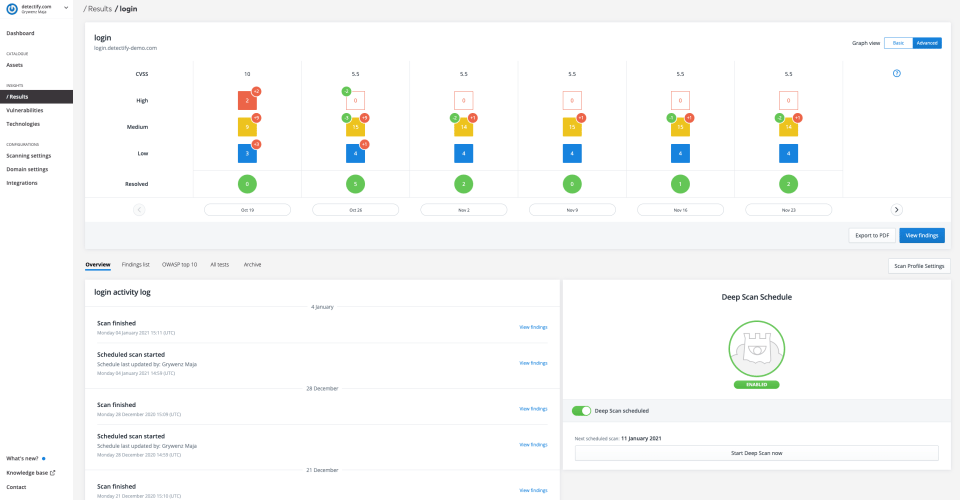
Detectify is a Swedish DAST platform built around a crowdsourced vulnerability research model. Its Crowdsource program feeds new detection modules from a curated network of ethical hackers into the scanning engine, which means Detectify often ships checks for newly disclosed vulnerabilities faster than signature-based scanners. This model has produced strong coverage on emerging web vulnerabilities, subdomain takeovers, and misconfigurations that traditional DAST tools miss.
The platform splits into two products: Surface Monitoring, which continuously discovers and scans an organization’s external attack surface, and Application Scanning, which performs deeper authenticated testing against specific web apps and APIs.
Detectify is a solid fit for organizations that want continuous DAST coverage with fresh detection signatures from the hacker community. It stops short of detecting business logic vulnerabilities.
Pros
- Keeps detection signatures fresh
- Strong external attack surface monitoring with subdomain takeover detection
- Good coverage of modern JavaScript-heavy applications and SPAs
- Fast time-to-detection for newly disclosed vulnerabilities
- Clean reporting UI with clear remediation guidance
Limitations
- Surface Monitoring and Application Scanning are priced separately, which can increase total cost
- Limited coverage of business logic flaws that require multi-step reasoning
Customer Review
“It is very comprehensive with lots of features to test security and can be automated and tailored easily to your needs. It has excellent documentation on how best to fix any detected problems.” – Paul E
Best For: Continuous DAST coverage powered by crowdsourced hacker research, with strong subdomain and attack surface monitoring.
4. Acunetix
Features:
- Scanner Capacity: Web applications
- Accuracy: False positives possible
- Vulnerability Management: Yes
- Compliance: OWASP, ISO 27001, PCI-DSS, NIST
- Price: Quote on Request
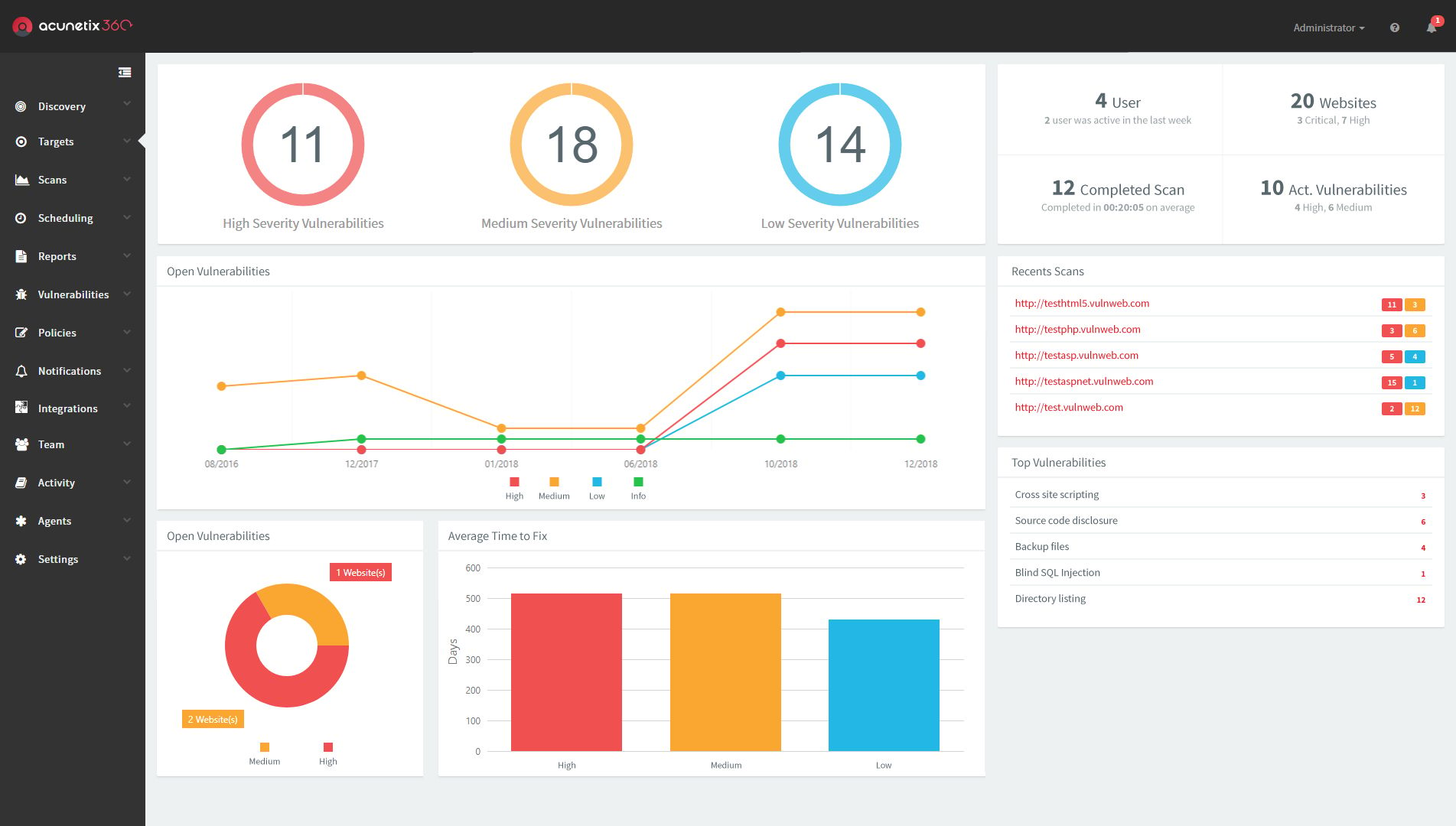
This web pentesting software provides vulnerability assessments and automated penetration tests provided by Invicti. Acunetix helps reduce vulnerabilities across various kinds of web applications.
It also allows the scanning of multiple environments as well as the prioritization of vulnerabilities.
Pros
- Time release of updates
- Can find a wide array of vulnerabilities.
- Agile testing with detailed reports
Limitations
- Does not provide expert remediation assistance with professionals.
- Does not ensure zero false positives.
- Dated user interface with scope for improvement.
Customer Review
“What I like best about Acunetix by Invicti is how seamlessly it combines powerful vulnerability detection with ease of use. It’s not just another security scanner — it’s an intelligent, automated tool that feels built for both developers and security professionals. The way it quickly identifies and prioritizes critical vulnerabilities like SQL injection, XSS, and misconfigurations across websites and APIs saves a huge amount of manual effort. ” – Ranit D.
Best For
Best for automated web vulnerability scanning with broad vulnerability coverage and prioritization.
5. Probely
Features:
- Scanner Capacity: Web applications, APIs
- Manual pentest: No
- Accuracy: False positives possible
- Vulnerability management: Yes
- Compliance: HIPAA, PCI-DSS, GDPR, & OWASP TOP10
- Price: Starts at $98/month – Pro Plan
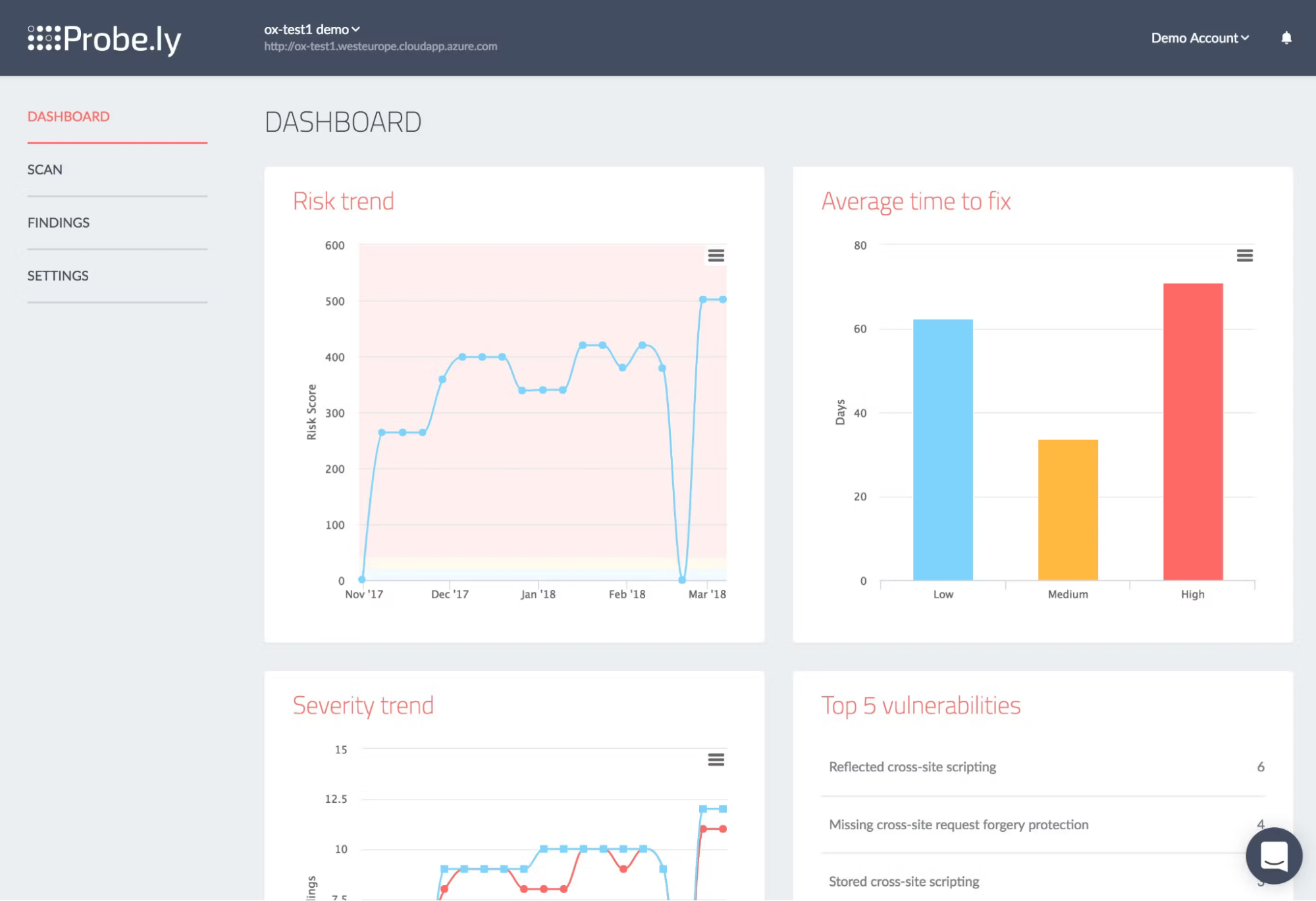
Probely is designed for web application scanning and API scanning. They say, using Probely is like adding a virtual specialist to your team. We will let you be the judge after you look at the features.
Probely automatically prioritizes vulnerabilities based on the risk of the vulnerabilities and provides proof of legitimacy for each issue.
Pros
- Simple to use with continuous scanning.
- Wide range of tests.
- Good customer support.
Limitations
- Could have better integrations.
- Custom vulnerability scoring does not align with general scoring.
Customer Review
“Helps the development team in building secure apps through scanning for vulnerabilities before going live.
Provides reports and insights that help future app development.
Secure web applications and API’s access.” – Odbor K.
Best For
Best for continuous automated web and API scanning with developer-friendly reporting.
6. IndusfaceWAS
Features:
- Scanner Capacity: Web and mobile applications, APIs
- Accuracy: Zero false positives
- Vulnerability management: Yes
- Compliance: PCI-DSS, ISO 27001
- Price: Starts at $ 59/app/month – Advance plan
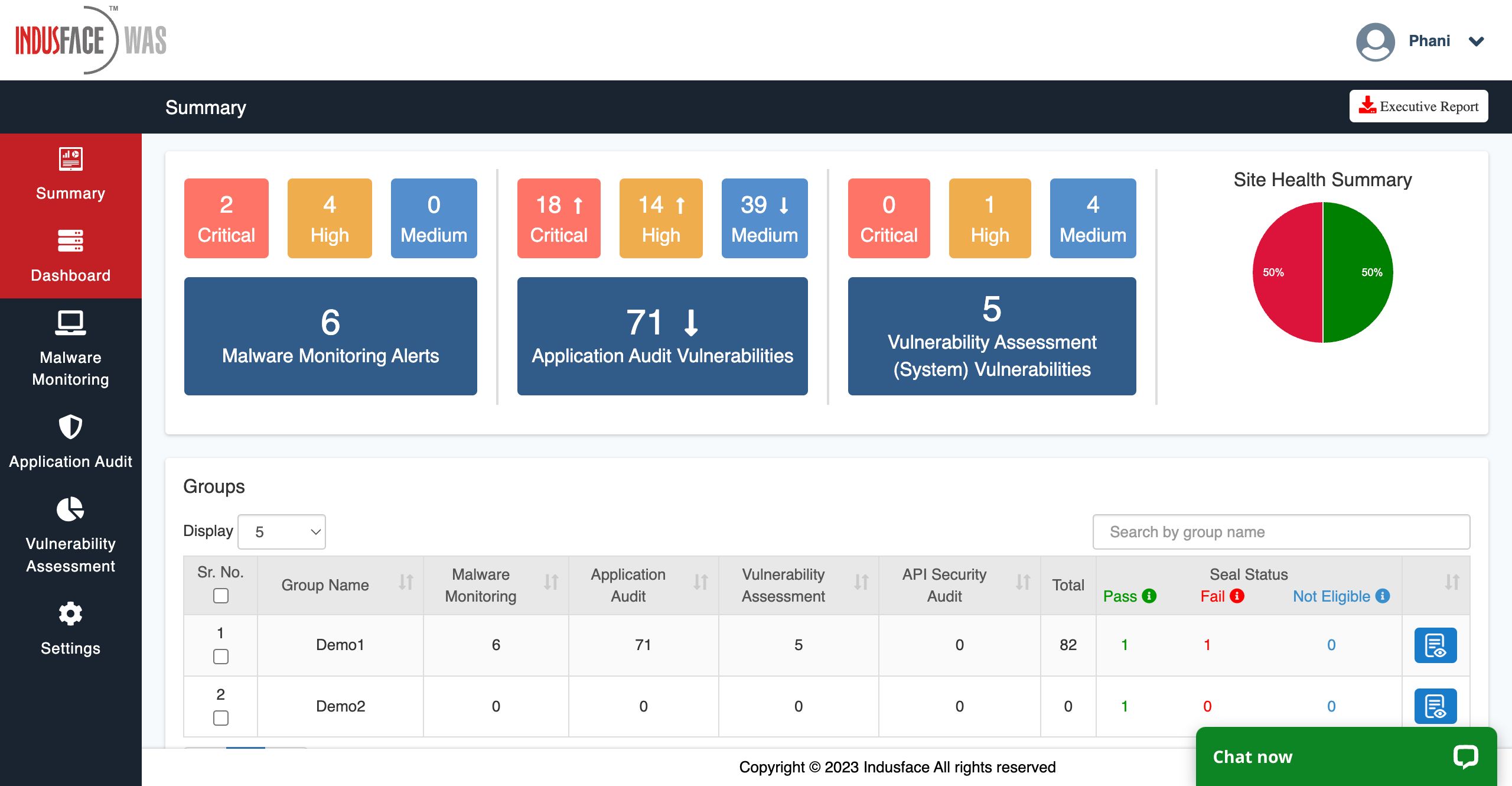
IndusfaceWAS combines automated scanning and manual pentesting to help you detect all OWASP top 10 vulnerabilities and business logic errors. Indusface also promises zero false positives and provides remediation assistance.
The scanner built by Indusface is focused on scanning single-page applications and intelligent crawling. It offers unlimited scans and detects application vulnerabilities validated by OWASP and WASC.
Pros
- Assured zero false positives through zero-day protection.
- Helps achieve compliance with regulations like PCI-DSS and ISO 27001.
- Vulnerability detection is not limited to OWASP Top 10.
- It has an executive dashboard that provides necessary information.
Limitations
- Not available for mobile applications.
- Reports are difficult to understand.
Customer Review
“What I like about the WAS platform is that it combines EASM + PTaaS and provides Risk based Vulnerability scoring for all the vulnerabilities.” – Mazhar S.
Best For
Best for automated web and API scanning with zero false positives and compliance-focused dashboards.
7. StackHawk
Key Features
- Platform: Online (cloud-based SaaS) with local CLI scanner
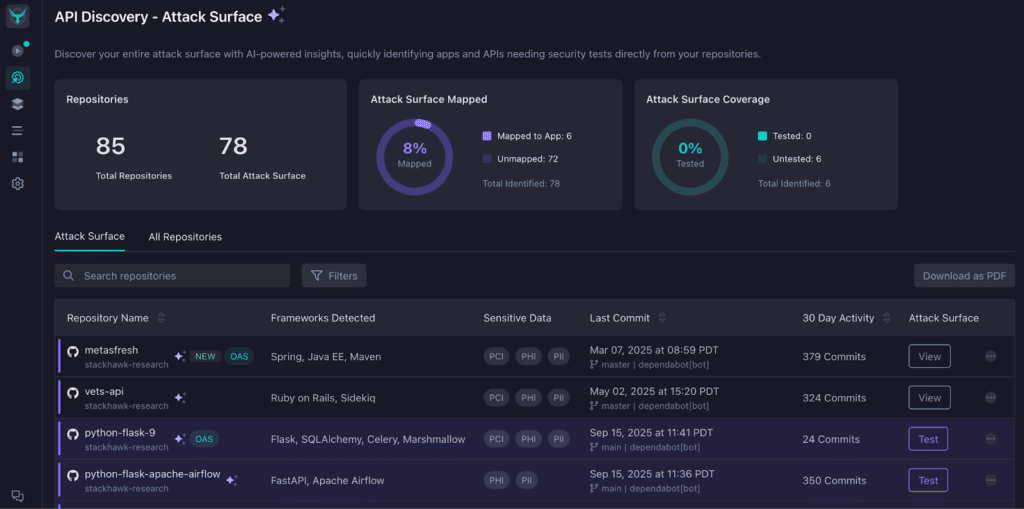
- Scanner Capacity: Continuous automated DAST scanning of web apps, REST APIs, GraphQL, and gRPC, built on the OWASP ZAP engine
- Accuracy: Developer-tuned scan configuration with contextual rules to reduce noise, though without dedicated human validation on findings
- Vulnerability Management: Findings dashboard with per-application scoring, PR-level integration, and remediation tracking
- Compliance: Reporting support for SOC 2, PCI DSS, and HIPAA
- Price: Free tier for single-app scanning, paid plans start at $49/app/month (Pro), with Enterprise custom pricing
StackHawk is a DAST platform built specifically for developer workflows, positioning itself as “DAST that runs in CI/CD” rather than a security team console with a pipeline integration bolted on. The scanner is packaged as a Docker container that runs inside the customer’s own CI/CD environment, scans a pre-production deployment on every PR, and returns findings as pipeline output before the code merges. This local-execution model is unusual in the DAST space and is StackHawk’s biggest differentiator.
StackHawk is a strong fit for engineering-led organizations that want DAST baked into every PR with minimal security team involvement.
Pros
- Developer-first workflow with scans running inside the customer’s own CI/CD
- YAML-based scan configuration that lives in the repo alongside the app
- Strong REST, GraphQL, and gRPC API scanning support with schema ingestion
- Free tier available for single-application use cases
- Clean PR-level integration with GitHub and GitLab
Limitations
- ZAP-based engine inherits ZAP’s coverage limitations on business logic flaws
- Per-application pricing can escalate for organizations with many microservices
Customer Review
“The onboarding of application. Vendor customer support. API files scanning. Easy to use and implementation and DevSecOps CI/CD integration The dashboard results… Attack Surface utilization… etc.,” – Ramgopal K.
Best For: Developer-first DAST that runs inside CI/CD pipelines, purpose-built for engineering teams shipping REST, GraphQL, and gRPC APIs.
8. Nessus
Key Features:
- Scanner Capacity: Web applications
- Accuracy: False positives possible
- Vulnerability management: Yes (Additional Cost)
- Compliance: HIPAA, ISO, NIST, PCI-DSS
- Price: Starts at $4,236/year
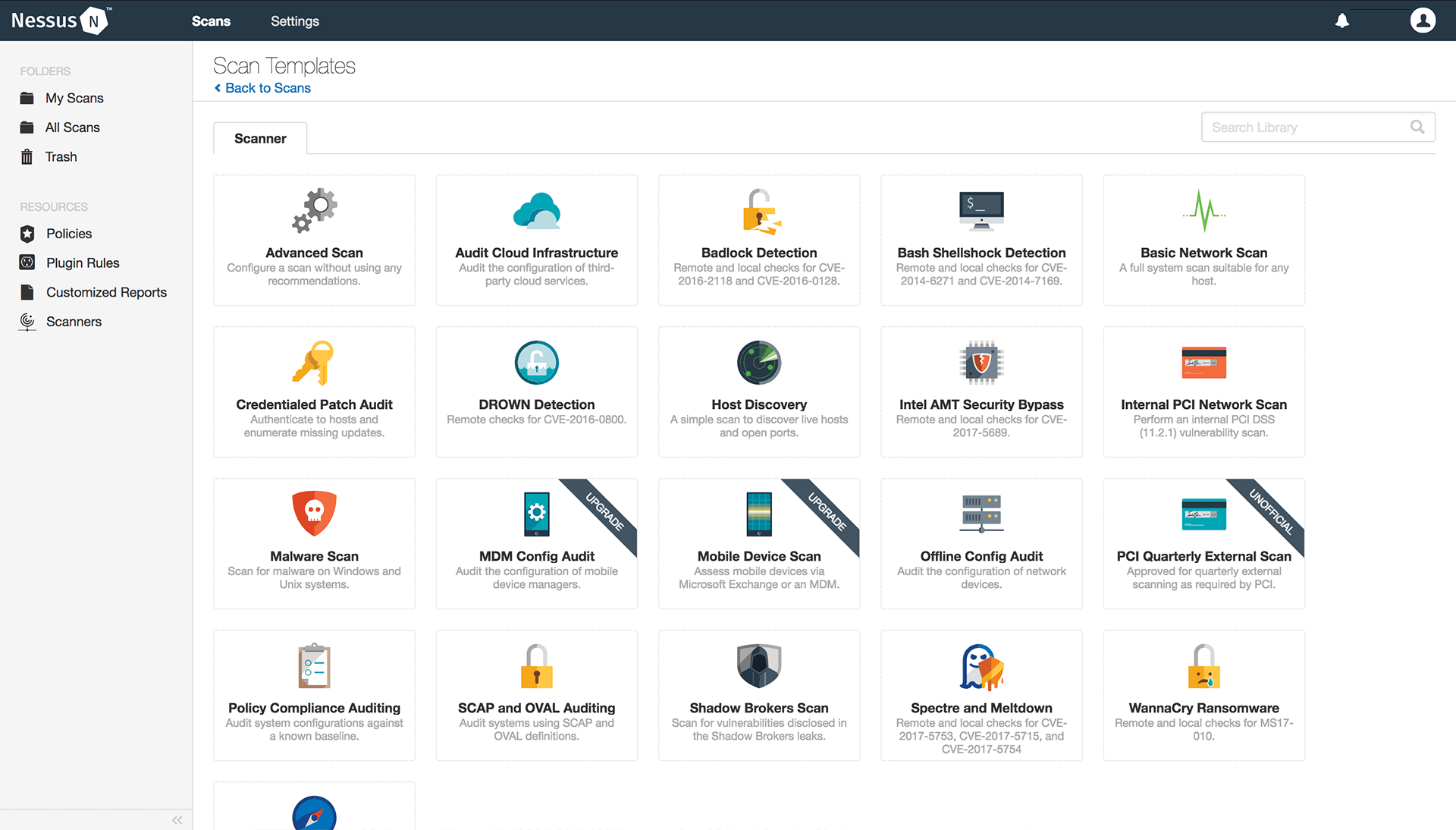
Nessus is an automated website penetration testing tool by Tenable. It has been used by security professionals for vulnerability assessment since 1998. They aim to make vulnerability assessments simple and quick remediations. You can deploy it on a variety of platforms.
It’s easy to navigate and use UI, and simplified automation of scanning and reporting tasks makes it one of the leading choices for web app pentests.
Looking for reliable Tenable alternatives that offer advanced vulnerability management and compliance coverage?
Pros
- Helps find missing patches that are critical to maintaining security.
- Point-in-time analysis of security system.
- Helps achieve compliance with the scans.
Limitations
- Advanced support is only available upon additional payment.
- Takes time to complete scans.
- Can be an expensive solution.
Customer Review
“I think Tenable Nessus is a very popular toolset that stands out because of its usability, allowing me to learn and use it quickly without requiring extensive training or facing a steep learning curve. Its intuitive nature facilitates swift adoption, making it accessible for our team. Additionally, I value the ability to specify the range of IP address assets and perform both ad-hoc and scheduled scanning. This functionality is crucial for maintaining the integrity and security of our network infrastructure, and it helps us in managing and mitigating vulnerabilities efficiently.” – Herman
Best For
Best for automated vulnerability scanning and compliance-driven assessments across web applications and infrastructure.
9. Rapid7
Features
- Scanner Capacity: Cloud and Web Applications
- Accuracy: False positives possible
- Vulnerability management: Yes
- Compliance: CIS, ISO 27001
- Price: Starts at $175/app/month
As a vulnerability assessment service provider, Rapid7 is another web pentesting tool with a range of services dedicated to web application security. They configure the scans, schedule them, validate the findings, and remove false positives.
They optimize the vulnerability scans based on your compliance requirements. Apart from these things, Rapid7 also provides business logic testing that is otherwise impossible with a vulnerability scanner.
Pros
- Simple and easy-to-navigate interface.
- Capable of finding hidden vulnerabilities
- Great and easy-to-understand reports.
Limitations
- Customer support can be improved.
- Removal of scanned devices must be done manually.
Customer Review
“Their CRC Essentials license is absolutely value for money as it includes three of their products – InsightVM, InsightCloudSec and InsightConnect, giving us a nice package for all our needs including vulnerability management, cloud security and compliance and to some extent security orchestration and automation capabilities.
Whilst the package is great for a business like ours, considering we are a small security team, we got a wide variety of various services from Rapid7 in a single license, However, it has made our work significantly more which is pretty annoying.” – Himanshu K.
Best For
Best for enterprise-grade vulnerability management with validated findings and business-logic testing support.
Manual Testing & Intercepting Proxies
10. Burp Suite
Features:
- Scanner Capacity: Web applications
- Accuracy: False positives possible
- Vulnerability management: No
- Compliance: PCI-DSS, OWASP Top 10, HIPAA, GDPR
- Price: $449/per user/per year
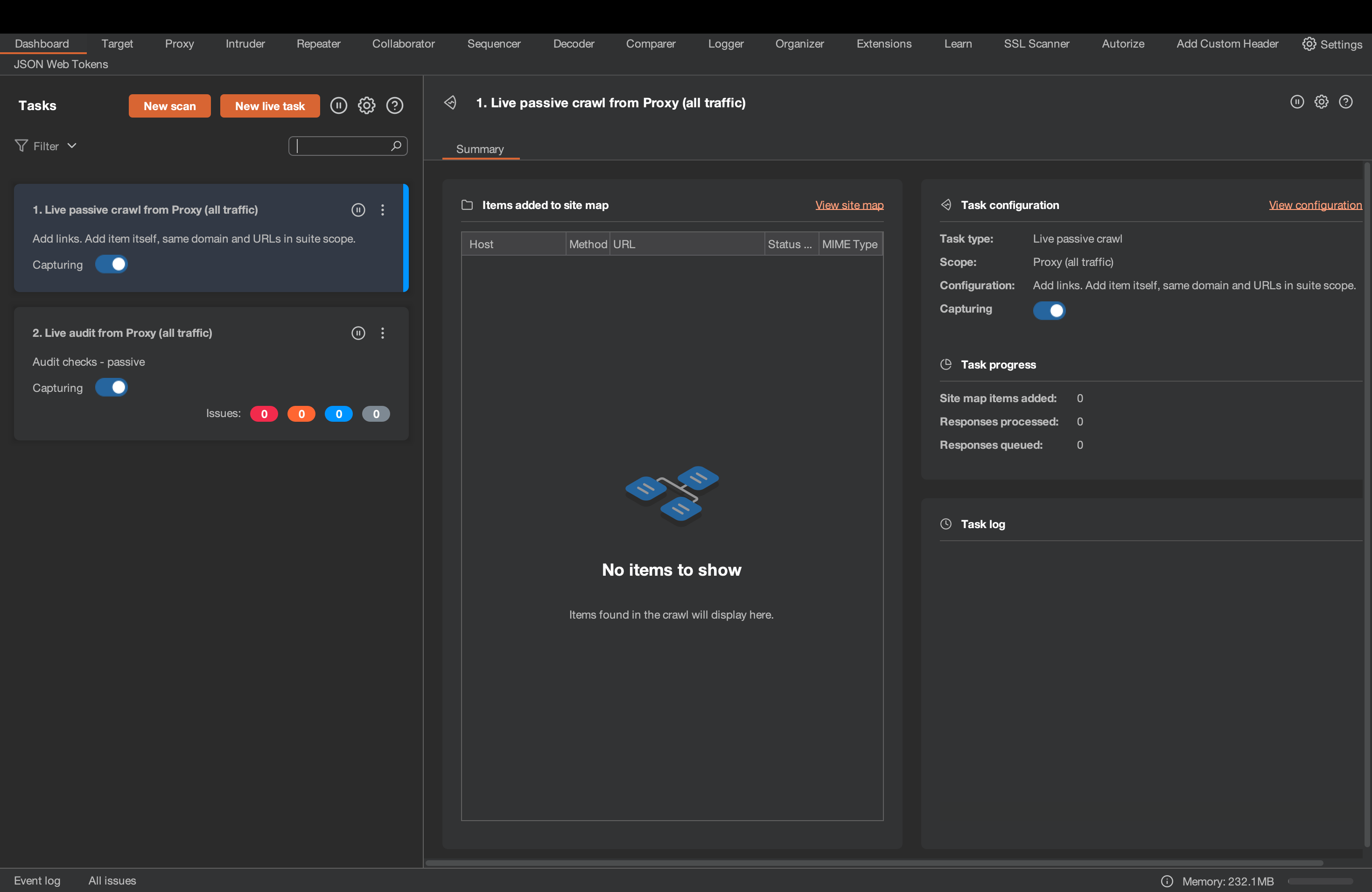
Burp Suite stands out as a top-tier web penetration testing tool, equipped with features for both manual and automated testing. It identifies vulnerabilities by intercepting and analyzing web traffic, automating tedious tasks, and performing fuzzing and brute-force attacks on login mechanisms.
This tool is highly effective at detecting common web vulnerabilities like SQL Injection, Cross-Site Scripting (XSS), and Insecure Direct Object References (IDORs). It offers both, a free community edition and a commercial edition.
Pros
- Provides advanced automated pentesting services.
- Provides step-by-step advice for every vulnerability found.
- Can crawl through complex targets with ease based on URLs and content.
Limitations
- Advanced solutions are commercialized and can be expensive.
- Does not provide expert customer service and assistance.
Customer Review
“Burp Suite is incredibly user-friendly for a tool with such depth. The interface is well-organized, and even beginners can start intercepting and analyzing traffic with minimal setup. Real-time interception and request modification through the Proxy and Repeater tools are extremely powerful – they allow me to instantly test and validate web vulnerabilities as I discover them. The ability to view and manipulate requests and responses in real time makes it an essential tool in any web security assessment.” – Nikhil S.
Best For
Best for manual web application testing, request interception, and identifying common web vulnerabilities like XSS and SQL injection.
11. Caido
Key Features
- Platform: Desktop application (Windows, macOS, Linux) with team collaboration server
- Scanner Capacity: Manual intercepting proxy for hands-on web application pentesting, with automation via workflows and plugins
- Accuracy: Not a scanner in the traditional sense; findings are produced by the human pentester using the tool
- Vulnerability Management: Session-based finding tracking within the tool, exportable to external systems
- Compliance: Not applicable; Caido is a pentesting tool used to produce findings, not a compliance platform
- Price: Free Community edition, Pro at $30/month, Team at $60/user/month, Enterprise custom pricing
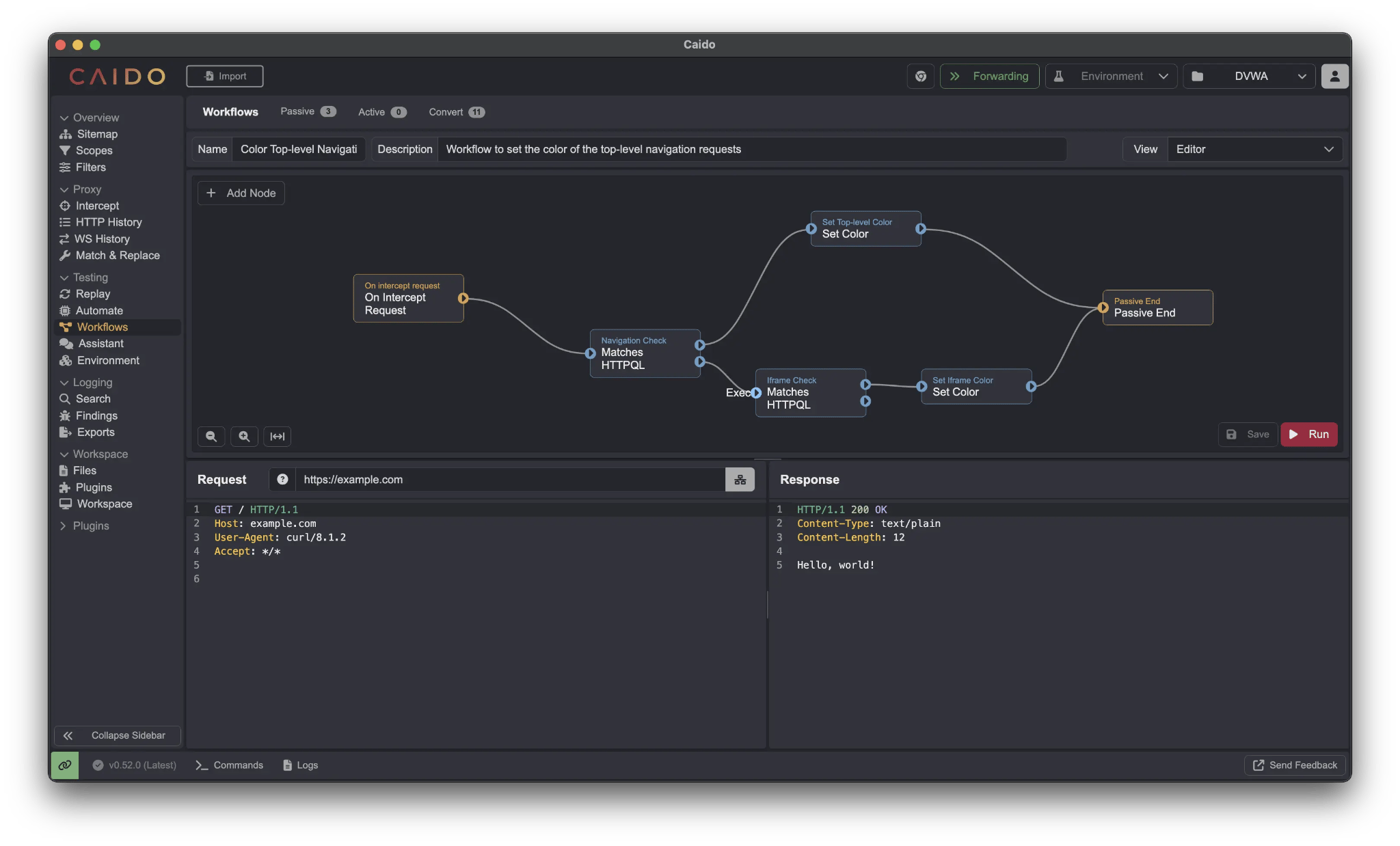
Caido is a modern web application pentesting toolkit built as a lightweight alternative to Burp Suite. The tool is a hands-on intercepting proxy designed for individual pentesters and bug bounty hunters, giving them a fast, keyboard-driven UI for capturing, modifying, and replaying HTTP requests against a target application. Caido has gained traction quickly since its launch because it addresses long-standing usability complaints about legacy proxies while keeping the core workflow familiar.
Pros
- Fast, keyboard-driven UI that many pentesters prefer to Burp
- Free Community edition makes it accessible for solo researchers and students
- Active development with frequent releases and a growing plugin ecosystem
- Cross-platform desktop support (Windows, macOS, Linux)
- Team collaboration features for shared engagements
Limitations
- Manual pentesting tool rather than automated or autonomous DAST
- Requires a skilled human pentester to produce findings
- No native compliance reporting, exploit chaining, or vulnerability management workflow
- Ecosystem is younger than Burp’s, so extension coverage is still catching up
Customer Review
“Hi, I took some time to use Caido. I really like it, especially the ability to switch between projects. I also thought the UX that introduces users to the application was well-done. Tbf, I have years of experience with Burp, but I think anyone would have been able to follow along. Nice, clean UI and installation was breezy. Great job!” – Ping00
Best For: Manual, hands-on web application pentesting for security researchers, bug bounty hunters, and internal red teams.
12. OpenVAS
Features
- Scanner Capacity: Web applications, network protocols
- Accuracy: False positives possible
- Vulnerability Management: No
- Compliance: No
- Price: Free
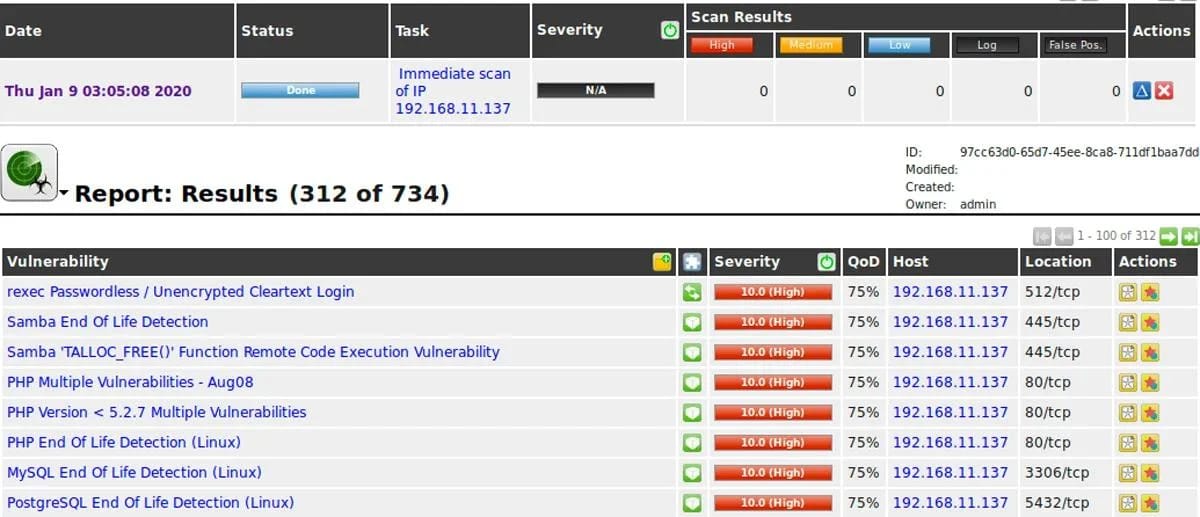
OpenVAS is an open-source penetration testing software that is comprehensive and powerful. It is supported and updated constantly with the help of expert pentesters all around the world, thus making it up to date.
Most importantly, it has been observed to miss basic vulnerabilities and may result in false positives.
Pros
- Automated vulnerability scanning is quick and efficient
- Freely available network vulnerability scanning tool.
- Scans for improper file access, XSS injections.
Limitations
- Could be difficult for beginners to make use of.
- Automated causes false positives to appear.
Customer Review
“OpenVAS is a great free software for vulnerability scans, offering good performance compared to other free tools. Easy to deploy and well configurable.
The UI of OpenVAS can be confusing for new users. The options are hidden and not very intuitive. The lack of a more well-developed and organized inventory can also be a point of improvement.” – Victor Hugo M.
Best For
Best for free, open-source network and web vulnerability scanning for baseline security assessments.
13. OWASP ZAP (Zed Attack Proxy)
Features
- Platform: Desktop application (Windows, macOS, Linux), Docker image, and headless daemon mode with REST API
- Scanner Capacity: Automated DAST scanning of web apps and APIs, intercepting proxy, active and passive scanning, fuzzing, and WebSocket testing
- Accuracy: Community-maintained rule set with well-known false positive rates
- Vulnerability Management: Session-based findings within the tool, exportable to HTML, XML, JSON, Markdown, and SARIF for downstream tooling
- Compliance: Doesn’t support compliance mapping
- Price: Free and open source (Apache 2.0 license)
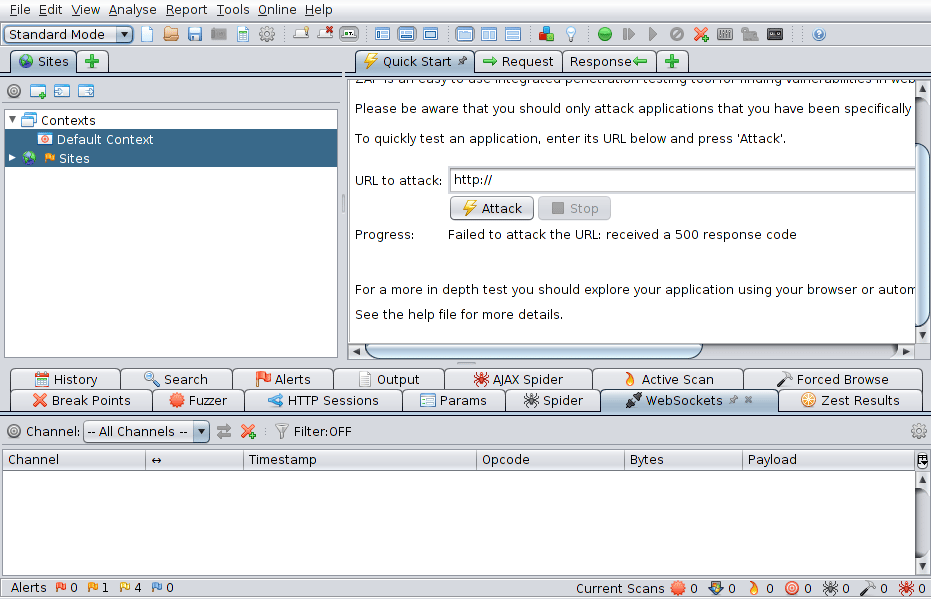
OWASP ZAP is the most widely deployed open-source DAST tool in the world and has been the community-maintained flagship of the OWASP Foundation for over 15 years. It combines a full-featured intercepting proxy, an automated active scanner, passive analysis, fuzzing, and API testing into a single tool that anyone can run for free. ZAP’s ubiquity means it has become the baseline DAST layer for countless engineering teams, CI/CD pipelines, and commercial tools (StackHawk builds on ZAP under the hood, for example).
Pros
- Free, open source, and actively maintained with a large global community
- Full-featured intercepting proxy for manual pentesting alongside automated scanning
- YAML-based Automation Framework for CI/CD integration
- Broad protocol support (HTTP, HTTPS, WebSockets, GraphQL, OpenAPI)
- Extensible via Marketplace add-ons and scripting in Zest, JavaScript, and Groovy
- Widely adopted, so tutorials, integrations, and community support are plentiful
Limitations
- Signature-based detection produces higher false positive rates than commercial scanners
- Slower feature and detection updates compared to commercial vendors
- No autonomous exploit chaining or multi-identity authorization testing
- No managed human validation, so triage overhead sits with the customer team
- UI and configuration complexity can be steep for teams new to DAST
Customer Review
“I find the automated scans in ZAP by Checkmarx help me save time and offer valuable reports and suggestions. I like that the reports come in different formats, which is really convenient. Also, I appreciate that it’s open-source, which adds to its flexibility. Plus, the initial setup was very easy.” – AJAYRAJ T.
Best For: Free, open-source DAST baseline scanning and manual pentesting proxy work for small teams, beginners, and CI-driven pipelines.
Specialized & CLI Tools (Targeted Testing)
13. SQLMap

Features
- Scanner Capacity: SQL injection testing for web applications
- Manual pentest: Semi-automated exploitation tool
- Accuracy: High accuracy for SQL injection detection
- Vulnerability management: No
- Compliance: OWASP Top 10 (Injection category – indirect)
- Price: Free (open source)
SQLMap is a specialized open-source penetration testing tool designed exclusively for detecting and exploiting SQL injection vulnerabilities. It automates the process of identifying injectable parameters, fingerprinting database systems, extracting data, and even taking over database servers under certain conditions.
The tool supports a wide range of databases including MySQL, PostgreSQL, Oracle, MSSQL, and SQLite. While extremely powerful, SQLMap assumes the user has a strong understanding of SQL injection concepts and database internals.
Customer Review:
Widely regarded in the security community as the “gold standard” for SQL injection exploitation.
Pros:
- Extremely effective at detecting and exploiting SQL injection
- Supports nearly all major database engines
- Highly customizable via command-line options
- Actively maintained by the security community
Limitations:
- Not beginner-friendly
- Limited strictly to SQL injection vulnerabilities
- No reporting or vulnerability management features
Best For: Experienced penetration testers performing deep SQL injection testing and database exploitation.
15. Nuclei
Key Features
- Platform: Command-line tool (open source, written in Go), with optional cloud platform (ProjectDiscovery Cloud)
- Scanner Capacity: Template-driven vulnerability scanning across web apps, APIs, DNS, TCP, SSL, and infrastructure
- Accuracy: Depends on template quality; core template library is well-maintained, but custom or community-contributed templates vary in precision
- Vulnerability Management: Raw output by default (JSON, Markdown, SARIF); structured findings and dashboards available via ProjectDiscovery Cloud
- Compliance: Not a compliance platform
- Price: Free and open source (MIT license); ProjectDiscovery Cloud has free and paid tiers, with team pricing on request
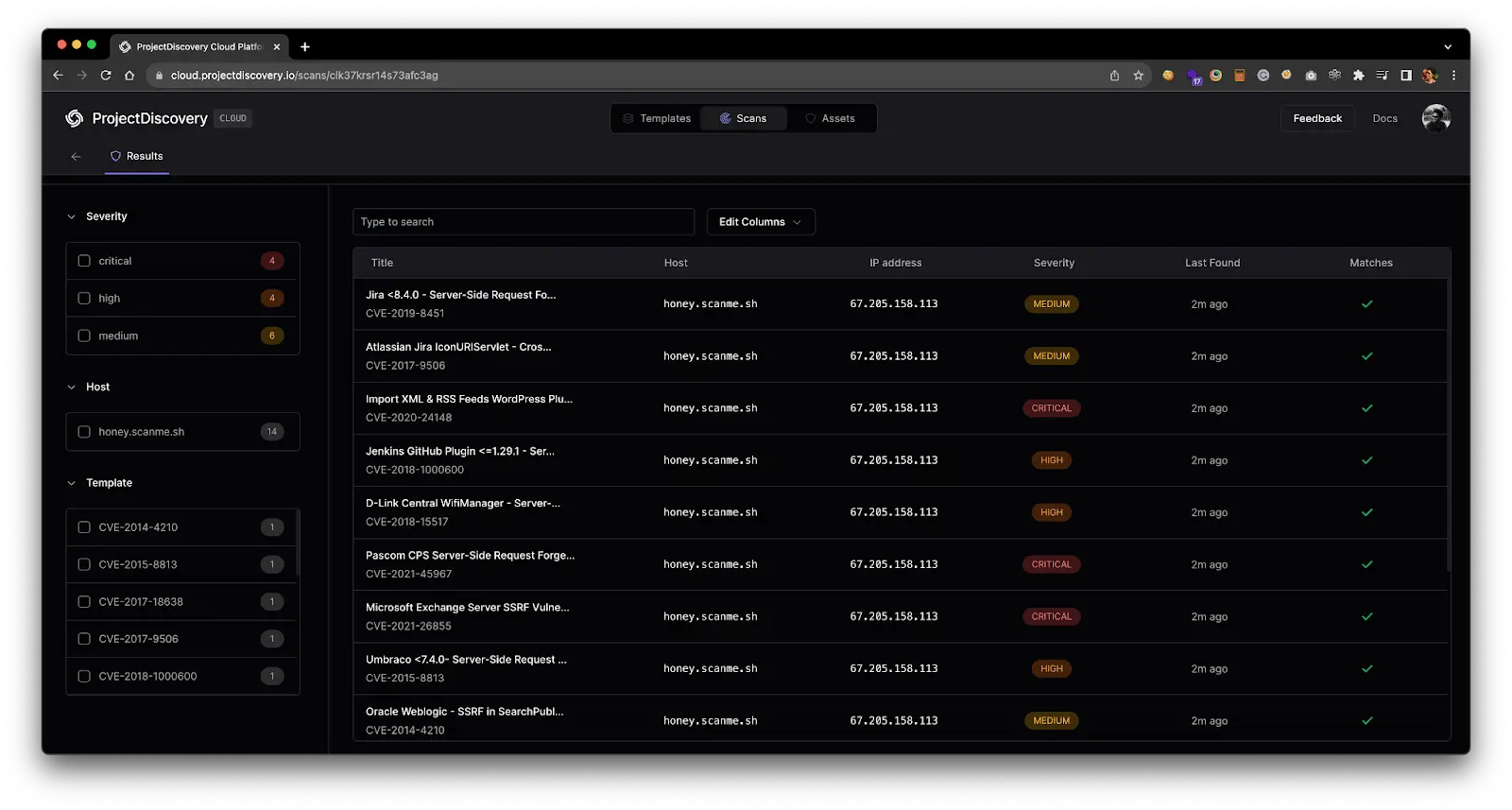
Nuclei is an open-source vulnerability scanner from ProjectDiscovery that has become the de facto tool for template-driven security testing across the bug bounty and offensive security community. Rather than shipping a hardcoded detection engine, Nuclei runs YAML-based templates that describe how to detect a specific vulnerability, misconfiguration, or exposure. The community-maintained template repository ships checks for thousands of CVEs, default credentials, exposed panels, misconfigured cloud services, and technology-specific issues, with new templates landing within hours of major CVE disclosures.
Pros
- Massive community-maintained template library covering thousands of known vulnerabilities and misconfigurations
- Fast time-to-detection for newly disclosed CVEs, often within hours of public disclosure
- Free, open source, and actively maintained by ProjectDiscovery
- Flexible YAML template DSL that lets teams write custom detection logic
Limitations
- Template-driven scanner rather than autonomous pentesting; no exploit chaining or multi-identity authorization testing
- Detection quality depends on the template; community templates vary in precision and can produce false positives
- Requires operator expertise to configure meaningfully at scale
- No native business logic or complex authorization flaw detection
- Raw open-source output is not directly consumable by developers without tooling around it
Best For: Template-driven vulnerability scanning and large-scale reconnaissance across web apps, APIs, and infrastructure, powered by a community-maintained detection library.
16. ffuf
Key Features
- Platform: Command-line tool (open source, written in Go)
- Scanner Capacity: High-speed web fuzzer for directory brute-forcing, parameter discovery, virtual host enumeration, and payload testing
- Accuracy: Depends entirely on the wordlist and matcher configuration supplied by the operator
- Vulnerability Management: None; ffuf produces raw output that must be consumed by the pentester or piped into other tools
- Compliance: Not applicable
- Price: Free and open source (MIT license)
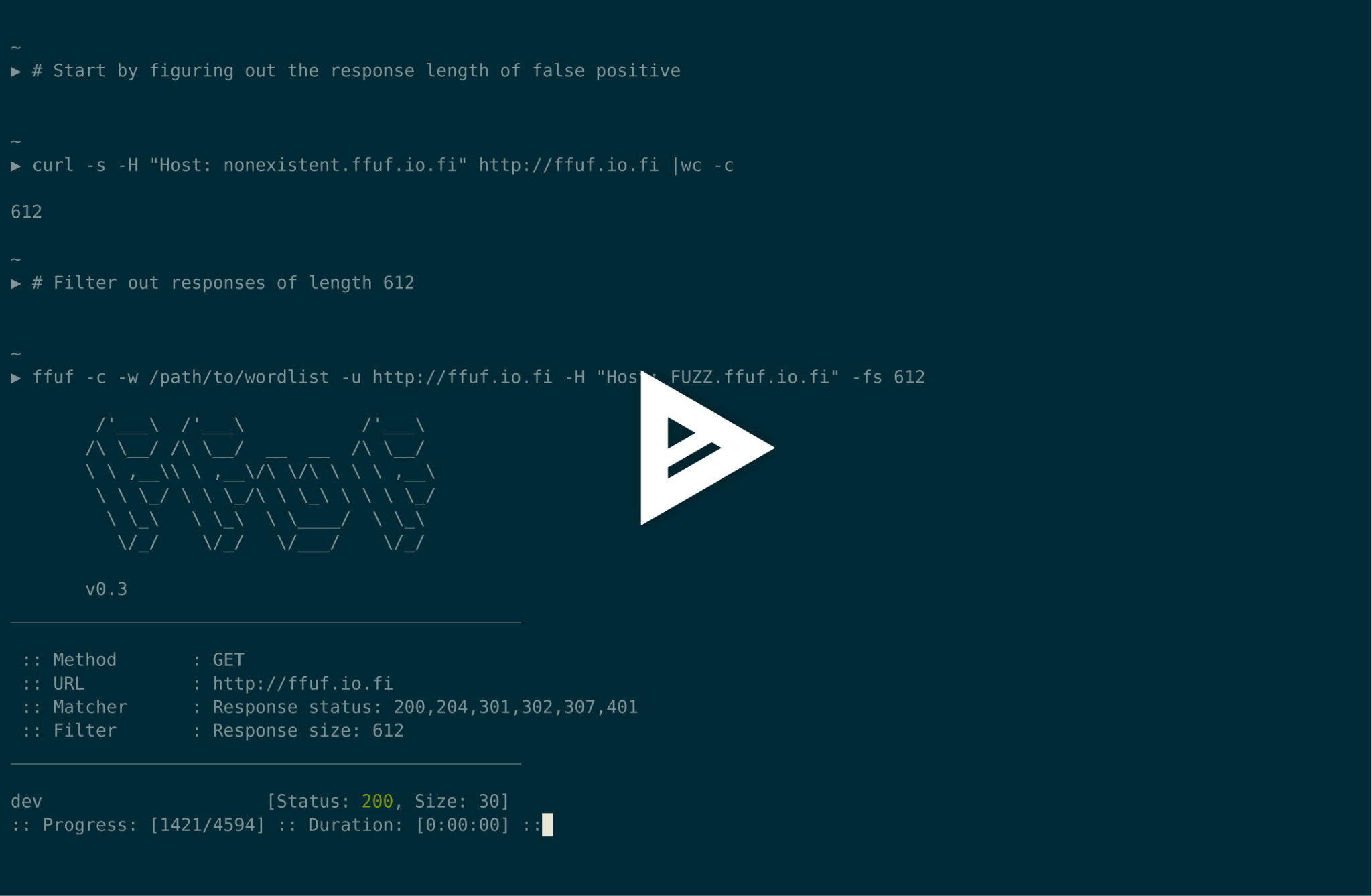
ffuf (“Fuzz Faster U Fool”) is a widely used open-source web fuzzer that pentesters and bug bounty hunters rely on for content discovery and parameter enumeration during reconnaissance. It is not a vulnerability scanner in any meaningful sense. It is a fuzzer that sends configurable HTTP requests at high speed and reports matches based on response filters (status code, size, word count, regex).
ffuf is written in Go, is shipped as a single static binary, and supports directory brute-forcing, subdomain fuzzing, virtual host discovery, GET and POST parameter fuzzing, and header fuzzing. It handles multiple wordlists via clusterbomb, pitchfork, and sniper modes, supports request templates, and integrates with common wordlist collections like SecLists. Output can be exported to JSON, CSV, or HTML for downstream tooling.
Pros
- Extremely fast, thanks to Go’s concurrency model
- Free, open source, and actively maintained on GitHub
- Widely adopted, so tutorials, wordlists, and community support are plentiful
- Single-binary distribution makes it trivial to deploy in any environment
Limitations
- Can only do reconnaissance
- No authentication management, exploit chaining, or vulnerability tracking
- Requires operator expertise to produce useful security signal
- Not suitable as a standalone security control for engineering teams
Best For: High-speed content discovery, parameter fuzzing, and reconnaissance during the manual pentesting workflow.
17. Nikto
Key Features
- Platform: Command-line tool (open source, written in Perl)
- Scanner Capacity: Web server scanning for outdated software versions, known misconfigurations etc.
- Accuracy: Higher false positive rates than modern scanners
- Vulnerability Management: Raw output (plain text, HTML, XML, CSV, JSON)
- Compliance: Nikto is a reconnaissance-layer scanner.
- Price: Free and open source (GPL license)
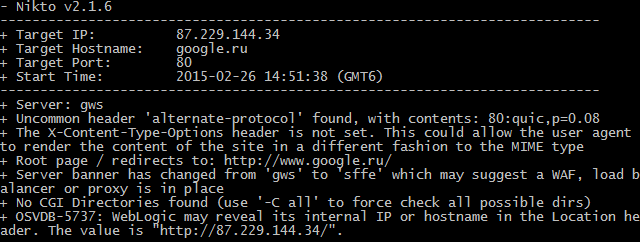
Nikto is one of the oldest open-source web server scanners still in active use, originally released in 2001 and maintained by CIRT.net. It has stayed relevant because it does one narrow job well: fast, exhaustive scanning of web servers for outdated software, known-dangerous files, default credentials, insecure HTTP methods, and common misconfigurations. Pentesters still reach for it during early reconnaissance because a Nikto scan takes minutes and often surfaces low-hanging misconfigurations that more sophisticated scanners deprioritize.
Pros
- Fast, exhaustive server misconfiguration scanning with 6,700+ built-in checks
- Free, open source, and mature (24+ years of active maintenance)
- Lightweight and easy to run in any environment with Perl installed
- Supports SSL, proxy chaining, and multiple authentication methods
Limitations
- Signature-based detection produces high verbosity and frequent false positives
- No coverage of modern web frameworks, single-page apps, or API-first architectures
- No application-layer testing, exploit chaining, or authorization validation
- Not suitable as a standalone security control for engineering teams
Best For: Fast web server misconfiguration checks and known-file discovery during the reconnaissance phase of manual pentesting.
Recon & Attack-Surface Mapping
18. OWASP Amass
Key Features
- Platform: Command-line tool (open source, written in Go), cross-platform
- Scanner Capacity: External attack surface discovery through OSINT, DNS enumeration, certificate transparency logs, web archives, and 80+ passive and active data sources
- Accuracy: High recall on asset discovery
- Vulnerability Management: Raw output (JSON, text, graph databases like Neo4j and JanusGraph) for downstream analysis only
- Compliance: Not applicable; Amass is a discovery-layer tool
- Price: Free and open source (Apache 2.0 license)
OWASP Amass is the leading open-source tool for external attack surface mapping and has become a standard part of the reconnaissance workflow for bug bounty hunters, red teams, and internal security teams building asset inventories.
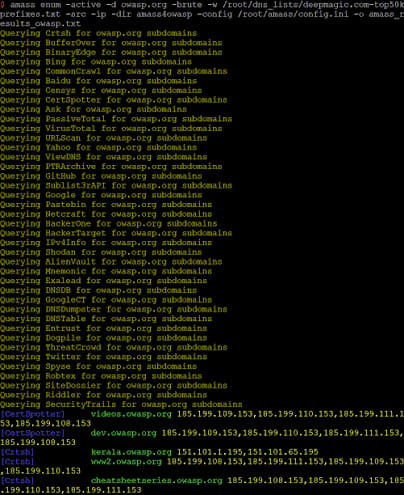
Amass combines passive OSINT sources (certificate transparency logs, DNS databases, search engine indexes, web archives) with active enumeration techniques (DNS brute-forcing, zone transfers, permutation scanning) to surface domains, subdomains, IP ranges, ASNs, and forgotten dev endpoints that an organization owns but may not know about.
Pros
- Free, open source, and the most comprehensive OSINT-driven asset discovery tool available
- 80+ integrated data sources for passive and active enumeration
- Graph database output for relationship analysis across large asset inventories
- Widely adopted by bug bounty hunters and red teams, with strong community support
- Cross-platform single-binary distribution
Limitations
- Generates high-volume raw output that requires triage to filter active from stale assets
- Requires API keys for many data sources to unlock full coverage
- Learning curve on advanced enumeration techniques and graph output analysis
Best For
External attack surface mapping and OSINT-driven asset discovery during reconnaissance and ongoing attack surface management workflows.
Exploitation & Validation
19. Metasploit
Features:
- Scanner Capacity: N/A
- Manual pentest: Metasploit contains an assortment of tools that can be used for pentesting
- Accuracy: N/A
- Vulnerability management: No
- Compliance: Indirectly relates to compliance reporting
- Price: Free
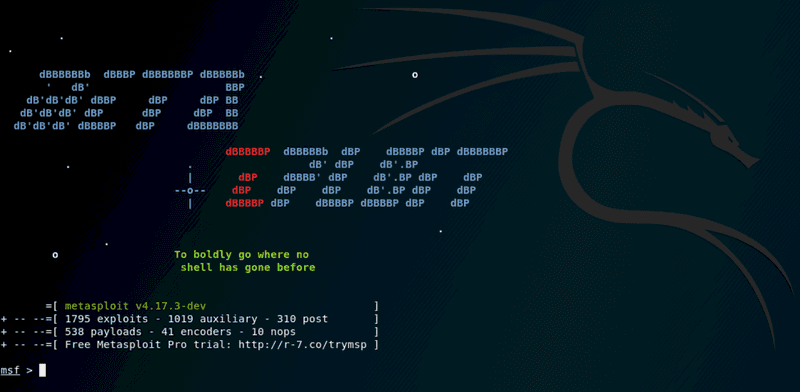
Metasploit is a Ruby-based open-source framework used by ethical and malicious actors to probe systematic vulnerabilities on networks and servers. The Metasploit framework also contains portions of fuzzing, anti-forensic, and evasion tools with listeners, encoders, post-exploitation code, and whatnot.
It is easy to install and can work on a wide range of platforms regardless of the languages they run on. The popularity and the wide availability of Metasploit among professional hackers make it an essential tool for Penetration Testers.
Pros
- Includes nearly 1677 exploits.
- Freely available online pentest tool.
- Easy to use.
Limitations
- Not beginner-friendly.
- Initial navigation can be difficult.
Customer Review
“What I enjoy best about Metasploit is that it contains an extensive database of exploits that can be tailored to match the individual needs of the user. Metasploit can also be readily connected with other security tools such as vulnerability scanners, network analyzers, and IDS/IPS systems.” – Yasir D.
Best For
Best for advanced exploit development, vulnerability validation, and chaining real-world attack scenarios.
Shift-Left / Code-Level Companions (SAST)
20. Veracode
Features:
- Scanner Capacity: Web applications
- Manual Pentest: Yes
- Accuracy: False positives possible
- Vulnerability Management: Yes
- Compliance: NIST, PCI, OWASP, HIPAA, GDPR
- Price: Quote upon request
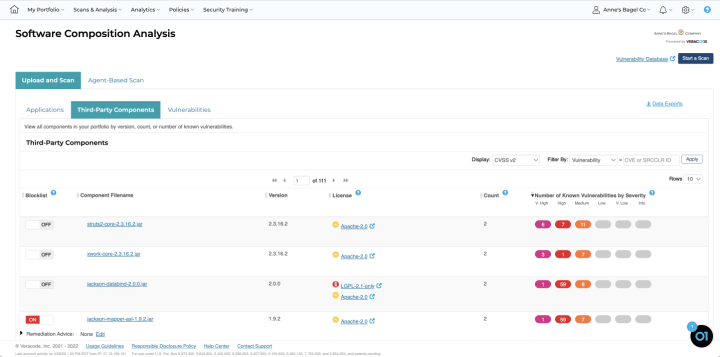
Veracode is a dynamic solution and one of the best tools for web application pentesting that helps analyze web apps to find vulnerabilities. It can run thousands of tests with a less than 1% false positive assurance rate.
While it offers great utility for web app pentesting, the user interface can have a steep learning curve for beginners.
Pros
- Offers quick penetration testing services.
- Extremely comprehensive reports.
- Remediation assistance is provided.
Limitations
- Zero false positives are not assured.
- Could improve its user interface
Customer Review
“I find the Veracode Application Security Platform incredibly useful for identifying social injections and providing static code analysis, which helps in addressing all security vulnerabilities effectively. The ease of integrating with GitHub and cloud-based repositories streamlines our development process. The platform’s PR static analysis feature is invaluable for maintaining best code practices, especially in preventing SQL injections and cross-site scripting attacks. I also appreciate the comprehensive code analysis capabilities that ensure our applications maintain high security standards.” – Bhanu Prakash M.
Best For: Best for enterprise DevSecOps teams needing CI/CD-integrated web application security testing and remediation guidance.
21. Semgrep
Features:
- Platform: Cloud (Semgrep AppSec Platform) and open-source CLI
- Scanner Capacity: Static application security testing (SAST), software composition analysis (SCA), and secrets scanning across 30+ languages
- Accuracy: Rule-based detection with strong precision on supported patterns; false positive rates depend on rule configuration
- Vulnerability Management: Findings dashboard with severity scoring, dependency graph analysis, and PR-level triage
- Compliance: Reporting support for SOC 2, PCI DSS, and OWASP Top 10 alignment
- Price: Free tier and open-source CLI, Team plan starts at $40/contributor/month, Enterprise custom pricing
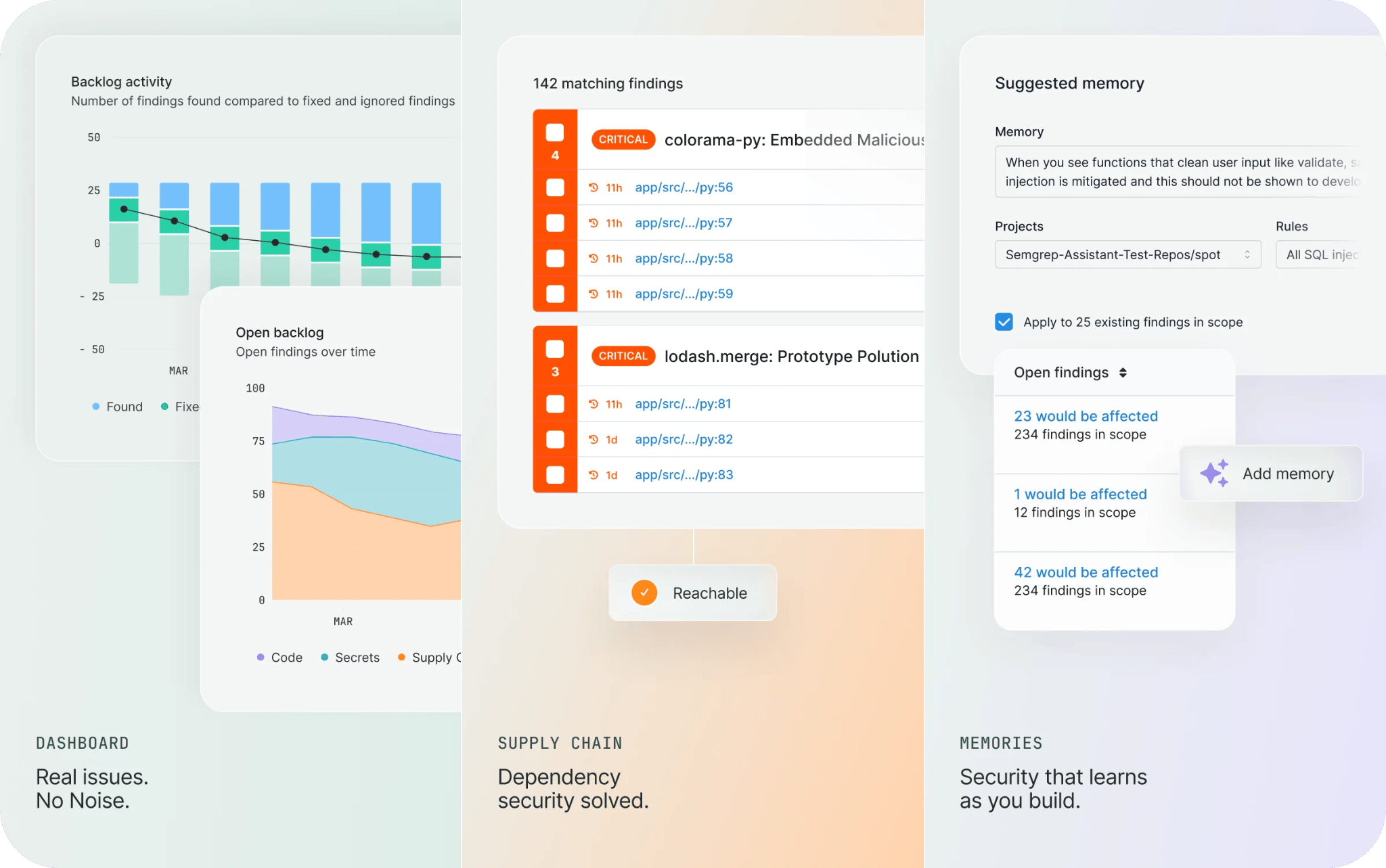
Semgrep is a static analysis platform that has become one of the most widely adopted SAST tools in the developer community, largely because its rule syntax is readable, its open-source CLI is genuinely useful on its own, and its default rulesets ship with high precision out of the box. The platform runs static pattern matching across source code, dependencies, and secrets, with results delivered through CI/CD integration or PR comments.
Pros
- Strong open-source foundation with an actively maintained CLI
- Readable YAML-based rule syntax that developers can author themselves
- Reachability analysis in Semgrep Supply Chain filters out unexploitable CVE noise
- Broad language coverage across 30+ languages
- Native CI/CD integration with PR-level feedback
Limitations
- SAST tool rather than DAST or autonomous pentesting, so it cannot detect runtime authorization flaws like BOLA, BFLA, or SSRF
- Rule quality varies across less-common languages
- Business logic and complex data-flow vulnerabilities remain hard to catch with static analysis
- Enterprise features (Supply Chain, Secrets, Assistant) are priced separately from core SAST
Best For: Static code analysis (SAST), software composition analysis (SCA), and secrets scanning integrated into developer CI/CD workflows
Final Thoughts
By understanding the importance of web penetration testing and leveraging the right tools, you can significantly enhance your security posture. Choosing a tool that aligns with your specific needs is imperative, whether it’s a comprehensive platform like Astra Pentest or specialized tools for network scanning (Nmap) or protocol analysis (Wireshark).
Remember, penetration testing is an ongoing process. Regular assessments, coupled with effective vulnerability management, are essential to staying ahead of cyber threats.
FAQs
1. What are Web Application Penetration Testing Tools?
Web application penetration testing tools are software solutions that help identify security vulnerabilities in web apps by simulating real-world attacks. These tools analyze application logic, authentication flows, APIs, and server interactions to uncover issues such as SQL injection, XSS, insecure authentication, and misconfigurations.
2. How do Web Application Pentesting Tools work?
Web pentesting tools work by crawling the application, mapping endpoints, and sending crafted requests to detect vulnerabilities. Some tools rely on automated scanning, while others support manual testing through intercepting proxies, fuzzing, or exploit frameworks. Advanced tools combine automation with expert validation to reduce false positives.
3. What is the difference between Web Application Pentesting Tools and Vulnerability Scanners?
Vulnerability scanners primarily rely on automated checks to flag potential weaknesses, often resulting in false positives. Web application pentesting tools go further by supporting manual testing, business logic validation, and exploit verification, helping teams understand whether vulnerabilities are actually exploitable in real-world scenarios.
4. Are open-source Web Application Pentesting Tools sufficient?
Open-source tools like OWASP ZAP, Nmap, and Metasploit are excellent for learning, reconnaissance, and baseline security testing. However, they often require skilled operators and manual validation. For production environments and compliance needs, many teams complement open-source tools with commercial platforms that offer better coverage, reporting, and support.
Explore Our Penetration Testing Series
This post is part of a series on penetration testing.
You can also check out other articles below.

Chapter 1: What Does Pentest Mean?
Chapter 2: Different Types of Pentest Testing
Chapter 3: Top 5 Pentest Methodology
Chapter 4: Top Penetration Testing Companies
Chapter 5: Best Pentest Online Tools – Top List
Chapter 6: A Super Easy Guide on WordPress Pentest
Chapter 7: Average Penetration Testing Cost in 2026
Chapter 8: Pentest Reporting (Sample Report)
Chapter 9: Web App Pentest Guide