For years, the defensive side held the asymmetric advantage over threat actors. Writing exploits requires a deep understanding of how memory corruption works, how authentication tokens can be forged, etc. That knowledge gap is what made it hard to exploit a vulnerability.
LLM proliferation lowered that floor and quickly removed that advantage. Even script kiddies can now carry out cyberattacks like APTs without understanding POC. The barrier that once separated a curious amateur from a capable attacker collapsed faster than most security teams noticed.
But the defender side is now catching up with autonomous pentesting. Autonomous pentesting is using AI agents to probe security gaps across your infrastructure with minimal human intervention. It is born out of a collision between lightning-fast DevOps release cycles and increasingly sophisticated AI-driven attackers.
If AI democratized the ability to generate exploits, autonomous pentesting puts that same capability to work on the side of the people who are supposed to find the vulnerabilities before attackers do.
What Is Autonomous Pentesting?
Autonomous pentesting is a pentesting technique that uses AI-driven agents to continuously simulate sophisticated, multi-stage attacks. It validates what can actually be exploited and provides real-time insights into your security posture, all without needing a human to manually run every test.
The key difference is in the reasoning. A typical DAST scanner asks, “Is this known vulnerability present?” An autonomous pentesting agent asks, “Can I reach the critical data? If this path is blocked, what’s the next best route to get there?” It focuses on exploitation paths and business impact, not just flaw detection.

 Expert’s Tip
“The core shift is from detection to validation. Autonomous pentesting confirms exploitability with proof. It doesn’t just share a list of problems, it shows you which ones an attacker would actually use to breach your systems.”
Key characteristics of Autonomous Pentesting
- AI-driven decision making: The agent plans attack sequences based on discovered context, not a fixed script
- Exploit validation: Findings are confirmed as actually exploitable, not merely theoretically present
- Continuous execution: Testing runs on an ongoing basis and re-triggers with each infrastructure change
- Adaptive attack paths: If one exploit route fails, the agent pivots to alternative approaches in real time
What Autonomous Pentesting Is NOT
- Not a vulnerability scanner: Scanners detect potential flaws while autonomous agents prove exploitability
- Not traditional automation: Scripted automation follows fixed test sequences; autonomous agents reason and adapt
- Not a full human replacement: Creative attack chains and nuanced risk judgments still require human expertise.
How Does Autonomous Pentesting Actually Work?
Autonomous pentesting follows a structured workflow that mimics professional penetration testing but executes at machine speed.
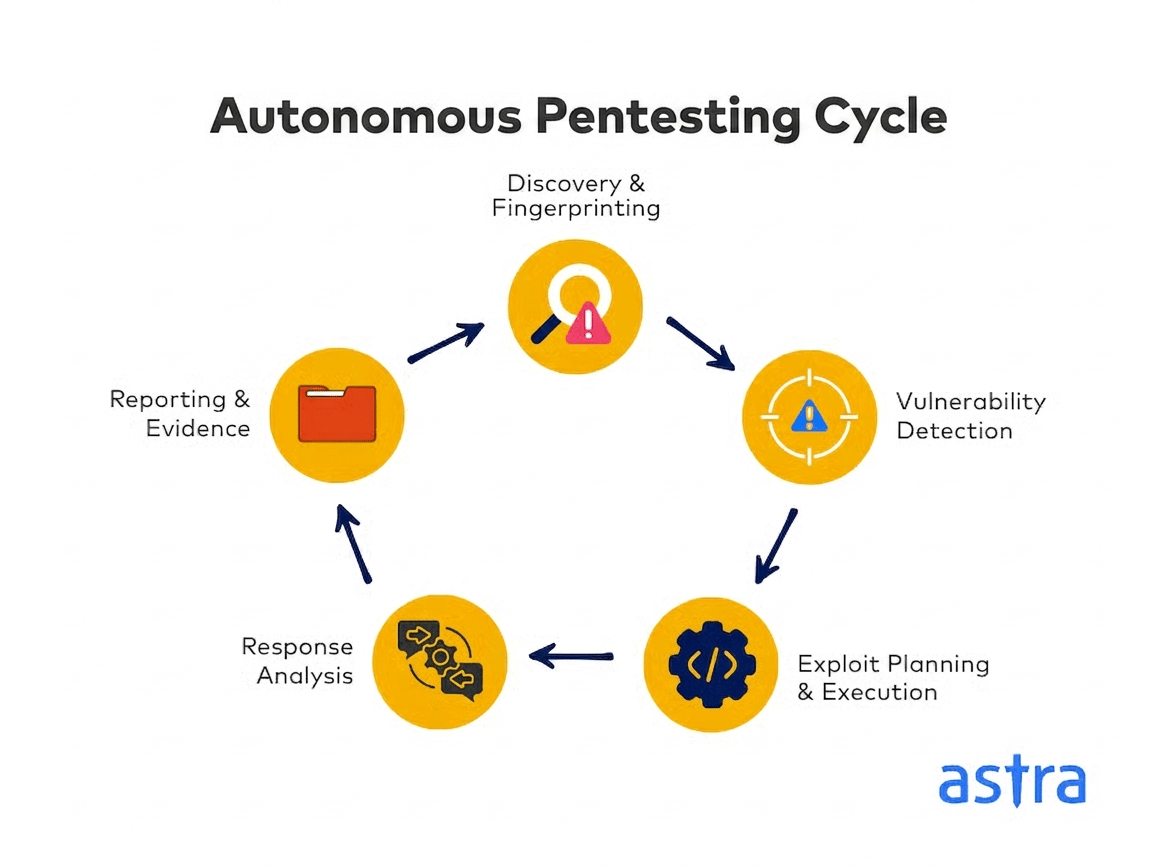
Step 1: Automated Discovery & Fingerprinting
The agent first maps your defined attack surface. It finds all asset types, including web apps, APIs, cloud instances, and network services. Then, it fingerprints them to understand the technologies in use.
Step 2: AI-Driven Vulnerability Detection
Using a significantly large, constantly updated knowledge base of vulnerabilities, the agent identifies potential threats. This goes beyond CVE matching to include misconfigs and insecure settings.
Step 3: Attack Graph Modelling
This is where autonomy actually comes into action. The system builds dynamic attack graphs that model potential kill chains across your infrastructure.
Using advanced AI reasoning engines, the agent plans and executes chained exploits at Levels 2–3 complexity. For example, exploiting a reflected XSS to steal a session token, then leveraging that access for an insecure file upload that leads to remote code execution and lateral movement.
Step 4: Response Analysis & Adaptive Testing
After that, the agent analyzes how your systems respond to its attacks. If one exploit fails, it adapts its approach in real-time, testing alternative methods to achieve its objective, just as a persistent attacker would.
Though the human approach remains supreme here, adopting a hybrid (human + autonomous agent) approach is the most economical and advantageous way for organizations to conduct penetration testing in 2026 and beyond.
Step 5: Reporting & Evidence Generation
Finally, the agent compiles its findings into clear, actionable reports. It provides step-by-step evidence of each successful exploit, including PoC data, so your team knows exactly what to fix and why it matters.
Reports are effectively prioritized by business impact rather than just CVSS scores. This helps your team focus their limited remediation time on risks that actually matter. Reports are mapped directly to compliance frameworks like SOC2 and ISO 27001 to provide tangible evidence for auditors.
Autonomous Pentesting vs Other Security Testing Methods
Autonomous pentesting occupies a distinct position in the security testing landscape. Understanding where it fits relative to other methods is essential for making informed investment decisions.
| Method | Primary Goal | Testing Frequency | Human Required | Exploitability Validated |
|---|---|---|---|---|
| Vulnerability Scanner | Detect known flaws | Continuous | No | No |
| DAST | Application-layer testing | Scheduled | Low | Partial |
| Breach and Attack Simulation (BAS) | Validate security controls | Continuous | No | Partial |
| Manual Penetration Test | Creative, deep attack simulation | Periodic (annual) | Yes | Yes |
| Autonomous Penetration Test | Exploit validation at scale | Continuous | Hybrid | Yes |
Note:
- Vulnerability scanners and DAST tools identify potential issues but do not prove exploitability.
- BAS tools validate whether your security controls detect and block known TTPS.
- Manual penetration tests provide the deepest, most creative testing available. They remain the gold standard for complex environments and compliance requirements, but their infrequency creates significant coverage gaps.
- Autonomous pentesting combines exploit validation with continuous execution. It cannot fully replicate human creativity, but it provides consistent, scalable coverage that manual testing cannot match on a budget.
Key Benefits of Autonomous Pentesting (Especially for SMBs)
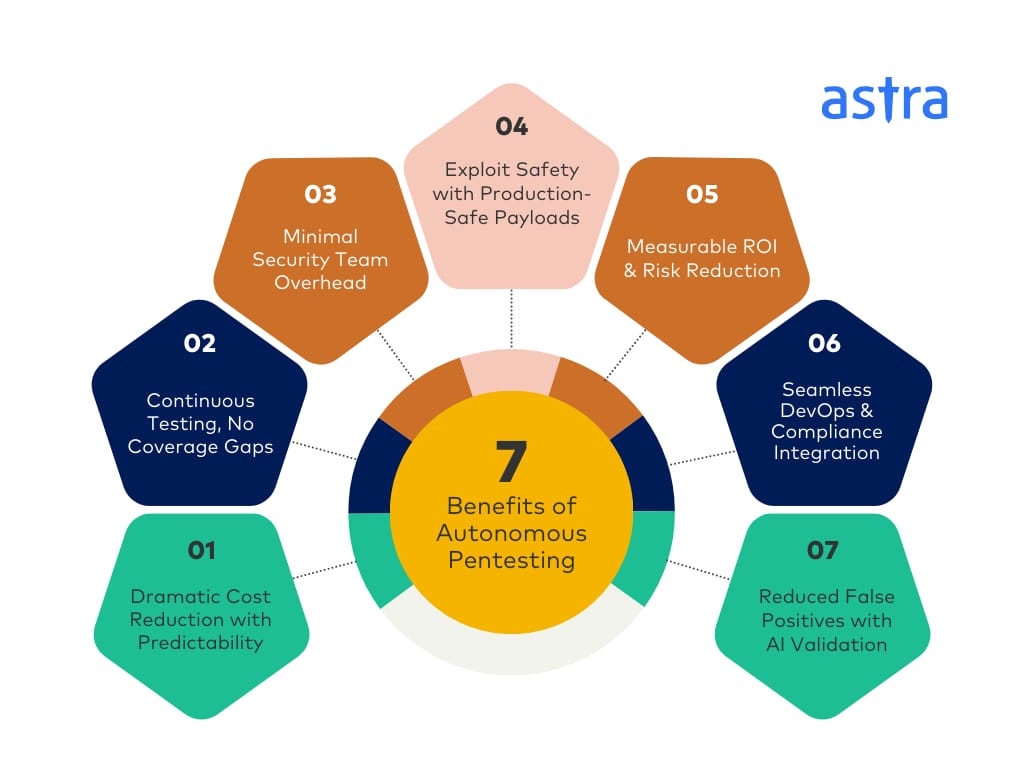
For organizations balancing limited security resources against expanding attack surfaces, autonomous pentesting offers a materially different value proposition than traditional approaches.
1. Dramatic Cost Reduction with Pricing Predictability
Traditional manual penetration testing costs between $15,000–$30,000 per engagement. Autonomous pentesting platforms operate on subscription or credit-based models with transparent, predictive pricing. This eliminates surprise invoices and spreads cybersecurity costs predictably across the year.
Did you know, according to DeepStrike, 33% of companies skip pentesting due to cost? With autonomous platforms reducing annual costs by as much as 50-60%, that barrier disappears.
2. Continuous Testing with No Coverage Gaps
An annual test is a snapshot. The moment you deploy new code or change a configuration, that snapshot becomes outdated. Research shows a major percentage of orgs find pentest results invalid within weeks due to these changes.
Autonomous penetration testing that runs continuously eliminates these dangerous gaps. It validates every update, new API, and infrastructure change as it happens. This continuous validation collapses remediation timelines from months to days, directly shrinking your window of exposure.
3. Minimal Security Team Overhead and Adaptability
Coordinating a manual test, i.e., scheduling, scoping, and vendor management, can consume weeks for a lean security team.
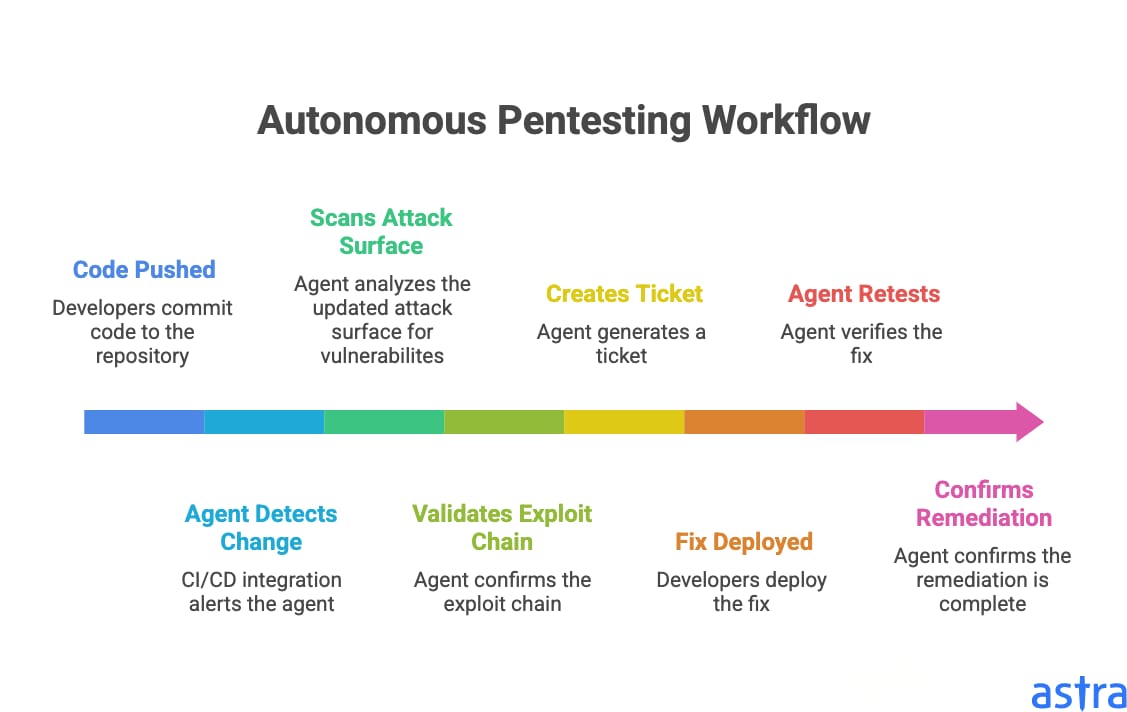
Autonomous tools eliminate this overhead. Once configured, they run on their own schedule. They integrate findings directly into Jira or Slack, creating tickets and alerts without manual intervention. This leaves your team to focus on strategic remediation, effectively multiplying their capacity.
4. Exploit Safety with Production-Safe Payloads
A common fear is that autonomous testing will crash production systems. Modern autonomous pentesting platforms are built with safety-first constraints. They use non-destructive, read-only PoC payloads and can be scheduled for off-peak hours.
For example, to safely test for a file upload vulnerability, the autonomous pentesting tool would upload a harmless, uniquely-named verification document and then immediately delete it, proving exploitability without storing malicious content.
Strict, machine-readable rules of engagement prevent the agent from testing out-of-scope targets. Features like emergency stop buttons and immutable audit trails provide control and visibility. This allows for safe, frequent autonomous pentesting without needing your infrastructure team on standby.
5. Reduced False Positives with AI Validation
Legacy scanners are often loaded with noise, with false positive rates often ranging around 60-80%. This forces your team to look for real threats in a stream of false alarms. Autonomous pentesting validates exploitability before reporting.
The AI doesn’t just flag a potential vulnerability; it proves it can be exploited in your specific environment. Security teams using this approach report a significant reduction in false positives. This means your team spends time fixing genuine, exploitable risks, not investigating scanner mistakes.
6. Seamless Integration into DevOps & Compliance Workflows
Autonomous penetration testing tools can trigger directly from your CI/CD pipeline, testing every new build. Findings flow automatically into issue trackers, and compliance evidence for SOC 2, ISO 27001, and PCI-DSS is auto-generated from test results. This bakes security into your development process, making it a seamless part of release cycles rather than a disruptive, annual gate. However, it’s important to note that human validation and an auditor check-off are still needed for compliance certification.
7. Measurable ROI & Risk Reduction with Retesting Validation
The value of a traditional pentest report diminishes daily. Autonomous pentesting provides unlimited retesting. When your developer fixes a critical flaw, you can trigger an immediate validation test at no extra cost.
This creates a closed-loop of find-fix-verify, augmenting security from a cost center into a measurable risk reduction activity. Industry data shows every dollar invested in robust testing can save ten dollars in potential breach losses. This means, for leadership, dashboards can show clear metrics like “exploitable paths reduced by 40% this quarter”, showing tangible ROI.
Where does Manual Penetration Testing Fall Short vs Autonomous Pentesting?
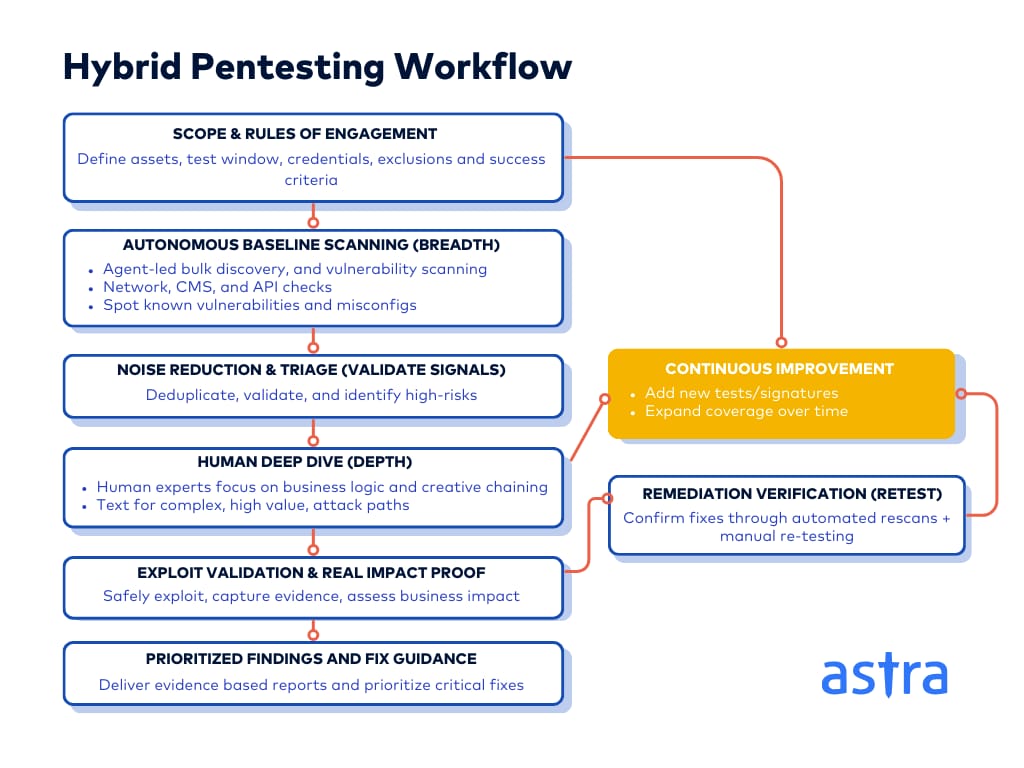
Manual penetration testing by skilled experts is invaluable for deep, creative attacks. However, for the ongoing security needs of an organization with lenient security teams, it has critical shortcomings when used alone.
First, it cannot scale with modern DevOps. Manual tests can’t match weekly or daily deployment cycles, leaving new code untested for months.
Second, the high cost and complexity force infrequency, often just once a year, creating vast, uncharted windows of exposure. Studies show over 87% of critical findings occur in organizations under 200 employees, highlighting the acute need for frequent testing that only automation can provide affordably.
Finally, manual testing depth depends heavily on the individual tester’s skill and focus. Autonomous tools provide consistent, repeatable coverage against a vast, constantly updated knowledge base of attack techniques.
Expert’s Tip
“The modern approach to security is hybrid. Use autonomous pentesting for continuous, broad coverage of your ever-changing attack surface. Then, supplement it with targeted manual tests annually for deep, creative exploration that AI might miss. This gives you both breadth and depth.”
Top 5 Autonomous Pentesting Tools in 2026
Choosing the right platform for autonomous pentesting is crucial for organizaions. Hence, here’s a comparison of the leading tools based on relevant key features:
| Tool | AI-powered Reconnaissance | Automated Exploitation | Continuous Testing (DAST) | Integrates with CI/CD | Human-in-the-loop | Comprehensive Coverage | Pricing (Starts from) |
|---|---|---|---|---|---|---|---|
| Astra Security | No | ✅ | ✅ | ✅ | ✅ | ✅ | $5999/year |
| XBOW | ✅ | ✅ | ✅ | No | No | No | Custom Quote |
| Penligent | ✅ | ✅ | No | ✅ | No | No | $39.92/month (annual plan) |
| Aikido Security | ✅ | ✅ | ✅ | ✅ | No | ✅ | $700/month |
| Escape | ✅ | ✅ | ✅ | ✅ | No | ✅ | Custom Quote |
Common Challenges of Autonomous Pentesting
While powerful, the tech behind autonomous pentesting is still maturing, and honest adoption requires understanding where current tools fall short. Here are just some of them:
1. AI Hallucinations & Erratic Behavior
In complex environments, AI agents can sometimes generate illogical or non-existent attack paths. Without oversight, this wastes resources or creates dangerous false negatives if real flaws are missed. A human-in-the-loop review process is essential to catch these anomalies.
2. Persistent Blind Spots in Unique Business Logic
Every business has a unique workflow. For example, a custom pricing engine, or a special checkout process, etc. AI may struggle to understand and test these nuanced, proprietary logic flows. Periodic manual testing is still recommended to cover these specialized areas.
3. Integration and Setup Complexity
Despite promises of simplicity, deploying these tools requires configuration, system access, and integration work. For a lean security team, this initial lift can be significant and may require external assistance to get it right.
4. Lack of Situational Awareness
An autonomous agent doesn’t know if it’s Tuesday or a holiday sales peak. It could trigger testing during a critical business period, potentially impacting performance. Mitigate this with strict scheduling rules, health-check integrations, and clear operational protocols.
5. Compliance and Liability Gaps
Regulatory frameworks are still catching up to AI. Most audits still require human-validated evidence. Clearly define accountability in vendor contracts and maintain immutable audit logs of all autonomous agent actions for compliance and forensic purposes.
Best Practices for Deploying Autonomous Pentesting
Having understood the limitations, it’s also important to get a hang of the practices that can help maximize value and minimize risk before starting. This can include:
Establishing Machine-Readable Rules of Engagement
Define your testing scope in a system that the AI can understand. Use allowlists for approved targets and denylists for systems never to test. Integrate the platform with your asset inventory so the scope is dynamically validated, not based on a stale spreadsheet.
Implement Human-In-The-Loop with Emergency Stops
Never let the AI run fully unchecked. Mandate human approval for high-risk actions like privilege escalation. Ensure there is an immediate, accessible “kill switch” for infrastructure teams to stop all testing activities if needed.
Enforce Multi-Tool Correlation
Don’t trust a single finding from one tool. Correlate results across different methods. A true critical vulnerability will often be flagged through multiple detection paths, helping filter out hallucinations.
Use Ephemeral Credentials with Least Privilege
AI Agents should operate with minimal, temporary permissions. Use dedicated service accounts that provide only the access needed for the test, and rotate these credentials after each session. Never grant production-level access.
Maintain Immutable Audit Trails
Log every action the autonomous agent takes. These logs prove compliance, provide training data to improve the AI, and are crucial for forensic analysis if something goes wrong. Use write-once cloud logging to prevent tampering, too.
Bonus:
- Simulate agent misuse. Attempt to make the agent escape its scope, hallucinate false findings, or cause production disruption. Use adversarial testing techniques to identify failure modes and implement detection and prevention controls.
- Autonomous pentesting systems are themselves attack surfaces. Threat model the agent itself. Can it be compromised or manipulated to test unauthorized systems? Can malicious actors influence its behavior through crafted inputs?
How Astra Security Augments the Autonomous Pentesting Process?
At Astra Security, we believe in a hybrid, practical approach. We combine the speed and consistency of autonomous AI with the critical thinking of human experts.
Our Offensive Attack-AI Engine performs deep, continuous simulation. But every finding is then vetted by our security engineers to ensure near-zero false positives. For complex scenarios, like testing AI applications or nuanced business logic, we deploy human-led, AI-powered pentests that leverage the best of both worlds.
Deep CI/CD and compliance integration means Astra integrates natively with Jira, Slack, GitHub, and Jenkins. Reports map directly to SOC 2, ISO 27001, PCI-DSS, and HIPAA, providing a unified dashboard for both developers and auditors. Findings flow automatically into your remediation workflows without manual ticket creation.
As the industry evolves toward more agentic systems, Astra is developing dedicated autonomous AI agents (coming soon) that provide continuous validation within a human-managed, enterprise-grade framework. This makes advanced cybersecurity accessible and actionable for every security teams who need results, not just reports.
Final Thoughts
The benefits of autonomous pentesting are clear. It transforms pentesting from a costly, periodic event into a continuous, integrated, and affordable practice. It directly addresses the core challenges of cost, coverage gaps, and resource constraints.
Your most practical next step is to start with a clear scope. Map your most critical digital assets, i.e., your customer-facing app, your database, and your payment APIs. Then, deploy an autonomous agent against that defined environment with strict safety rules enabled.
This controlled start allows you to experience the continuous validation and risk reduction firsthand while building a stronger security posture with every deployment, without breaking the bank.
Autonomous Pentesting FAQs
Can autonomous penetration testing tools truly replace a human security expert?
No, autonomous pentesting tools cannot fully replace human security experts. It excels at machine speed and scale by continuously scanning, modeling attack paths, and executing thousands of exploit chains 24/7. This dramatically increases testing frequency and coverage far beyond what any human team can achieve.
How much does autonomous pentesting cost compared to a regular manual penetration test?
Autonomous pentesting is significantly more cost-effective, often operating on a subscription model that provides predictable, lower ongoing expenses compared to the high upfront cost of a manual engagement. This efficiency allows for frequent, even continuous, testing.
Is it safe to run autonomous pentesting on our live production environment?
Yes, when using modern platforms designed with safety in mind.
Reputable autonomous pentesting solutions include strong safety features like non-intrusive payloads, configurable execution limits, rate limiting, and emergency stop functions. These features allow teams to validate security controls in real-world conditions without risking system downtime or data integrity.
Will autonomous penetration testing find complex business logic flaws?
It can, but it heavily depends on the quality and relevance of the training data used. Well-trained autonomous platforms can detect many business logic issues by learning from thousands of real-world test cases, spotting unusual data flows, privilege escalations, or rule bypasses.
Explore Our Autonomous Penetration Testing Series
This post is part of a series on autonomous penetration testing. You can also check out other articles below.
- Chapter 1: Autonomous Pentesting: How it Works, Benefits, Tools (2026)
- Chapter 2: Autonomous vs Traditional Pentesting: What’s More Secure in 2026?
- Chapter 3: Top 10 Autonomous Pentesting Tools in 2026
- Chapter 4: How to Evaluate Autonomous Penetration Testing Security Vendors in 2026
- Chapter 5: OWASP APTS: A Complete Guide to Autonomous Penetration Testing Standard
- Chapter 6: Agentic AI in Cybersecurity: The Complete Guide for Security Teams