For the ten years I have watched this industry, hunting business logic vulnerabilities has been notoriously expensive and exceedingly difficult. Every attempt to bring the cost down has hit the same wall. Now, for the first time, we as an industry have the capability to meaningfully lower the ceiling on what this work costs. I would argue Astra’s autonomous pentesting platform is pioneering that shift.
Why This Was Hard
For most of that time, business logic vulnerabilities were detected by a skilled human sitting in front of the target and reasoning about intent. The tools around that human improved (Achilles, then Paros, then Burp Suite, then Postman), but the tools were always execution layers. The reasoning happened in the tester’s head.
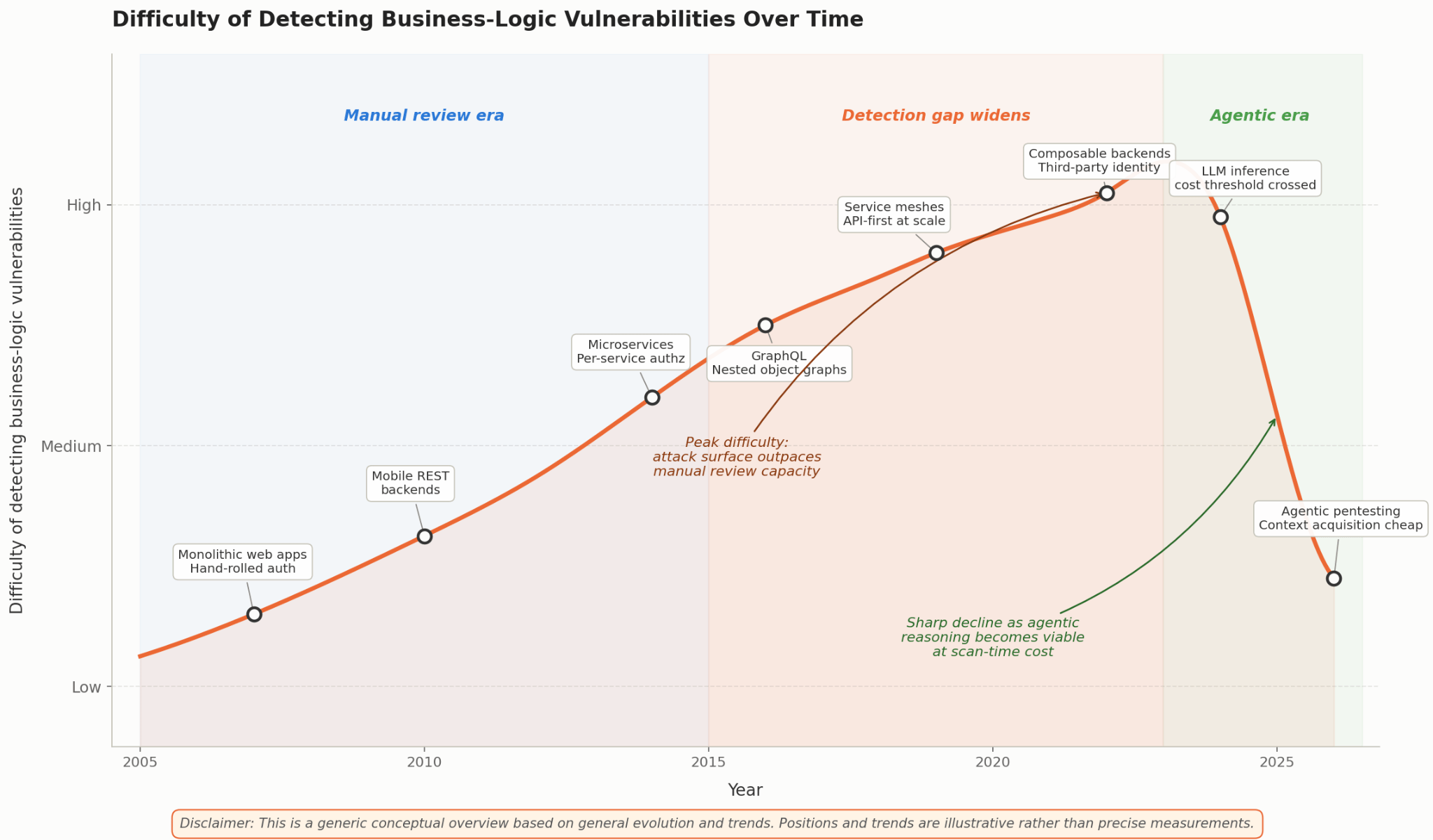
Multiple attempts through the early 2020s tried to automate this. None produced meaningful results at scale. The reason: business logic is by definition context-specific, and the tools of that era had no mechanism to acquire context. A pattern-matching scanner cannot know that PATCH /invitations/:id with {“role”: “admin”} is an illegal state transition, because “illegal” is a property of the intended state machine, and the state machine only lives in the developer’s head and the application’s runtime behavior.
Then applications shifted from monolithic web apps to heavy API-driven architectures. GraphQL, REST at scale, service meshes, and mobile-first backends dramatically increased the attack surface for logic bugs while detection tooling barely moved. The gap widened for almost a decade.
The First Wave of Semi-Automation
Around 2020, a handful of commercial DAST tools started shipping features specifically aimed at authorization testing, and a few Burp Suite extensions offered the ability to rotate between two authenticated sessions and flag cross-tenant response equivalence. On paper, this was progress.
In practice, it was still expensive. The tools required careful configuration. ID enumeration scopes had to be defined by hand. Session provisioning was manual. False positive rates were high enough that a human security engineer still had to validate every finding before it went anywhere near an engineering team. The tools shifted the cost from execution to configuration, but they did not reduce total cost. In some cases, they raised it, because now you were paying for the tool license and the human was still doing most of the work.
The Real Cost Was Context Acquisition
The reason automation kept failing was that business logic testing is not a testing problem. It is a context problem. To detect a BOLA on GET /api/invoices/:id, the tool has to know that :id is an object reference, that invoices have owners, that the ownership relationship is enforced elsewhere in the application, and that a request from User B should not return User A’s invoice. That is a lot of context, and none of it lives in the source code, the OpenAPI spec, or the request itself. It lives in the application’s behavior across identities.
For years, context acquisition was the single largest cost driver in business logic testing. A senior pentester spent 60 to 70 percent of an engagement reading documentation, clicking through the UI, mapping the object model, and reasoning about what “correct” looked like before they could meaningfully test what “incorrect” looked like.
Even when budget was not the constraint, that context acquisition was fundamentally not replicable at scale. You could pay one pentester to build a mental model of your application. You could not pay 50 pentesters to build the same model in parallel, because most of the model would be duplicated work and the rest would be inconsistent across testers.
Feeding that context into a DAST tool or an automated scanner was harder still. Configuration files could capture a fraction of it. Custom scripts could capture a bit more. The core problem stayed unsolved.
What AI-Powered DAST and Autonomous Pentesting Changed
The current generation of agentic pentesting tools solves this differently. Instead of requiring humans to translate context into configuration, the agent acquires context by interacting with the application directly.
Concretely, this is what happens in a modern autonomous pentesting run. The agent crawls the target application while authenticated. As it observes requests and responses, it builds an object graph: which fields are identifiers, which identifiers appear in which endpoints, which endpoints modify which objects, which fields represent state transitions, which values look like role enumerations.
The agent then provisions multiple authenticated sessions across identity boundaries and executes cross-context tests systematically: substituting IDs across identities and comparing response equivalence, submitting mass-assignment payloads and verifying server-side persistence, enumerating illegal state transitions against the observed state machine, and chaining findings into full exploit paths.
The context acquisition cost, which used to be the single largest expense in business logic hunting, collapses to close to zero. The agent does the work in minutes, and the same run can scale a thousand times over. Since the agent is not maintaining a mental model that gets lost when the engagement ends, the context is reused across every scan, every merge, every night.
Autonomous pentesting is cheaper per unit of context acquired, and context is the actual cost center in business logic testing.
What This Looks Like in Numbers
A single autonomous pentesting run through Astra starts at around $2,500 and delivers reproducible exploit chains across the classes that dominate 2026 breach reports (BOLA, BFLA, mass assignment, verb tampering, IDOR enumeration), along with rescans and support from security experts. The cost delta compared to a traditional business-logic-focused engagement is roughly 100x for the specific subclass of bugs that reduce to state-machine violations or authorization boundary failures.
The economic impact axis backs this. Critical BOLA and IDOR findings consistently pay $4,000 to $15,000 on public bug bounty programs per HackerOne payout data, and Wallarm’s 2025 analysis attributed 52% of confirmed API-layer breaches to broken authentication and authorization failures. This is the class where autonomous pentesting is now measurably cheaper per finding than any other detection method available.
Final Thoughts
I am not going to claim autonomous pentesting replaces pentesters.
What autonomous pentesting does is scale. It handles the mechanical majority of business logic testing (which is a larger share of the total than the industry currently acknowledges) at a cost curve humans cannot match, on a cadence humans cannot sustain.
That frees the senior pentesting talent to focus on the class of bug that actually needs their reasoning, and it means the average engineering team can afford business logic coverage that used to be reserved for the top 5% of security-mature organizations.