

In 2026, the most interesting conversation happening in the pentesting industry is around autonomous pentesting. For the first time, a handful of vendors, Astra included, are shipping platforms that detect business-logic vulnerabilities and the class of flaws that have traditionally required significant human context to reach.
That capability has been the industry’s white whale for over a decade. Watching it become a product category has been genuinely exciting. What’s turned out to be more interesting to me, though, is the second-order thing that fell out of it: auto-fix, or AI-assisted remediation delivered alongside those chained findings.
I’d call this the silver bullet for devs who have been struggling to patch the vulnerabilities their tools keep finding.
The industry has tried almost everything around the edges. Even before autonomous pentesting tools, vendors were shipping sample fixes, reference links, screenshots, video PoCs, and vendor support. We ourselves shipped an AI-powered chatbot for our DAST as part of that same evolution.
Every one of those helped at the margins. None of them meaningfully collapsed the remediation queue. AI-assisted remediation wired directly into the developer’s IDE is the first primitive I think actually breaks the loop.
So where are developers struggling? Once you get past “we described the fix,” the friction lives inside the workflow itself:
- Lack of application context
- Local reproduction
- Sink ambiguity
- Cross-team ownership
- Skipped regression tests.
- Toolchain switching (Security dashboard, Jira, IDE, local repro environment, back to the dashboard for a rescan)
This is where auto-fix from an autonomous pentesting platform has a genuine advantage: the artefact it carries into the developer workflow.
An autonomous pentest finding is a completed exploit chain. A sequence of authenticated requests that crossed real trust boundaries, carried session cookies, JWTs, and CSRF tokens between steps, mutated application state, and terminated in a demonstrated business-impact outcome.
That exploit trace is incredibly valuable for remediation. Instead of telling a developer “here is a vulnerability, consider validating this input,” the remediation system receives the actual attack path through the application. That changes the problem from generating a generic fix to generating a fix against a demonstrated exploit.

At Astra, we ship this as a four-stage loop.
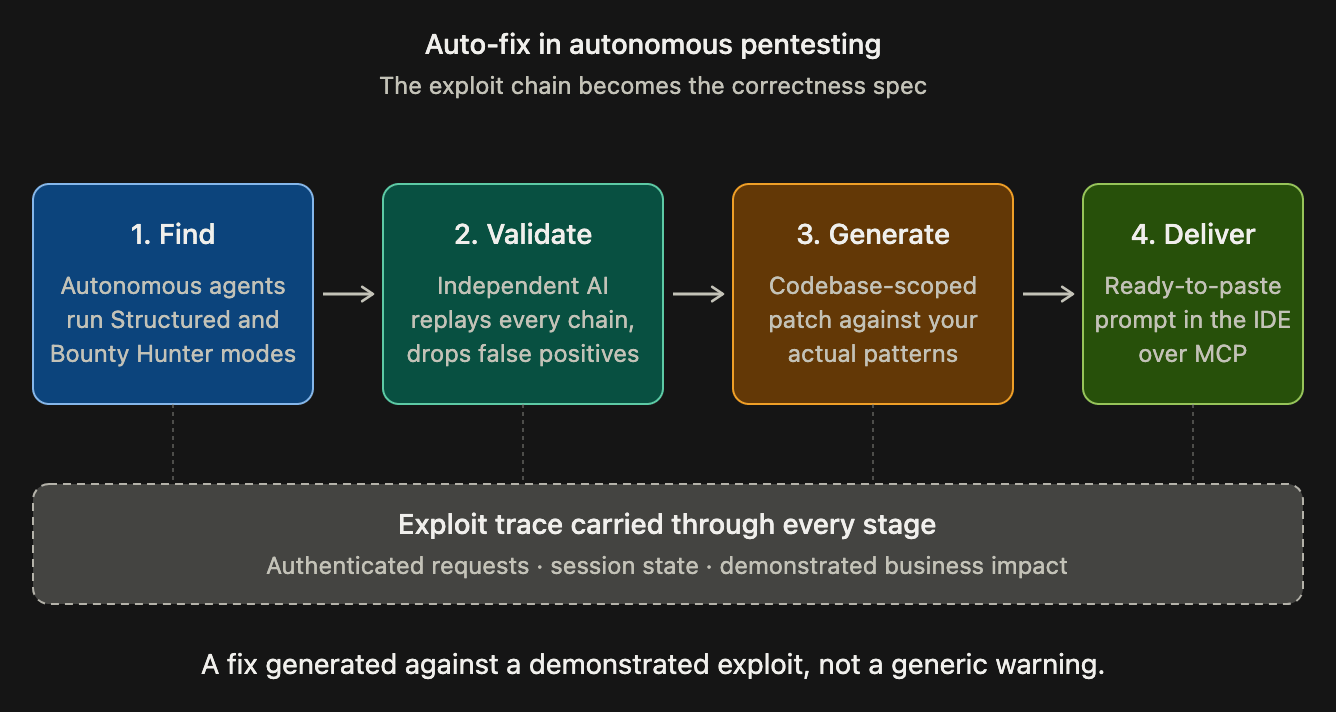
- Find runs autonomous agents in two modes, Structured for breadth and Bounty Hunter for depth, producing chained exploits with proof.
- Validate replays every candidate finding through an independent AI validator, so the fix layer only ever operates on confirmed true positives.
- Generate writes a codebase-scoped patch against your actual patterns, using the exploit trace as the correctness spec.
- Deliver lands the fix as a ready-to-paste prompt inside the developer’s IDE over MCP.
Solving almost 99% of the devs patching problem.
So the obvious question: when does this actually show up in the numbers?
I don’t expect auto-fix to suddenly collapse industry-wide MTTR. Only a small number of vendors ship meaningful auto-fix capabilities today. Until adoption broadens, aggregate remediation metrics will naturally lag.
There is also a counterintuitive effect at play. As detection quality improves, we find more vulnerabilities. The raw number of findings entering developer queues keeps rising even while remediation itself becomes more efficient. Better detection and better remediation can coexist with a growing queue in the short term.
I see it as part of the transition. The technology needs time to move from a capability offered by a handful of vendors into a standard part of the application security stack. Once that happens, the impact will become visible in remediation metrics.
My expectation is that we start seeing a meaningful shift over the next two to three years as adoption expands and auto-fix becomes a default part of security and development workflows.