Over the years, Dynamic Application Security Testing (DAST) has helped you identify common vulnerabilities via automated scanning, fuzzing, and pattern-based detection. While valuable for baseline vulnerability discovery and compliance requirements, many security leaders, including maybe yourself, are now questioning DAST.
What began as a monolithic-style of app building has now transformed into sprawling ecosystems of APIs, single-page applications (SPAs), microservices, cloud-native workloads, and rapidly changing CI/CD pipelines. All this means security teams now balance validating real-world risk across expanding and dynamic attack surfaces without adding friction to development velocity.
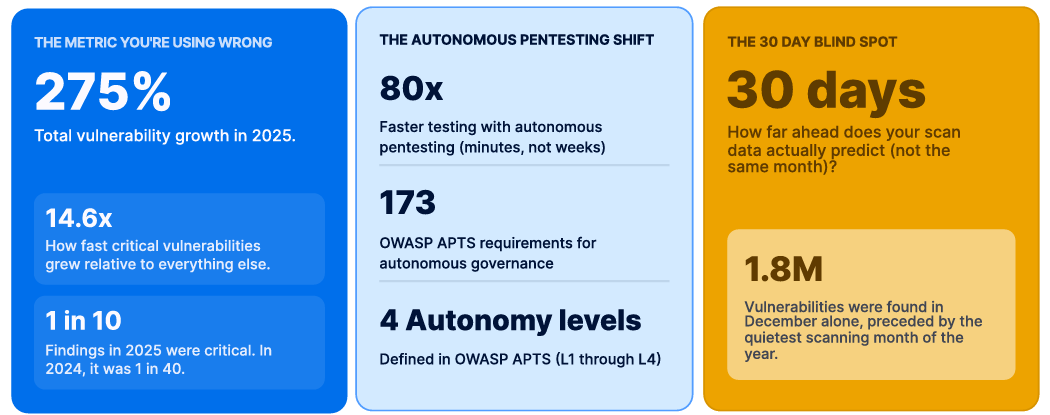
Secondly, modern applications require deeper context, broader coverage, and stronger validation and traditional scanners often struggle to understand business logic, complex authentication flows, API-driven architectures, and interconnected attack paths across distributed environments. Manual pentesters do that, but then speed gets compromised.
This gap is what led to the rise of the autonomous penetration testing framework that moves beyond scanner-based assessments. By combining AI penetration testing, attack path analysis, exploit validation, and continuous security validation, autonomous pentesting platforms simulate attacker behavior, chain vulnerabilities together, and continuously assess exposure while helping you shift left.
Thus, understanding DAST vs autonomous pentesting has become essential for CISOs, AppSec teams, DevSecOps engineers, and enterprise security buyers who are trying to both shape and evaluate the future of offensive security testing.
What Is Legacy DAST?
Dynamic Application Security Testing does not read your source code; rather tests your application from the outside while it is running. It behaves like an external attacker poking at your exposed interfaces and watching how the app responds.
Here is roughly how a traditional DAST scan works:
- Crawling: The scanner maps your app by following links, forms, and endpoints.
- Request fuzzing: It sends large volumes of varied inputs to those endpoints.
- Payload injection: It fires known attack payloads, such as SQL injection or XSS strings.
- Pattern detection: It matches responses against signatures and rules to guess at vulnerabilities.
- Alert generation: It reports anything that trips a rule.
What DAST Does Well:
- Authenticated scans that scour for user‑specific flows.
- Detection of generic logic misuses, especially around Broken Access Control and Insecure Design
- Customizable scripts for common multi‑step actions (login → transfer → confirmation).
Legacy DAST genuinely earns its keep in a few areas. It is good at catching common OWASP Top 10 issues, it integrates into CI/CD, it scales across many apps because it is technology-agnostic, and it supports compliance reporting.
The Core Problem With Legacy DAST
DAST has not stopped being useful. It’s just not as fast and business-logic friendly as today’s high ship velocity demands it to be:
A. Pattern-based detection: Traditional DAST leans on signatures and static payload logic. It looks for known shapes of known bugs, which means it has limited contextual understanding of what your app is actually doing.
B. High false positives: Because it flags symptoms rather than confirming exploitability, DAST is famous for noise. Bright Security and OX Security both note that legacy tools routinely report non-exploitable issues, which buries real findings and burns engineering time on dead ends.
C. Poor business logic understanding: A scanner cannot reason about your approval workflows, privilege escalation chains, or multi-step authentication bypasses, because those depend on context that no signature captures.
D. Weak modern app coverage: SPAs, REST, and GraphQL APIs, dynamic JavaScript rendering, microservices, and identity systems are exactly the surfaces where automated crawling struggles to reach deep, authenticated paths.
E. Point-in-time testing: Scheduled scans are snapshots. They tell you the state of your app at one moment, which is little comfort in an environment that ships several times a day.
Tired of triaging scanner noise? Talk to an Astra security expert about exploit-validated findings.
What Is a Modern Autonomous Penetration Testing Framework?
Simply put, modern autonomous penetration testing frameworks use integrated pipelines to carry out adversarial attacks to test your system’s resilience.
It is not just “AI-powered DAST”, they also dissolve advanced graph modeling, multi-agent systems, deep reinforcement learning, and LLMs to best simulate attack scenarios that also help you stay compliant. It goes beyond and combines AI agents, attack-path reasoning, exploit chaining, autonomous decision-making, validation workflows, and continuous testing into one loop.
The important distinction is intent. Where a scanner asks “Does this input trip a rule?”, an autonomous framework asks “Can I actually reach a valuable target by chaining what I find?” It plans, acts, observes the result, and adapts its next move, much like a human tester working through an engagement.
Evolution: From Scanners to Autonomous Security Validation
The shift did not happen overnight. It tracks the broader maturing of application security.
| Era | Security Approach |
|---|---|
| Early 2000s | Signature-based scanners |
| 2010s | DAST automation |
| Late 2010s | Continuous security testing |
| 2020s | Autonomous pentesting and CTEM |
The big inflection point is Continuous Threat Exposure Management (CTEM), a framework Gartner introduced in 2022. In 2024, Gartner went further and defined adjacent categories such as Adversarial Exposure Validation (AEV), bringing automated pentesting and breach-and-attack simulation under one umbrella. Modern vendors increasingly position themselves around exposure validation rather than pure scanning.
Autonomous Pentesting vs Legacy DAST: A Head-to-Head Comparison
| Capability | Legacy DAST | Autonomous Pentesting |
|---|---|---|
| Testing method | Crawl, fuzz, pattern-match | Reason, exploit, validate |
| Exploit validation | Rare or none | Core function |
| Attack chaining | No | Yes |
| Business logic analysis | Weak | Stronger, context-aware |
| AI reasoning | None | Central |
| Continuous testing | Scheduled | Ongoing |
| Cloud awareness | Limited | Built-in |
| API understanding | Surface-level | Deeper, authenticated |
| Contextual risk analysis | Low | High |
| False positives | High | Reduced via validation |
| Remediation validation | Manual re-scan | Automated re-test |
| Human-like decision making | No | Approximated |
| Scalability | High (shallow) | High (deeper) |
| CI/CD integration | Yes | Yes |
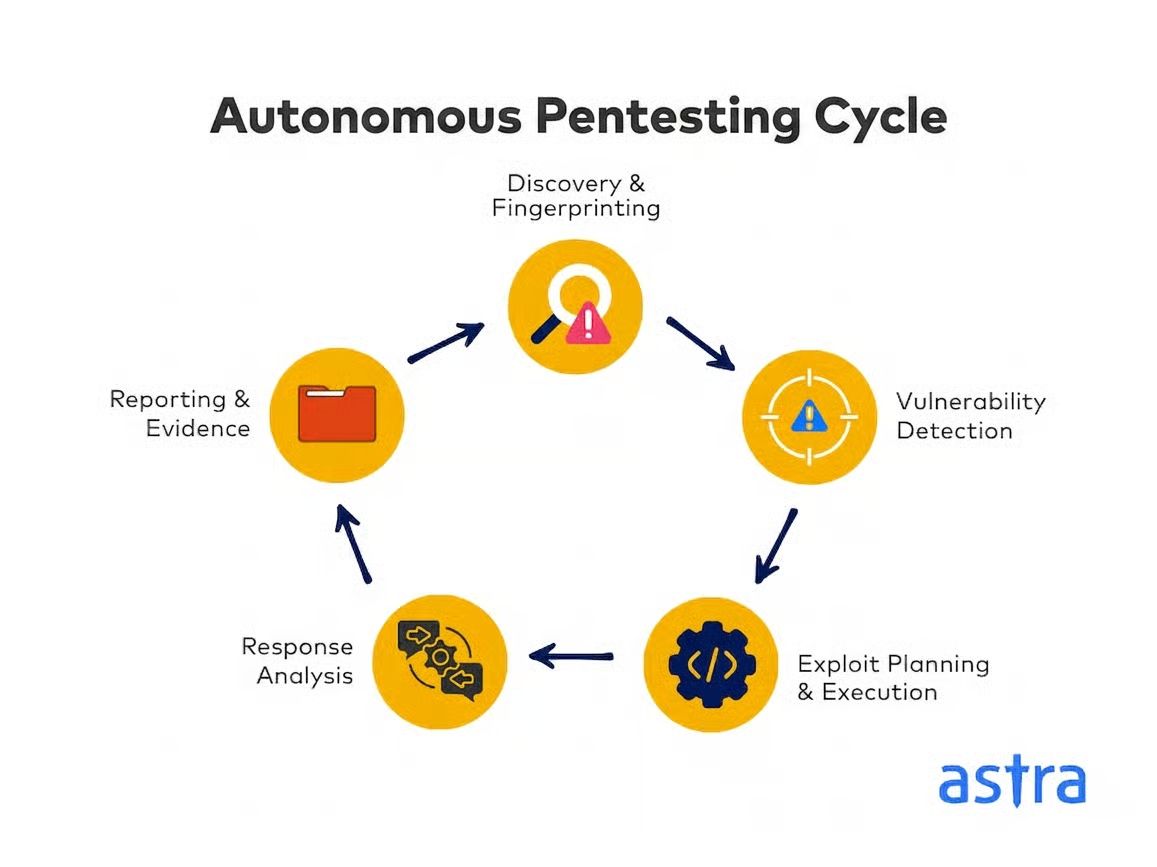
How Autonomous Frameworks Actually Work
Most of the serious work here comes from academic research, and it consistently points to multi-agent designs.
A. AI agents. Frameworks split the job across specialized agents: reconnaissance, exploitation, and validation, coordinated by an orchestration layer. The award-winning PentestGPT, presented at USENIX Security 2024, and newer multi-agent systems such as PentestAgent (ASIA CCS 2025) demonstrate this division of labor.
B. Attack path reasoning. Instead of testing endpoints in isolation, the framework chains vulnerabilities together, simulates lateral movement, and pivots using harvested credentials.
C. Exploit validation. This is the heart of the difference. Instead of plainly reporting a possibility, the framework attempts to prove exploitability and measure real impact, which is what cuts down false positives.
D. Continuous learning and adaptation. Agents generate context-aware payloads, retain memory across steps, and adjust their approach based on what the target actually returns.
Why Legacy DAST Struggles With Modern Applications
The architectures that define modern software are precisely the ones legacy scanners handle worst:
- SPAs and dynamic JavaScript: Content rendered client-side is hard to crawl reliably or in case serverless setups where logic runs outside the purview of the traditional server interactions for most of the time
- REST and GraphQL APIs: Flexible, schema-driven endpoints rarely expose themselves to a simple crawler.
- Kubernetes and cloud-native apps: Ephemeral, distributed workloads have no fixed surface to scan.
- Identity-based and dynamic authentication flows: Token-based and federated auth confuse tools built for simple session cookies. Improper configurations can lead DAST to flagging generic vulnerabilities that don’t reflect your specific business or threat landscape.
Continuous Pentesting vs Scheduled Scanning
Legacy DAST is reactive by design. You schedule a scan, you get a report, and the report ages the moment your next deployment goes out— between scans, you are flying blind.
Autonomous frameworks invert that model. They run continuous attack simulations, validate exposures on an ongoing basis, or rather anytime you commit a ship. Plus they monitor your runtime surface as it changes. For daily shippers, that difference between a quarterly snapshot and continuous validation is the whole ballgame that if played silly can eat into their entire P&L.
False Positives and Alert Fatigue
This is where autonomous penetrating testing frameworks carry the highest impetus.
Legacy scanners produce many low-confidence alerts, plus they carry a decent enough human cost. In the 2025 SANS Detection and Response Survey, 73% of security teams named false positives their top detection challenge, and roughly 3 out of 4 organizations cited alert fatigue as a primary SOC concern.
| Category | Impact metric | Source | Year |
|---|---|---|---|
| Uninvestigated alerts | 42% of alerts go uninvestigated | Microsoft/Omdia | 2026 |
| Missed real threats | ~50 genuine threats per year missed from ignored low-severity alerts | Intezer | 2026 |
| U.S. manual triage cost | $3.3 billion annually | Vectra AI | 2023 |
| Fragmented SOC labor premium | 40% higher operational labor costs | Microsoft/Omdia | 2026 |
| Global average data breach cost | $4.44 million | IBM | 2025 |
| Analyst burnout | 63% (Tines 2023) to 76% (Sophos 2025) report burnout | Tines, Sophos | 2023, 2025 |
| Junior analyst attrition | 70% with five years or less experience leave within three years | SANS | 2025 |
| Insider risk cost | $17.4 million annual average | Ponemon | 2025 |
When analysts and their tooling offer reduced trust, the first to slip through are real vulnerabilities. This is exactly where Autonomous frameworks waltz in.
They attack the root cause rather than the symptom. By confirming exploits, validating findings against business context, and simulating actual attacks, they raise signals and cut the noise that drives fatigue in the first place.
To be fair to DAST, it is not the worst offender among automated tools. The OWASP Benchmark Project actually credits DAST with a lower false-positive rate than some other testing categories. DAST is uniquely noisy, but validation-first approaches have set a higher bar.
Real-World Attack Simulation: The Biggest Difference
If you remember one thing, make it this. Legacy DAST detects symptoms. Autonomous pentesting simulates how the symptoms arose.
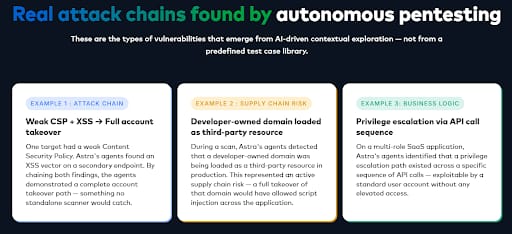
Picture a reflected XSS flaw. A traditional scanner flags it: “possible reflected XSS here.” Useful, but where does it lead?
An autonomous framework goes further. It chains that XSS into session theft, uses the stolen session to access a privileged account, and demonstrates a path to privilege escalation. One output is a warning. The other is a story about how you actually get breached, which is far more convincing to an engineering team deciding what to fix first.
Human Pentesters vs Autonomous Frameworks
Let us be clear, because the marketing around this gets overheated: autonomous frameworks do not replace human pentesters.
The research backs this up. On the AutoPenBench benchmark, fully autonomous LLM agents solved only about 21% of real-world tasks, while semi-autonomous, human-assisted agents reached 64%. The gap is the point. Autonomous frameworks are strongest when they:
- Automate repetitive validation and reconnaissance.
- Expand coverage across a large, changing attack surface.
- Free up human testers for higher-value work.
Human experts still dominate creative business-logic abuse, advanced adversarial thinking, and deep contextual attacks that no current model reliably reproduces. The best programs pair the two.
Compliance and Enterprise Considerations
Gartner correctly predicted that organizations that prioritize investments through a CTEM program will be three times less likely to suffer a breach.
Continuous validation ornaments compliance needs. Autonomous frameworks reduce your TAT for gathering and documenting audit ready evidence along with continuous exposure validation across multiple frameworks such as SOC 2, ISO 27001, PCI DSS, HIPAA, etc.
One caveat worth stating plainly is that most enterprises and auditors still require human review, expert validation, and a signed pentest report. Autonomous Penetration testing and frameworks bolster this process. It does not yet replace the signature on the certificate.

Modern Use Cases for Autonomous Pentesting
Autonomous testing is best suited for wherever your attack surface is large, fast-moving, or both. A scheduled scan once a quarter is simply insufficient when juxtaposed against environments with high frequency shipping, which is exactly where continuous, validation-first testing pays off:
- SaaS platforms: If you push releases weekly or daily, a point-in-time scan is stale almost immediately. Autonomous testing keeps pace with each deployment, so a feature that ships on Tuesday gets validated on Tuesday rather than at the next scheduled window. This tight loop matters most for multi-tenant apps, where a single broken access control can expose one customer’s data to another.
- API-first companies: Modern products live behind sprawling REST and GraphQL endpoints, many of them authenticated and chained together in ways a crawler never sees. Autonomous frameworks can authenticate, walk those flows, and probe how endpoints behave together rather than testing each one in isolation. That is where real API risks such as BOLA tend to hide.
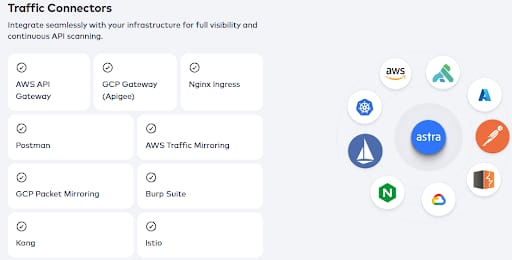
- Cloud infrastructure: Containers spin up and tear down in minutes, and your surface varies each hour. Continuous testing maps and re-tests ephemeral, distributed workloads as they change, so a misconfigured service that only existed for an afternoon still gets caught.
- DevSecOps teams: When testing is wired directly into the pipeline, validated findings reach developers while the code is still fresh in their heads. This shortens the fix cycle and keeps security from becoming the bottleneck everyone routes around. The goal is fewer surprises at release, without slowing you down.
- CTEM programs: Autonomous validation is a natural fit for the validation stage of a CTEM lifecycle. It proves which exposures are actually reachable and exploitable, so your team prioritizes the handful that matter instead of drowning in a ranked list of impractical ones.
- External attack surface monitoring: Your internet-facing footprint grows quietly, through a forgotten subdomain, a staging server left exposed, or a new third-party integration. Autonomous testing scours such perimeters as they shift and validates whether newly exposed assets are genuinely at risk of being exploited by an attacker.
Limitations of Autonomous Pentesting
A trustworthy comparison has to name the downsides too. Autonomous frameworks carry real risks you should weigh:
- Hallucinations: Models can confidently invent findings or steps that do not hold up.
- Limited business context: They still miss nuances a human tester would catch.
- Unsafe automation: An agent running exploits in production needs strong guardrails.
- Unpredictability: Non-deterministic behavior makes results harder to reproduce.
- Governance challenges: Approving, scoping, and auditing autonomous activity is a maturing discipline.
This is also why benchmark scores remain modest, and why human oversight stays non-negotiable for now.
The Future of Application Security Testing
The direction of travel is clear. The industry is moving from vulnerability detection toward exposure validation and exploitability analysis. Expect to see AI copilots for AppSec, autonomous attack simulation, and agentic security validation become standard, with the once-separate worlds of DAST, breach-and-attack simulation, CTEM, and pentesting steadily converging into unified platforms driven by multi-agentic systems.
Conclusion
Legacy DAST is not dead. It remains a solid choice for baseline scanning, compliance coverage, and broad vulnerability detection across many applications, plus it is comparatively cheaper as you scale initially.
But its scanner-era design simply cannot keep pace with cloud-native architectures and current shipping velocity.
Modern autonomous penetration testing frameworks deliver what DAST cannot: deeper exploit validation, continuous testing, confirmed exploitability, and realistic attack simulation.
The cleanest way to think about it is this. Legacy DAST evolved from passive scanners. Autonomous frameworks are evolving into active security validation systems, and for most modern teams, that is where the value resides.
FAQs
What is autonomous penetration testing?
It is security testing carried out by AI-driven agents that reason about a target, attempt real exploits, chain vulnerabilities, and validate impact, with minimal human intervention.
How is autonomous pentesting different from DAST?
DAST crawls an app and pattern-matches responses to flag possible issues. Autonomous pentesting reasons about the app, attempts exploits, and confirms whether a finding is actually exploitable.
Can autonomous pentesting replace DAST?
Not entirely. Many teams run both, using DAST for broad baseline coverage and autonomous frameworks for deeper,attack-scenario level testing.
Is autonomous pentesting fully AI-driven?
Not in practice. Benchmark research shows agents assisted by humans outperform fully autonomous endeavors, human oversight thus remains crucial.
What are the limitations of DAST?
Pattern-based detection, high false positives, weak business-logic understanding, poor coverage of modern apps, and point-in-time scanning.
What is exploit validation?
The process of proving whether a vulnerability is actually exploitable and measuring its real impact, rather than just reporting that it might exist.
Does autonomous pentesting reduce false positives?
Yes. By confirming exploits and validating findings in context, it filters out the non-exploitable noise that leads to alert fatigue.
Is autonomous pentesting suitable for compliance?
It supports you in continuous compliance and becoming audit-ready for frameworks like SOC 2, ISO 27001, PCI DSS, and HIPAA, but most, if not all, audits still require human-validated and signed reports.
How does autonomous pentesting work with CI/CD?
It integrates into the pipeline to run continuous attack simulations as code changes, replacing scheduled snapshots with ongoing validation