
Modern software is built on the backs of APIs (Application Programming Interface). It unites separate bits of the web, allowing systems to communicate with each other. With APIs being used on such a wide scale, managing them becomes a mammoth task.
To add to the chaos, we’ve got shadow APIs, too. Shadow APIs live in a company’s systems somewhere but without official knowledge and use. They are created as band-aids, side projects, or hacky solutions but can create problems if left unchecked.
We will now pick up the torch and show what shadow APIs are, why they are harmful, and how to detect and restrain them. We will also look at some great tools and tactics to give you back control over your API security landscape.
What is a Shadow API?
A shadow API is an unmanaged and, in most cases, undocumented or unofficial internal API inside the organization’s IT environment. These API endpoints circumvent standard governance processes and are invisible to IT and security teams.
Internal Shadow APIs can be homegrown and unregistered, or merged with an outside API without a proper process. These systems tend to have little or no documentation, security controls and are not properly maintained which carries a large amount of risk.
These hidden APIs arise from rushed development, legacy systems, third-party integrations, or lack of centralized API management. Their proliferation is further driven by shadow IT practices.
Business leaders need to deal with shadow APIs, as they can lead to security issues, non-compliance with data protection laws and regulations, tech debt, and efficiency killers.
Without visibility into all shadow APIs, your organization will be limited in strategically planning and executing any API initiative or dealing with security breaches and deployment errors that can spoil the organization’s name.
Astra API Security Platform where offensive testing meets live traffic intelligence
- Complete API observeability
- 15000+ DAST test cases
- Risk classification & scoring

Risks Associated with Shadow APIs
Shadow APIs open up a number of risks that are more likely to tangent in the future at times when there will be fewer organizations considering their API exposure.
Therefore, easily and effectively managing these threats is important for any issue management on systems like this.
- Security Vulnerabilities: Security controls are almost always missing or incomplete in shadow APIs because they aren’t part of a company’s API catalog, so threat actors/hackers seek them out. A breach of the shadow API would allow hackers to access even more data.
- Breach of Compliance: Shadow APIs can unintentionally contravene data protection laws, such as GDPR compliance or HIPAA laws, which may lead to huge fines and legal action.
- Operational Inefficiencies: Shadow APIs can also cause operational inefficiencies, such as duplication of efforts and hidden system dependencies. This makes maintenance and upgrades more difficult, costing you a great deal of money down the road.
Lastly, shadow APIs can harm business reputation and customer trust. Additionally, security breaches or service outages resulting from unmanaged APIs can undermine customer confidence and result in churn and bad PR.
How to Prevent Shadow API Exposure
Given the risks associated with shadow APIs, preventing their exposure becomes a crucial challenge for organizations today. Some of the key strategies to prevent exposure include:
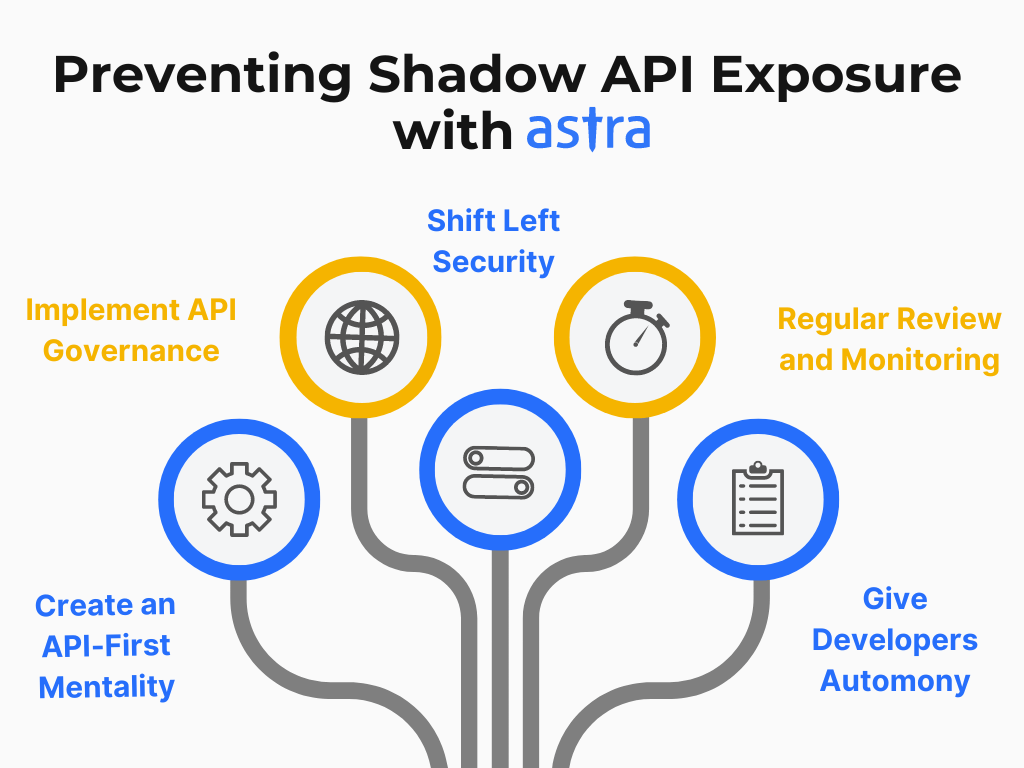
Creating an API-First Mentality
An API-aware culture is essential here to avoid exposure to shadow APIs. It’s always good to have regular API best practices training and workshops with all staff. Be sure to educate your team at all company levels on how easy it is to build unofficial APIs quickly.
Open an API Usage discussion across departments. If everyone is on the same page about maintaining solid API hygiene, they will more likely adhere to compliance and be vigilant in identifying such APIs.
Implementing API Governance
Define API creation, deployment, and management policies. Establish a single source of truth for APIs in your organization by recording every API the developers use, such as email validation APIs, payment gateways, open-source, etc., centrally, containing documentation and approval before usage. Enforce automated Shadow API discovery tools.
Check your API landscape for governance adherence as part of a regular audit. Adopt API gateways and management platforms for greater visibility and control.
Giving Developers Autonomy (While Keeping an Eye on Things)
Give developers access to the latest development tools for faster development and API creation/development. Introduce self-service portals through which developers can simply register and document their APIs.
Provide API design guidelines and ready-to-use. This way, you can be a better innovator and still have the much-needed oversight.
Regular Review and Monitoring

Regularly review your API strategy to ensure it meets business goals and security requirements. Continuous monitoring should be in place for your API ecosystem so that any abnormal activities and unauthorized APIs will raise an alarm.
Shift Left Security
One of the best ways to detect shadow APIs early on is to have security in place from the start when developing your API. When a secure design is the default, you are not just stopping vulnerabilities—you are establishing a culture in your organization that produces APIs protected by security as a standard and does things right because of it.
API Security starts with visibility, you can’t secure what you can’t see. With Astra API Security Platform, you get:
- Complete API observeability
- Continuous offensive DAST tests
- AI-powered fixes, developer-first workflows
What is API Discovery, and How Can it Help?
Shadow API Discovery is a way of finding all APIs in an organization, including those that are hidden or undocumented (the functionality may still be available). This is also an essential practice that benefits organizations by keeping a consolidated view of their APIs, making them easy to monitor, secure, and govern.
API Discovery provides comprehensive coverage of the challenge of defending against such APIs. It enables organizations to discover APIs that may be living in production but undiscovered or forgotten – which would prove to be a security threat and make things go wrong.
Identifying these APIs allows teams to address them through proper management, establishing use under appropriate controls and security standards, and overall API strategies. In this way, duplicate efforts and resources can be avoided.
Best Enterprise & Open-Source Tools to Detect Shadow APIs
Defending shadow APIs needs a blend of specialized tools and domain knowledge. Below is a summary of some important tools and ways to go about it:
Astra Security
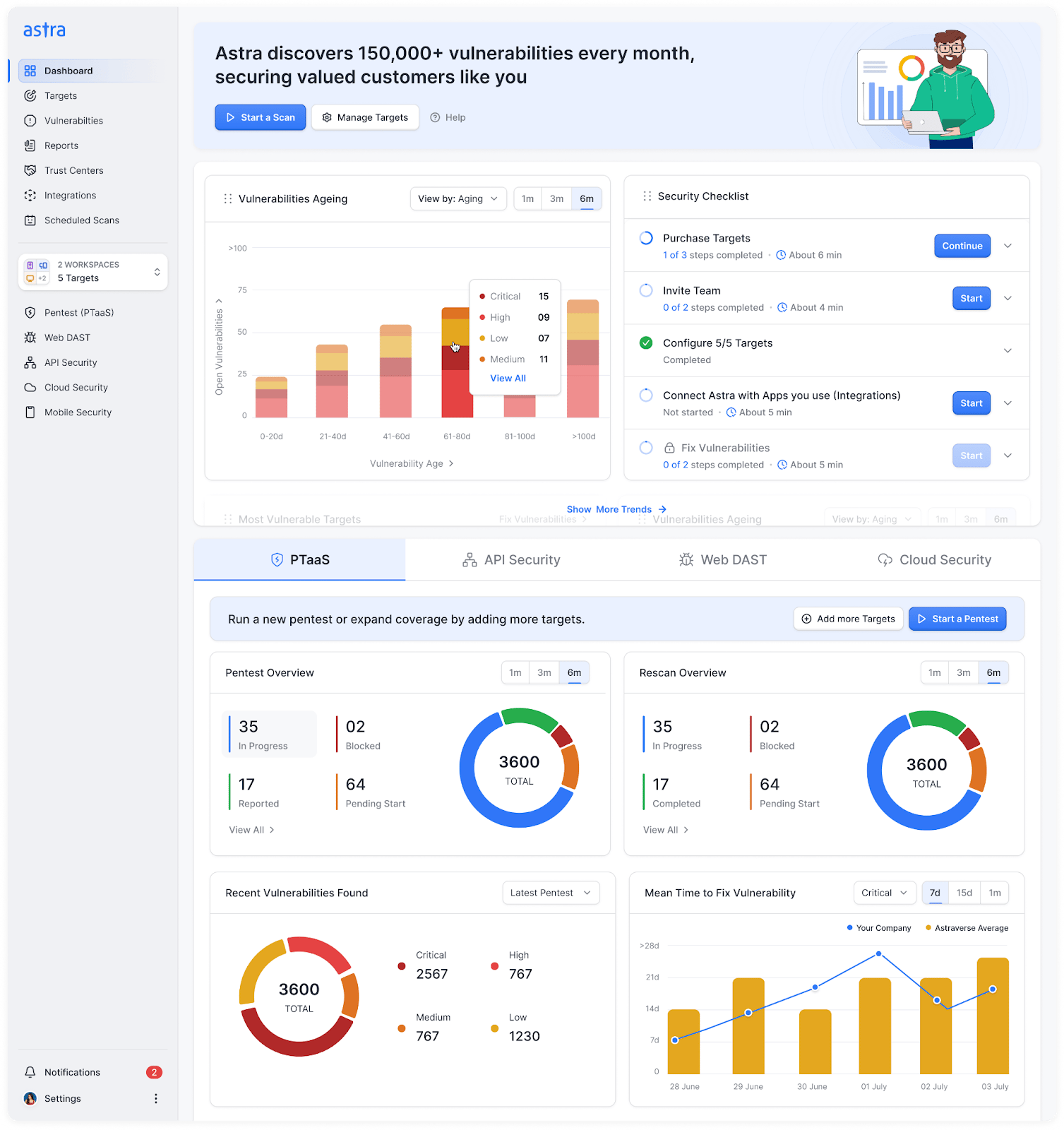
Astra Security is a complete security testing platform that can help you discover and perform a thorough security test. Some of the features include:
- Automatic API discovery across your network
- API-specific vulnerability scanning
- Ongoing security testing integration with CI/CD pipelines
The key benefits of using Astra Pentest are visibility into your API landscape, reduced risk of data breaches, and ease of compliance management.
Open-source Options
- OWASP ZAP (Zed Attack Proxy): OWASP ZAP is an open-source security testing tool that can act as a reverse proxy. The tool can intercept API traffic and, therefore, discover typically undocumented APIs (being used behind the scenes). ZAP is also capable of basic security testing, so it serves as a dual-purposed discovery and preliminary audit tool for shadow APIs.
- Fiddler: Fiddler is a web debugging proxy that can intercept, modify, and analyze API traffic. Its ability to intercept all HTTP and HTTPS traffic also makes it a valuable tool for locating such APIs, particularly in client-side (web or mobile) applications.
- Mitmproxy – mitmproxy is a free and open-source interactive HTTPS proxy. You can use it to inspect, modify, and replay API requests, which makes it a great tool for discovering hidden APIs.
Astra API Security Platform where offensive testing meets live traffic intelligence
- Complete API observeability
- 15000+ DAST test cases
- Risk classification & scoring
Advanced Shadow API Mitigation Strategies
As organizations mature in API management practices, more sophisticated approaches are needed to mitigate shadow APIs fully. Following are some ways to level up your API security game:
Zero-trust Architecture for APIs
A zero-trust architecture assumes that, by default, no API can be trusted, even within the internal network. This approach involves:
- API requests individual checks for authentication and authorization
- Micro-segmentation of API access based on least privilege principles
- Ongoing validation of API consumer’s authentication and authorization
- All API traffic is encrypted, both in transit and at rest.
API Monitoring and Anomaly Detection
Continuous monitoring is more than once-in-a-while scans; it is full visibility into the API behavior in real-time.
- Utilize AI-powered tools to create baseline API behavior patterns.
- Set alerts for any abnormal API activity, unusual access, or increased traffic volumes.
- Possible API detection based on traffic analysis using Machine Learning algorithms.
API Versioning and Deprecation Strategies
If there’s one coding chore/task that is a nightmare for developers, it’s API versioning. APIs’ true lifecycle cannot be understood or managed until a proper versioning and deprecation strategy is implemented to help address these shadow APIs.
- Get specific versioning enabled across all APIs (internal & external).
- Give your stakeholders as much advanced notice about API changes and deprecations.
- Migrate away from deprecated APIs and identify the migration path by providing a transition to newer versions of managed services.
- Streamline identification and consolidation of dormant and sunset API versions.
Automated API Security Scans
You need proper automated security testing to monitor the 24/7 load in your API ecosystem. This is where Astra’s automated API security testing comes in:
- Regularly monitor your API environment for security vulnerabilities
- Detection engine for common API security vulnerabilities such as injection flaws, broken authentication, and improper access controls
- CI/CD pipeline integration for left shift security practices
The power of Astra’s platform extends far beyond basic testing and provides a more holistic view by assessing API security in its entirety.
How Can Astra Security Help?
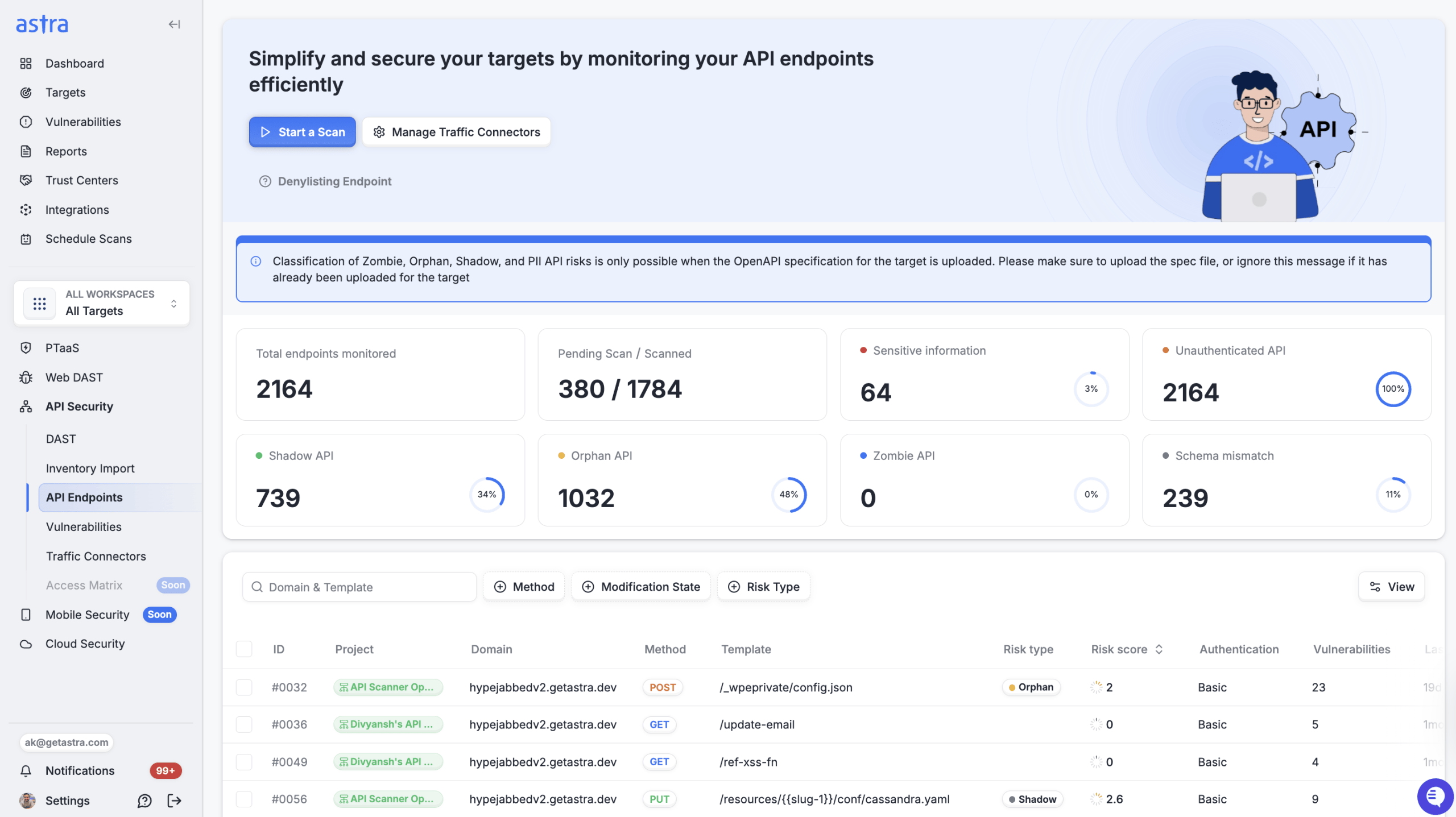
Key features:
- Discover active, dormant, and undocumented API endpoints in >30 minutes using runtime traffic analysis.
- Live API traffic capture via 10+ connectors, including AWS, GCP, Azure, NGINX, and Kong, for continuous observability.
- Modern DAST scanner with 15,000+ API-specific test cases, including OWASP API Top 10, BOLA, and IDOR.
- Continuous automated scanning (20+ DAST scans/month up to 1000+ per year) with selective instant rescans for fixes.
Astra’s API Security platform starts by building a live, risk-mapped inventory. Discovering zombie, orphan, and shadow APIs from runtime traffic and CI pipelines so you see what exists and why it matters. Our AI-powered logic testing flags real-world business-logic flaws and PII or secret leaks that spec-only tools miss. Coupled with anomaly detection and contextual risk scoring, the platform turns noisy traffic into high-fidelity findings prioritized for remediation.
Remediation is developer-first. Deep integrations with Postman, Burp, GitHub, Jira, and CI/CD let teams receive validated reports, AI-assisted fixes, and instant selective rescans that confirm patches. Management-ready exports (PDF/CSV/JSON) and compliance mappings for SOC2, GDPR, PCI, etc., simplify audits while MTTR metrics and expert reviews keep remediation measurable, offering continuous visibility without slowing DevOps velocity.
API Security starts with visibility, you can’t secure what you can’t see. With Astra API Security Platform, you get:
- Complete API observeability
- Continuous offensive DAST tests
- AI-powered fixes, developer-first workflows
Final Thoughts
In short, shadow APIs form hidden gaps that lead to security, compliance, and operational risks. These start as quick developer fixes. But if ignored, they turn into lasting threats that become persistent. Fixing them requires both discovery and governance, not just one or the other.
Start with a focused 30-day discovery audit to map runtime endpoints and CI artifacts. Register everything you find, enforce simple approval rules, and run continuous monitoring so issues surface before they become incidents.
FAQs
What is the difference between shadow API and zombie API?
Shadow APIs are undocumented, but active APIs that are created outside official channels. Zombie APIs, on the other hand, are deprecated, forgotten remnants of past versions. Both pose security risks due to a lack of oversight.
Recommended Reading:
- Astra API Security Solution
- What is API Security?
- API Management Security Best Practices
- What is API Security testing?
- OWASP Top 10 API 2023 Vulnerabilities
- 7 Top API Penetration Testing Tools in 2026
- DAST vs SAST Comparison
- The Ultimate 2026 API Security Checklist
- The Top API Security Risks and How To Mitigate Them
- What is Broken Object Level Authorization (BOLA)?
- Top API Security Vendors List (Updated)
- What is Shift Left Security? (Guide)
- Mobile App API Security: A Complete Guide
- What are Shadow APIs? (Explained)
- Top 5 API Security Challenges and How to Overcome Them
- How to Build a Solid API Security Strategy for 2026?
- What are Zombie APIs (Complete Guide)
- Top 7 API Security Trends to Know in 2026
- Guide to API Security Maturity Model
- How to Protect Your APIs for Healthcare Industry?
- API Security Pricing: Complete Cost Guide for 2026
- Why is Fintech API Security Important in 2026
- How to Secure Your APIs Against These Vectors?
- What is the Difference Between API Security and Application Security?
- What is API Security Management?