
Key Takeaways
- API security management secures APIs end-to-end, continuously discovering, monitoring, testing, and protecting them across their lifecycle.
- APIs are prime attack targets, with common risks including BOLA, authentication flaws, excessive data exposure, injection attacks, and unmanaged shadow and zombie APIs.
- Visibility is the first major win, often revealing 2–3× more APIs than expected and exposing the true API attack surface.
- Proactive detection replaces firefighting, enabling early identification of anomalous behavior through continuous monitoring and runtime protection.
- Effective API security is layered and automated, combining discovery, testing, policy enforcement, strong authentication, CI/CD integration, and the right security platform.
The fact that you’re here is proof enough that API is somewhere disturbing your or your security team’s sleep. Whether it is 99% of organizations reporting API security issues in recent surveys, or it’s a compliance/client mandate.
We know you are (fear you soon will be) grappling with shadow APIs, misconfigured endpoints leaking sensitive data, BOLAs, unauthorized access, and more. Even with a solid understanding of API attack vectors, strategies, and best practices, you can’t really wipe those sweat beads with a faint phew.
You still need to manage the enforcement, monitoring, reporting, and evolution of your API Security, especially given that tools were rarely designed with the dynamic, distributed nature of modern API ecosystems in mind.
This is where API security management walks in. It serves as your go-to document, with a specialized security framework to address the unique challenges your API ecosystem presents.
API security management involves selecting and documenting dedicated tools, processes, and governance structures designed exclusively to protect your API infrastructure. Understanding how to implement this approach effectively can mean the difference between a secure API ecosystem and a data breach waiting to happen. And we have written this piece to help you with just this bit and no other gimmicks.
What is API Security Management?
API security management helps you identify yours and build a framework to eliminate them effectively, in line with your business strategy and finances. At its core, this discipline involves continuously tracking every API endpoint in your environment, whether documented or not.
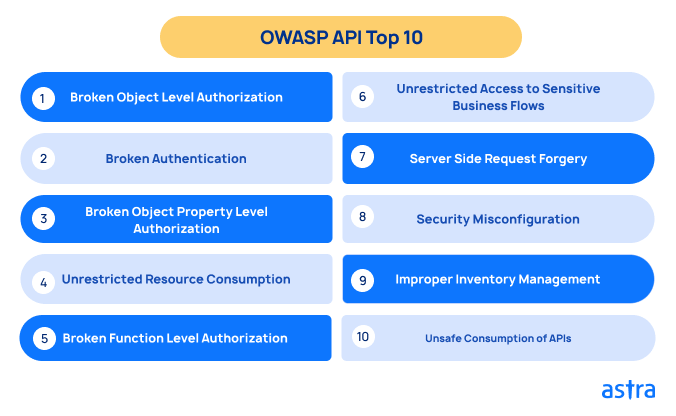
This is followed by analyzing traffic patterns to detect anomalous behavior, enforce authentication and authorization policies, and ensure APIs comply with security standards like the OWASP API Security Top 10.
Today’s API security management solutions need to create a complete inventory of your API estate, including REST APIs, GraphQL endpoints, and other API types. They also need to monitor API calls in real-time and flag suspicious activities.
But API security management extends beyond just tools and technology. It involves defining who can access which APIs, establishing security testing requirements before deployment, and creating incident response protocols when security fails.
Scan, Discover, and Secure your APIs from evolving threats with Astra Security’s comprehensive API security platform.

Why is API Security Management Important?
API security management is crucial because APIs significantly expand your attack surface while handling your most sensitive data.
The explosion of API usage has fundamentally transformed how applications communicate, but it has also created unprecedented security challenges. Managing hundreds or thousands of APIs that handle sensitive customer data, financial transactions, critical business operations, etc., creates a broad and vulnerable attack surface for attackers seeking to compromise your systems.
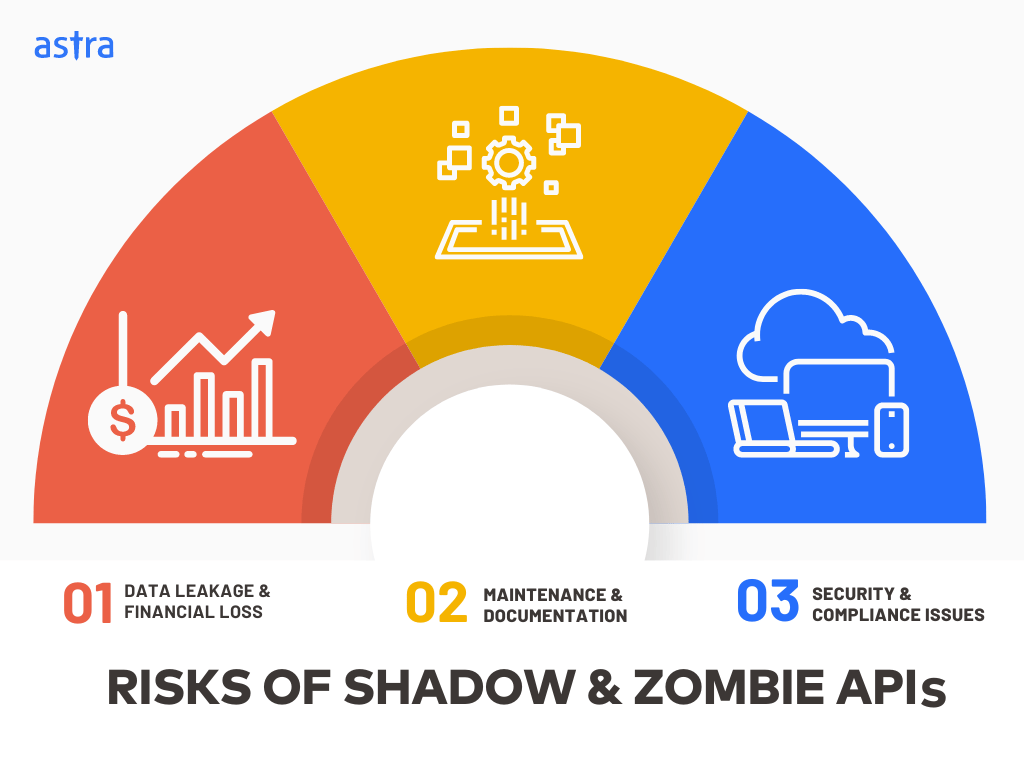
Why fragile? Because APIs operate in distributed, cloud-native environments and can give rise to multiple shadow and zombie APIs even when you’re firewalling, documenting, and authenticating everything. These forgotten API endpoints are an attacker’s paradise because they often lack basic security controls.
API security management helps you account for these scenarios and highlights the risks you are taking by not hiring an external API Security service provider. Managing your Shadow & Zombie APIs thus becomes a crucial part of your API security management.
Next, API security management is also crucial for meeting regulatory and compliance requirements. Standards like GDPR, PCI DSS, and HIPAA impose strict requirements and heavy fines for non-compliance or breaches. Since APIs frequently transmit PII, financial details, or health records, securing this data by multiple means is what you elucidate and enforce through your API security management frameworks, which provide the framework and maintain regulatory compliance.
Business continuity depends on API security as well. Modern applications rely so heavily on APIs that a compromised endpoint can bring entire services offline. Attackers increasingly target APIs for ransomware attacks, data exfiltration, and service disruption. Implementing robust API security management ensures your digital services remain available and trustworthy.

Discover and protect every API endpoint with Astra Security’s automated discovery and continuous monitoring. Schedule your scan right away
What are the Benefits of API Security Management?
The benefits of API security management extend beyond basic protection to include visibility, control, and resilience across your entire API ecosystem, reducing risk, strengthening compliance, preventing costly breaches, and enabling secure growth at scale, as explained below:
Enhanced visibility is perhaps the most immediate benefit. Many organizations discover they have two or three times as many APIs as they initially thought. And it’s not just about jotting down your APIs; complete visibility requires understanding your true attack surface, identifying which APIs handle sensitive data, and prioritizing security efforts where they matter most. This is what adds management to your API security.
Proactive threat detection means ensuring your approach is preventive, not reactive. API security management platforms help you here by identifying suspicious patterns as they emerge. Moreover, they flag anomalies such as unusually high data access volumes, authentication attempts from unexpected locations, or API calls that deviate from baseline norms.
This streamlines compliance as API security governance becomes centralized. You can now automatically track which APIs process regulated data, monitor access controls, generate audit trails, and produce compliance reports. This reduces the manual effort required to demonstrate compliance and ensures your security standards remain consistent across all endpoints.
API-related breaches are more expensive, mainly due to their high data volumes. That is why continuous scanning and periodic pentesting become indispensable so you can remediate issues before attackers exploit them.
Improved development velocity might seem counterintuitive, but proper API security management actually accelerates secure development. When security teams provide developers with clear guidelines, automated testing tools, and quick feedback on security issues, developers build secure APIs faster.
Transform your security posture from reactive to proactive via Astra Security’s AI-infused API Pentesting.
How Does API Security Management Work?
API security management is a continuous, closed-loop process that discovers, analyzes, tests, and protects APIs throughout their lifecycle, adapting to your evolving API landscape rather than relying on one-time assessments.
It requires you to understand your operational flow that generally operates through a continuous cycle of discovery, analysis, testing, and protection, and adapts to your changing API landscape.
| Process Stage | Focus Area | Key Activities |
|---|---|---|
| Automated API Discovery | Visibility & Inventory | Identify all API endpoints, including shadow and undocumented APIs |
| Analysis | Scan network traffic, code repositories, and API gateways | |
| Lifecycle Management | Maintain a continuously updated API inventory with metadata | |
| Security Posture Assessment | Access Control | Assess authentication and authorization mechanisms for weaknesses |
| Vulnerability Exposure | Evaluate APIs against OWASP API Security Top 10 risks | |
| Data Protection & Abuse Prevention | Verify input validation, encryption, and rate-limiting controls | |
| Continuous Runtime Monitoring | Traffic Observation | Monitor API traffic in real time and establish normal behavior baselines |
| Anomaly & Threat Detection | Identify abnormal activity such as credential abuse and data exfiltration | |
| Alerting | Generate immediate alerts for suspicious or malicious behavior | |
| Security Testing | Pre-Production Validation | Perform automated security testing during development cycles |
| Attack Simulation | Test injection, authentication bypass, and authorization flaws | |
| Release Assurance | Ensure identified vulnerabilities are resolved before production | |
| Policy Enforcement | Request Control | Block or challenge requests that violate security policies |
| Traffic Governance | Automatically rate-limit or throttle suspicious behavior | |
| Standardization | Enforce consistent security controls across all APIs |
What are Key Components of API Security Management?
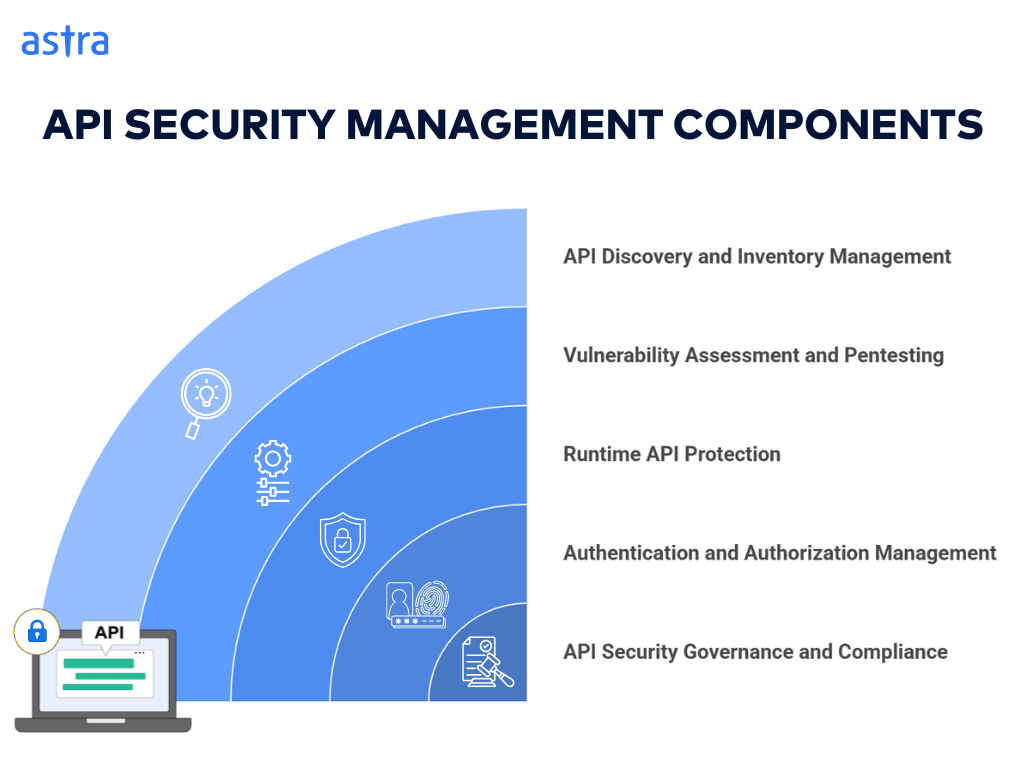
A robust API security management starts with API discovery and inventory management. Here, you maintain a living catalog of every API in your environment, tracking metadata such as API ownership, version information, dependency relationships, and data classification.
Moreover, you, along with your vendor, identify shadow APIs created outside formal processes and flag zombie APIs. This inventory ensures your security teams don’t stare bewildered at the face of compliance or worse, a breach.
Vulnerability assessment and offensive pentesting probe your APIs for weaknesses. These tools test for injection flaws, broken authentication, excessive data exposure, lack of resource limits, and other common API vulnerabilities. They examine both the API implementation and its configuration, checking for issues like weak encryption algorithms, permissive CORS policies, missing security headers, etc.
Runtime API protection analyzes API traffic as it flows through your infra and blocks malicious requests as they pop. Also, it detects and prevents automated attacks such as credential stuffing, identifies bot traffic that wish to scrape data, and stops injection attempts before they enter your backend systems. Machine learning models improve detection accuracy over time by learning your specific API usage patterns.
Authentication and authorization management involves implementing and enforcing standards like OAuth 2.0, validating JWT tokens, managing API keys securely, and enforcing the principle of least privilege. The component tracks which identities have access to which APIs and can automatically revoke access when it detects suspicious activity.
Last but not the least, you have API security governance and compliance that includes:
- Defining security standards based on frameworks such as OpenAPI Specification
- Ensuring APIs meet compliance requirements before deployment
- Generating audit reports that demonstrate your adherence to regulations
Build a robust defense with integrated security components that scale and help you shift-left.
What are the Common API Security Risks & Threats?
Understanding the specific threats targeting APIs helps you appreciate why dedicated security management matters. Here, we try to summarize the most critical API security risks organizations such as yours face today:
| Threat Type | Description | Impact |
|---|---|---|
| Broken Object Level Authorization | APIs fail to validate whether users should access specific objects or resources. Attackers change parameters (e.g., account IDs) to access unauthorized data. | Unauthorized access to user data, database records, financial information, and personal profiles |
| Authentication Vulnerabilities | Weak authentication mechanisms, improperly validated tokens, unencrypted credential transmission, or predictable API keys enable unauthorized access. | Account takeover, session hijacking, credential compromise, and impersonation attacks |
| Excessive Data Exposure | APIs return more information than necessary in responses, exposing sensitive fields not displayed in the interface. | Leakage of social security numbers, password hashes, financial data, and other sensitive information |
| Injection Flaws | Lack of input validation allows SQL injection, NoSQL injection, command injection, and LDAP injection attacks. | Data extraction, record modification, arbitrary code execution, and complete system compromise |
| Rate Limiting Failures | Missing or inadequate throttling enables API abuse at scale through automated attacks. | Brute force attacks, credential stuffing, large-scale data scraping, and service disruption |
| Security Misconfiguration | Unnecessary HTTP methods enabled, permissive CORS policies, missing security headers, verbose error messages, and excessive privileges. | System information disclosure, cross-origin attacks, and expanded attack surface |
| Insufficient Logging & Monitoring | Lack of comprehensive logging prevents attack detection, incident investigation, and compliance auditing. | Delayed breach detection, inability to track attacker activities, and compliance violations |
Identify vulnerabilities and pentest your entire tech stack before attackers exploit them. Start your API security audit today
Best Practices for Effective API Security Management
Though we have a separate piece where we discuss in detail the best practices to manage and scale your API security, below we summarise in pointers the major ones:

Firstly, start by implementing comprehensive API discovery as your foundation:
- Deploy automated discovery tools, including those created outside formal development processes
- Maintain an up-to-date inventory that tracks each API’s purpose, data sensitivity, ownership, and dependencies
- Make discovery an ongoing process since the rate of new APIs accelerates faster than you can supervise and control them via periodic checks and inventorization.
Secondly, adopt a security-first API design philosophy right from the inception:
- Incorporate security requirements into API specifications before writing any code.
- Use the OpenAPI Specification to document security schemes, required authentication methods, and expected behaviors.
- Conduct threat modeling sessions during the design phase. This proactive approach will cost you far less than retrofitting security into existing APIs.
Thirdly, implement strong authentication and authorization consistently across all APIs:
- Use modern standards like OAuth 2.0 for authorization rather than creating custom authentication schemes.
- Enforce the principle of least privilege, granting each API consumer only the minimum access and only when necessary.
- Validate authorization for every API request rather than assuming, and make sure initial authentication does not grant blanket access.
- Consider implementing fine-grained authorization that checks permissions at the object level.
Build comprehensive API security testing into your development pipeline:
- Automate security scans that run whenever developers commit code changes.
- Test for common vulnerabilities outlined in resources like the OWASP API Security Top 10. Conduct both static analysis of API code and dynamic testing against running APIs.
- Include testing for business logic flaws and not just technical vulnerabilities. Make sure test results are visible to your development teams so they can remediate quickly.

Establish robust input validation and output filtering:
- Validate all input parameters against strict schemas that define acceptable data types, formats, and ranges.
- Reject invalid input rather than trying to sanitize it.
- Implement output filtering to ensure API responses never expose sensitive data unless required.
- Apply the principle of least disclosure, returning only the specific fields on a use case basis.
Apply rate limiting and throttling to prevent abuse:
- Implement different rate limits for authenticated versus unauthenticated requests.
- Consider business logic when setting limits rather than applying blanket restrictions. For example, an API endpoint that processes payments might need stricter limits than one serving public product information.
Encrypt all API traffic using current TLS versions and maintain detailed API documentation:
- Disable older protocol versions with known vulnerabilities.
- Ensure APIs reject unencrypted connections rather than allowing fallback to HTTP.
- Validate SSL certificates properly in API clients to prevent MiTM attacks.
- For highly sensitive APIs, consider implementing mutual TLS where both client and server authenticate each other.
- Document required authentication methods, expected input formats, error codes, and rate limits.
- Keep documentation synchronized with API implementations
- Make security requirements explicit so that API consumers can understand how to use your APIs safely.
- Create an API security checklist, define roles and responsibilities for API security, and review APIs periodically to identify those no longer needed and need to be retired.
Need an API security vendor that does this all more without agitating your finance guys?
How to Choose an API Security Management Solution
Selecting the right API security management platform is not something you ask your intern to handle. It requires careful evaluation of your specific requirements via SMEs and the capabilities different solutions offer.
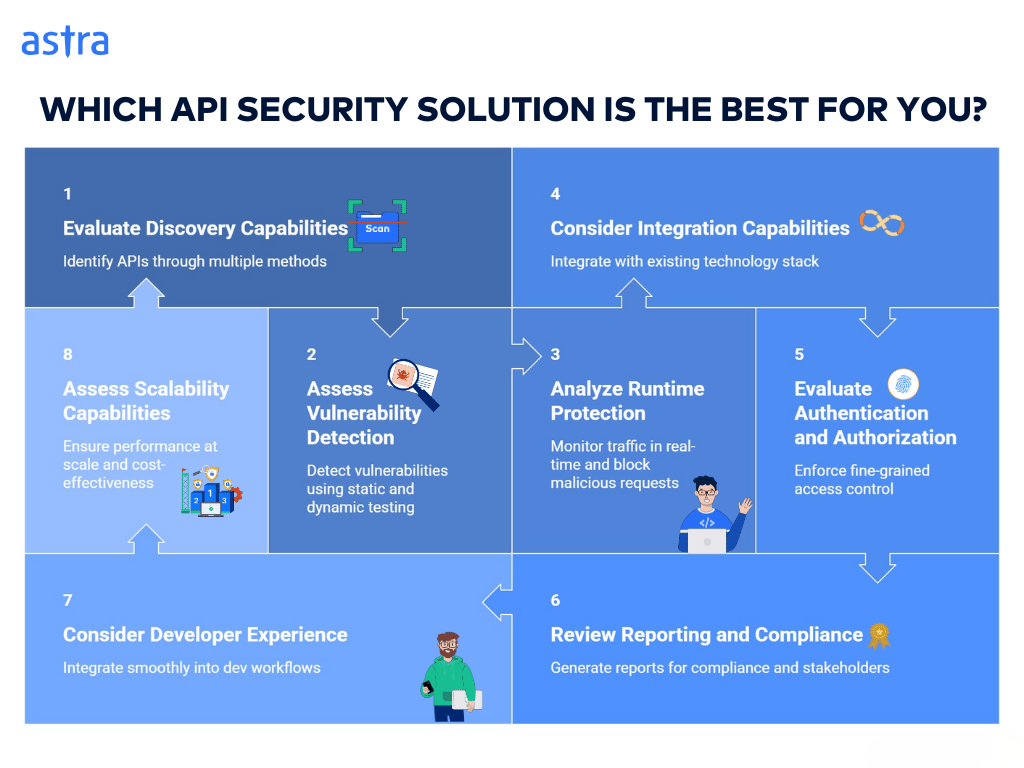
Begin by evaluating their discovery capabilities. Look for vendors that discover APIs through multiple methods, including traffic analysis, API gateway integration, code repository scanning, and cloud provider APIs. Assess how well their platform identifies shadow APIs and whether it can distinguish between internal, partner, and public APIs.
Examine the platform’s coverage of vulnerability detection. Start with the OWASP API Security Top 10, focusing on misconfigurations, weak authentication implementations, and business logic flaws, and ensure they perform both static code analysis and dynamic runtime testing. Also, evaluate how frequently they update vulnerability signatures to address new attack vectors.
Assess their runtime protection capabilities carefully. This involves analyzing API traffic in real time without excessive latency. ML-based behavioral analysis definitely counts for some brownie points as it expedites deviation processes. Moreover, evaluate whether the solution can actively block malicious requests or only alert, and their false positive rates.
Consider integration capabilities across your existing technology stack. The vendor should integrate with your API gateways, service meshes, web application firewalls, SIEM systems, etc. Check whether it supports the API types you use, including REST APIs, GraphQL, SOAP, and gRP, and covers both on-premises and cloud-based APIs.
Evaluate the platform’s approach to authentication and authorization. Look for native support for standards like OAuth 2.0, OpenID Connect, and SAML. Assess whether it can enforce fine-grained authorization policies and integrate with your identity providers.
Review reporting and compliance features. The platform should generate reports that demonstrate compliance with regulations relevant to your industry and geography. Look for customizable dashboards that display metrics meaningful to stakeholders ranging from developers to CXOs.
Consider the developer experience the platform provides. Solutions that integrate smoothly into dev workflows get adopted more readily than those that require significant process changes. Look for platforms that offer IDE plugins, CI/CD integrations, and developer-friendly APIs for automation.
Never eschew assessing their scalability capabilities. Evaluate performance at scale by examining how the solution performs when monitoring thousands of APIs that receive millions of requests. Check pricing models to ensure the costs are within your API estate expansion budget.
How Can Astra Security Help?
Our comprehensive cybersecurity solutions blend automation and manual expertise to run 15,000+ tests and compliance checks that ensure blanket safety, irrespective of the threat and attack location.
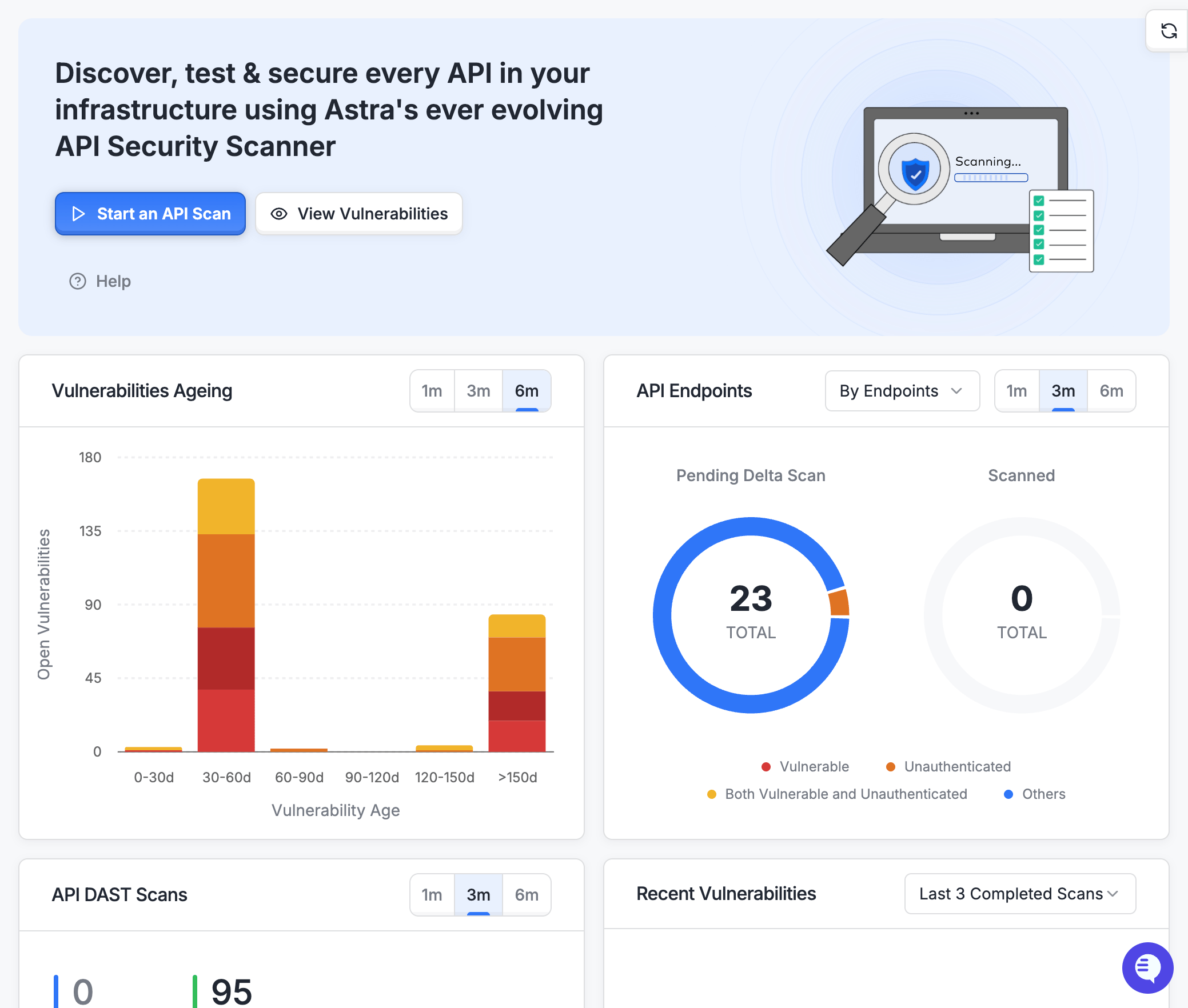
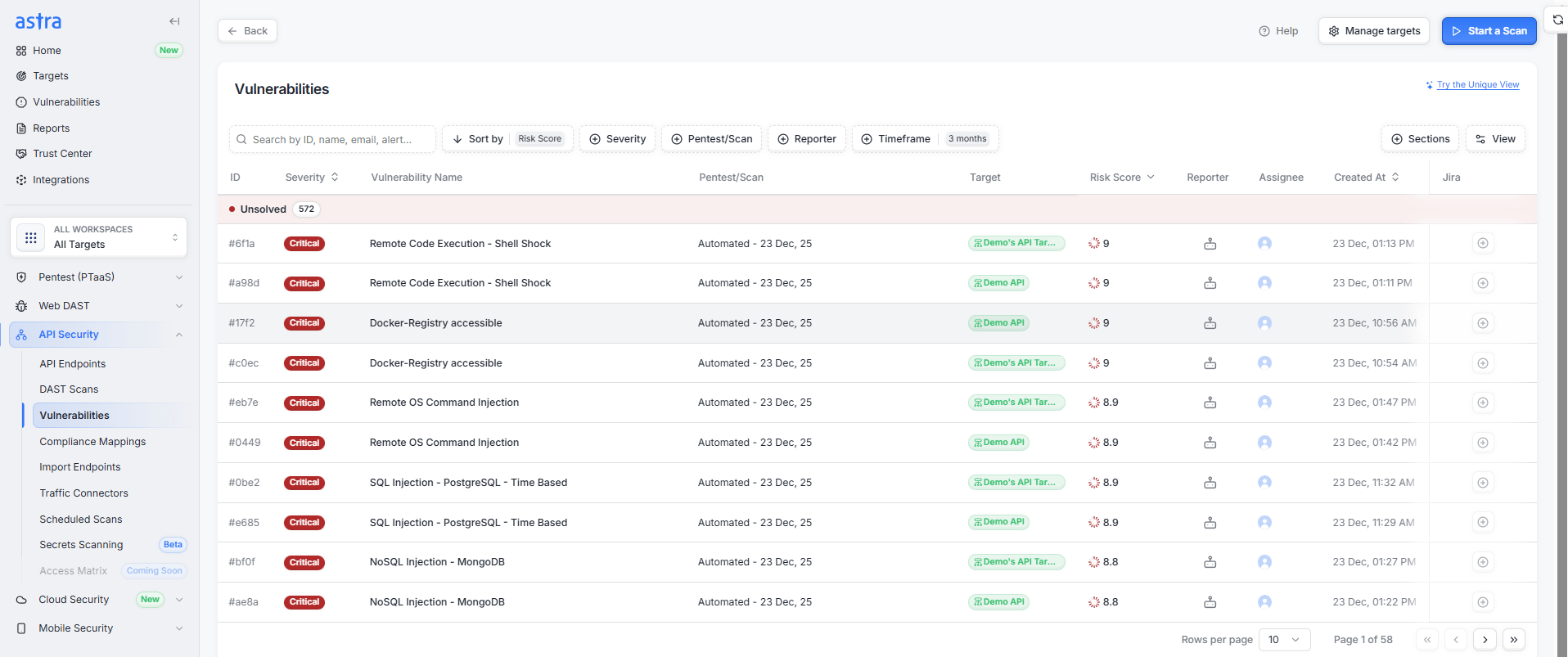
For APIs, Astra provides an end-to-end API security solution that combines automated scanning and manual penetration testing to protect against over 10,000 vulnerabilities, including the OWASP API Top 10 and business logic flaws.
Key capabilities
- Automatically detect all APIs (shadow, orphan, and zombie APIs) and maintain a comprehensive API inventory for complete visibility.
- Categorize APIs by sensitivity and exposure to help prioritize security efforts.
- Run deep, authenticated dynamic security tests to find misconfigurations, data leaks, and security loopholes.
- Expert-led penetration testing simulating real-world attacks to uncover business logic vulnerabilities.
- Ensure low-privilege users don’t have unintended access to sensitive APIs.
- Seamless integrate with AWS Traffic Mirroring, Kubernetes, GCP Packet Mirroring, Azure, Apigee, NGINX, and more for real-time scanning.
- Automates security testing within CI/CD pipelines to shift API security left with continuous, incremental security scans
- Provides actionable remediation steps directly within development workflows with developer-friendly fixes.
Why Astra Security?
- Detects and helps fix vulnerabilities, not just identify them.
- Combines API discovery, testing, and pentesting in a single workflow.
- Works without disrupting engineering workflows.
- Certified Security professionals with various certifications & CVEs [OSCP, CEH, eJPT, eWPTXv2, and CCSP (AWS)]
As a testament to our vision, we’ve been recognized as a rising star and leader for vulnerability scanning and penetration testing by G2, been accelerated at Techstars in Berlin, awarded the Most Innovative Security Company by Prime Minister Narendra Modi at GCCS’17, and offered a grant under the French Government’s Tech Ticket program by President François Hollande.
Final Thoughts
As APIs become the primary way applications communicate and share data, securing them effectively determines whether you safely embrace digital transformation or expose yourself to devastating breaches.
Implementing effective API security management requires commitment. Developers need to embrace security-first design principles. Security teams need specialized tools that provide visibility, control, and leadership to categorize API security as a strategic priority worthy of appropriate investment.
The journey begins with understanding your current API landscape, assessing your security posture against recognized frameworks such as the OWASP API Security Top 10. The identified gaps are then systematically addressed through improved processes, enhanced tooling, and greater security awareness.
Remember that as your API portfolio grows and evolves, your security practices too must adapt accordingly, rendering vigilance and continuous improvement indispensable. The question thus is how quickly you can implement API Security Management effectively.
We hope that, through the practices, tools, and structures outlined in this guide, you can build an API security program that protects your organization without compromising the innovation that APIs enable.
FAQs
What is API security management, and how is it different from API management?
API security management focuses exclusively on protecting APIs from threats through vulnerability scanning, attack detection, and security policy enforcement. While API management handles API creation, deployment, performance monitoring, and developer experience aspects like caching and analytics.
What are the common API security risks addressed by API security management?
API security management addresses broken object-level authorization, weak authentication mechanisms, and excessive data exposure. Moreover, it protects against injection vulnerabilities and security misconfigurations, such as a lack of rate limiting, which enables abuse, and insufficient logging.
What features should I look for in an API security management tool?
Look for a tool that excels at automated API discovery, identifying all endpoints, including shadow and zombie APIs, offering comprehensive vulnerability scanning covering OWASP API Security Top 10, and runtime traffic monitoring.
Other essential features include:
– Integration with your development tools
– Authentication enforcement
– Automated CI/CD testing
– Compliance reporting and remediation guidance.
– Shift-left security
How does API security management discover and secure shadow or undocumented APIs?
API security management platforms discover shadow APIs through passive traffic analysis, network flow monitoring, API gateway log analysis, cloud-provider API integration, and code repository scanning. Once discovered, these platforms assess shadow APIs for vulnerabilities and missing security controls, create inventory entries and alert security teams, and apply documented security policies to prevent exploitation.
Recommended Reading:
- Astra API Security Solution
- What is API Security?
- API Management Security Best Practices
- What is API Security testing?
- OWASP Top 10 API 2023 Vulnerabilities
- 7 Top API Penetration Testing Tools in 2026
- DAST vs SAST Comparison
- The Ultimate 2026 API Security Checklist
- The Top API Security Risks and How To Mitigate Them
- What is Broken Object Level Authorization (BOLA)?
- Top API Security Vendors List (Updated)
- What is Shift Left Security? (Guide)
- Mobile App API Security: A Complete Guide
- What are Shadow APIs? (Explained)
- Top 5 API Security Challenges and How to Overcome Them
- How to Build a Solid API Security Strategy for 2026?
- What are Zombie APIs (Complete Guide)
- Top 7 API Security Trends to Know in 2026
- Guide to API Security Maturity Model
- How to Protect Your APIs for Healthcare Industry?
- API Security Pricing: Complete Cost Guide for 2026
- Why is Fintech API Security Important in 2026
- How to Secure Your APIs Against These Vectors?
- What is the Difference Between API Security and Application Security?
- What is API Security Management?