
Key Takeaways:
- APIs are the primary gateway for attackers, exposing sensitive data and business logic that traditional tools cannot see.
- Security scanning misses API-specific risks as it can’t detect hidden logic flaws, under-tested endpoints, or undocumented integrations.
- ModernAPI security attack vectors, such as BOLA, mass assignment, and business logic abuse, are increasingly common and often evade surface-level defenses.
- Adequate protection demands a shift to logic-aware, context-driven testing that covers all endpoints, authentication flows, and edge cases.
- Relying on outdated web app security approaches leaves APIs and your core systems vulnerable to attack.
APIs run the show today. Whether it’s a mobile app fetching user data, a SaaS platform integrating with Stripe, or a microservice coordinating with ten others, APIs are the glue and the backbone. This is something that attackers are notoriously aware of.
The challenge? Most security tooling still operates on a page-view and form-based model. It can’t view the business logic of API calls, like knowing who is supposed to do what on what object and in what context. As teams move more endpoints at a faster pace than ever before, a large portion of those endpoints remain under-tested or unseen by traditional scans.
That’s where the real risk creeps in. API security attack vectors, including BOLA and mass assignment, are now commonplace strategies, rather than isolated examples of breaches. In 2026, when you are building, testing, or securing APIs, you want to know precisely how these threats unfold rather than letting somebody execute them to discover them.
Run automated and manual API Pentests to uncover every hidden vulnerability.
What Are API Security Attack Vectors?
API security attack vectors refer to the various methods and vulnerabilities that attackers use to exploit APIs and gain unauthorized access, manipulate data, or disrupt services. These vectors commonly target flaws in authentication, authorization, input validation, and business logic unique to API-based systems.
Attackers exploit these weaknesses to:
- Bypass access controls and gain unauthorized access.
- Steal or manipulate sensitive data exposed through the API.
- Abuse business workflows for privilege escalation or fraud.
- Exploit poorly tested, undocumented, or shadow endpoints.
- Circumvent rate limits and perform automated attacks.
Detecting and defending against these vectors requires logic-aware, context-driven security testing beyond traditional scanning.

Why Astra is the best in API Pentesting?
- We’re the only company that combines artificial intelligence & manual pentest to create a one-of-a-kind pentest platform.
- Runs 120+ test cases based on industrial standards.
- Integrates with your CI/CD tools to help you establish DevSecOps.
- A dynamic vulnerability management dashboard to manage, monitor, and assess APIs your web app consumes.
- Conduct 2 rescans in 60 days to verify patches.
- Award publicly verifiable pentest certificates which you can share with your users.
- Helps you stay compliant with SOC2, ISO27001, PCI-DSS, HIPAA, etc.
- Trusted by the brands you trust like Agora, Spicejet, Muthoot, Dream11, etc.

Why Are APIs a Prime Target?
APIs are a prime target because they expose direct access to backend data, workflows, and business logic, often without the same level of security scrutiny as frontend apps. Their complexity and rapid deployment make them easier to exploit, harder to secure.
Attackers exploit APIs as the fastest way into the heart of your system, and they know where to look. Here’s why they focus their energy on APIs:
- They expose internal logic and data structures. Unlike a frontend, APIs often reveal object IDs, actions, and relationships: the exact context attackers need.
- They grow fast and sprawl faster. New endpoints get added with every sprint. Security reviews often can’t keep up.
- They’re under-tested by default. Many scanners still treat APIs like web pages, missing logic flaws entirely.
- They integrate everywhere. From mobile apps to third-party services, one overlooked integration can significantly expand your reach.
- They’re full of edge cases. Rate limits, token refresh flows, undocumented parameters: it’s a playground for anyone willing to probe.
What are the Most Common API Security Attack Vectors?
| Attack Vector | How It Works | Real-World Risk | How to Prevent It |
|---|---|---|---|
| BOLA / IDOR (Broken Object Level Authorization) | Attacker modifies object IDs to access unauthorized data (e.g., user IDs, order IDs). | Exposes personal or financial data by skipping ownership checks. | Enforce object-level access control on every request. Never trust client-side identifiers. |
| Mass Assignment | API accepts extra fields in requests, allowing privilege escalation or data tampering. | Attackers modify sensitive fields, such as isAdmin, during signup or updates. | Allow list updatable fields and validate payloads on the server side. |
| Excessive Data Exposure | The API returns full objects; the frontend filters the data, but the backend still exposes sensitive fields. | Sensitive info (e.g., password hashes, internal notes) leaked in responses. | Minimize response data. Use serializers or DTOs to control exposure. |
| Broken Authentication | Flaws in token validation or session handling enable impersonation, replay, or escalation. | Token reuse, JWT tampering, or weak token rotation is exploited for account takeover. | Use strong token signing, rotate tokens, and bind sessions to context. |
| Rate Limiting Bypass / DoS | Attackers flood endpoints or bypass throttling to overwhelm APIs or exhaust resources. | Resource exhaustion or service unavailability from scripted abuse. | Implement per-IP and per-user rate limiting; monitor for usage anomalies. |
| Injection Attacks | User input gets injected into the database, OS, or command functions. Includes SQLi, NoSQLi, etc. | API endpoints are the points of access to data theft or system hacking. | Sanitize inputs, use parameterized queries, and apply input validation to prevent SQL injection attacks. |
| Insecure API Keys & Tokens | Secrets are exposed in code, stored insecurely, or transmitted without encryption. | Attackers discover credentials in public repos or logs. | Rotate secrets, avoid hardcoding, and use environment variables with secure storage. |
| Business Logic Abuse | Manipulates workflows (e.g., order flows, pricing logic) to gain unfair access or disrupt systems. | Attackers exploit loopholes in the intended flow (e.g., skipping payment steps). | Define and test expected workflows: threat model edge cases and abuse paths. |
| Lack of Schema Validation | The API accepts malformed or unexpected data that can lead to backend misbehavior or bypasses. | Attackers submit extra or nested fields to bypass filters or trigger errors. | Enforce strict schema validation (e.g., OpenAPI, GraphQL) on every request. |
| SSRF via API Parameters | API fetches user-provided URLs or resources without restricting target destinations. | Internal IPs, metadata endpoints, or cloud services get exposed. | Block internal IP ranges, validate user-provided URLs, and use allowlists. |
What Makes API Security Different (and Harder)?
APIs’ security is completely different from web application security. Old scanners and security software were written to support pages and forms, not logic-based data highways with many edge cases.
Here’s where API security throws the curveballs:
- There’s no UI to guide a scanner: APIs don’t have buttons or visual flows. So crawlers can’t “click through” your app to discover hidden functionality. If an endpoint isn’t documented, it’s often invisible to traditional tools.
- Authentication gets complicated: session handling, refresh tokens, JWTs, OAuth – every API has its authentication dance. Miss a step, and you’re either locked out or testing anonymously.
- APIs are logic-first, not UI-first: Most web vulnerabilities are input/output-based. API vulnerabilities often stem from logic abuse, such as updating someone else’s address or skipping a checkout step. These don’t show up in a scanner that only looks for cross-site scripting.
- REST, GraphQL, gRPC, each with quirks: GraphQL can expose entire schemas by default. gRPC isn’t easily human-readable. And REST? It depends on how well your devs follow conventions (spoiler: they often don’t).
- Test coverage is challenging to prove: You can’t just say, “We scanned the app.” You need to prove that you have covered every method, every permission path, and every edge case.

Testing for API Security Attack Vectors: A Modern Approach
1. Automated API Discovery
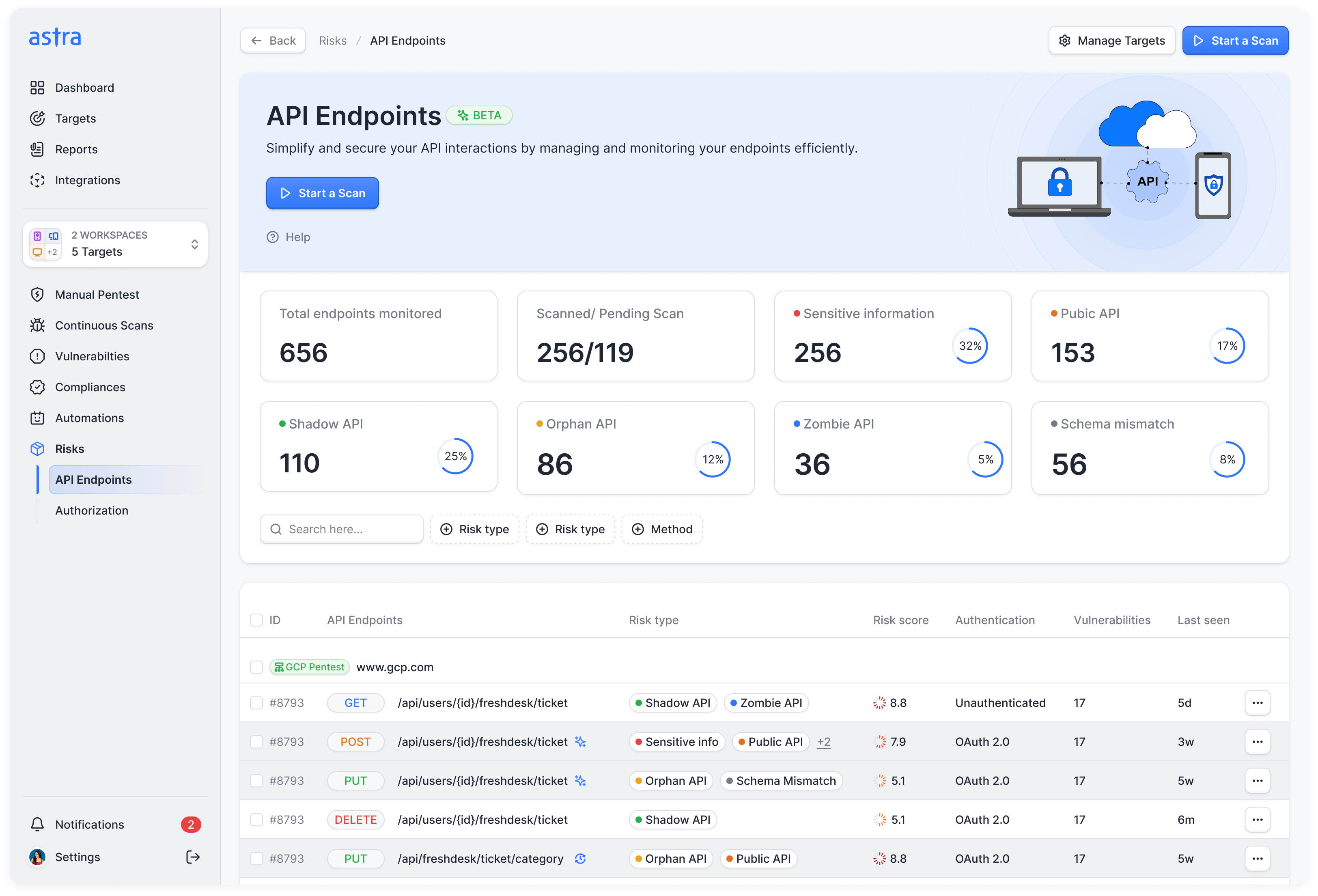
You can’t test something if its existence is unknown. Tools should chart all endpoints, including shadow APIs, versioned paths, and edge-case methods such as PATCH, PUT, or DELETE. Bonus points if it picks up undocumented routes and internal-only APIs.
2. Auth-Aware Testing
Session tokens, OAuth flows, refresh cycles: this is where most scanners give up. Real API security testing maintains auth context, handles re-authentication mid-session, and tests endpoints as a real user would, not just anonymously.
3. Dynamic Testing + Fuzzing
Once you’ve mapped your endpoints, it’s time to push them. That means injecting malformed payloads, flipped booleans, unexpected field types, anything that can expose how your logic behaves under pressure. Fuzzing here isn’t random; it’s schema-aware and flow-aware.
4. Schema-Based Testing
OpenAPI, Postman collections, GraphQL schemas – your API docs aren’t just for developers anymore. Security tools should parse these specifications to enforce strict input validation, identify overly permissive parameters, and detect mismatches between what is allowed and what works.
Checklist: How to Secure Your APIs Against These Vectors
1. Authorization & Access Control
- Enforce object-level authorization on every endpoint.
- Apply role-based access control consistently across APIs.
- Prevent privilege escalation via Mass Assignment or missing field filters.
2. Input & Payload Validation
- Enforce strict schema validation using OpenAPI/GraphQL schemas.
- Reject extra or unexpected fields in request payloads.
- Use serializers or DTOs to control what gets returned in response.
3. Authentication & Token Handling
- Use strongly signed JWTs.
- Rotate, expire, and invalidate tokens correctly (especially on logout).
- Bind tokens to user context (IP, device, etc.) where feasible.
4. Rate Limiting & Abuse Detection
- Apply per-user and per-IP rate limits on critical endpoints.
- Throttle or block excessive calls to sensitive methods (/login, /reset, etc.).
- Monitor for abuse patterns (e.g., repeated ID enumeration, bursty traffic).
5. Secrets & Configuration
- Never hardcode API keys or secrets in client-side code.
- Store credentials in secure vaults or environment variables.
- Validate and restrict URLs fetched by your APIs to prevent SSRF.
6. Business Logic & Workflow Testing
- Test for unexpected flows (e.g., ordering without payment, skipping steps).
- Validate state transitions: does the app behave the same under unusual sequences?
- Include red team or adversarial testing in your release cycle.
How Can Astra Help You Detect and Prevent API Attacks?
Key Features:
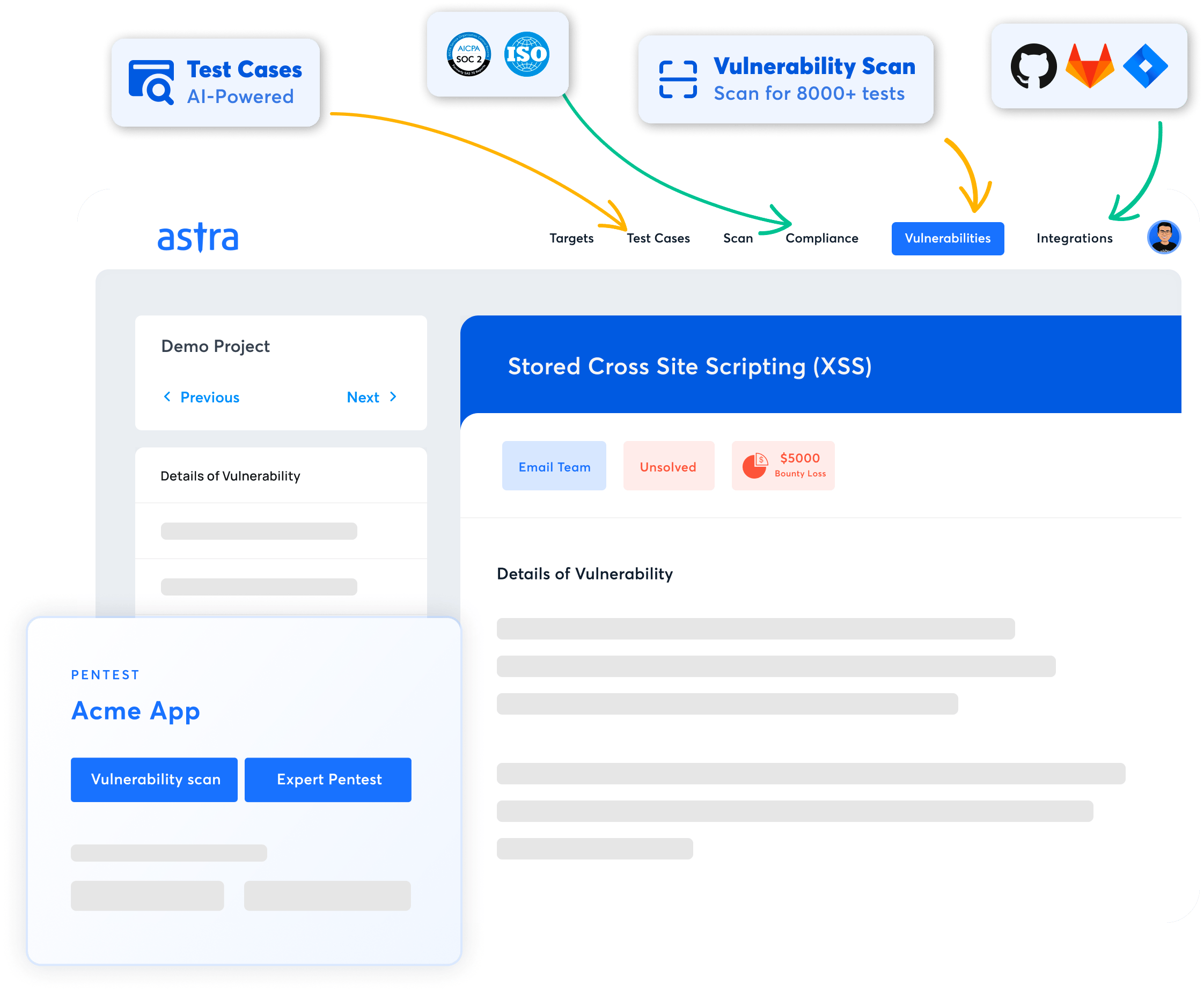
- Continuous scanning with 20+ API DAST scans/month, going up to 1000+ scans/yr.
- Discover active, dormant, and undocumented API endpoints in under 30 minutes with runtime traffic analysis
- Modern DAST scanner built for APIs with authenticated scans
- 15,000+ DAST test cases, including OWASP API Top 10, BOLA, and IDOR
- Capture live API traffic with connectors for AWS, GCP, Nginx, and Azure for continuous observability, handling more than 15 million requests/month.
- AI-powered logic testing to catch real-world risks beyond spec violations
- Validated, expert-reviewed vulnerability reports delivered within 1.5 days
Astra’s API Security platform combines live traffic intelligence with API-native scanning to discover zombie and shadow APIs that never made it to documentation, utilizing runtime traffic capture to map undocumented endpoints and usage patterns, reflecting how your APIs behave in production.
This allows teams to identify PII and secret leaks across REST, GraphQL, and mobile APIs, while deep integrations with Postman and Burp ensure the security inventory remains accurate as endpoints evolve.
Vulnerabilities are triaged and validated by experts, producing audit-ready reports. Meanwhile, automated, focused rescans expedite verification, enabling engineering to close the loop with an average MMTR of under 44 days. Lastly, our authenticated API DAST, AI logic testing to catch real-world misuse, broad protocol support, and compliance evidence for SOC2, GDPR, ISO, and PCI, we help you test like an attacker and ship with confidence.
Final Thoughts
API security is a moving goal post that requires context, accuracy, and interpretation. Since APIs are the de facto way of connecting systems, teams, and users, they are becoming the most common attack surface and are frequently overlooked in conventional security approaches.
API risks don’t always announce themselves. You won’t catch a BOLA or a business logic flaw with a surface-level scan. These are quiet, context-based vulnerabilities that hide behind “working as expected” behaviors, until someone abuses them.
Securing APIs today means moving beyond reactive tooling. It means shifting from perimeter checks to logic-aware testing. It means recognizing that a perfectly functional API can still leak sensitive data, allow privilege escalation, or buckle under misuse, all without triggering a red flag in your dashboard.
Astra Pentest is built by the team of experts that helped secure Microsoft, Adobe, Facebook, and Buffer
FAQs
1. What are the most common API security attack vectors?
The most common API security attack vectors include BOLA/IDOR, mass assignment, broken authentication, excessive data exposure, rate limiting bypasses, and business logic flaws. These often stem from insecure design and lack of access control rather than technical bugs alone.
2. Can traditional DAST tools detect API-specific threats?
Traditional DAST tools often miss API-specific threats, such as logic flaws or authentication bypasses, because they treat APIs like web applications, focusing on URLs rather than data flow or request structure. API-aware tools with auth and schema support offer far better coverage.
3. How can I test my API without disrupting production?
Test against staging environments that mirror production, with real authentication flows and traffic patterns. Use API-specific testing tools that support context-aware scans and non-destructive payloads to simulate attacks without impacting performance or data integrity.
4. What’s the difference between API testing and web app testing?
API testing focuses on how data and logic are exposed through endpoints, often without UI, making business logic and auth flaws harder to catch. Web app testing targets browser-accessible flows. APIs demand deeper, context-rich, request-level testing to be effective.