Shift left was the right idea for the wrong decade. It was engineered for a world where exploitable vulnerabilities could be detected as taintable data flowing through source code, and the person writing the diff author understood the control flow.
Neither is true anymore, so a shift-left strategy can’t address the security issues causing breaches in 2026.
The original pitch was “Move controls upstream.” That meant SAST in the IDE running incremental analysis on save, SCA resolving the transitive dependency graph at PR-open, and pre-commit hooks running entropy-based secret detection.
Simply put, each control was pinned to the earliest point in the SDLC where finding vulnerabilities was cheapest to remediate. IBM’s Cost of a Data Breach data pegged development-phase remediation at 15x to 100x cheaper than production-phase. The economics were unarguable on paper.
At some point, we kept moving controls further left and assumed we would eventually catch most of the security problems that mattered. That was the real failure.
Putting SAST in the IDE was never the mistake, but believing it could carry the entire security strategy against modern threats was.
From what I see, two things broke it: the tooling category’s structural limits on what it can detect, & operational cost of running it at modern code volumes.
Limitations of shift-left
The entire shift-left security philosophy is dominated by three engines:
- Pattern-based SAST (e.g., Semgrep, SonarQube)
- Semantic SAST with data-flow analysis
- Lockfile-driven SCA (e.g Snyk, Dependabot, OSV-Scanner).
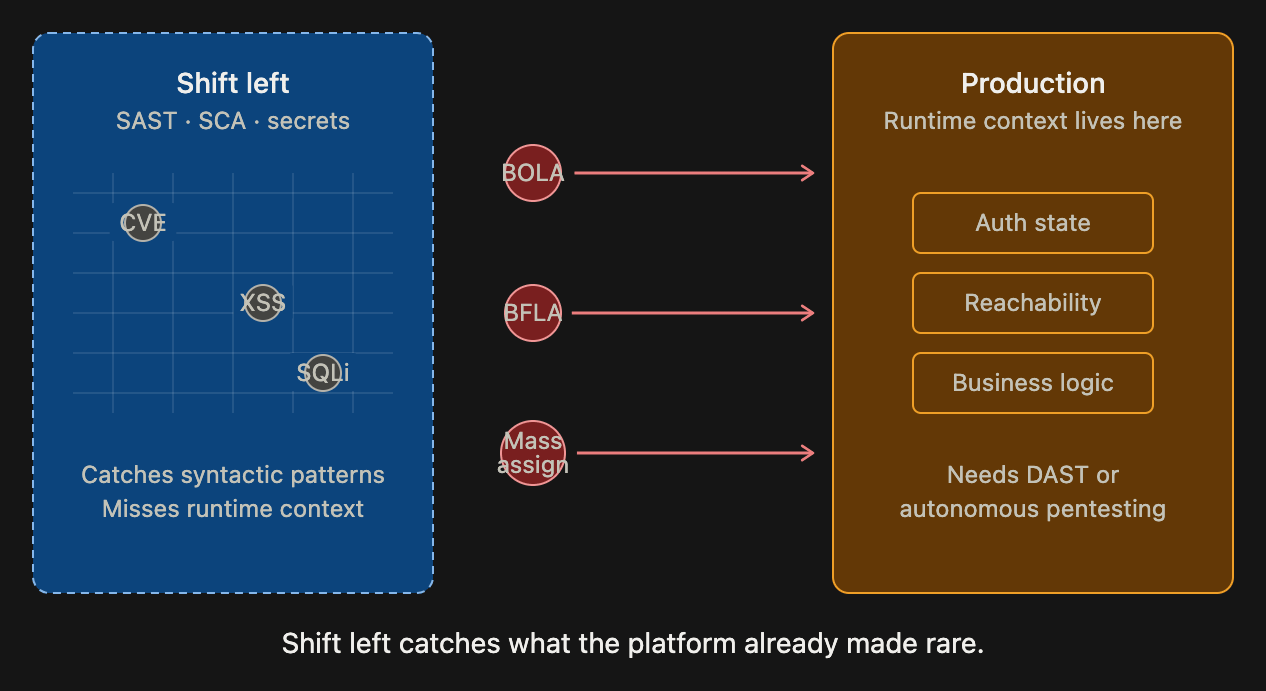
Each engine I mentioned above operates on source code as an AST, a control-flow graph, or a dependency manifest without executing the application. What the tool flags as critical at PR-open is often not critical once deployed, because reachability, authentication state, runtime configuration, feature flags, and network topology all live outside the analysis boundary.
Over-investing in shift-left means overlooking supply-chain risks, runtime misconfigurations, and business-logic vulnerabilities. Every vulnerability class has a detection stage, and shift left covers only one.
For example, let’s take its coverage of the OWASP API Top 10.
The OWASP API Top 10 makes this concrete. API1 BOLA requires two authenticated identities and a cross-context object reference to detect, and only at runtime. A vulnerable BOLA handler has no taint source because the taint source is another user’s identity, and identity is not a syntactic property. Only modern AI-powered DAST, autonomous pentesting, or a skilled human pentester can flag it.
I didn’t pick BOLA as an edge case to prove a point. Studies show more than 40% of confirmed API-layer breaches happen due to authorization failures like BOLA and BFLA.
The class shift left is architected around (SQL injection sinks resolvable through taint tracking, XSS sinks reachable from unsanitized DOM sources, dependency versions matching CVE ranges) is the class that ORM parameter binding, framework auto-escaping, and lockfile hygiene already suppress at the platform layer. Shift left catches the vulnerabilities the platform layer already made structurally rare, and misses the ones that dominate every breach postmortem.
Where Shift Left Failed?
The architectural constraint alone would be enough. Even inside the narrow class of issues static tools can theoretically catch, modern code volumes turn the pipeline into noise.
Here are the four I see most often.
1. Signal degradation
A modern Node.js service with 800+ transitively resolved packages generates dozens of SCA findings per PR, on top of the pattern-based SAST rulepack. Devs dismiss five to ten findings per merge as reflex. The pipeline trains users to ignore it, and the false-positive rate doesn’t need to be high for this to happen.
2. Findings without decisioning context
A CodeQL taint flow does not know whether the sink is reachable from an unauthenticated endpoint, whether the handler sits behind an internal-only feature flag, or whether the deployment topology puts the service behind a WAF that already filters the primitive.
Devs reconstruct that context manually every time, or they reject the finding. Either way, the tool has shifted the analysis cost from itself to the human.
3. AI-authored and short-lived code
The developer receiving the IDE squiggle is increasingly the developer who accepted 300 lines of Cursor output with two keystrokes and has no mental model of the control flow. Ephemeral preview environments, throwaway branches, and generated boilerplate compound this.
4. Delivery friction that gets routed around
Rigid PR-blocking gates cause context-switching and slow merges. The predictable response is workarounds: exception tickets, .semgrepignore sprawl, auto-approved suppressions, “we will fix in the next sprint” bypasses. The gate stays green on the dashboard while the control quietly stops firing.
So what’s the fix?
I would demote shift left, not abandon it. It’s still useful scaffolding. So I’d keep a lean layer of SAST, SCA, and secret scanning. These controls still catch a low-cost, high-frequency subset of issues (hardcoded credentials, CVE-matched lockfile entries, the pattern-matchable sinks), and dropping them would be overcorrecting.
What I’d change is the allocation. I play it by the 80/20 rule: 20% of the effort and budget goes to that lean static layer, and 80% goes to runtime verification through DAST, autonomous pentesting, or both.
Both categories solve the architectural and operational failures that shift left couldn’t. They execute against the running application, so reachability, auth state, and deployment topology are inside the analysis boundary instead of outside it. And from what I see, modern platforms in both categories are built to serve teams of every size and maturity.
Take our offerings at Astra, for example. Our autonomous pentesting platform ships an AI-assisted fix feature that reads the finding and the surrounding code, then applies the patch directly. That closes the loop for the developer who accepted 300 lines of generated code and has no mental model of the handler.
We’ve also fought false positives harder than most vendors in the market, because I’ve seen what noise does to a pipeline. Our DAST runs on a zero-false-positive policy vetted by security experts, and our autonomous pentesting platform will meet a similar standard in the coming quarters.
Many DAST and autonomous pentesting platforms, including ours, also ship secret scanning. So with one of them in place, you’re mostly covered. If your environment is complex or you want extra peace of mind, I’d add SAST on top.
I have nothing against another safety net.
To put it simply, the frame I’d build around is shift-everywhere plus verify-at-runtime. For a deep, defensible security posture, I’d run every layer together. But for most teams shipping product against a real deadline, DAST or autonomous pentesting alone will catch more real, exploitable risk than the entire shift-left stack combined.