Key Takeaways
- SP-API Guard grades your AWS configuration against the DPP; a pentest finds out what an attacker could do with the whole environment.
- Anything above or outside of AWS (i.e. app logic, APIs, Azure, Atlas, etc.) is completely invisible to Guard.
- Run Guard first so the pentest hours are spent on the auth flaws and attack chains rather than a public bucket.
- Astra fills the gap with human pentesters, an Autonomous Pentest facility and a retest that culminates in a signed report and a security certificate which is then displayed on your bespoke trust centre.
Sooner or later someone on the team is going to say it: we’ve run Guard, so the pentest is all covered, right? That’s a perfectly reasonable assumption, just utterly misleading. Both are governed by Amazon’s Data Protection Policy (DPP); both produce a report, and both reports end up in the hands of the same assessor.
The issue is really what questions are they answering? Guard checks your AWS config against the DPP. Conversely, a pentest is about whether an attacker could actually get to Amazon data via your app, your APIs, or the cloud behind them. Amazon asks for the pentest separately.
This post covers what Guard does, where it stops, and how you can use it alongside a pentest without doing the same work twice or having your engineers/security people go Ragnarok.
What is SP-API Guard
SP-API Guard is a serverless application you deploy into your AWS account. It runs scan rules built on AWS security services against your AWS data and returns a findings report after 24 hours. Each finding comes with a risk type, severity, DPP policy reference and a suggested fix.
The report sits in a read-only S3 bucket, and you decide whether Amazon sees it. Per Amazon, it runs on least privilege and doesn’t collect or share data about the specific tools in your environment or your proprietary information.
Guard is a wrapper around the existing AWS services, so its depth is the depth of those services. The checks you get will vary depending on your deployment.
- Macie looks for unencrypted PII in S3 only.
- GuardDuty raises threat signals from account activity logs. It’s detective, so it says nothing about whether your app is exploitable.
- IAM Access Analyzer flags roles shared outside your account.
- Inspector finds package vulnerabilities and network exposure on EC2, from configuration and version data.
- AWS Config tracks resource configuration against rules, so it flags drift but sees nothing beyond configuration.
- AWS Security Hub collects findings from other AWS services in one place, which adds visibility and no extra testing depth.
The 24-hour return also means each report is a dated snapshot. That’s useful as evidence of what happened, but it shouldn’t be read as continuous monitoring.
Amazon positions Guard as a self-service way of assessing and maintaining your DPP compliance. Check whether your own assessment request treats it as required.
What is a Pentest?
A pentest is an authorized attempt to find and exploit vulnerabilities in the systems that hold Amazon’s data (web apps, APIs, cloud config, networks, databases and file storage). Amazon’s Vulnerability Management guidance requires one at least every 365 days and the use of an industry-recognised methodology (OWASP WSTG, PTES or NIST SP 800-115).
It also calls for a second test following remediation to confirm that the fixes have in fact been applied, and a report with a ‘recommended actions’ section. That’s the sequence that distinguishes a pentest from a scan with a slightly more attractive cover page.
What SP-API Guard Can’t See?
Amazon don’t publish a complete list of Guard’s limits. They’re all derived from what the underlying services do, so you’ll need to check them against the deployment guide for your particular setup.
| Gap | Why Guard misses it | What a pentest does |
|---|---|---|
| App logic | Nothing in the stack reasons about your code | Tests trust boundaries, like an endpoint that accepts a seller ID the client sends |
| APIs | Authorization, mass assignment & excess data exposure sit above the layer Guard reads | Works the OWASP API Top 10 with real tokens across tenants |
| Attack chains | Each service sees its own finding in isolation | Follows an SSRF to instance metadata to role credentials to a bucket |
| SP-API tokens | LWA credentials and seller refresh tokens live in your app and data store | Checks where they’re stored, how they’re encrypted and whether tenant A can reach tenant B’s |
| Non-AWS stacks | Guard scans AWS data only | Covers Azure, MongoDB Atlas (open network access lists, user privileges) and Cloudflare when in scope |
Say Guard flags an S3 bucket containing unencrypted PII. That’s a good catch, easy to fix and precisely what it’s for.
Now say your order API returns another seller’s order when someone changes the ID in the request. Guard isn’t designed to find that. It’s an object-level authorization flaw, the sort of thing that tops the OWASP API Security Top 10, and it takes someone testing the API with a real account and a curious mind. Both problems matter to an assessor. Only one needs a pentest.
Use Both
Run Guard first. The pentest hours are the expensive part, and they shouldn’t be spent rediscovering a public bucket that Guard would have found in a day.
- Run Guard and close the easy findings. Keep the tickets and note the report date.
- Give the output to your testers. It saves them time on your AWS layout. Scope the test to name the web app, APIs, cloud configuration, databases, object storage, and network boundaries, as Amazon’s guidance lists them.
- Point the pentest at what Guard can’t reach: authorisation, API abuse, chained paths, token handling, non-AWS systems.
- Remediate, then retest. Amazon will expect a second test and has 7-day and 30-day fix windows for critical and high findings, respectively.
Pro tip: Guard doesn’t replace the 30-day scans, the change-triggered scans or the pre-release code scans.
SP-API Guard vs. Pentesting: A Detailed Look
| SP-API Guard | Penetration test | |
|---|---|---|
| Question it answers | How does our AWS setup compare to the DPP? | Can an attacker reach Amazon data through our systems? |
| Scope | AWS data, using AWS security service rules | Network, cloud, web apps, APIs, databases, file and object storage |
| Method | Automated scans, policy-mapped findings | Manual and automated testing, controlled exploitation |
| Misses | App logic, APIs, exploitability, non-AWS | AWS drift between tests |
| Human judgment | Limited | Central: context, chaining, business logic |
| Non-AWS systems | Outside its model | Covered when authorised and in scope |
| Output | Findings with severity, policy reference and fixes, after 24 hours | Report with methodology, scope, findings, evidence, recommended actions and retest |
| Cadence | After deployment and AWS changes | Every 365 days, plus retest at least per the DPP requirements |
| Amazon’s position | A self-service assessment and remediation aid | Required every 365 days |
How Astra can Help
Guard is a very good first read on AWS. Astra picks up where Guard leaves off: it’s an Autonomous Pentest with human pentesters doing the hands-on work, complete with an engagement letter, report, retest, and signed executive summary.
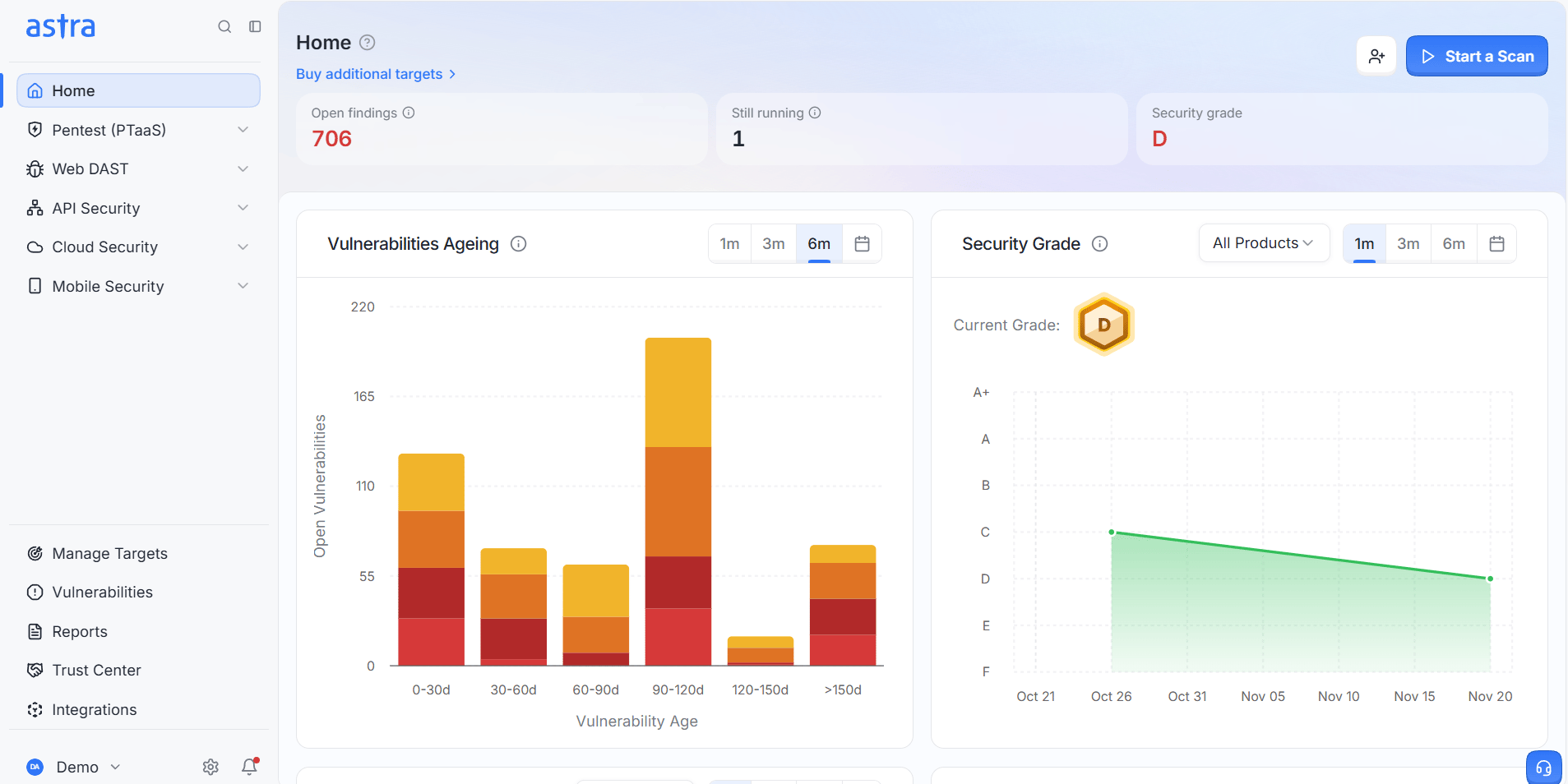
It also includes authenticated DAST scans for the 30-day, after-change, and pre-release cycles, plus a Cloud Scanner if you’re going beyond AWS.
Note: Amazon calls the shots on that, and neither tool guarantees you’ll get approved. Talk to Astra, have a look at our SP-API pentest page or pick up the DPP checklist and templates.
Final Thoughts
Guard and a pentest are frequently mentioned as alternatives, and the confusion is entirely understandable. They’re really just two different tools for the same job. One will give you a very quick, cheap read on your AWS config. The other will actually test whether your systems can withstand someone trying to break in.
Teams that do it well use Guard to clear the easy issues early on so the pentest budget can be applied to the things only a human can find. Amazon’s policy update has broadened pentest and scanning expectations to include APIs, which makes getting that split right even more important.
FAQs
Is SP-API Guard a penetration test?
No. Guard is an automated check of your AWS environment against the DPP and returns findings with fix recommendations. A pentest is an authorised attempt to exploit weaknesses across a much wider scope (apps, APIs, databases, etc.) carried out by people who can think about the context.
Does Amazon require SP-API Guard?
Amazon positions Guard as a self-service way of assessing and maintaining your DPP compliance, so check that your own assessment request treats it as such. Separately, the vulnerability management rules require 30-day scans, an annual pentest, pre-release code scans and fix deadlines, and Guard doesn’t take the place of any of that.
Does Guard replace a pentest?
No. Guard scans the AWS data against the DPP-aligned rules. The Amazon pentest requirement is much broader, covering web apps, APIs, cloud, databases, object storage, and network infrastructure with a retest after fixes. You can use the Guard findings to drive your remediation, but don’t expect the report to be a substitute for a pentest.
Can Guard test Azure or MongoDB Atlas?
No. Guard is built for AWS and will only look at AWS data. Azure, MongoDB Atlas, Cloudflare, and the like are all out of scope. A pentest would cover those if they’re in scope and you have authorisation to do so, which is why it’s so important for so many organisations who have a mix of cloud and SaaS.
How often should I run Guard?
Amazon describes Guard as a means of continuous assessment and management of security, with no prescribed schedule in the implementation guidance. A sensible cadence would be after the first deployment and then again after any significant AWS change. You need to keep every report, ticket and fix with the dates on them so that you have the history if and when you need it.