Amazon’s SP-API pentest review is one of the strictest in compliance, and even a small paperwork mistake can get your report rejected. Every rejection leaves your compliance posture in limbo while you resubmit.
The difficulty further increased when Amazon revised its Data Protection Policy (DPP) on 25 August 2026 to make APIs a mandatory standalone scope item. So now a report that passed last year can be flagged even when pentesting found nothing new.
This guide explains who needs a pentest, what the clause requires, and why reports get flagged. It also covers how to choose a vendor who treats the DPP as what it is at heart: an evidence specification.
TLDR;
- Amazon’s assessors reject SP-API pentest reports on documentation failures far more than on testing quality.
- Scope statements that say “Web App” only, missing retest confirmations, unnamed methodologies, and undated cover pages account for almost every first-round rejection.
- Scope must cover all four DPP categories in one engagement: network, cloud infrastructure, APIs as a distinct category, and application, including databases and storage.
- The 25 August 2026 revision made APIs mandatory as a standalone scope item.
- SP-API Guard is useful but does not satisfy the pentest clause. It is a runtime API-layer check, not a scoped, methodology-named, retested report.
Who actually has to comply
The DPP splits obligations into two sections. Section 1 applies to every SP-API developer. Section 2 applies the moment your system deals with PII. Most teams underestimate how quickly that happens: a buyer’s shipping address is PII, an order report is PII, a customer email passed through a tax integration is PII.
If you hold any of the Restricted SP-API roles, you are inside Section 2 by default. There is no ambiguity. Amazon audits these roles directly, and the Amazon SP-API pentest is one of the first artifacts they ask for.
| Developer type | Section 1 | Section 2 (PII) | Amazon pentest required |
| Public developer, no PII | ✓ | No | |
| Public developer with PII access | ✓ | ✓ | Yes |
| Restricted SP-API role holder | ✓ | ✓ | Yes |
| Private developer, own seller only | ✓ | No (recommended) |
Private developers who only access their own seller account technically fall outside Section 2. That stops being true the moment you onboard another seller or resell the integration.
The pentest clause in plain English
The pentest clause sits in Section 2 of the DPP and runs about half a page of legal prose. Strip out the formal language, and it collapses into five technical requirements, each tied to a specific artifact Amazon’s assessors look for in the submitted report.
Test at least once every 365 days
The clock starts based on the close date of the previous engagement. Many confuse that with the calendar year. For example, if your last pentest was done on November 10, 2025, the next one is due no later than November 10, 2026.
Amazon’s assessors calculate the window from the final-report date on the cover page, which is why engagements that lack a clearly dated cover, or that date only the kickoff rather than the close, create disputes during review.
The 365-day window resets on the retest confirmation date. If the original test closed November 10, 2026, and the retest closed December 5, 2026, your next engagement is due by December 5, 2027.
Tracking the right date is a surprisingly common bookkeeping failure that causes teams to schedule the following year’s test a few weeks early for no reason, or late, which costs them their compliance posture until the engagement closes.
Use an industry-recognized methodology
Amazon accepts three popular pentest methodologies, i.e OWASP WSTG, PTES, and NIST SP 800-115 (Technical Guide to Information Security Testing and Assessment, September 2008 revision).
The report must name the methodology and version. “Based on OWASP” is not enough, because the assessor has no way to verify which test categories were actually covered without a version anchor.
Mixing methodologies is allowed, as long as each finding is anchored to one of them. The methodology statement in the executive summary should name all methodologies used and the version of each.
Cover four scope categories
Amazon expects everyone to cover network, cloud infrastructure, APIs, and application databases and storage. All four scopes should be mentioned explicitly in the scope statement on page one.
Moreover, Amazon expects specific evidence for each category; for example, for network, they expect coverage of external and internal network segments, firewall rule review, etc
And since the August 25, 2026 revision, APIs are a standalone category and must be documented separately from the web-application tests.
Include a recommended-actions section
Every finding must include a recommended action next to it. A findings list on its own, even if well documented, usually gets sent back for remediation guidance. The reviewer reads this section to check that the tester prioritized the findings and that there is a real path to fixing them.
Critical findings have to be remediated within 7 days of discovery, and High within 30. The recommended-actions section is where the SLA clock starts, so the dates on it matter.
Retest after remediation
The retest is mandatory, and the retest confirmation has to live inside the same report Amazon reads. A separate “retest letter” filed elsewhere is treated as missing, even when it exists and even when the Amazon reviewer is told where to find it.
Cadence Amazon expects around the pentest
The pentest is one artifact in a continuous program. The DPP asks for scans and reviews on a tighter cadence.
| Activity | Frequency |
| Vulnerability scans | Every 30 days |
| Change-triggered scans | After any material infrastructure or code change |
| Code scans | Before every production release |
| Critical fix SLA | 7 days from discovery |
| High fix SLA | 30 days from discovery |
A yearly Amazon pentest without continuous scanning in between does not meet the DPP. This is where most teams shift to DAST plus a scheduled pentest rather than treating the annual engagement as the whole program.
What changed on August 25, 2026
- APIs are now explicitly listed as a distinct scope category.
- A WAF is required in front of any endpoint that receives or returns PII.
- Credentials and SP-API refresh tokens should always be encrypted at rest and in transit, with the encryption scheme documented.
- A named security incident contact is mandatory.
- If your most recent pentest report predates August 25 and does not cover APIs as a distinct scope category, assume it will be flagged.
Why reports get flagged (from real engagements)
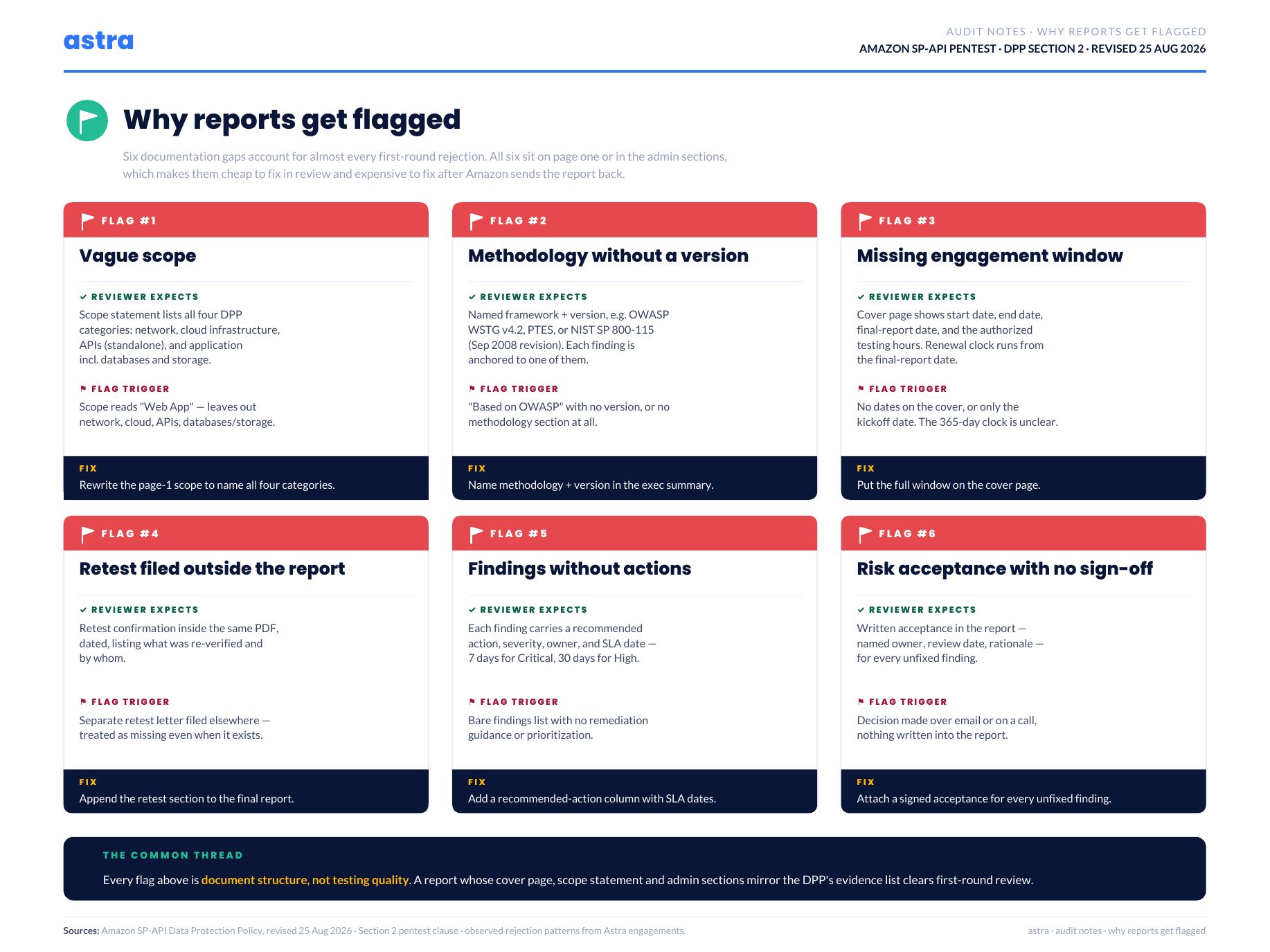
When an assessor opens your report, they are looking for proof that each DPP requirement was met, and they look for it in specific places. Most of the rejections we see come from the same few documentation gaps, and nearly all of them sit on the first page or in the admin sections, which makes them easy to fix before you submit.
- Vague scope: Reviewers want clear confirmation that the assessment covered your specific SP-API endpoints. A scope line that just says “Web App” is the classic example, and it leaves out network, cloud infrastructure, APIs, and databases/storage.
- Incomplete methodology: The report names a framework like OWASP, PTES, or OSSTMM but gives no version, or skips the methodology entirely. Without a version, the assessor can’t check which test categories were covered.
- Missing engagement window: The cover page has no start and end dates, and ideally no authorized testing hours either. The report looks unfinished, and nobody can work out your 365-day renewal date, since Amazon counts from the final-report date.
- Retest handled outside the report: Amazon wants one closed record of the engagement, so anything filed elsewhere counts as missing.
- Findings without recommended actions: A findings list with nothing beside each item usually comes back for remediation guidance. Reviewers use that section to see that findings were prioritized and that the 7-day (Critical) and 30-day (High) fix dates are clear.
- Risk-accepted findings with no sign-off: You can leave a finding unfixed, but the report needs a written acceptance statement from your side, with a named owner and a review date. A decision made over email or on a call doesn’t count.
SP-API Guard is not a pentest
Amazon’s SP-API Guard checks runtime behavior against DPP policy at the API layer. It is useful, and we recommend it, but it does not replace the Amazon pentest, because usually it won’t cover network, cloud, databases, or storage, and it does not produce a methodology-named, retested, scoped report. If you are relying on SP-API Guard alone to meet the pentest clause, Amazon will ask for the report
How to pick a vendor for SP-API engagement?
Picking the right pentest vendor for an SP-API engagement is less about who runs the sharpest exploits and more about who understands the DPP as an evidence specification.
The seven questions below surface that distinction before you sign the engagement letter.
- Does the engagement letter state all four scope categories: network, cloud, APIs, and databases/storage?
- Is the retest included in the quote, or billed separately?
- Who will sign the executive summary, a pentester or the firm?
- Does the report explicitly mention the methodology (OWASP WSTG, PTES, or NIST SP 800-115)?
- What is the timeline from kickoff to final report plus retest?
- Does the vendor also provide the 30-day continuous scanning the DPP requires?
- Who tests the environment: in-house pentesters or contractors you cannot meet?
How Astra helps
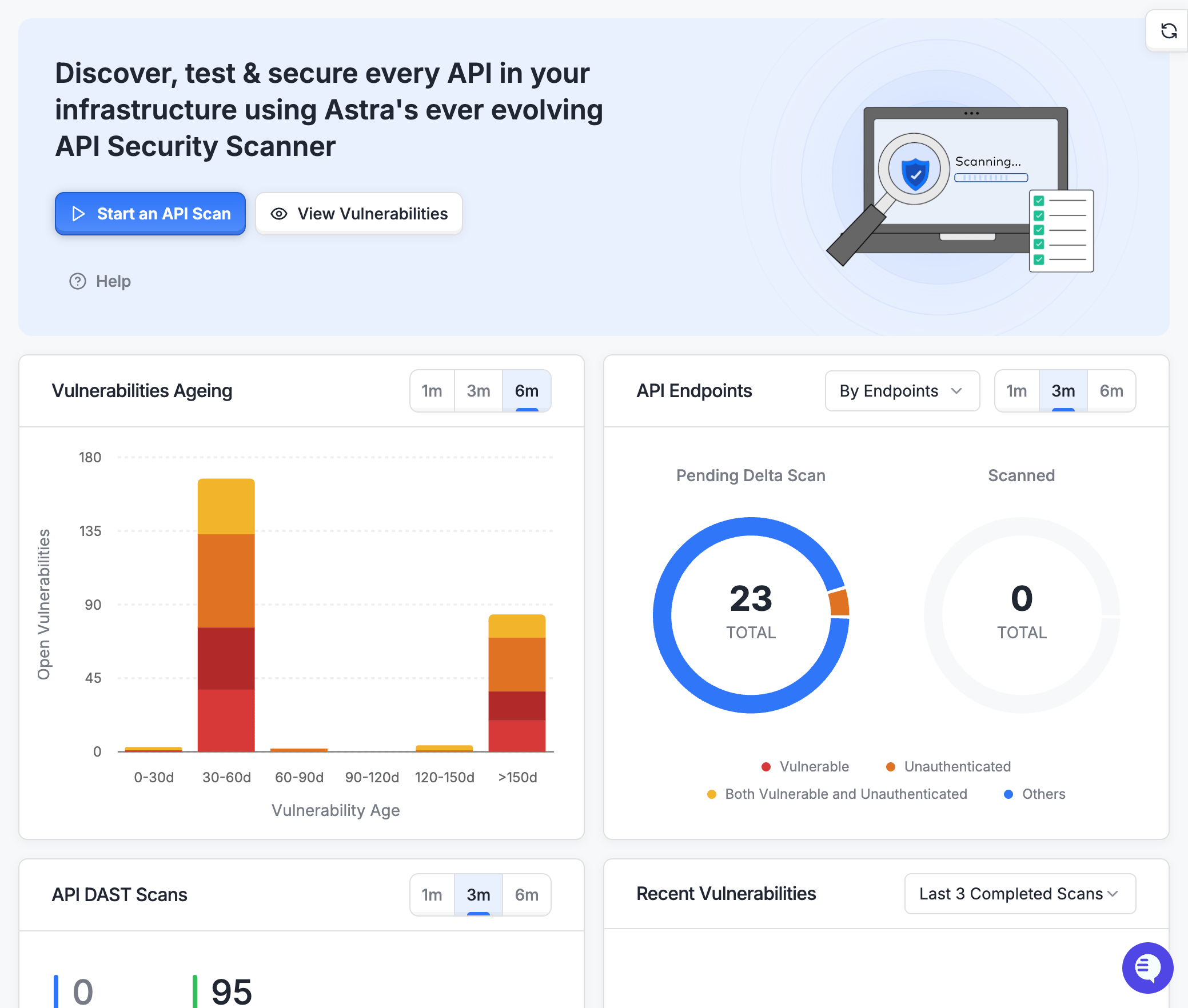
At Astra, we offer Manual PTaaS, Continuous DAST, and a Cloud Scanner, and each one supports a different part of what the DPP asks for in an SP-API submission.
Our Manual PTaaS runs the 365-day pentest against an industry-recognized methodology, which in our case is OWASP WSTG, PTES, or NIST SP 800-115. The report maps scope to the four DPP categories (network, cloud infrastructure, application including databases and storage, and the API layer) and includes fix verification before it ships to you.
The 25 August 2026 revision expanded scanning and pentest requirements to explicitly include APIs, which means submissions scoped only to the web application may not satisfy the requirement. Our Continuous DAST runs on CI/CD across web and API layers and covers the 30-day scan cadence and change-triggered scans the DPP asks for under 2.7.1.
The Cloud Scanner produces configuration evidence for the cloud controls in scope, including encryption at rest, TLS in transit, IAM and MFA coverage, and WAF presence in front of internet-facing endpoints.
For more on how these three pieces come together for an SP-API submission, contact us.
Final Thoughts
Amazon SP-API pentest compliance requires more than an annual security assessment. Organizations must demonstrate comprehensive security coverage across network infrastructure, cloud environments, APIs, applications, databases, and storage.
The August 25, 2026 DPP revision makes standalone API security testing mandatory, increasing the importance of clearly documented scope, recognized testing methodologies, remediation evidence, and retest validation.
To maintain compliance, organizations should integrate annual penetration testing with continuous vulnerability scanning, change-triggered assessments, and timely remediation.
FAQS
Does a vendor’s report guarantee approval?
Amazon decides whether an application meets its requirements through its own security-assessment process. A complete, accurate evidence pack compiled via the Amazon SP-API DPP checklist supports that process and makes questions easier to answer, but no vendor can promise approval, and anyone who does is overselling what a report can do.
How often do I need a pentest?
Pentests need to be done annually, using an industry-recognized methodology such as OWASP WSTG, PTES, or NIST SP 800-115, while vulnerability scans are done at least every 30 days, and again after significant network, application, or infrastructure changes. Code scans before each release sit alongside both
Does the pentest need to cover APIs?
Yes, the August 25, 2026 policy update extended pentest and scanning requirements to APIs, so a report scoped before that date may no longer be enough. Name your APIs in the scope, and state that testing followed the OWASP API Security Top 10, so nobody has to ask.
Do I need a retest?
Yes. Amazon expects a proper retest to confirm that identified vulnerabilities were actually fixed post-remediation, whereby critical findings are due within 7 days and high within 30, so plan the retest around those clocks and keep the results, with dates, alongside the original report and remediation tickets.
Are these templates official Amazon forms?
No. They are working formats, built around what assessors commonly ask to see, and a pentest lead should review them before use. Amazon doesn’t issue a standard report form, so follow any instructions in your own assessment request first, and treat these as a starting point.
Does every SP-API app need a pentest?
No. Only apps that fall under DPP Section 2, covering any public developer handling PII or any developer holding a Restricted SP-API role, need one. Section 1-only apps and private developers testing only their own seller account are exempt by default.
How often does Amazon require a pentest?
Every 365 days from the close date of the previous engagement, not the calendar year. A retest after remediation is mandatory and must be documented inside the same report. Missing the window invalidates your compliance posture until the next test closes.
Does Amazon approve pentest vendors?
No. Amazon does not maintain an approved-vendor list for SP-API pentests. The vendor you choose must use an industry-recognized methodology such as OWASP WSTG, PTES, or NIST SP 800-115, and the report must name that methodology explicitly. Amazon or its assessor reviews it.
Is SP-API Guard enough to meet the pentest clause?
No. SP-API Guard is a runtime API-layer policy check. It does not cover network, cloud infrastructure, databases, or storage, and it does not produce a methodology-named, scoped, retested report. Amazon will still ask for the pentest report regardless of your Guard deployment.
Do I send the pentest report to Amazon directly?
You submit evidence through the SP-API compliance workflow when Amazon requests it, or directly to the assessor Amazon designates for your account. The pentest report is the primary artifact reviewed, alongside your scan cadence evidence and remediation records.
Do APIs have to be in scope?
Yes. Since the August 25, 2026 DPP revision, APIs are explicitly listed as a distinct scope category alongside network, cloud infrastructure, and application, including databases and storage. Reports that fold APIs into the “web application” scope get flagged in review and returned for resubmission.