Security leaders at key financial institutions in Singapore now have a new line in their compliance calendars: AI-assisted red teaming, a requirement MAS introduced on 1 July 2026. What appears to be a scoping exercise actually asks a harder question, i. e., how does a bank differentiate between another convincing report and one that secures the institution?
Simply put, “AI-assisted red teaming” is a phrase a team can satisfy in an afternoon: a vulnerability scanner with an LLM wrapped around the output, generating a report that reads like analysis. It’s also a phrase a different team can spend months turning into a genuinely adversarial capability, one that reasons about a target the way an attacker would.
Effectively, the MAS AI red teaming mandate itself reflects a real capability shift, and moving this fast is the right instinct, but the rift sitting underneath it is a market problem: the category is too young for the industry to have agreed on what separates the two yet, and until it does, both versions clear the same bar.
Key Takeaways
- MAS mandates AI-assisted red teaming for critical systems as of July 2026, but lacks a shared technical standard for genuine vs. superficial compliance.
- Most “AI-powered” security tools rewrite scanner output into prose rather than perform real adversarial reasoning across chained attack paths.
- Genuine red teaming requires maintaining state across the attack surface to identify multi-step vulnerabilities that isolated scanners miss.
- An evidentiary standard showing the AI’s reasoning chain would separate real capability from compliance theater.
So, before we dissect the implications, let’s understand what led us to this article.
What MAS actually did, across three moves
November 2025. MAS opens consultation on MAS AI Risk Management Guidelines (AIRM):
- How financial institutions should govern the AI they build, use, or procure;
- Board oversight, AI inventories, risk materiality assessments, lifecycle controls.
- Consultation closes 31 January 2026.
April 2026. Issues MAS April 2026 cyber advisory calling on financial institutions to strengthen cyber defenses and accelerate the adoption of AI in secure coding, vulnerability detection, and security testing, as frontier models compress the time between vulnerability discovery and exploitation.
1 July 2026. MAS introduces a new requirement for key financial institutions to conduct AI-assisted red teaming on critical internet-facing systems, to identify attack paths that could let attackers disrupt critical services or reach sensitive customer data.
28 July 2026. The Managing Director publicly confirms the July requirement and announces the ABS AI-Driven Cyber and Tech Risk Taskforce (ACT), alongside further supervisory expectations from MAS on vulnerability management, still to come, covering threat management, pre-deployment testing, and recovery of critical systems.
4 moves across nine months, all connected to the same threat. Much like the sides of the same coin, AIRM governs the AI a bank deploys, its inventory, oversight, and lifecycle, while the April advisory and the July mandate defend against the AI an attacker deploys against that same bank.
2 documents, 2 threats in mind, and yet the same infrastructure sits beneath both: the fraud model AIRM governs is also what an AI-directed attacker will try to manipulate.
More importantly, which framework actually owns testing that overlap is still an open question (possibly for the MAS ABS AI taskforce or ACT taskforce to answer), and reasonably so, since MAS itself has flagged that more supervisory expectations are still coming.
Why Singapore’s move is worth watching
Singapore isn’t the only jurisdiction responding to this. The UK’s Bank of England, FCA, and HM Treasury issued a joint statement in May 2026 warning that frontier AI can rapidly identify and facilitate exploitation of vulnerabilities, and asked firms to remediate faster, more frequently, and at scale, including through automation.
EU moved further: in June and July 2026, the European Systemic Risk Board warned that frontier models can craft weaponized exploits “in a matter of minutes or hours,” calling it a paradigm shift with systemic consequences for the EU financial system.
Days later, the ECB’s Supervisory Board wrote directly to the CEOs of every significant institution it supervises, demanding cyber action plans by 31 October 2026, and pushed back its own annual IT risk questionnaire to make room for the work, effectively leaning on its existing machinery: DORA, TIBER-EU, and the supervisory letter.
Conversely, Singapore, rather than reinforcing existing expectations like the UK or routing the response through existing supervisory letters like the EU, named a specific method, MAS AI red teaming requirement, attached a date to it, and paired it with a task force built for what no single institution can solve alone, which, in our opinion, is also the most operationally well-defined move.
Why the pattern feels familiar
If we are being honest, we have had the ultimate solutions to security problems proposed before, whether that was “AI governance” three years ago (which covered everything from a genuine model risk framework to a policy PDF that sat unread on a shared drive) or “zero trust” that went from an identity-first rebuild to a marketing refresh on an existing VPN.
High-value compliance language, when it’s new enough to lack a shared technical bar, gets satisfied at whatever point clears the audit, simply because behavior is driven by what incentives reward, or in this case, the audit clearance.
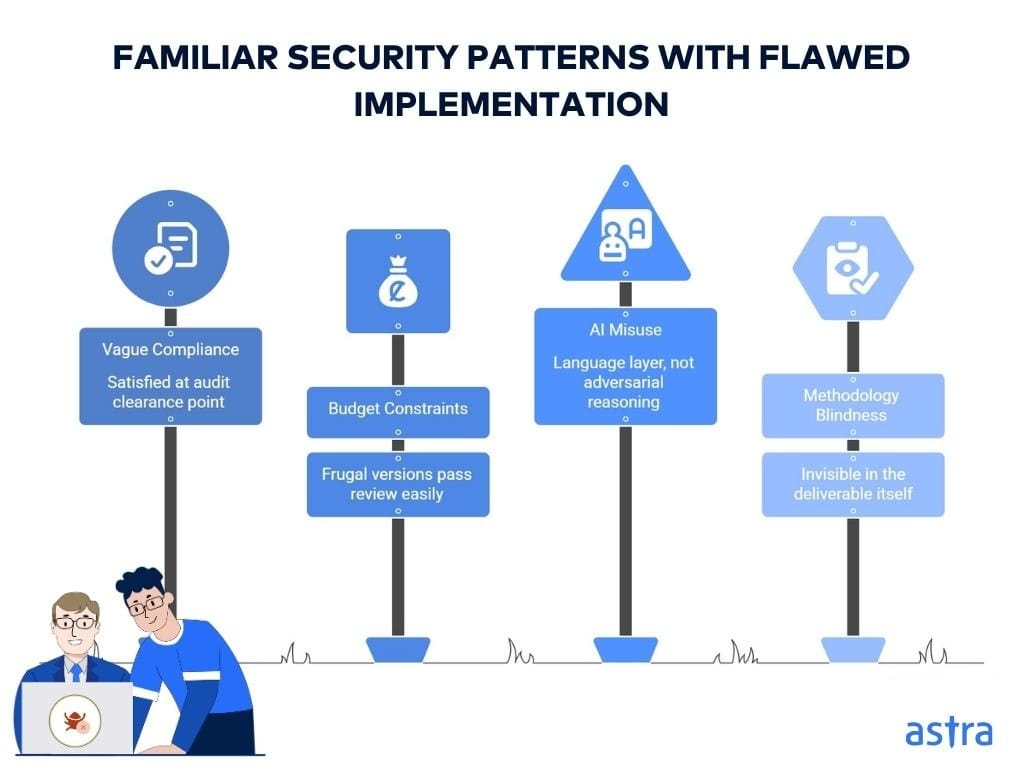
A security team under budget pressure will rarely volunteer for the expensive version of a requirement when a more frugal version passes review just as cleanly. In fact, it’s already how most “AI-powered” security tooling on the market works today:
- point a model at a list of endpoints
- run the same scanners the team already owns
- have the model rewrite the raw scanner output into a paragraph of confident, analyst-sounding prose about attack paths and risk scores.
So the setup summarizes rather than implements adversarial reasoning; i.e., the model never forms a hypothesis about the target or tests whether one weak finding connects to another, or verifies anything. It’s a language layer sitting on top of the same DAST or SAST output that’s been sitting in the backlog for years, now formatted to look like it came from something smarter.
To an auditor working from the report alone, that output can look identical to one from a system doing genuine adversarial reasoning about the target. The difference lives entirely in the methodology, invisible in the deliverable itself, aka the part a compliance review is weakest at evaluating.
What the real version would actually require
Genuine MAS AI red teaming needs something a scanner-plus-summary pipeline structurally lacks: the ability to hold state across an entire attack surface and reason across findings the way an experienced tester does when they’re chaining a path together.
A concrete example any pentester will recognize:
- Finding A: an endpoint leaks an internal account ID in a public response. Low severity alone, nobody escalates it.
- Finding B: an admin action checks that a user is logged in, but never verifies if they have admin rights or own the submitted account ID. Unremarkable in isolation.
- Scored independently, neither finding clears a “critical” threshold.
- Chained: a standard user takes the leaked account ID from Finding A and submits it into Finding B, instantly gaining unauthorized admin control, the exact multi-step path a real attacker hunts for, but basic scanners miss.
Navigating this would require maintaining state across a target’s entire attack surface and distinguishing a finding a scanner would flag in its laundry list from a finding that constitutes real business risk, even though both produce a PDF labeled “AI-assisted red teaming.”
The fork this creates in AI red teaming for FI vendor selection includes:
| Teams extending real offensive security maturity | Teams treating this as a new checklist item | |
|---|---|---|
| Action | Layer AI tooling onto existing adversarial practice | Adopt the fastest tool that produces an acceptable report |
| Outcome | Genuine capability uplift against AI-directed attackers | Compliance status changes; resilience stays where it was |
| What the evidence file shows | A convincing report | A convincing report |
What would close the gap?
We believe the fix is an evidentiary standard, rather than more prescriptive rules about which tools to use, since tool-specific rules go stale within a year given how fast the underlying models move.
Institutions should be able to show, alongside the report, the reasoning chain the AI system used to arrive at its conclusion, i.e., what it tried, what it ruled out, and why, all ideally reproducible by a second party.
That converts “we ran an AI tool” into “here’s a chain of adversarial reasoning you can check.” Faking a plausible chain of reasoning about a real target takes almost as much work as doing the real testing, which is exactly why it’s a stronger bar, and exactly why it’s a fair one to ask of everyone in this market, ourselves included.
What to look for, if you’re the one signing off on this
For a CISO or technology risk officer picking up Singapore banks’ AI red teaming mandate implementation…beyond what is simply documented, here’s the checklist worth holding any vendor to, us included:
- Does the testing maintain state across your full attack surface, or does it run isolated, stateless checks per endpoint? Chained attack paths are the whole point; isolated checks miss them by design.
- Does it distinguish exploitable from theoretical, and can it prove it? A report full of unverified findings becomes noise your team has to triage manually, which defeats the speed argument entirely.
- Is it continuous, or does it produce a point-in-time snapshot with a new engagement fee attached? A single AI-assisted pass repeats the exact failure mode this requirement exists to fix, just faster.
- Does a human ever see the finding before you do? An agent that discovers a vulnerability and an agent that validates it should be two different things, not the same process marking its own homework.
- Can the output feed straight into remediation, or does it stop at a PDF? Speed of discovery only matters if speed of fixing keeps pace with it.
This is close to the standard our own Astra Autonomous Pentesting platform was built against, with armies of AI agents mapping an application, building a threat model from it, and testing continuously.
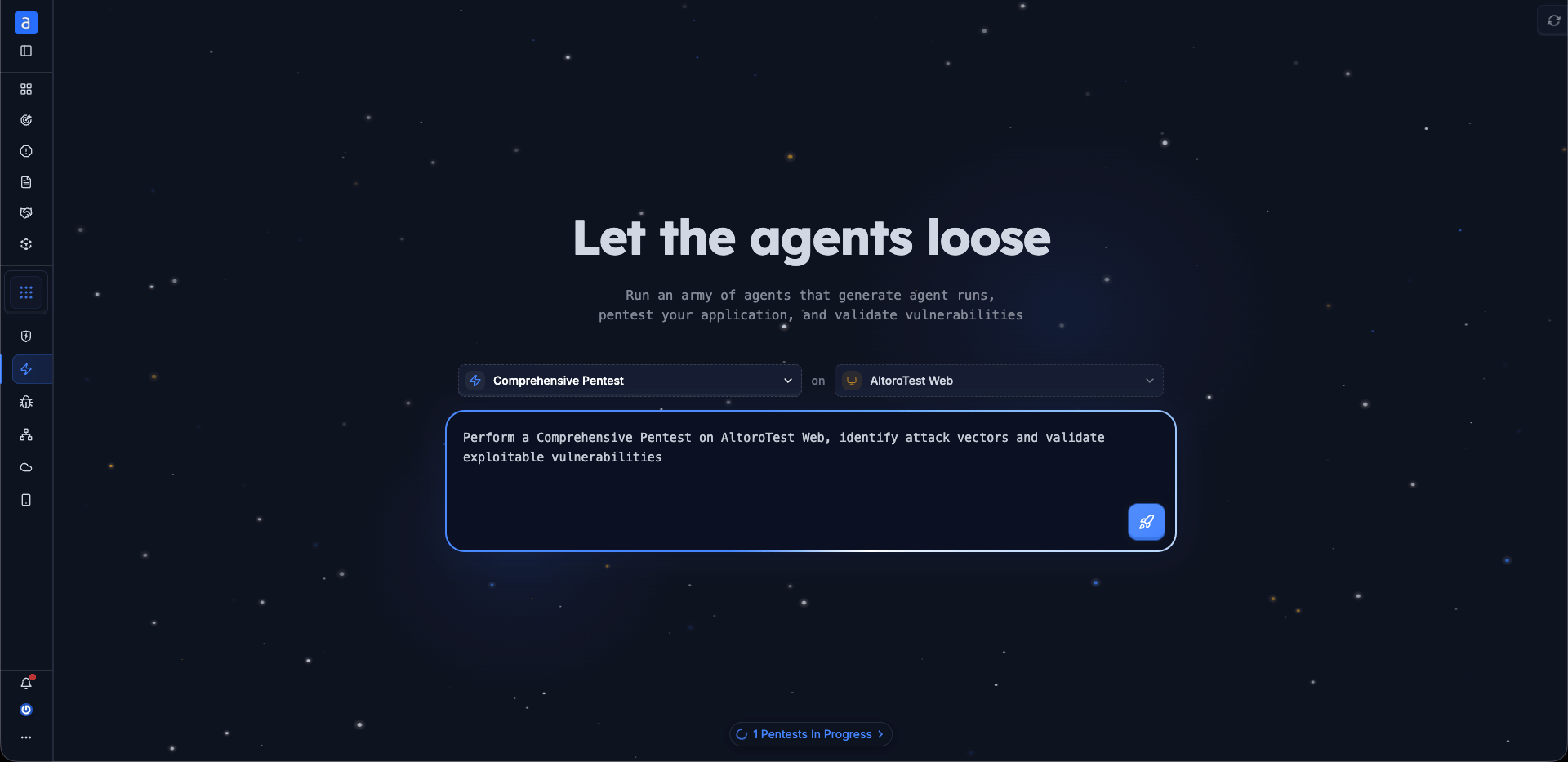
Two agent modes run in parallel against every target, one working systematically through every role, endpoint, and auth flow the way a compliance-mapped structured pentest would, the other hunting the way a bug bounty researcher does, chasing the highest-value chain by whatever route gets there.
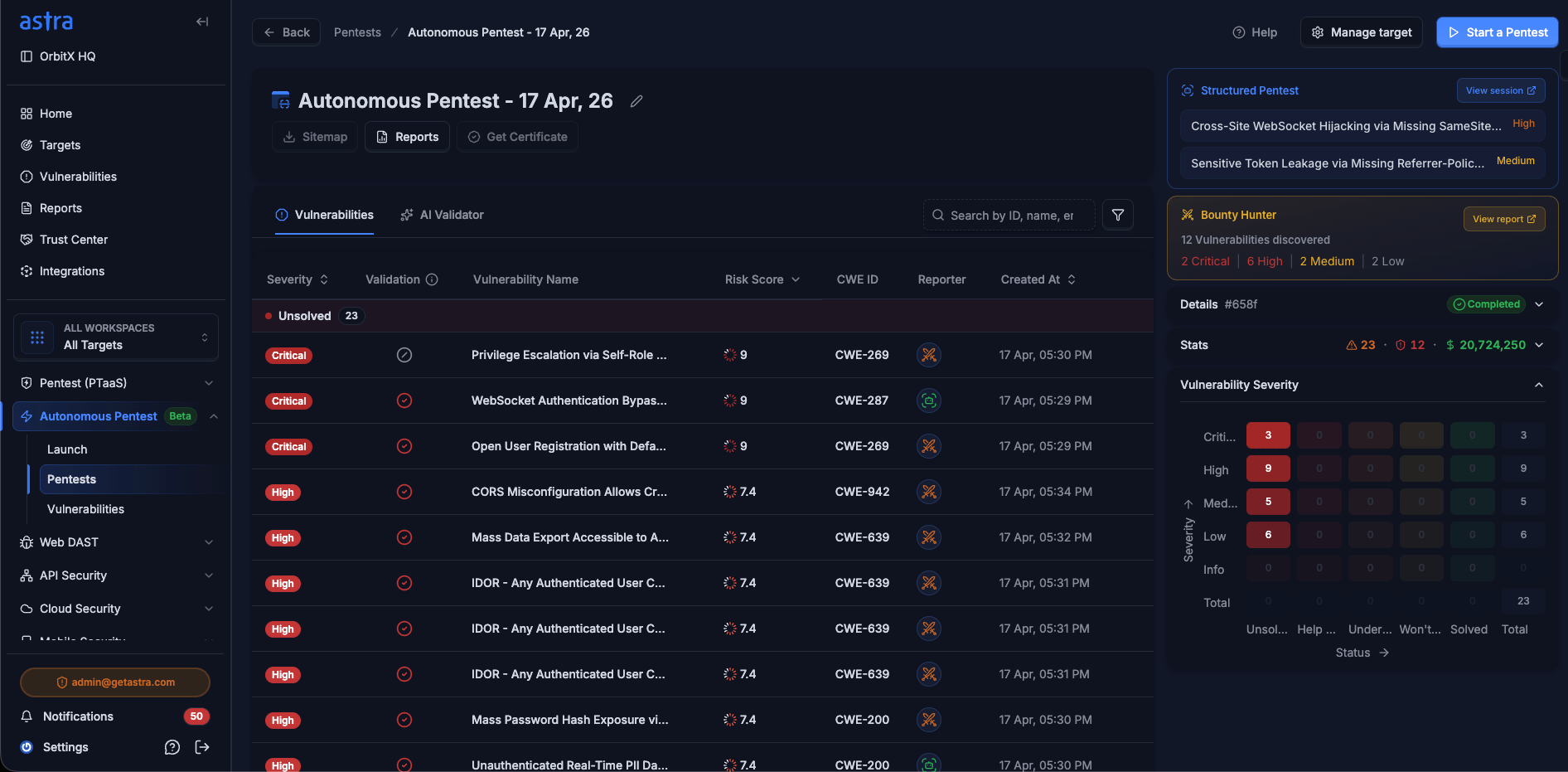
Every finding then passes through a separate AI validator agent, walled off from discovery, that independently exploits it before it reaches a dashboard.
One honest limit: this covers the critical internet-facing systems side of the requirement: applications, APIs, business logic. Extending the same rigor to a bank’s own deployed AI, fraud models, and agentic workflows is a related but separate problem that currently is covered by Astra’s PTaaS capabilities.
What’s next?
The evidentiary bar this category needs will get built eventually, by regulators, by the market, or by whichever vendor’s approach becomes the reference point everyone else gets measured against.
MAS has been explicit that 1 July isn’t the finished version of this regime in AI red teaming requirements in Singapore; more supervisory expectations are already on the way. Until then, the safest assumption for any bank is that its next audit and its next real attack will ask two different questions, and only one of them is on the compliance calendar.