
Most vulnerability assessments read like they’re written for engineers. This one’s for decision-makers.
As a CXO, you don’t need a technical checklist; you need clarity. Clarity on where your organization is exposed, who’s accountable, and what gaps can turn into board-level failures. The real risk isn’t just a missed patch or an open port. It’s a false sense of security.
This vulnerability assessment checklist flips the script. It’s built to help leaders spot structural weaknesses, challenge surface-level answers, and lead from a position of informed urgency, not blind trust. Modern resilience is about knowing the right questions to ask, and not assuming someone else already has.
What is Assessment Fatigue?
When every scan flags hundreds of issues, teams go numb. Reports stack up, action stalls, and real risks get buried in noise. That’s assessment fatigue.
A strong checklist fixes that. It filters out the static, frames what matters, and links risk to responsibility. However, for it to work, you need to know what kind of signal you’re even looking for.
Remember, not all assessments speak the same language, or serve the same purpose.
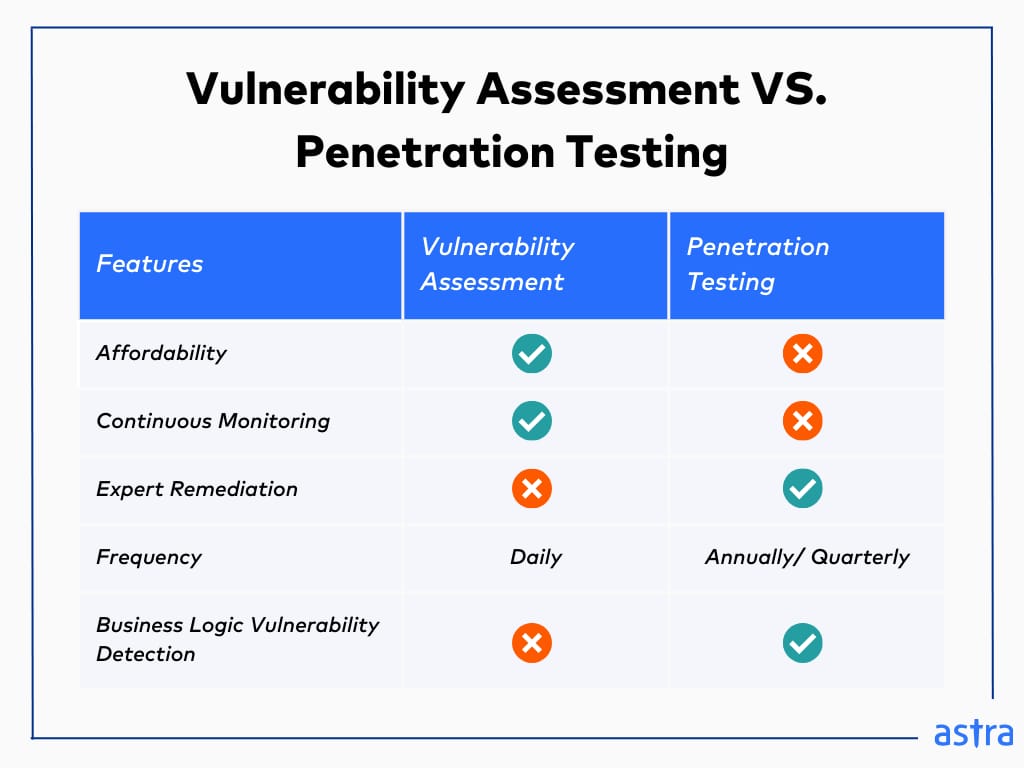
Vulnerability Assessment vs Penetration Testing
Although both vulnerability assessment and penetration testing serve a similar purpose – which is to help organizations identify and fix vulnerabilities present in their systems, many IT professionals often get confused between these terms and conversely implement them for their IT security needs.
The main difference between vulnerability assessment (VA) and penetration testing (PT) is that the VA is an automated process where tools like web and network security scanners are used and in PT a combination of automated tools and manual process of exploiting vulnerabilities is performed.
Book a pentest for your Indian Business and stay protected with our 10,000+ AI-powered test cases.
Discuss your security needs & get started today!
What does Vulnerability Assessment Checklist for CXOs Include?
Pre-Assessment Essentials: Set the Stage
Before anything gets scanned, something else needs to happen: leadership alignment. Many vulnerability assessments fail before they begin, not because of bad tools, but due to isolation. A CISO kicks off a scan, the CIO signs off, but the business risk lens is missing. Assets are miscounted. Scope is unclear. And the findings? Disconnected from reality.
This checklist exists to bring CXOs into the room before the engine starts. Because the most dangerous flaw isn’t in your code; it’s in your assumptions.
Set the Business Objective
Many security teams mandate vulnerability assessment services, but often without understanding their business impact. Before evaluating any service or tool, it’s critical to define what the organization expects to achieve.
Key outcomes every VA should deliver for both business and security leaders:
- Minimizing response time during critical incidents.
- Preventing data breaches and SLA violations.
- Prioritizing fixes based on business impact.
- Justifying cybersecurity ROI.
- Meeting industry compliance (GDPR, ISO, PCI).
- Reducing long-term risk from exploitable gaps.
Prepare Your Data Asset Inventory
After understanding the business implications of VA, it is now time to start gathering information about your IT and data assets and prepare an inventory of them to plan and conduct the vulnerability assessment.
You may want to consider the following IT and data assets for conducting vulnerability assessment:
- Network infrastructure (routers, switches, firewalls).
- Apps and services (web, mobile, SaaS).
- Servers and databases.
- APIs and cloud environments (AWS, Azure, GCP).
- Internal systems, credentials, configs, and keys.
What are Some Essential Questions CXOs Must Ask?
Strategic Clarity
- Have we defined the purpose of this assessment in business terms (risk, compliance, resilience)?
- Are we tying vulnerability findings to larger security ROI or transformation goals?
- Do we understand the potential impact of vulnerability exploit on revenue, operations, or reputation?
Scope and Visibility
- Is our asset inventory complete and accurate—across cloud, legacy, and third-party systems?
- Are critical data flows, APIs, and dependencies mapped?
- Do we know what’s exposed externally vs. internally?
Roles and Accountability
- Have we named a clear executive owner for this process?
- Are security, IT, and business aligned on scope and expectations?
- Is there clarity on who remediates what and when?
Legal and Compliance Readiness
- Are we compliant with privacy, data handling, and third-party access requirements (e.g., GDPR, HIPAA)?
- Are necessary NDAs, data access rights, or vendor authorizations in place?
- Have we evaluated potential legal implications if high-risk findings surface?
Pro Tip: Think of this stage like a pre-flight checklist for your organization’s digital risk. If you miss something here, everything downstream will be skewed. The most successful CXOs treat this not as a technical warm-up, but as a strategic audit of how seriously their enterprise takes risk visibility. Set the tone here, and the rest will follow.
During Assessment: Run it Right
Once the scanning process starts, security teams operate in technical shorthand, and critical findings trickle up weeks later, stripped of urgency and context. The real issue isn’t whether vulnerabilities are found (they always are). It’s whether the right vulnerabilities, on the right assets, are surfaced in time for the business to respond.
This vulnerability assessment checklist ensures the assessment doesn’t just run but resonates. Visibility, timing, and context turn raw data into usable intelligence.
Understand Your Risk Surface
After you make an inventory of your systems, you need to identify the types of potential security risks or vulnerabilities that could be used against your systems and further enable hackers to compromise your network or perform a data breach.
Here are some common security risks, attack types and vulnerabilities that could harm your systems:
- Malware and phishing attacks.
- DoS/DDoS disruptions.
- Credential brute-force attacks.
- Insider threats and misconfigurations.
- OWASP Top 10, SANS25, and zero-day exploits.
There are many different kinds of attacks and vulnerabilities, so it is important to familiarize yourself with the most common ones. This will help you better understand how to protect your systems against them.
Prioritize by Risk and Likelihood
To prioritize vulnerability assessments effectively, focus on two things: impact and likelihood. Start by identifying which systems, if compromised, would cause the most damage, like a customer database versus a marketing site. Then consider how likely each system is to be targeted, based on your industry, exposure, and scale. The higher the impact and probability, the higher the priority.
- Perform continuous vulnerability assessment scanning daily for your ‘high-risk’ systems.
- Consider doing vulnerability assessments on a monthly or quarterly basis for your ‘medium or low-risk’ systems.
No other pentest product combines automated scanning + expert guidance like we do.
Discuss your security
needs & get started today!

Consider Compliance Requirements
Vulnerability assessments help companies identify weaknesses in their systems and processes. If these vulnerabilities are exploited before being identified and fixed by the company, it could lead to serious damage such as disruption of financial transactions, theft of healthcare information, sensitive data breach of customers, service unavailability etc.
Hence, it is always important to comply with certain security laws and regulations. And in order to achieve this, a vulnerability assessment can be conducted by considering the requirements for compliance.
Here are some important compliances that can be achieved with vulnerability assessment and penetration testing:
- PCI-DSS for the companies that store or process payment-related data or transactions.
- HIPAA for the companies who store healthcare information.
- GDPR for data privacy and protection.
- SOC2 for services companies.
- ISO 27001 for companies in information security
Choose the Right Testing Method
The next step in the vulnerability assessment checklist is to understand the different types of vulnerability assessment. Vulnerability assessment can be divided into two main categories: active and passive.
Active assessments are typically more intrusive and can involve exploitations, while passive assessments are less invasive and usually only involve analyzing data that is already present. Each type of assessment has its own advantages and disadvantages, so it is important to understand the difference before deciding which one is right for your system.
Involve the Right People
The goal of a vulnerability assessment is to identify, quantify, and prioritize risks to organizational operations (including assets, systems, and information) posed by vulnerabilities. Vulnerability assessments can be conducted as internal or external audits. Internal audits are performed by security personnel within the organization; external audits are performed by third-party VAPT service or solution providers.
It is very crucial to involve both security professionals and development teams in the entire internal or external audit process. This is because most IT professionals aren’t capable enough to clearly read the vulnerability scan results. And of course, the development team needs to be kept in the loop in order to fix the vulnerabilities assigned to them by security professionals.
What are Some Essential Questions CXOs Must Ask?
Risk Understanding
- Are we assessing risk types most relevant to our attack surface (e.g., cloud misconfig, credential abuse)?
- Are we using active vs. passive scanning based on asset sensitivity?
- Do we understand how threats map to high-value business assets?
- Are we accounting for configuration drift, privilege misuse, and insider risks, not just missing patches?
Testing Approach
- Is the VA coordinated to avoid disruptions to production systems?
- Are external providers vetted and aligned on scope?
- Are we validating scan results with human context where necessary?
- Are vulnerabilities being scored not just by severity, but by business risk (asset value, exploitability, exposure)?
- Are findings being cross-referenced with known attack paths or active threat intelligence?
Collaboration and Ownership
- Are dev teams involved early in triage conversations?
- Are security leaders surfacing business-contextualized findings to stakeholders?
- Is there a clear comms plan if a critical flaw is uncovered?
- Are we documenting decisions, such as why certain risks are accepted or deferred?
Pro Tip: Too often, technical teams chase CVEs while business leaders are left in the dark. A strong CXO presence during this phase ensures that what gets uncovered actually matters to the business, and that risk signals don’t get lost in translation. The goal isn’t to fix every issue, it’s to elevate the ones that could break you.
Post-Assessment: Act With Precision
The report lands. It’s long. It’s technical. It’s filled with acronyms. And then…it sits. That’s the moment when many organizations quietly lose the plot. Vulnerability assessments aren’t about what was found; they’re about what happens next. And that’s where most strategies stall.
This final stage is about turning raw findings into forward motion: decisions, investments, priorities. Done right, it transforms risk discovery into risk leadership.
Triage and Fix Vulnerabilities
After a vulnerability assessment is complete, it’s time to start fixing the issues that were found. And the process of managing and assigning issues to your dev team may become cumbersome for you. But before you can do that, you need to prioritize the vulnerabilities.
Here are some factors to consider when deciding which vulnerabilities to fix first:
- Severity of the vulnerability
- CVSS Score
- Likelihood of exploitation
- Potential loss in revenue (if exploited)
- Difficulty of remediation
- Business impact
To avoid this doing manually, you should consider a comprehensive vulnerability management solution that can do this job for you. A risk-based vulnerability management offers risk-grading, severity, CVSS score, impact rating which helps you prioritize vulnerabilities for fixing in a very easy way.
Build Reports That Drive Action
When a vulnerability assessment is complete for your system, It is now time to create a report that can provide you with a bird-eye view of the security of your systems that were part of the VA process.
For example, a detailed vulnerability report for website vulnerability assessment includes:
- A list of all identified vulnerabilities, including a description, affected URLs, etc.
- The risk level for each vulnerability, including severity, impact, and potential revenue loss
- Steps to reproduce each discovered vulnerability with videos or textual documentation
- Recommendations for mitigating or remedying each vulnerability
A vulnerability assessment report can help an organization identify, quantify, and prioritize risks to its operations. By identifying vulnerabilities, an organization can take steps to mitigate or remediate them, thereby reducing the likelihood of a successful attack.
Institutionalize Learning
A well-written vulnerability report can also provide valuable information to incident response teams in the event of a breach. Incident response teams can use the information in a vulnerability assessment report to more quickly understand the scope of an attack and take steps to contain it.
Some crucial documents can include:
- Historic data for pattern tracking.
- Playbooks updated based on recent insights.
- Incident response teams trained using recent findings.
Hence, it is important to document and maintain all your learning from the previously performed vulnerability assessments and keep them for future.
What are Some Essential Questions CXOs Must Ask?
Risk Resolution
- Have we categorized findings into quick wins, strategic fixes, and long-term structural risks?
- Is there a clear owner, deadline, and budget (if needed) for each critical remediation task?
- Do we have compensating controls or interim mitigations for risks that can’t be fixed immediately?
Executive-Level Insight
- Has the report been translated into a business-impact summary for leadership and the board?
- Can we clearly articulate what’s been fixed, what’s outstanding, and what residual risks remain?
- Are post-assessment findings informing cybersecurity roadmaps, budget priorities, and risk posture metrics?
Continuous Improvement
- Have we documented recurring or systemic weaknesses (e.g., misconfigurations, outdated protocols, lack of asset visibility)?
- Are lessons learned feeding into incident response plans and security awareness efforts?
- Have we scheduled the next assessment or implemented continuous scanning/monitoring where possible?
Pro Tip: Post-assessment is where leadership shows up. Smart CXOs accept the PDF, but also ask what changed because of it. They push for metrics that matter, hold teams accountable for risk reduction, and use the findings to shape not just remediation, but resilience. In a high-velocity threat environment, speed to insight and action is a board-level skill.
How can Astra Pentest Help?
Astra’s DAST scanner cuts through the noise of traditional vulnerability assessments with automated scans and pentests that mimic real-world attacks, across web apps, APIs, and infrastructure. Backed by 15,000+ test cases mapped to OWASP, NIST, and SANS25, it doesn’t just flag issues; it surfaces what’s exploitable, what’s urgent, and who needs to act.
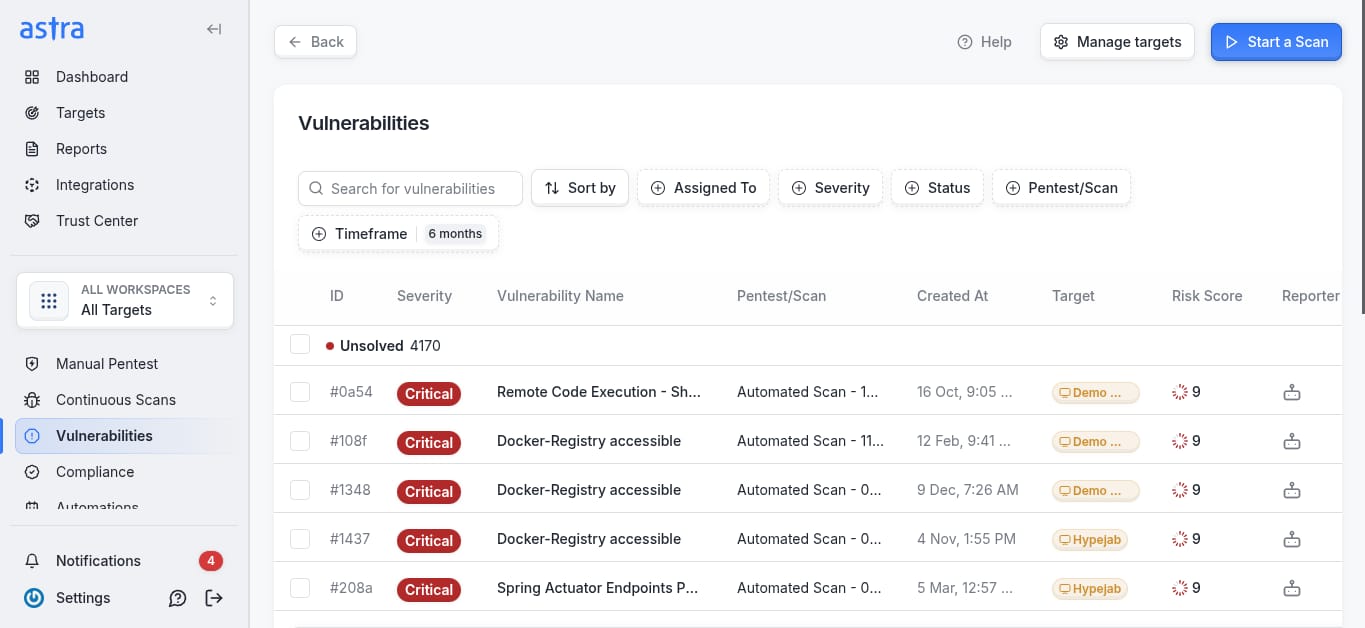
With hacker-style techniques like scan-behind-login and subdomain takeover, Astra brings offensive security into your daily workflow, minus the complexity. Whether you’re a CTO or a security engineer, you get tailored insights, seamless integrations, and a CXO-friendly dashboard that turns raw data into real decisions.
Why teams choose Astra?
- AI-generated test cases tailored to your industry and tech stack
- Developer-friendly issue tracking with instant Jira ticketing
- Smart automation guided by expert-reviewed findings
- Astranaut Bot: your built-in assistant for alerts, fixes, and context—right when you need it
No other pentest product combines automated scanning + expert guidance like we do.
Discuss your security
needs & get started today!
Final Thoughts
Conducting a vulnerability assessment can be a complex and time-consuming process, but it is essential for ensuring the security of organizational assets, systems, and information. By taking the time to identify and assess risks, companies can make informed decisions about how best to protect their assets and ensure their continued operations.
We hope that by following this vulnerability assessment checklist, you can be sure that you are doing everything possible to protect your systems against any attack.
FAQs
What is a vulnerability assessment checklist?
A vulnerability assessment checklist is a structured list of steps used to ensure systems, networks, and applications are thoroughly evaluated for security weaknesses that helps maintain consistency across assessments. Common items include asset inventory, scanning, prioritization, and remediation tracking.