

Key Takeaways:
- Static analysis via SAST reveals potential issues, whereas DAST identifies proof-based findings that occurred during actual attacks.
- From broken access control to SSRF, DAST covers each threat category at runtime to identify authentication bypasses, injections, and misconfigs.
- Integrating DAST into your CI/CD and production monitoring means you catch security gaps early and continuously.
- AI-led DAST tools learn from your app and create smarter payloads that flag threats ordinary scanners often miss.
- With clear evidence-request traces, screenshots, and extracted data, DAST gives auditors and executives confidence in your OWASP Top 10 compliance.
Your app isn’t just HTML anymore. It is containers talking to microservices, SPA front ends calling GraphQL, and third‑party SDKs everywhere. That mix creates blind spots and unpredictable OWASP Top 10 gaps.
Continuous DAST looks through every layer, including mobile backends, APIs, and container workloads, simulating attacker behaviour across your entire technology stack. Hence, no more guessing which component hides the next SSRF, injection, or misconfiguration.
As the OWASP Top 10 evolves into a universal benchmark for modern assets like AI engines, CI/CD workflows, and cloud functions, incorporating DAST means you secure every phase in real time, not just the code you wrote.
What is DAST & Why Does It Matter for OWASP Compliance?
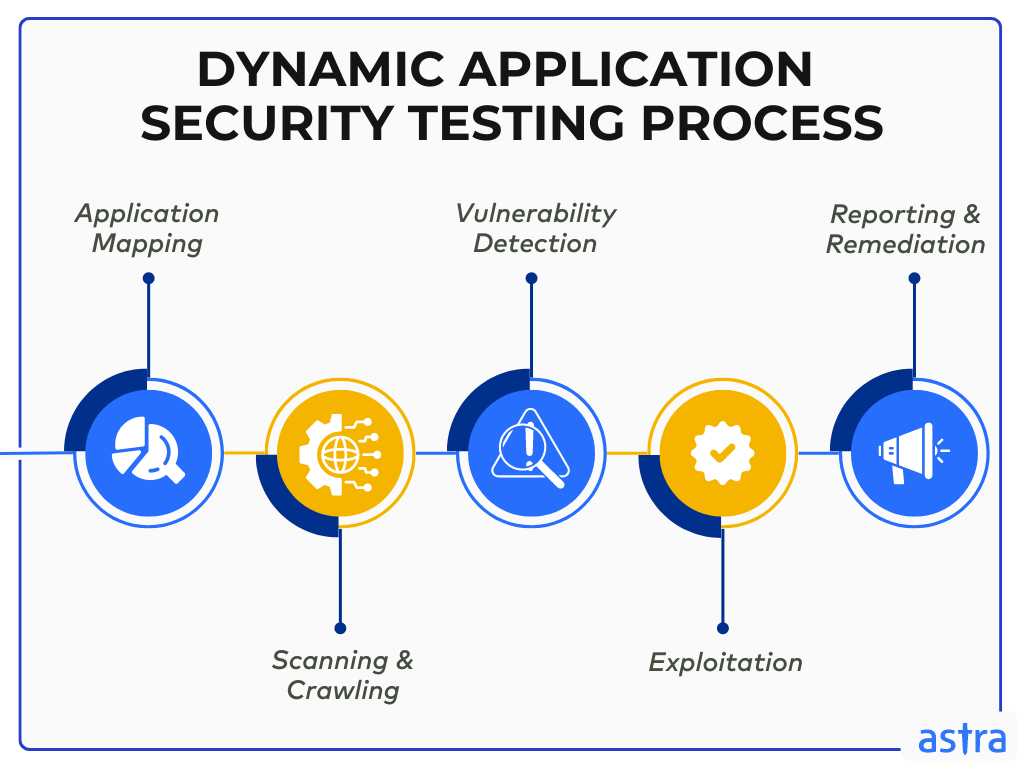
Dynamic Application Security Testing (DAST) is a black‑box security method that attacks a running application from the outside to detect real‑world vulnerabilities. By simulating external threats against live endpoints, it validates actual exploit paths, especially web‑app risks, providing solid proof of flaws under real operating conditions.
Now, you might be thinking how DAST compares to other testing approaches? Well, here’s how:
- SAST (Static Application Security Testing): It scans your codebase before anything runs, spotting insecure patterns in files and libraries. Great for catching mistakes early, but it won’t tell you if that “fix” actually blocks an attack in production.
- IAST (Interactive Application Security Testing): It hooks into your app during tests, watching how code executes in real time. It blends code insights with runtime feedback, but usually needs heavy instrumentation and controlled test environments.
DAST offers proof‑based validation. Instead of flagging suspect code, it shows actual exploits, for example, extracting database records via SQL injection to satisfy auditors and build stakeholder confidence.
Modern DAST tools also slash false positives by confirming each finding with real exploit evidence, so security teams focus on just the genuine risks.
How DAST Supports OWASP Top 10 Compliance?
DAST is best at detecting runtime vulnerabilities that static analysis tools often miss. Here’s how dynamic testing maps to each OWASP Top 10 risk:
| OWASP Risk | What It Is | How DAST Helps |
|---|---|---|
| Broken Access Control (A01) | Users accessing functions or data they shouldn't | Tests authorization bypasses, BOLA attacks, and privilege escalation across user roles. |
| Cryptographic Failures (A02) | Weak encryption or exposed sensitive data | Detects missing HTTPS, weak TLS configs, and unencrypted data transmission. |
| Injection (A03) | Malicious data sent to interpreters | Injects SQL, OS commands, and XSS payloads to prove exploitability. |
| Insecure Design (A04) | Missing security controls by design | Identifies architectural flaws, missing rate limiting, and unsafe workflows. |
| Security Misconfiguration (A05) | Default/incorrect security settings | Finds default credentials, exposed services, and extra error messages. |
| Vulnerable & Outdated Components (A06) | Outdated libraries with known flaws | Runtime detection of component versions with published CVEs. |
| Identification & Authentication Failures (A07) | Broken login and session management | Test password policies, session tokens, and MFA bypasses. |
| Software & Data Integrity Failures (A08) | Untrusted data in critical flows | Scans for deserialization flaws, CI/CD tampering, and malicious updates. |
| Severity Logging & Monitoring Failures (A09) | Insufficient security event tracking | Points out missing logs and weak alerts for critical events. |
| Server-Side Request Forgery (SSRF) (A10) | Server tricked into making unintended requests | Crafts SSRF payloads targeting internal systems and cloud metadata. |
Note: No single tool covers 100% of A04, A08, and A09. And that’s where business‑logic testing and extended workflows come in.
Can DAST Handle Business‑Logic & Custom Risk Scenarios?
Yes and no. Generic business-logic flaws, such as an e-commerce search bar SQL injection or a missing parameter check, can surface in automated DAST scans. However, truly contextual vulnerabilities, such as multi-step loan application bypass, depend on a deep understanding of your specific processes, data flows, and industry rules.
What DAST Does Well:
- Authenticated scans to look for user‑specific flows.
- Customizable scripts for common multi‑step actions (login → transfer → confirmation).
- Detection of generic logic misuses, especially around Broken Access Control and Insecure Design.
Where Human Expertise Wins:
- Complex workflows tied to business rules or proprietary logic.
- Contextual checks that require domain‑specific knowledge (finance, healthcare, e‑commerce).
- Nuanced scenarios where automated tools lack visibility into backend processes.
In practice, effective OWASP Top 10 coverage mixes DAST’s runtime scans with targeted manual testing, ensuring you catch both the low‑hanging fruit and the deeply buried logic flaws.

Why is Astra Vulnerability Scanner the Best Scanner?
- We’re the only company that combines automated & manual pentest to create a one-of-a-kind pentest platform.
- Vetted scans ensure zero false positives.
- Our intelligent vulnerability scanner emulates hacker behavior & evolves with every pentest.
- Astra’s scanner helps you shift left by integrating with your CI/CD.
- Our platform helps you uncover, manage & fix vulnerabilities in one place.
- Trusted by the brands you trust like Agora, Spicejet, Muthoot, Dream11, etc.

How to Utilize DAST for Continuous OWASP Coverage?
Adding DAST throughout development creates a quick feedback loop that identifies OWASP risks early. Live scan results are shared back into the development and monitoring tools, allowing you to address problems immediately.
How and Where Should You Integrate DAST into Your DevOps & SIEM Workflows?
Continuous DAST means including automated security testing throughout your development lifecycle, not just during security reviews. This includes:
| Dev Lifecycle | What You Should Do |
|---|---|
| Dev Environment | Run fast & lightweight DAST scans on feature branches to catch obvious vulnerabilities before code review. This prevents security debt from accumulating. |
| Staging Environment | Execute comprehensive authenticated DAST scans with full OWASP Top 10 coverage. This is where you identify configuration issues and runtime vulnerabilities that may not exist in development. |
| Production Environment | Deploy continuous monitoring with DAST tools that can safely test live applications without impacting performance or user experience. |
| CI/CD Pipelines | Add DAST into Jenkins, GitHub Actions/GitLab to auto-trigger scans and fail builds for high-severity issues. Use secure credential storage for authenticated tests. |
| SIEM Integration | Ship DAST results into your SIEM for unified dashboards, real-time alerts, and automated incident response. |
What Metrics & ROI Should You Track?
DAST scanners should generally offer measurable outcomes that showcase value to stakeholders. Here, businesses should track:
- Time-to-detect: How quickly does DAST identify new vulnerabilities after deployment?
- Time-to-remediate: How long does DAST take to fix identified issues?
- Vulnerability reduction rate: Drop in percentage of recurring OWASP top 10 vulnerabilities.
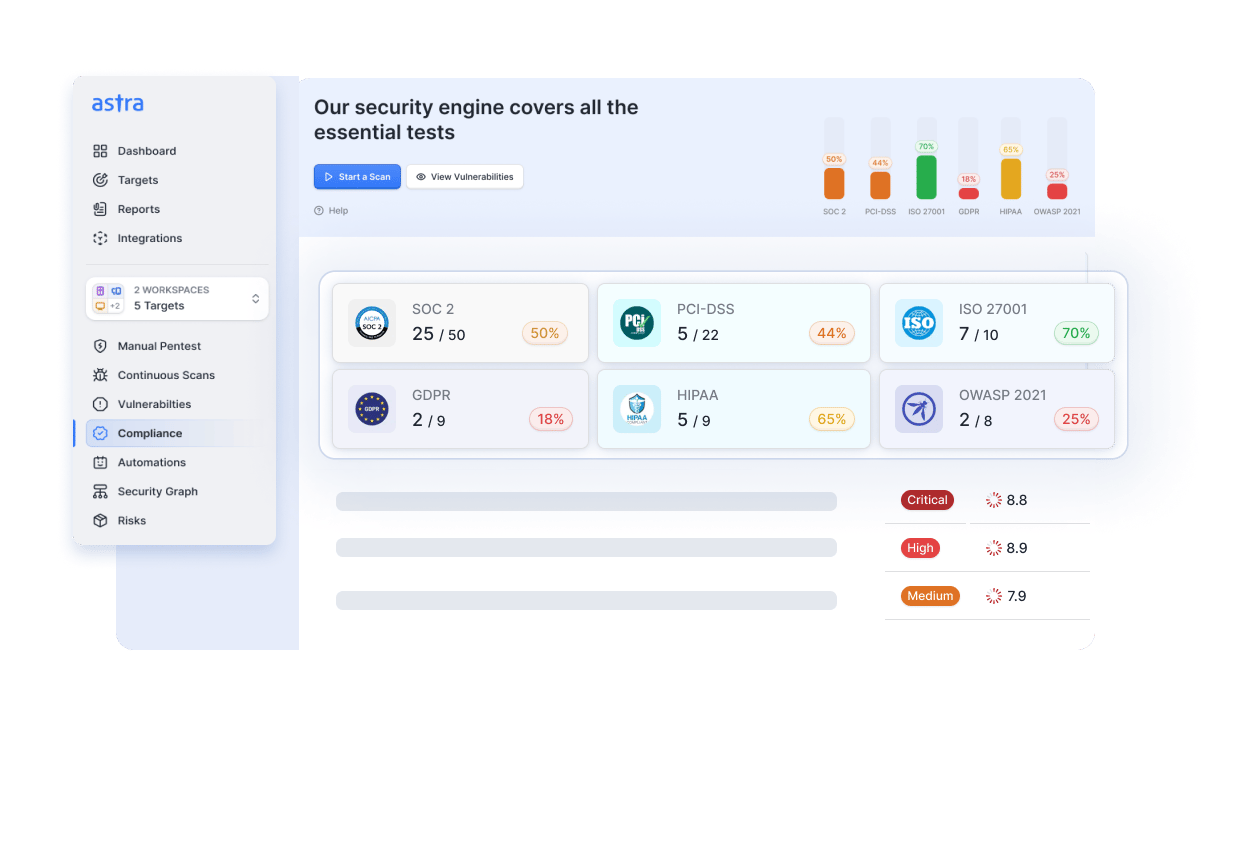
- Compliance score: Mapping your results against major compliances like PCI, GDPR, HIPAA, etc.
In addition to all this, you can readily track false positive rates to ensure your security team focuses on real threats rather than scanner noise.
Why Choose AI-Powered Continuous DAST?

Traditional DAST tools follow predetermined test scripts and rule sets. AI‑powered DAST platforms adapt their testing approach based on application behavior, significantly improving coverage and accuracy.
AI capabilities in DAST include:
- Anomaly Detection: Detects unusual application responses, hinting towards possible vulnerabilities.
- Attack Modeling: Learns from successful exploits to improve future testing.
- Contextual Understanding: Adapts strategies based on your app’s architecture and tech stack.
- Intelligent Payload Generation: Creates custom attack payloads optimized for each application.
These advanced features provide enhanced coverage of OWASP Top 10 vulnerabilities while reducing false positives that waste the security team’s time.
At Astra Security, we not only deliver these AI-driven capabilities but also contribute directly to the OWASP LLM Top 10 initiative. This, in turn, helps define the next-gen benchmarks for securing AI and LLM‑powered applications.
Choosing the Right DAST Tool for OWASP Coverage
Not all DAST tools provide comprehensive coverage of the OWASP Top 10. To choose the right partner, here’s what you should evaluate:
- SPA/API/GraphQL Support: Modern applications are not just traditional web pages. Your DAST tool must be able to handle single-page applications, REST APIs, and GraphQL endpoints.
- Authenticated Scan Capabilities: Many OWASP vulnerabilities only appear behind login screens. Look for tools that can handle complex authentication flows, including multi-factor authentication.
- Proof-based Validation: The tool should provide evidence of exploitation, not just theoretical vulnerability reports.
- CI/CD & SIEM Integration: Seamless integration with your existing development and security workflows.
- AI Features: Real-time decision making, contextual guidance, more brilliant authentication handling, and threat modeling assistance.
Here’s a quick comparison of the top 3 DAST tools in the market based on these criteria:
| Feature | Invicti | Acunetix | Astra Security |
|---|---|---|---|
| SPA/API/GraphQL Support | Yes | Limited | Full Coverage |
| Authenticated Scans | Intermediate-level credential and workflow testing | Intermediate-level credential and workflow testing | Complex MFA & SSO workflow testing |
| Proof-Based Validation | Yes (proof-based scanning) | Partial | Yes (Screenshot + POC) |
| CI/CD & SIEM Integrations | Jenkins, GitLab, GitHub Actions, Azure DevOps, Bamboo, and SIEM | Jenkins, GitHub Actions, Azure DevOps, etc. | All major pipelines |
| AI-Driven Attack Modeling | No | No | Yes |
No other pentest product combines automated scanning + expert guidance like we do.
Discuss your security
needs & get started today!

How to Validate Attack Proofs & Reduce False Positives?
Proof-based validation separates modern DAST tools from basic scanners. When a tool reports SQL injection, it should provide evidence. The actual database query that succeeded, the data that was extracted, or the error message that confirmed the vulnerability.
This evidence serves multiple purposes:
- Developer Trust: Engineers can see exactly what went wrong and how to fix it.
- Audit Readiness: Compliance reviewers get concrete proof of security testing.
- Stakeholder Confidence: CISOs and CTOs like you can demonstrate due diligence.
Accurate findings also reduce alert fatigue. When security teams trust their DAST results, they respond faster to real threats rather than dismissing scan results as noise.
How Can Astra Help with OWASP Compliance?
Key Features:
- Delta scanning for changed endpoints, delivering feedback in minutes
- Always‑on monitoring in production without performance impact
- Chained attack simulation to uncover multi‑step exploits
- Audit‑ready, timestamped logs and PDF reports
- Cloud & container awareness for Kubernetes, Docker, and serverless
Astra Security runs 15,000+ unified security tests covering OWASP Top 10, SANS, ISO, SOC controls, against your live app. AI‑powered business‑logic coverage generates custom test cases that adapt as your architecture evolves, so you stay ahead of emerging risks.
Delta scanning means you only re‑test what’s changed, cutting scan times and letting your engineering teams fix critical OWASP gaps fast. Meanwhile, always‑on monitoring quietly checks production endpoints, so you never lose visibility between releases.
Our chained attack simulation links related issues like bypassing access controls, then exfiltrating data, so you see the full exploit path. And with detailed logs, live Trust Center status, and PDF exports, you get audit‑ready proof that your OWASP compliance is real, verifiable, and shareable.
Success Story: Zenduty integrated Astra Security’s scanner right into their CI/CD pipeline overnight, shifting from DevOps to true DevSecOps. They identified and addressed 103 OWASP Top 10 vulnerabilities, avoided $34,200 in potential losses, and achieved SOC 2 compliance. Recurring risks dropped sharply, and engineering teams now lead every release with a security‑first mindset.
Astra Pentest is built by the team of experts that helped secure Microsoft, Adobe, Facebook, and Buffer

Final Thoughts
Though static analysis informs you what could go wrong, dynamic testing via DAST shows you what actually goes wrong when your application goes through real attacks, causing damage to OWASP compliance.
AI-driven DAST platforms are the future. They adjust to your app’s unique structure and fit seamlessly into DevSecOps processes. They don’t just detect vulnerabilities; they find proof and offer clear steps to fix and avoid them.
In short, choose a DAST partner that grows with your security needs and helps you stay compliant rather than adding hassle to your team.
FAQs
What are two vulnerabilities that DAST tools are helpful in detecting?
DAST scanners are the best in detecting runtime flaws like SQL injection and cross-site scripting (XSS) by injecting payloads into live inputs and monitoring responses for vulnerabilities.
How does DAST work?
DAST treats your running app as a black box. It automatically crawls pages and APIs, sending specialized attacks (like SQLi or XSS), and then analyzes responses to flag real exploitable issues. It stores proof such as request/response traces, making it highly practical with low false positives.
Can DAST replace manual penetration testing?
No, while automated DAST is great for continuous web‑app scanning for known OWASP Top 10 issues, it can’t fully replace manual penetration testing. Manual testing is essential for detecting complex attack chains, business‑logic flaws, and context-specific vulnerabilities that a DAST tool can’t always grasp.