TLDR;
- PHP2Shell (CVE-2026-109618 and CVE-2026-109619, CVSS 9.2) hit a runtime behind roughly 70% of websites, yet three weeks after disclosure, there has been no confirmed mass exploitation.
- Exploits rely on offsets tied to the exact PHP build, compiler, flags, and distribution packaging, so a universal exploit is unlikely.
- Production hosts ship with
display_errors=Off,forcing attackers to build the information leak from precise heap-layout control. - The
mod_php pathneeds two requests to land on the same worker, which is hard to force on busy sites. - It is not over: memory disclosure of tokens and keys works without full RCE, the patch window shrank to negative hours, and low-traffic edge appliance panels are easier targets.
When I look for a precedent for a critical vulnerability whose severity score overstated its real-world reach, I think of BlueKeep (CVE-2019-0708), a pre-authentication, wormable remote code execution flaw in Windows Remote Desktop Services. Microsoft considered it serious enough to patch unsupported systems like Windows XP, and the industry expected it to become the next WannaCry.
While BlueKeep was exploited in the wild as early as September 2019, the first widespread campaign came roughly six months after disclosure in the form of cryptomining, because a reliable exploit required kernel pool grooming tuned to the target’s OS build and memory configuration.
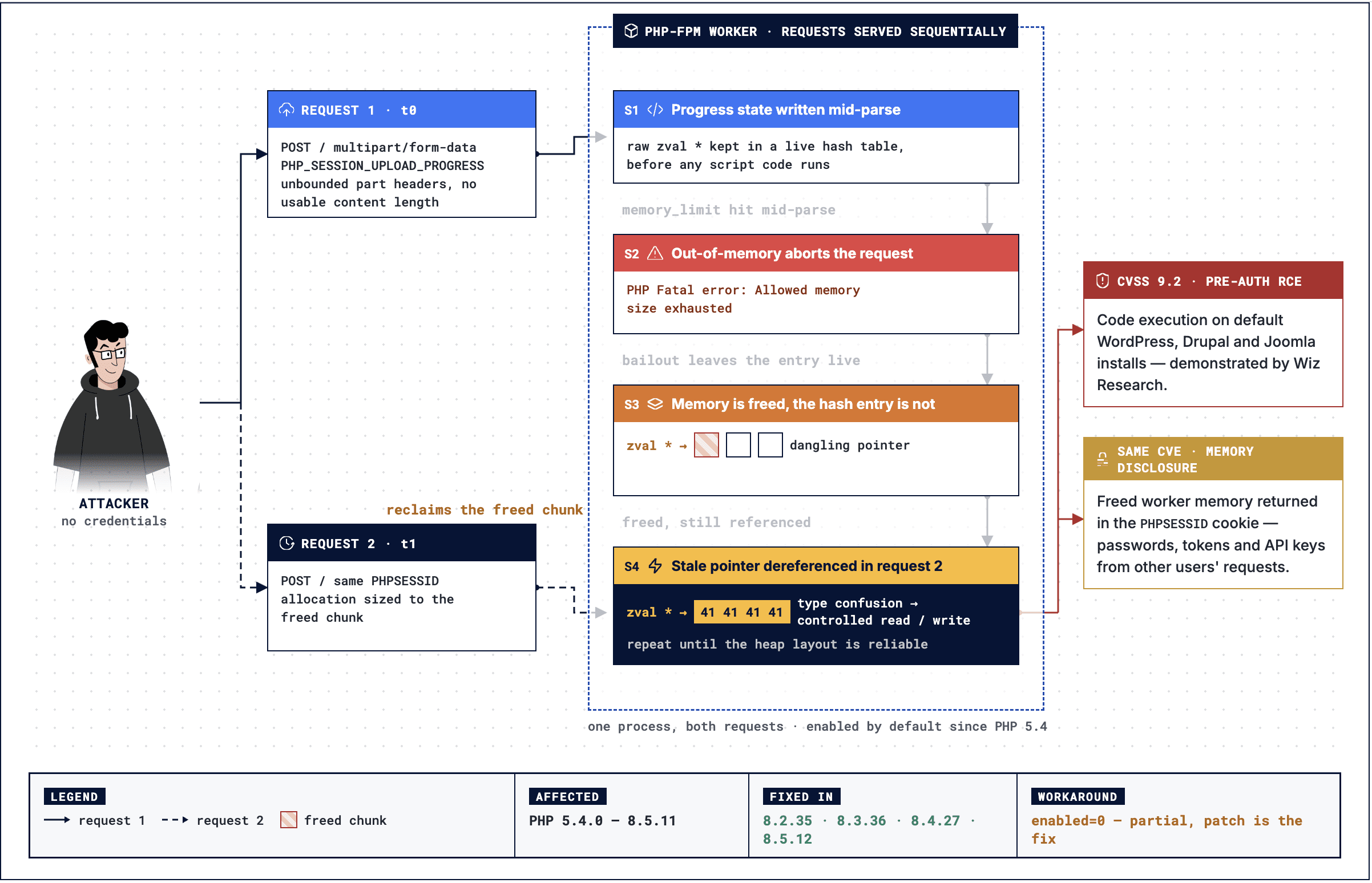
I see the same pattern in PHP2Shell (CVE-2026-109618 and CVE-2026-109619, CVSS 9.2), which affects a runtime behind roughly 70% of websites. Three weeks after disclosure, we have seen no confirmed mass exploitation, with honeypots recording only probing and unsuccessful attempts, and no weaponised public exploit in the wild.
So why did it not detonate?
From reading various reports and analyzing each flaw’s exploitability, I found three reasons:
Build dependency
Both CVEs are memory-safety flaws in PHP core. Researchers built a working RCE against PHP 8.4.26 under mod_php, but the exploit depends on offsets that change with the compiler, its flags, and the distribution’s packaging, so an offset set that works on one build fails on another with the same version string. That already reduces the attack surface to a fraction of all PHP deployments out there. Not every PHP site is a sitting duck.
Config dependency
PHP ships with display_errors=Off, while the early public PoCs assumed On, and reviews of exposed phpinfo output across production customer bases turned up zero hosts with display_errors=On.
Without error output, the attacker has to build the information leak from heap-layout control alone, which means shaping the number of remaining entries in a specific freelist bucket before triggering the out-of-memory condition in php_session_send_cookie. A skilled operator can do that against a single target, but it is difficult to automate across millions of hosts.
Timing dependency
The mod_php path needs two requests to reach the same worker with no other client’s request processed in between. On a busy WordPress site handling thousands of concurrent requests that condition is hard to force, whereas on a low-traffic management console it is far easier, which is why researchers pointed to edge appliances from a firewall vendor and an application delivery vendor, both of which have confirmed affected versions and published advisories.
Taken together, these constraints leave PHP2Shell usable by well-resourced actors against pre-researched, high-value targets, and unusable as a spray-and-pray exploit built from an AI-generated PoC.

Is it over?
I do not think it is. Advanced actors are expected to pursue exactly these targets where other methods are impractical, and BlueKeep is a reminder that a slow start does not mean an exploit stays unused.
I expect exploit developers to keep sharpening their tools; the headwinds that stalled the initial rollout don’t apply forever. There’s still plenty of exposed PHP systems on the internet, and as long as one of them has an unsafe config, we’ll keep seeing targeted attempts. But the worst-case “point and click RCE on most of the internet” scenario looks unlikely now that distros and cloud providers have hardened their base images. The combination of patched defaults and selective targeting means we might have a little more time to lock down the rest.
Still, let’s not get complacent.
Today, PHP2Shell is a Ferrari without gas, but once that tank is full, look out. One key build option or one new code path no one has thought to add an exception for is all it’ll take to turn it into a point-and-shoot exploit. As defenders, let’s use the time PHP2Shell’s limitations bought us to get ready for the next one.