TL;DR
- Platform: Nvidia Brev (cloud GPU development platform, acquired by Nvidia in July 2024)
- Incident window: October 4 to October 20, 2026 (16 days of unauthorized activity, per Nvidia’s customer notification)
- Exposure: Brev-provisioned SSH keys for customer VM access may have been exposed
- Nvidia’s status: Affected SSH keys rotated, customer instances updated with replacements, no confirmed evidence of misuse
- Disclosed: Early November 2026 via direct customer notifications
Nvidia disclosed in early November that its Brev cloud development platform experienced a security incident with unauthorized activity spanning October 4 through October 20, 2026. Brev is the GPU-instance platform Nvidia acquired from Brev.dev in July 2024, used by developers to spin up on-demand cloud GPU compute for AI and ML workloads.
Access to each customer VM is brokered through SSH keys that Brev provisions on the customer’s behalf during instance setup. Those keys are what the attacker may have reached. In the notification sent directly to affected customers, Nvidia confirmed the Brev-provisioned SSH key associated with each account “may have been affected” and that the key has since been rotated and the customer’s instances updated to use the replacement.
What Happened
The disclosed facts were sent to customers via email around November 2. Between October 4 and October 20, 2026, unauthorized activity was detected on the Brev platform, and the exposed data category was specifically the SSH keys Brev provisions for customer VM access.
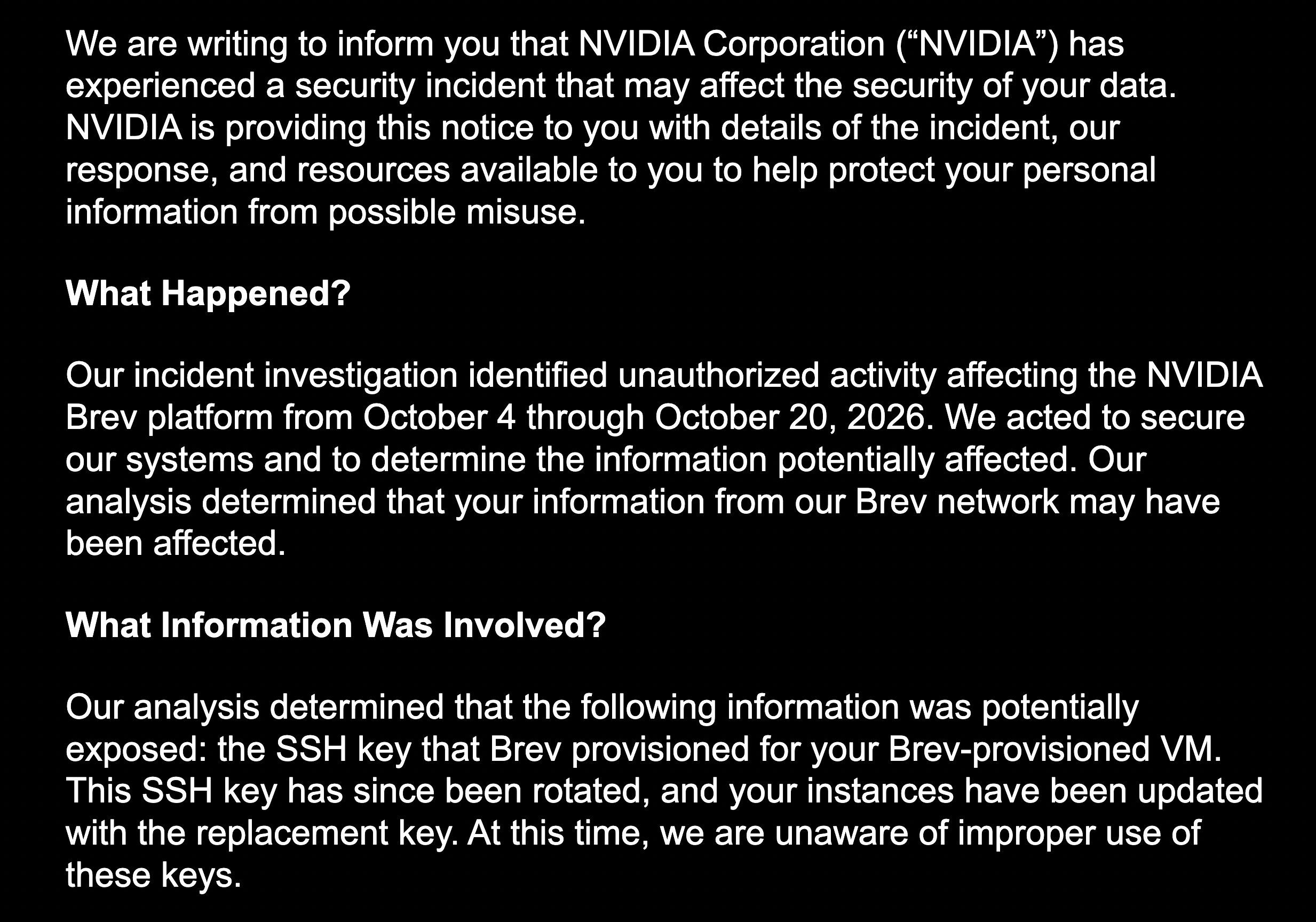
Nvidia’s investigation found “no evidence of improper use” of the exposed keys. The company has not published a technical post-mortem explaining how the attacker gained access, what detection event closed the window on October 20, whether workloads on affected VMs were accessed during the window, or whether any attacker-added persistence was found on customer instances.
Impact of Nvidia Brev Security Breach
Practical exposure depends on what each customer’s Brev VMs had access to. SSH access to a cloud GPU instance gives an attacker the running workload, environment variables inside it, mounted data or model weights, and any outbound credentials the instance holds for third-party services (object storage, model registries, inference APIs, data warehouses, deployment targets).
Downstream risk falls across three categories:
- Credential pivoting: AI dev VMs commonly hold API keys for cloud providers, model APIs, GitHub tokens, and container registry credentials. SSH access lets an attacker enumerate these from environment variables and shell history, then move laterally.
- Model and data exposure: Training data, fine-tuning datasets, model checkpoints, and proprietary inference pipelines stored on the VM are directly readable.
- GPU resource abuse: Attackers with cloud credentials from compromised AI dev instances have shown they will drive six-figure usage bills in hours by running up API calls through stolen keys.
Fix for Nvidia Brev Security Breach
Nvidia has handled the primary remediation on affected customers’ behalf. The Brev-provisioned SSH keys for impacted accounts have been rotated and customer instances updated with replacement keys. No action is required to replace the specific key Brev manages.
Customers should still receive a direct notification from Nvidia confirming the rotation on their account. Organizations with multiple Brev accounts or multiple team members with access would receive separate notifications per account.
Final Thoughts
The Brev incident is small in that Nvidia’s investigation found no confirmed misuse. It is large in that the breach pattern (16 days of undetected unauthorized activity on an AI developer platform, with SSH credentials sitting in the blast radius) is now the modal AI-infrastructure incident of October 2026.
Nine other platforms shipped similar notifications in the same month, and the attacker focus on stored environment variables with AI-service access is specific enough to look like a coordinated campaign. For teams running production workloads on managed AI developer platforms, the operational implication is the same across all of them: assume the credentials your VMs hold are reachable from any one of your tooling-stack breaches, store them with short rotation windows, and keep continuous audit on the services they can touch.
The Brev-provisioned SSH key is the one Nvidia rotated for you. Everything downstream of it is yours to clean up.