
Key Takeaways:
- The RBI Cyber Security Guidelines set the foundation for securing India’s rapidly growing digital payments ecosystem.
- Compliance requires board-approved policies that focus on the confidentiality, integrity, and availability of financial data.
- Banks and NBFCs must adopt comprehensive governance, risk, and compliance practices aligned with the RBI’s evolving framework.
- Technical controls, including infrastructure hardening and access management, are essential to meet RBI security baselines.
- Data security and privacy compliance involve encryption, classification, and adherence to data localization regulations.
- Continuous security operations, incident management, and proactive penetration testing strengthen cyber resilience.
- Meeting RBI’s mandates is vital for regulatory compliance, customer trust, and safeguarding financial stability.
Digital payments in India have expanded exponentially, and UPI alone is anticipated to register over 130 billion transactions by the end of 2025. This explosive growth goes beyond convenience, meaning that millions of people in India are fundamentally changing how they pay for things.
UPI currently accounts for about 80% of retail payments in India and facilitates over 13.5 billion transactions per month, with year-on-year growth of a massive 35%. However, the digital revolution also presents serious cybersecurity issues that banks (and businesses overall) cannot ignore.
In India’s rapidly expanding digital payments ecosystem, fraud risks have grown alongside real-time transaction volumes in FY 2024-25, UPI-related frauds resulted in losses of about ₹485 crore in 632,000 incidents, contributing to a cumulative ₹2,145 crore lost across 2.7 million reported cases since FY 2022-23, highlighting how rising transaction activity continues to fuel financial crime risks and the need for stronger security and fraud-prevention mechanisms.
What is the Foundation of RBI Cyber Security Guidelines?
The RBI’s cybersecurity framework revolves around the three fundamental aspects of the CIA triad: confidentiality, integrity, and availability. Confidentiality ensures that sensitive customer data and financial information are protected from unauthorized access through encryption, access controls, and data classification.
Integrity ensures that financial information and transactions are preserved in their original state, maintaining the correctness or completeness of data during processing; it prevents unauthorized tampering that could compromise the accuracy of financial data and transactions.
Availability ensures these core payment systems remain operational when needed for the continuous stream of digital transactions.
What Are the Key RBI Cyber Security Guidelines for Banks and NBFCs?
1. RBI Cyber Security Framework for Banks
The RBI’s Cybersecurity Framework for banks mandates that scheduled commercial banks put in place board-approved cybersecurity policies that take into account future developments in security and implement them as required. Banks should establish Security Operations Centers (SOCs) for threat monitoring, threat detection, and incident response on a 24/7 basis.
A few recommendations for financial institutions include deploying data leak prevention measures, establishing cybersecurity crisis management plans, conducting regular vulnerability assessments, and implementing proper incident reporting procedures.
2. IT Framework for the NBFC Sector
The Master Direction on Information Technology Framework for the NBFC sector classifies obligations based on asset value and imposes a higher standard on NBFCs with assets of more than ₹500 crores.
The framework focuses on IT governance, information security audits, business continuity planning, cybersecurity, IT operations, and outsourcing.
3. Digital Payment Security Controls under RBI Cyber Security Guidelines
The Master Directions on Cyber Resilience and Digital Payment Security Controls, launched by the RBI in July 2024, mandate a wide range of cybersecurity measures for non-bank payment system operators, including card payment networks, payment aggregators, and prepaid payment instrument issuers.
These directives include developing a cyber policy, performing regular risk assessments, and reporting security incidents.
Transitioning to RBI’s Proactive Risk-Based Cybersecurity Approach
Older cybersecurity philosophies were mainly based on preventive control methods aimed at defending the perimeter. However, the RBI’s current model accepts that intrusions will occur and focuses on creating a robust detection, response, and recovery capability. This paradigm shift requires banks to invest in proactive threat hunting, persistent monitoring, and scenario-based incident response plans.
The risk-based methodology requires organizations to continuously assess their cyber risks, including identifying threats and vulnerabilities and selecting risk mitigation strategies tailored to their operational profile.
This includes knowing which area of the business is impacted, what is at risk, and which critical dependencies need to be mapped to reduce uncertainty while prioritizing security investments focused on actual risk exposure rather than generic compliance tick boxes.
What Should Your RBI Compliance Testing Checklist Include?

1. Governance, Risk, and Compliance (GRC)
Organizations need to demonstrate that their cybersecurity policies are board-approved and refreshed periodically in line with business strategy and risk appetite. Assessments should test the effectiveness of cybersecurity committees, the authority of CISOs (Chief Information Security Officers), and the incorporation of cyber risk into enterprise risk management frameworks.
Risk management testing is about ensuring the organization can detect, evaluate, and respond to cyber risk using an explicit risk methodology. This involves testing threat modeling methodologies, vulnerability management processes, and risk quantification frameworks that underpin effective decision-making.
Compliance testing is used to ensure that organizations comply with RBI regulations, industry best practices, and applicable laws and regulations within a well-controlled internal audit, external assessment, and ongoing monitoring environment.
2. Technical Security Controls & Infrastructure Hardening
Infrastructure hardening testing evaluates the security posture of critical systems, networks, and applications to determine whether they meet the recommended security baseline. This includes checking the effectiveness of network segmentation, endpoint security controls, server hardening standards, and application-level security configurations.
Access control testing validates identification and access management systems, like user logins, permission verifications, and privilege management. Testing should include multi-factor authentication configurations or role-based access controls, as well as periodic, if not continuous, review of least privilege and separation of duties.
Vulnerability management testing measures the organization’s ability to scan for, identify, prioritize, and remediate security vulnerabilities across all information systems and software applications. This includes testing vulnerability scanning automation, patching methodologies, and methods for incorporating vulnerability data into tactical risk management decisions.
3. Data Security and Privacy
Data protection testing verifies the encryption of data at rest, in transit, and during processing. Organizations must demonstrate their ability to secure sensitive customer information through sound cryptographic controls, key management systems, and secure data-handling practices throughout the life of the data.
Data classification and handling verification tests the organization’s capability to discover, classify, and manage various types of sensitive data in accordance with security standards. This would involve testing data loss prevention techniques, data masking and anonymization processes, and safe data disposal processes.
Privacy compliance testing ensures that organizations maintain compliance with privacy regulations and adhere to both data protection rules and RBI-imposed requirements for handling customer data. This includes testing consent management, data subject rights, and cross-border data transfer controls to verify adherence to data localization regulations.
4. Security Operations and Incident Management
Security operations testing measures the performance and effectiveness of security operations centers (SOCs) and their ability to quickly identify, analyze, and respond to security threats in real-time.
This includes testing security monitoring tools, threat intelligence integration, and the analyst’s ability to recognize and escalate potential security incidents. Incident response testing demonstrates that the organization can effectively prepare for and respond to security incidents by way of tabletop exercises, simulated attacks, or real incidents.
Business resiliency and disaster recovery testing help ensure that organizations can continue their most essential business functions during and after cyber incidents.
Are RBI audit requirements leaving gaps in your security? We help you close them quickly.

Why Is Penetration Testing Critical for RBI Compliance? – Astra Security
1. Validating Controls in Real-World Scenarios
Penetration testing is the most accurate type of assessment an organization can conduct, because it simulates real attack scenarios that threat actors use. Penetration testing, unlike automated vulnerability scanning and compliance checklists, tests security controls as an attacker would in practice to uncover blind spots missed by other forms of testing.
Comprehensive penetration testing includes technical tests with business context to demonstrate how security weaknesses might affect essential business processes and sensitive customer information. This methodology is consistent with the RBI’s risk-based approach to implementing security enhancements based on actual business risk, rather than general security measures.
2. Fulfilling a Direct RBI Mandate for VAPT
RBI instructions specify that banks must also perform Vulnerability Assessment and Penetration Testing (VAPT) on an ongoing basis as per their information security guidelines. Experienced security professionals should conduct such assessments and must include all critical systems, applications, and network infrastructure that enable financial services.
The requirement is not limited to penetration testing but also includes a comprehensive assessment of the organization’s security posture, including governance controls, operational policies, and incident response procedures. Regular VAPT can help enterprises identify security vulnerabilities in their applications or networks before malicious attackers exploit them.
3. Pentest Reports as Proof of Security
Well-crafted penetration test reporting enables organizations to track security trends over time, justify investments in security programs, and confirm that the organization’s security stance is solid and continually improving. It provides valuable information for risk assessment and for planning business continuity and security strategies.
How Can Astra Security Help?
Key Features:
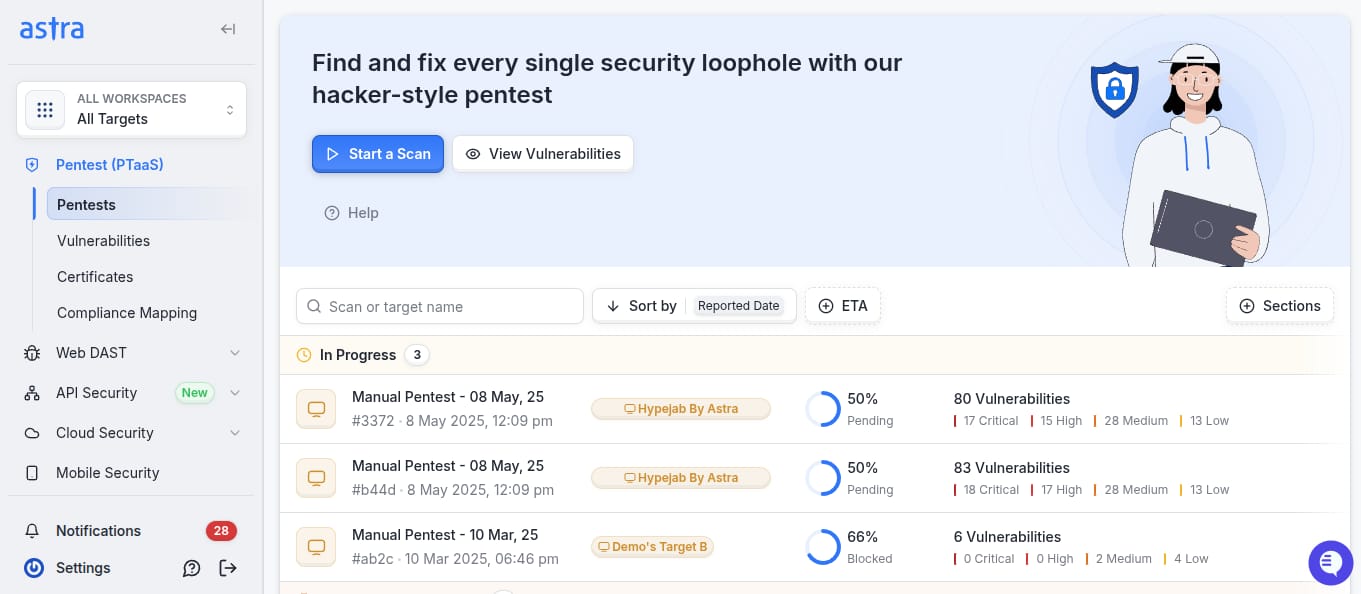
- 15,000+ test cases updated biweekly
- AI-powered test cases enhancing RBI pentesting accuracy
- Zero false positives for precise vulnerability detection
- Scan behind login pages for RBI security coverage
- Integrations with Slack, Jira, GitHub, GitLab, Jenkins for easy workflows
- Customizable reports tailored for RBI compliance management and developers
- Certified in-house experts (OSCP, CEH, eJPT, CCSP) specialized in RBI standards
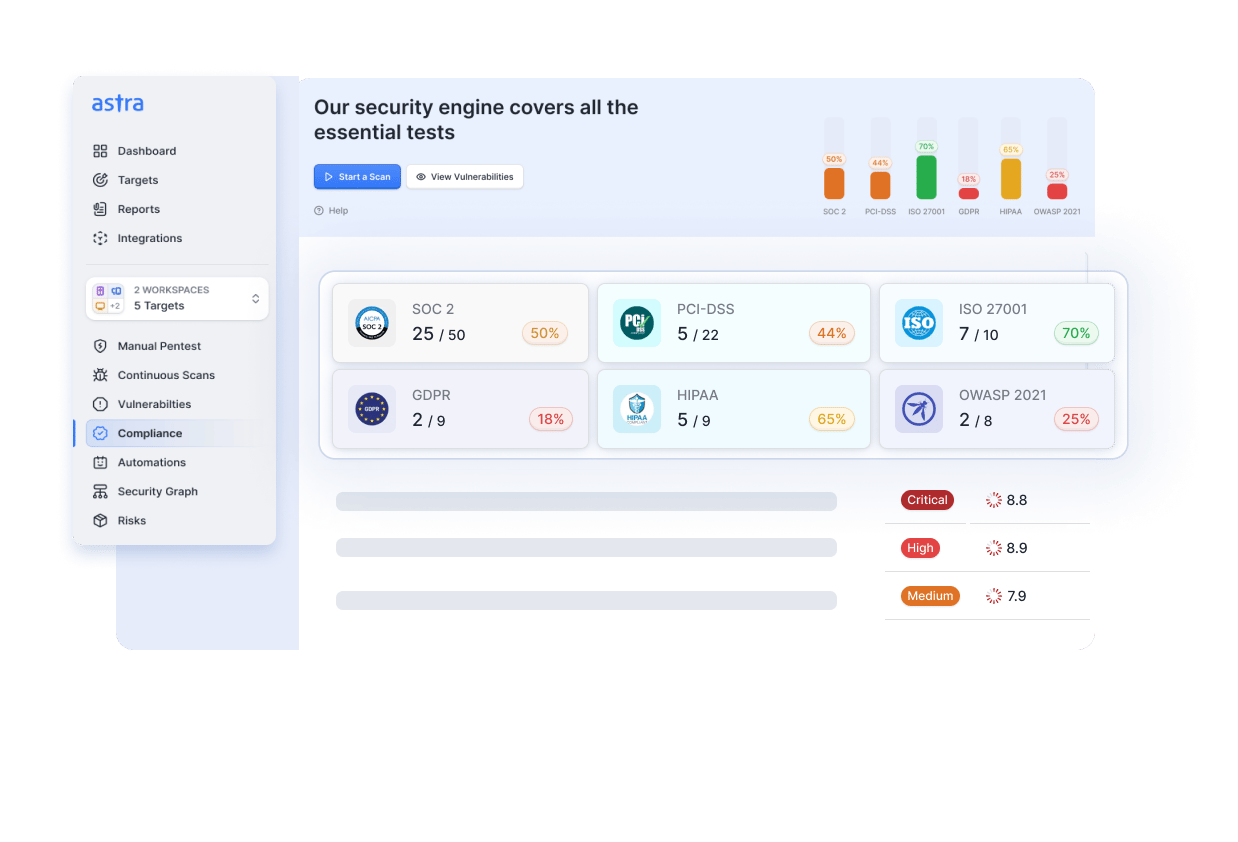
Astra Security simplifies how to get RBI certification by translating RBI’s VA/PT mandates into clear, automated workflows: semi-annual vulnerability scans and annual penetration tests for critical systems are scheduled by default, with lifecycle checks triggered before go-live, post-deployment, and after every major change, alongside generating audit-ready reports directly mapped to compliance clauses..
Beyond compliance, our RBI VAPT services, which include a comprehensive report, combine over 15,000 automated DAST checks with deep manual penetration testing by CERT-In certified experts. This is enhanced by behind-login coverage, AI-assisted logic testing, and two included rescans, which significantly reduce remediation cycles.
Final Thoughts
India has experienced a significant leap in digital payments, transforming the financial ecosystem on the one hand and thereby posing cybersecurity challenges that require a comprehensive approach.
RBI’s cybersecurity frameworks set the standard for securely operating this critical infrastructure. It requires a commitment to adopting, implementing, and evolving security practices that keep pace with the threat environment.
The RBI compliance testing checklist discussed in the blog outlines the minimum scope required by the RBI for compliance testing, including regular assessments, improvements, and adaptation. Organizations that implement regular penetration testing will meet regulatory requirements while building the resilience needed to maintain customer trust.
FAQs
1. Who needs to comply with RBI cybersecurity guidelines?
All scheduled commercial banks, urban cooperative banks, NBFCs, payment banks, and financial institutions regulated by RBI must comply with these guidelines to safeguard sensitive data and ensure robust cybersecurity measures as per regulatory standards.
2. What are the key requirements of the RBI cybersecurity framework?
Banks must implement risk management, access controls, incident response plans, security monitoring, staff training, and regular security audits. These measures help protect customer data and ensure regulatory compliance with the RBI’s standards.
3. What happens if a bank fails to comply with RBI cybersecurity guidelines?
Non-compliance can result in regulatory penalties, restrictions on operations, monetary fines, or even license revocation. Banks also risk reputational damage and greater vulnerability to cyberattacks if they fail to meet RBI requirements.
4. How soon must security incidents be reported to RBI?
Security incidents must be reported to RBI within two to six hours of discovery. Updates should be provided if initial reports are incomplete, ensuring timely communication and transparent resolution of cyber events.