Have you ever tried to answer “Is this container safe to run?” If yes, then you know how tricky that question is. Securing containers is one of the toughest jobs in security, and hunting vulnerabilities across an estate of them gives security folks the same vibe as hunting in the fifth domain.
Container vulnerabilities can live almost anywhere, from the image layers down to the kernel, and every week, a new base image, a new dependency, or a new manifest change opens a fresh gap.
Because the surface is so wide, there is a long-running myth that catching all of it needs a commercial platform. In reality, open-source tools can push coverage just as far, provided your team can absorb the tuning and integration work that a vendor would otherwise handle for you.
To help you go down that route without burning weeks on trial and error, we have put together the top 10 open-source container security tools in 2026. For each one, you get what it catches, where it fits in the stack, and its real limitations, so you can layer them into a defense that makes hunting container vulnerabilities a lot easier.
Top 10 Open-Source Container Security Tools
- Trivy
- Grype and Syft
- Clair
- Falco
- Tetragon
- Tracee
- Kubescape
- Docker Bench for Security
- Checkov
- Cosign
Top 10 Open-Source Container Security Tools in 2026
1. Trivy
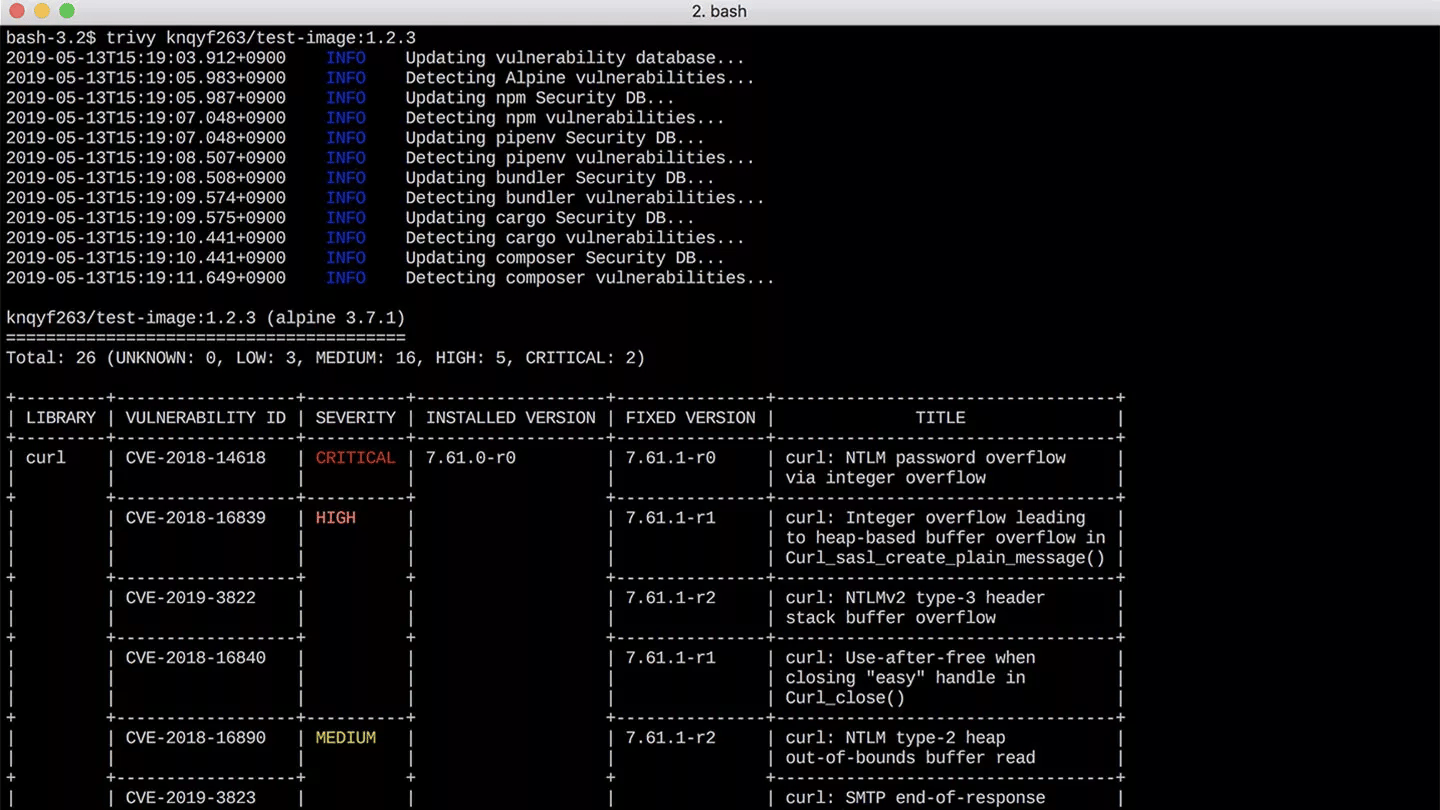
Trivy, maintained by Aqua Security, has become the de facto open-source scanner that most teams reach for first, and it anchors more container security tools pipelines than any other project.
Trivy parses the operating system package database (Alpine apk, Debian and Ubuntu dpkg, RHEL and Amazon Linux rpm) and the language lockfiles inside an image (npm, pip, Poetry, Maven, Go modules, Cargo, Composer), matches each component against vulnerability feeds, and emits CVEs with severity ratings, which is the baseline job every container security tools comparison starts from.
Beyond image scanning, it also performs Infrastructure as Code (IaC) misconfiguration checks (it absorbed the tfsec project), secret detection across roughly 100 credential patterns, and Software Bill of Materials (SBOM) generation in CycloneDX and SPDX formats.
Pros
- Covers image CVEs, IaC, secrets, SBOM, and Kubernetes cluster scanning, which collapses several container security tools into one install.
- Trivial CI/CD integration with native SARIF output that flows straight into GitHub code scanning.
- Extremely fast scans with a local vulnerability database that can run fully air-gapped.
- Broad ecosystem coverage, including Wolfi, Chainguard, and Bottlerocket base images.
Cons
- No runtime visibility
- High-volume CVE output without exploitability context
Use case: Your default build-time container security tools for image, IaC, and secret scanning across both Docker and Kubernetes workloads.
2. Grype and Syft
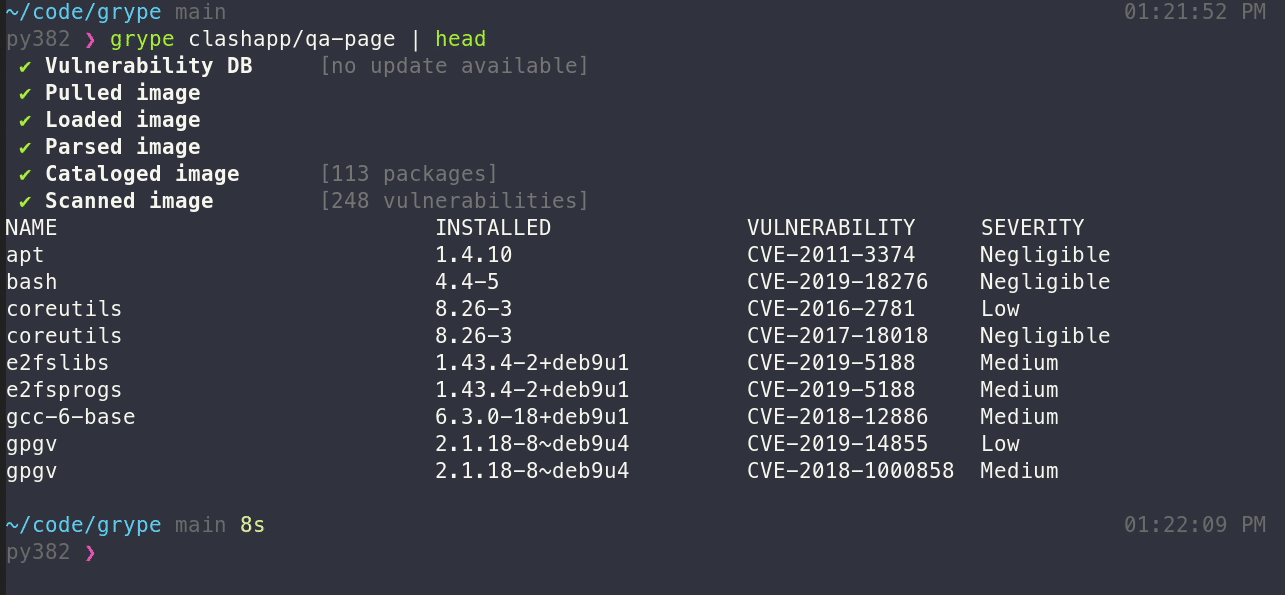
Grype and Syft, both from Anchore, form a tight pair that splits the SBOM and vulnerability-match problem cleanly. Syft generates the SBOM, cataloguing every package and layer in an image, and Grype consumes that SBOM to match components against vulnerability data.
Keeping generation and matching as separate container security tools is an architectural choice that pays off: you produce one signed SBOM at build time, store it, and re-scan it repeatedly as new CVEs are disclosed without rebuilding the image.
Pros
- Clean separation of SBOM generation from vulnerability matching, ideal for compliance pipelines.
- Re-scan stored SBOMs against new CVE data without touching the original image.
- Strong distro-aware matching that respects backported security patches.
- Lightweight and scriptable, making it easy to chain with other container security tools.
Cons
- Narrower scope than Trivy
- Two tools to manage and update, rather than one consolidated scanner.
Use case: SBOM-centric teams that want container security tools which decouple bill-of-materials generation from ongoing CVE matching.
3. Clair
Clair, originally built for the Quay registry, is one of the oldest container scanning tools still in active use, dating to 2015. Its design centers on registry-side scanning: as images are pushed, Clair indexes their layers, stores the contents in a database, and continuously re-evaluates stored layers against updated vulnerability sources.
Among open source container security tools, it occupies the registry-integration niche, and it is the engine behind Quay’s built-in scanning. Teams running their own registry often deploy Clair as the registry-side container security tool’s backend, so every pushed image is evaluated before it can be pulled into a cluster.
Pros
- Purpose-built for registry integration and continuous re-scanning of stored layers.
- Layer-indexing architecture scales efficiently across large image repositories.
- API-driven, so it slots into existing registry and admission workflows.
- Mature and battle-tested as the engine behind Quay.
Cons
- More operationally heavy to deploy and run than a single-binary CLI scanner.
- Focused on OS-level packages; language-dependency coverage lags behind Trivy and Grype.
Use case: Teams running a self-hosted registry that want every pushed image scanned at the registry layer.
4. Falco
Falco is the CNCF-graduated standard for runtime security and the project that effectively defines the container runtime security tools category. It graduated from CNCF in February 2024, having originated at Sysdig in 2016.
Falco loads an eBPF probe (or a kernel module) on each node and monitors Linux syscalls in real time. When a process opens /etc/shadow, spawns an unexpected shell inside a running container, or makes an outbound connection that violates policy, Falco evaluates that event against a declarative YAML ruleset and fires an alert.
Falco’s rulesets are mapped to MITRE ATT&CK for Containers, PCI DSS, and NIST 800-190, and Falco’s sidekick fans out alerts to more than 70 tools like Splunk, Elasticsearch, etc
Pros
- True kernel-level runtime detection that catches post-deployment behavior no scanner can see.
- CNCF-graduated maturity with the largest community and richest ruleset of any runtime tool.
- eBPF data collection keeps overhead low while giving full syscall visibility.
- Falcosidekick integrates cleanly with the rest of your container security tools and SIEM pipeline.
Cons
- Alert-focused by default; in-line blocking requires pairing with response automation or admission control.
- Custom rule tuning is mandatory, and an untuned deployment generates noise.
Use case: Any Kubernetes or container environment that needs runtime container security tools layered on top of build-time scanning.
5. Tetragon
Tetragon, from the Cilium and Isovalent ecosystem, is the runtime tool to reach for when eBPF precision and in-line enforcement matter. Like Falco, it observes syscalls through eBPF, but its differentiator is enforcement: using Linux Security Module (LSM) hooks, Tetragon can block a malicious action in the kernel.
This enforcement capability places Tetragon among the more aggressive open-source container security tools and among the few container runtime security tools that block rather than just alert.
Pros
- In-line kernel enforcement via LSM hooks.
- Native Cilium integration unifies network and runtime security telemetry.
- Low-overhead eBPF observation with fine-grained process-lineage tracking.
- Strong fit for teams standardizing on the Cilium data plane.
Cons
- Tightest value is realized with Cilium; standalone use loses some of the integration benefit.
- Policy authoring has a steeper learning curve than Falco’s YAML rules.
Use case: Cilium-based clusters that need runtime container security tools with kernel-level blocking in one place.
6. Tracee
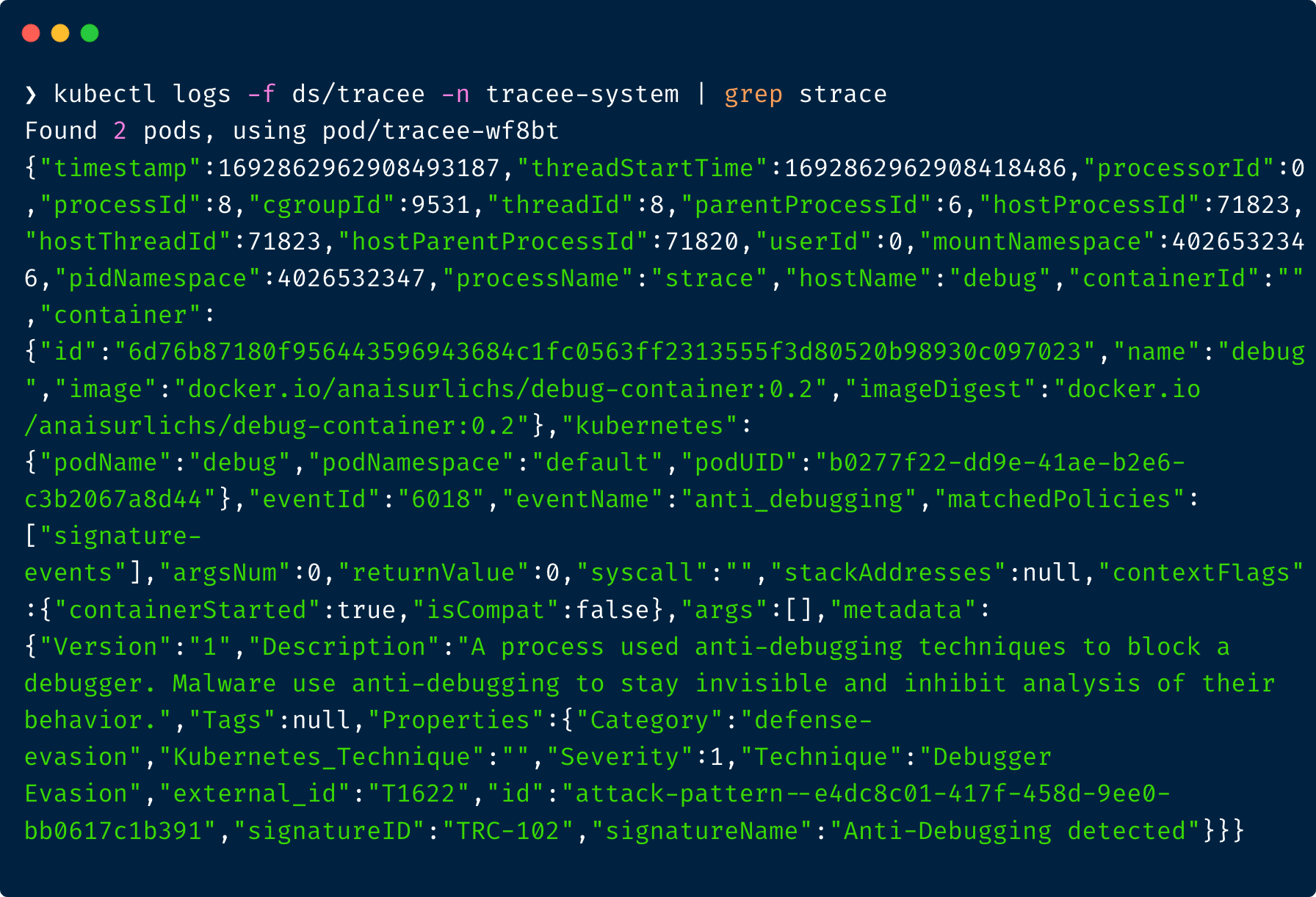
Tracee, also from Aqua Security, is an eBPF-based runtime detection engine that traces events and syscalls at the kernel level and evaluates them against a signature library to surface suspicious behavior, e.g., anti-debugging, code injection, and container escapes.
Since Tracee and Trivy share a maintainer, teams already standardized on Aqua’s open source container security tools to get a coherent build-plus-runtime story from a single ecosystem.
Among container runtime security tools, its signature-based approach suits teams that want detection rules out of the box, and it slots in alongside the rest of your container security tools without demanding a new data plane.
Pros
- eBPF runtime detection with a curated signature library covering escapes and injection.
- Coherent pairing with Trivy for teams on the Aqua ecosystem.
- Detects container-escape and defense-evasion behaviors that static scanners miss.
- Simple to deploy as a DaemonSet across a cluster.
Cons
- Smaller community and ruleset than Falco.
- Detection-only; enforcement requires additional tooling.
Use case: Aqua-ecosystem teams wanting runtime detection that complements Trivy image scanning.
7. Kubescape
Kubescape, created by ARMO and a CNCF incubating project as of January 2025, is the leading open-source scanner for Kubernetes misconfiguration and posture. Its differentiator among container security tools is first-class mapping to the NSA and CISA Kubernetes Hardening Guidance, the CIS Kubernetes Benchmark, and MITRE ATT&CK.
Rather than flagging a generic best-practice violation, Kubescape tags each finding with the specific NSA control and ATT&CK technique it relates to, which makes remediation and audit reporting concrete.
As one of the more comprehensive open-source container security tools, it evaluates RBAC, network policies, and workload configurations together rather than in isolation.
Pros
- Direct mapping of findings to NSA-CISA, CIS, and MITRE ATT&CK controls.
- Scans manifests, live clusters, and images, covering CI/CD through production.
- CNCF incubating status signals validated project health and momentum.
- VS Code extension surfaces misconfigurations as developers write manifests.
Cons
- Kubernetes-focused, so it adds little for plain Docker security tools workflows.
- Posture scanning alone does not detect runtime behavior; it must be paired with a runtime tool.
Use case: Kubernetes teams needing framework-mapped misconfiguration container security tools across CI and live clusters.
8. Docker Bench for Security
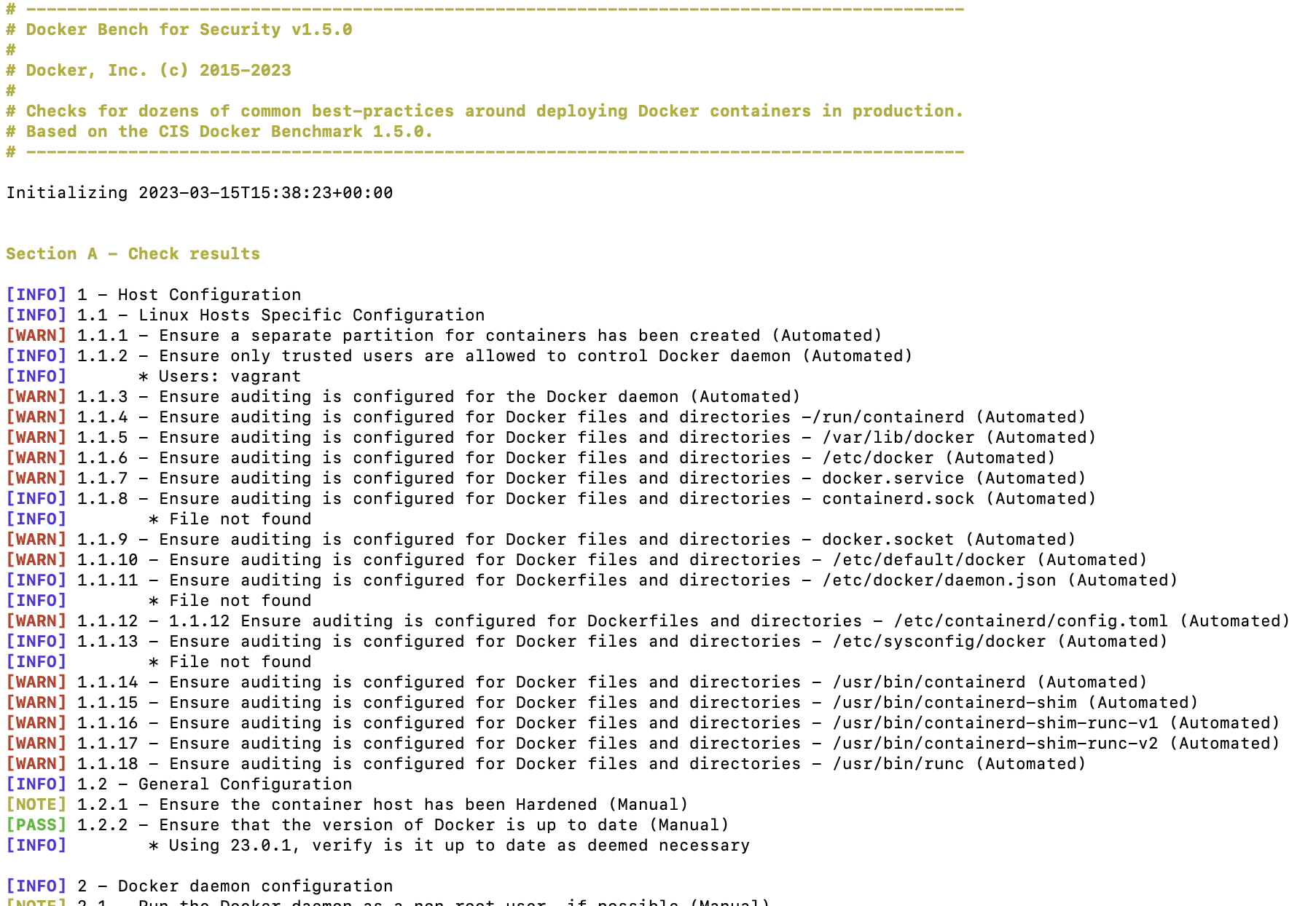
Docker Bench for Security is the reference implementation of the CIS Docker Benchmark, and it remains one of the most direct Docker security tools available as open source. It is a script that inspects a Docker host and its running containers against dozens of CIS checks.
For teams running Docker outside Kubernetes, it is one of the few container security tools purpose-built for the host and daemon layer rather than the image, a blind spot most container security tools share.
Pros
- Direct, scriptable implementation of the CIS Docker Benchmark with mapped recommendations.
- Audits the host and daemon layer that image scanners ignore entirely.
- Zero infrastructure to deploy; it runs as a single container or script.
- Pairs with kube-bench to cover both Docker hosts and Kubernetes nodes.
Cons
- Point-in-time audit rather than continuous monitoring.
- Reports findings without remediating them, so follow-up is manual.
Use case: Hardening Docker hosts and daemons against CIS benchmarks, especially in non-Kubernetes deployments.
Bonus Tip: Its sibling for Kubernetes nodes, kube-bench, applies the same CIS-benchmark approach to control-plane and worker configuration, and the two are frequently run together as host-hardening container security tools.
9. Checkov
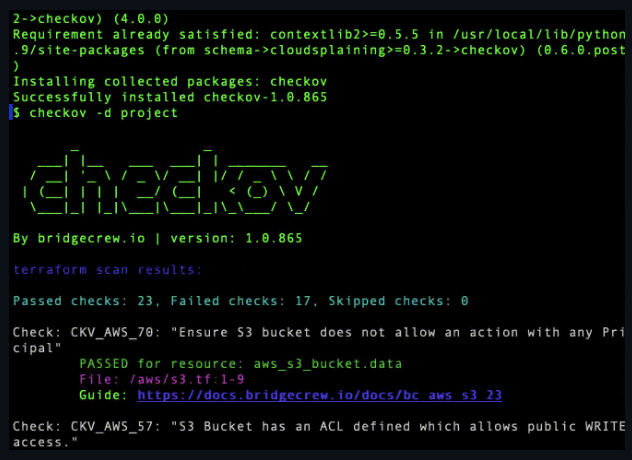
Checkov, maintained by Bridgecrew (now part of Palo Alto Networks), is a static analysis engine for Infrastructure as Code that ships with more than 1,000 built-in policies. While it spans Terraform, CloudFormation, and Helm, its relevance to container security tools is in catching the misconfigurations that define a container’s blast radius before deployment.
Checkov reads the YAML and HCL that describe your containers and infrastructure, then fails the build when a definition would create an exploitable gap. It is policy-as-code at the pipeline gate, and it complements image-focused container security tools by catching the orchestration-layer mistakes those scanners never see.
Pros
- Over 1,000 built-in policies spanning Kubernetes, Terraform, Helm, and Dockerfiles.
- Catches privileged pods, capability misuse, and exposed services before deployment.
- Custom policy support in Python and YAML for organization-specific guardrails.
- Fast CI/CD gate with SARIF output and broad platform coverage.
Cons
- Static IaC analysis only
- Large default policy set requires tuning to avoid alert fatigue.
Use case: Pipeline-stage container security tools that block insecure container and infrastructure definitions pre-deploy.
10. Cosign
Cosign, part of the Sigstore project, closes the supply-chain gap that scanning container security tools leave open. It signs container images and verifies those signatures at admission, so a cluster can refuse to run any image that was not signed by a trusted identity.
Sigstore’s keyless flow uses short-lived certificates from Fulcio and an immutable transparency log in Rekor, removing the nightmare of long-lived signing keys.
Pros
- Keyless signing via Fulcio and Rekor eliminates long-lived key management.
- Admission-time verification blocks unsigned or tampered images from running.
- Immutable transparency log gives auditable provenance for every signature.
- Integrates with Kyverno and other admission controllers as enforcement.
Cons
- Solves provenance, not vulnerabilities
- Requires an admission-controller integration to enforce, adding setup complexity.
Use case: Supply-chain container security tools that allow only signed, verifiably-built images to run.
Where to Use Which Tool and How to Layer Them
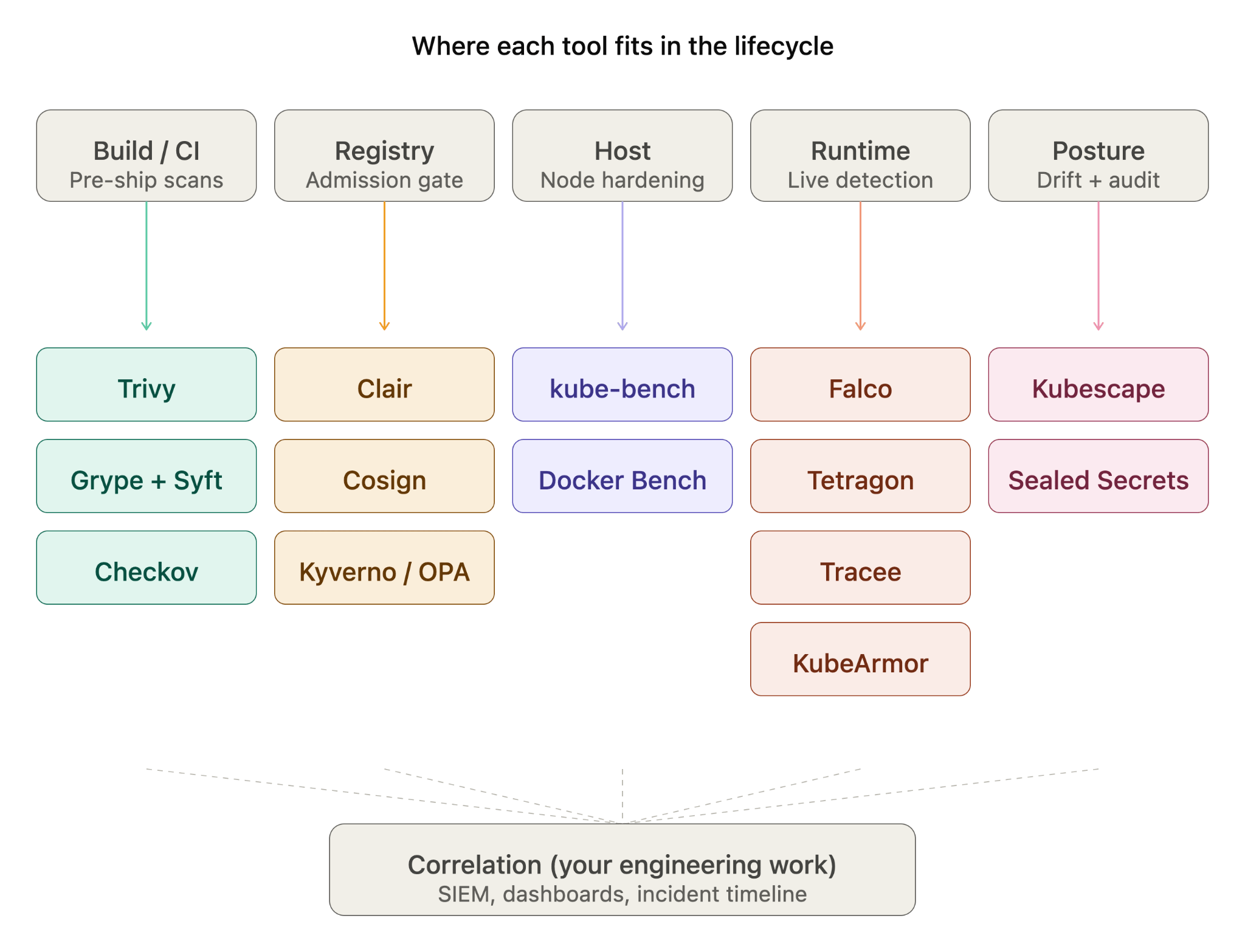
The open-source tools can be split into five branches (image scanning, supply chain, posture, runtime, and correlation) because the attack surface itself is split, and any open-source tool claiming to own all five at depth is overstating its reach.
While there are commercial tools that fold all five into one platform, doing the same with open source means stitching several focused tools together yourself.
The simplest way to get the maximum ROI from these tools is to match each one to the stage where containers actually get attacked. Here is how that breaks down.
- Build and CI/CD: Run Trivy (or Grype + Syft) to scan images for CVEs, and Checkov to catch misconfigured manifests before they ship. Fail the build on critical findings, since a vulnerability fixed here never reaches production.
- Registry and admission: Use Clair for continuous registry-side re-scanning, and Cosign with an admission controller to block any unsigned image from running.
- Host hardening: Run Docker Bench for Security on Docker hosts and kube-bench on Kubernetes nodes to audit against CIS benchmarks.
- Runtime: Deploy Falco for behavioral detection, add Tetragon where you need kernel-level blocking or already run Cilium, and use Tracee if your stack is Aqua-centric.
- Posture and drift: Schedule Kubescape against live clusters to catch configuration drift and map findings to NSA, CIS, and MITRE controls.
The biggest drawback is correlation. Each tool alerts in its own format and its own dashboard, so when a real attack chains across layers, someone still has to connect the timeline by hand. Layering gives you the coverage, but the correlation work is the price you pay for using open source container security tools instead of going commercial.
This setup is best suited to teams with solid engineering depth, the kind that can absorb the tuning and integration work.
How Astra Helps Secure Your Containers
At Astra, we offer manual penetration testing for containerized environments, where our security engineers treat your stack the way a real adversary would. Instead of reading one alert at a time, they look for the path between them, i.e., a vulnerable image that leads to a privileged pod, an over-permissive RBAC binding that enables lateral movement, or a misconfigured secret that opens the door to your registry.
The findings are mapped to compliance, so you know which gaps are exploitable and which are blocking compliance. We do not stop at the report either; our team works with your engineers on remediation, helping you fix what was found and verify the fix actually closed the gap.
If any of these sound like your environment, manual penetration testing for containers is the next step worth taking:
- You run containers in production but have never tested them against a real attack path.
- Your scanners flag hundreds of findings, and you cannot tell which ones are genuinely exploitable.
- You rely on open-source tools and want to know whether the layers actually hold together.
- You handle sensitive data or fall under a compliance regime that expects periodic third-party testing.
- You have made changes to your cluster, registry, or runtime config and want assurance that nothing has opened up.
If two or three of these apply, automated scanning alone is no longer enough to tell you where you stand.
You can contact us to book a demo and see how Astra validates whether your container defenses hold against a real attacker.
Final Thoughts
There is no single open-source tool that secures a container from build to runtime, and chasing one is how teams end up with gaps. The ten covered here work because each owns a stage where containers actually get attacked, and together they give you coverage across scanning, supply chain, posture, and runtime without a licensing bill.
That said, picking the tools is the easy 20 percent of the work. The other 80 percent is everything that does not fit in a comparison table, i.e., tuning rulesets so alerts carry signal, writing custom policies for your environment, wiring output into your pipeline gates, and more.
Choosing and installing a tool only takes hours, but building the muscle to run it takes time, and a lot of engineering hours if the environment is complex. So start with these open-source tools, layer them by stage, and let production pressure shape the stack. If the budget allows, go for a commercial tool, as it offers better support and correlation.
And whatever your stack ends up looking like, run a manual penetration test by a third party from time to time, because tools prove coverage on paper while a human attacker is the only one who proves whether the layers actually hold.
FAQS
What are container security tools?
Container security tools are software that detect vulnerabilities, misconfigurations, malicious runtime behavior, and supply-chain risks across the build, registry, and runtime stages of the container lifecycle, spanning image scanners, runtime monitors, and signing tools.
Are open-source container security tools good enough for production?
No, they take a lot of labor and engineering hours to tune. Several open-source container security tools are CNCF-graduated or incubating, so they are solid, but nothing comes close to the commercial options, which offer better support
What is the difference between container scanning tools and container runtime security tools?
Container scanning tools analyze static artifacts: an image’s package tree, its SBOM, and its known CVEs before deployment. Container runtime security tools watch live behavior, observing kernel syscalls to catch a container doing something malicious after it is already running.
Which container security tools should I start with?
A realistic starting set of container security tools is Trivy for image and IaC scanning, Falco for runtime detection, and Kubescape for Kubernetes posture, all free and open source. That trio covers build-time, runtime, and configuration in one move.
Do these tools work for Docker as well as Kubernetes?
Most do, with some specialization. Trivy, Grype, Clair, and Cosign operate on Docker images directly, which makes them solid Docker security tools as well as Kubernetes container security tools. Docker Bench for Security is purpose-built for Docker hosts and daemons, while posture scanners like Kubescape and kube-bench add the most value once you are orchestrating with Kubernetes.
Can container security tools replace manual penetration testing?
No. Container security tools automate the detection of known vulnerabilities and misconfigurations, which is essential coverage no team should skip. They do not chain those findings into real attack paths the way a human attacker does. Alongside open-source or commercial tooling, manual penetration testing by a third party remains necessary to uncover those chains.