Somewhere right now, someone is spinning up a fresh Kubernetes cluster, feeling pretty good with a basic firewall, skimmed a hardening guide, and maybe even applied a few CIS benchmarks. What could possibly go wrong?
Roughly 18 minutes. That’s the average time before a newly exposed Kubernetes cluster receives its first malicious probe or attack attempt. So there’s zero room for error when it comes to securing Kubernetes.
Kubernetes environments are complex, dynamic, and high-value targets, but the good news is that they can be secured by open-source security tooling, too.
And let’s be real, open-source Kubernetes security tools can be a bit like the Wild West.
So we roped in our Kubernetes security folks and narrowed it down to the 10 open-source tools actually worth running in 2026 to help k8 security folks. Each entry below covers what the tool does, where it fits, and where it falls short, so you know exactly which tool to reach for at each layer and how they fit together into one stack that actually holds.
What to Look for in a Kubernetes Security Solution
Kubernetes security maps cleanly to the 4 C’s of cloud-native security: Code, Container, Cluster, and Cloud. Each layer nests inside the next. Insecure code rides inside a container, a container runs inside a cluster, and the cluster lives inside a cloud account.
A complete Kubernetes security solution has to cover all four, because an attacker only needs one to be weak. In simpler terms, securing the cluster does nothing if the image it schedules ships with a known remote-code-execution CVE.
The cleaner way to think about tool selection is by lifecycle stage, because each stage has its own category of tooling.
- Scan (build): Catch vulnerabilities, misconfigurations, and secrets in images and manifests before they ship.
- Enforce (deploy): Use admission control to reject anything that violates policy at the moment of deployment.
- Detect (runtime): Watch kernel syscalls and process behavior to catch what static checks missed.
- Comply (operate): Continuously grade the live cluster against frameworks and prove it for auditors.
Quick Comparison of the Best Kubernetes Security Tools
| Tool | Category | Open Source / Commercial | Best For | Key Standout |
|---|---|---|---|---|
| Kubescape | KSPM / posture | Open source (CNCF Incubating) | Framework-mapped misconfig scanning | Maps findings to NSA/CISA, CIS, MITRE ATT&CK |
| Trivy | Scanner | Open source | Image, IaC, and cluster scanning | One binary for CVEs, secrets, SBOM, IaC |
| Falco | Runtime detection | Open source (CNCF Graduated) | Kernel-level threat detection | eBPF syscall monitoring with rich rules |
| Tetragon | Runtime + enforcement | Open source | In-line kernel blocking | LSM-based enforcement, Cilium-native |
| Kyverno | Policy/admission | Open source (CNCF Graduated) | YAML-native policy | Policies as Kubernetes manifests, no new DSL |
| OPA / Gatekeeper | Policy/admission | Open source (CNCF Graduated) | Complex custom policy | Rego language for expressive rules |
| kube-bench | Posture / CIS | Open source | CIS Benchmark auditing | Reference check against CIS Kubernetes Benchmark |
| Tracee | Runtime detection | Open source | eBPF behavioral detection | Signature-based escape and injection detection |
| KubeArmor | Runtime enforcement | Open source (CNCF Sandbox) | Inline runtime hardening | LSM-based policy enforcement per workload |
| Sealed Secrets | Secrets management | Open source | GitOps-safe secrets | Encrypts secrets so they can live in Git |
Best Open-Source Kubernetes Security Tools
Evaluation Criteria
When you evaluate any Kubernetes security solution, open source or commercial, weigh it against a consistent checklist:
- eBPF-based runtime visibility, which observes syscalls at the kernel with low overhead rather than relying on brittle sidecars.
- Native CI/CD integration with machine-readable output (SARIF, JSON) that fails builds on critical findings.
- Admission control to block non-compliant workloads at deploy time rather than only alerting after.
- Multi-cloud and multi-distro support across EKS, GKE, AKS, and self-managed clusters.
- Compliance reporting mapped to named frameworks: CIS Kubernetes Benchmark, NSA/CISA Kubernetes Hardening Guidance, and SOC 2.
A tool that covers four or five of these well is worth more than one that claims all of them shallowly.
1. Kubescape
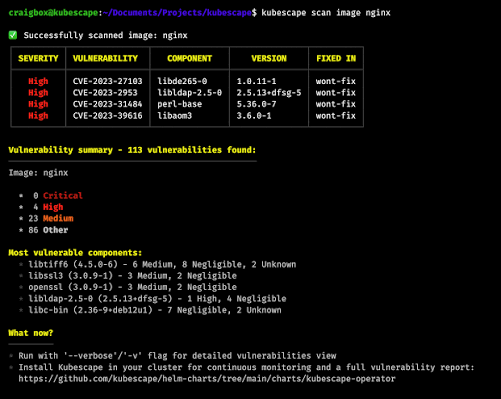
Kubescape, created by ARMO and a CNCF incubating project as of January 2025, is the leading open-source Kubernetes Security Posture Management (KSPM) tool. It grades your cluster against the hardening frameworks auditors actually cite and hands you the specific control ID for every failure.
Rather than flagging a generic best-practice violation, it tags each finding with the matching NSA/CISA control and MITRE ATT&CK technique, which makes both remediation and audit reporting concrete.
Key capabilities
- Framework-mapped scanning against the NSA/CISA Kubernetes Hardening Guidance, CIS Kubernetes Benchmark, and MITRE ATT&CK.
- Scans manifest in CI, live clusters, and container images from a single tool.
- An eBPF-based runtime context that flags which vulnerable code paths are actually executed.
- Output in JSON, SARIF, JUnit, HTML, and PDF for both pipelines and compliance teams.
Limitations
- Posture scanning alone does not detect live runtime threats and must be paired with a runtime tool.
- The richest experience and historical data require the hosted ARMO platform.
- Large clusters can produce a high finding count that needs tuning to prioritize.
Usage: Run kubescape scan framework nsa against a live cluster to grade it on the NSA hardening framework, or wire kubescape scan ./manifests/ into CI with a compliance threshold to fail pull requests below a set score.
2. Trivy
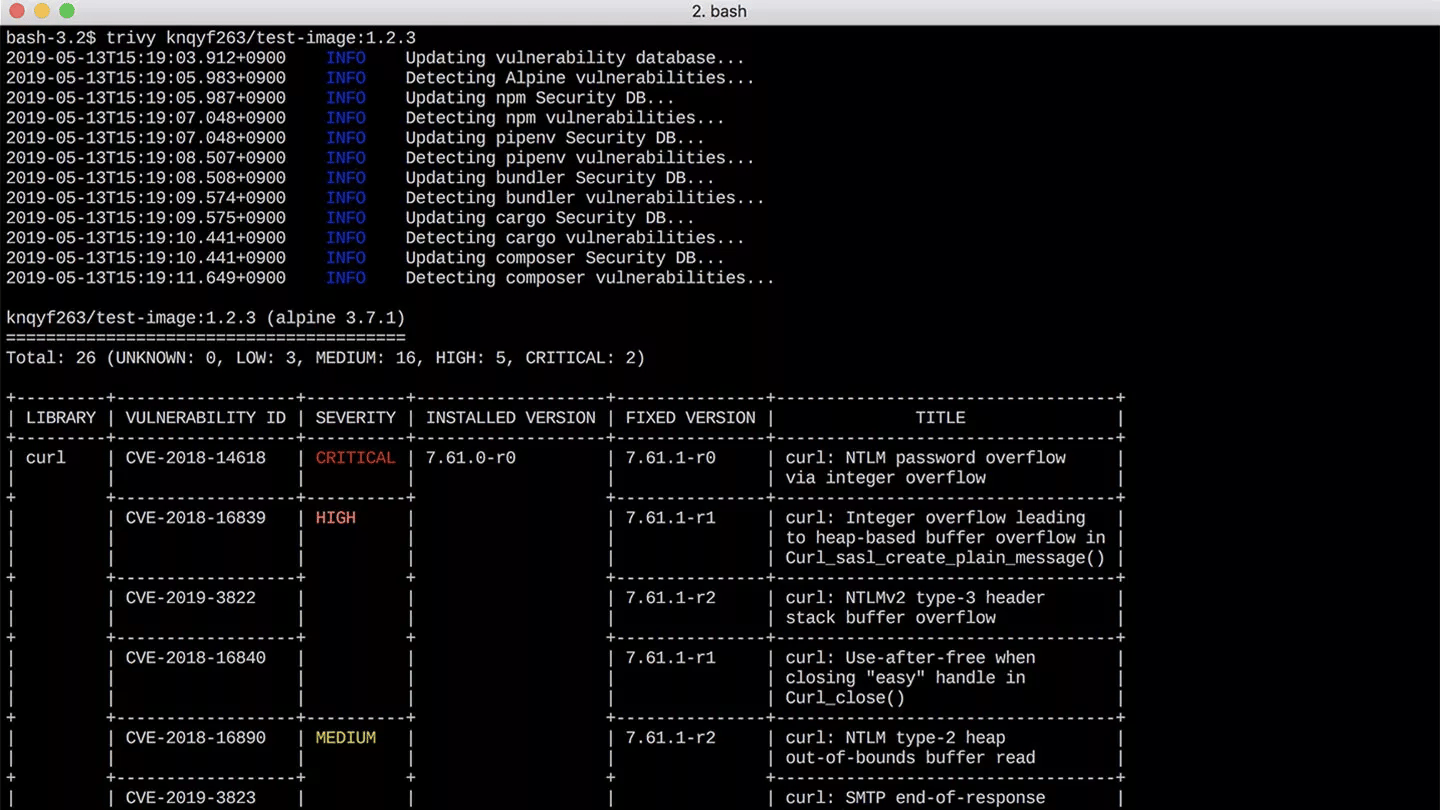
Trivy, from Aqua Security, is the de facto open-source scanner and the most common entry point into any Kubernetes security solution. A single binary covers image CVEs, Infrastructure as Code (IaC) misconfiguration, secret detection, and Software Bill of Materials (SBOM) generation, and the Trivy Operator extends that into continuous in-cluster scanning of running workloads.
Key capabilities
- One binary scans images, filesystems, Git repos, and Kubernetes clusters for CVEs.
- IaC misconfiguration scanning for Dockerfiles, Kubernetes YAML, Terraform, and Helm (it absorbed tfsec).
- Secret detection across roughly 100 credential patterns plus SBOM generation in CycloneDX and SPDX.
- Trivy Operator runs continuous in-cluster scans and exposes results as Kubernetes custom resources.
Limitations
- No runtime visibility; it sees configured state, never observed behavior post-deployment.
- High-volume CVE output without exploitability context can bury the findings that matter.
- Cluster-wide operator scanning adds resource overhead that needs sizing on large fleets.
Usage: Run trivy image myregistry/app:1.2.3 –severity HIGH,CRITICAL in CI to fail builds on serious CVEs, or deploy the Trivy Operator to continuously scan every workload already running in the cluster.
3. Falco
Falco is the CNCF-graduated standard for runtime security, having graduated in February 2024 after originating at Sysdig in 2016. It loads an eBPF probe on each node and watches Linux syscalls in real time, firing an alert when a process spawns an unexpected shell, reads /etc/shadow, or makes an outbound connection that violates policy.
Its key capability is a declarative rule engine with packs mapped to MITRE ATT&CK for Containers, PCI DSS, and NIST 800-190, plus Falcosidekick to fan alerts out to more than 70 destinations. This is the layer that catches cryptojacking worms like TeamTNT, which targeted exposed Kubelet and Docker APIs to drop miners
Key capabilities
- Kernel-level syscall monitoring via eBPF with low runtime overhead.
- Declarative YAML rule engine with packs mapped to MITRE ATT&CK for Containers, PCI DSS, and NIST 800-190.
- Kubernetes and container metadata enrichment so alerts name the offending pod, namespace, and image.
- Falcosidekick fans alerts out to 70+ destinations, including Splunk, Elasticsearch, and Slack.
Limitations
- Alert-focused by default; in-line blocking requires pairing with response automation or admission control.
- Untuned rulesets are noisy and demand ongoing maintenance to stay actionable.
- Syscall-level detection adds node-level resource cost that scales with event volume.
Usage: Deploy Falco as a DaemonSet via Helm and route alerts through Falcosidekick into your SIEM, then tune the default ruleset to your workloads to cut false positives.
4. Tetragon
Tetragon, from the Cilium and Isovalent ecosystem, is the runtime tool to reach for when you need enforcement rather than just detection. Like Falco, it observes syscalls through eBPF, but its differentiator is that Linux Security Module (LSM) hooks let it block a malicious action in the kernel mid-execution.
Tetragon integrates natively with Cilium, so teams already running Cilium as their CNI get network and runtime context from one data plane.
Key capabilities
- In-line kernel enforcement via LSM hooks, not detection alone.
- Fine-grained process-lineage and file-access tracking through eBPF.
- TracingPolicy custom resources for precise, declarative observation and enforcement rules.
Limitations
- Tightest value depends on Cilium; standalone use loses much of the integration benefit.
- Policy authoring has a steeper learning curve than Falco’s YAML rules.
- A younger enforcement ecosystem means fewer community rule packs than Falco.
Usage: Apply a TracingPolicy that blocks execve of disallowed binaries inside a namespace, giving you kernel-level prevention rather than an after-the-fact alert.
Falco vs. Tetragon, which should I use?
Both are eBPF runtime tools, but they differ on enforcement. Falco is detection-focused, has the largest community and richest ruleset, and is the safer default for most clusters. Tetragon adds kernel-level in-line blocking via LSM hooks and integrates natively with Cilium, so it is the better fit if you already run Cilium or need active blocking rather than alerting alone.
5. Kyverno
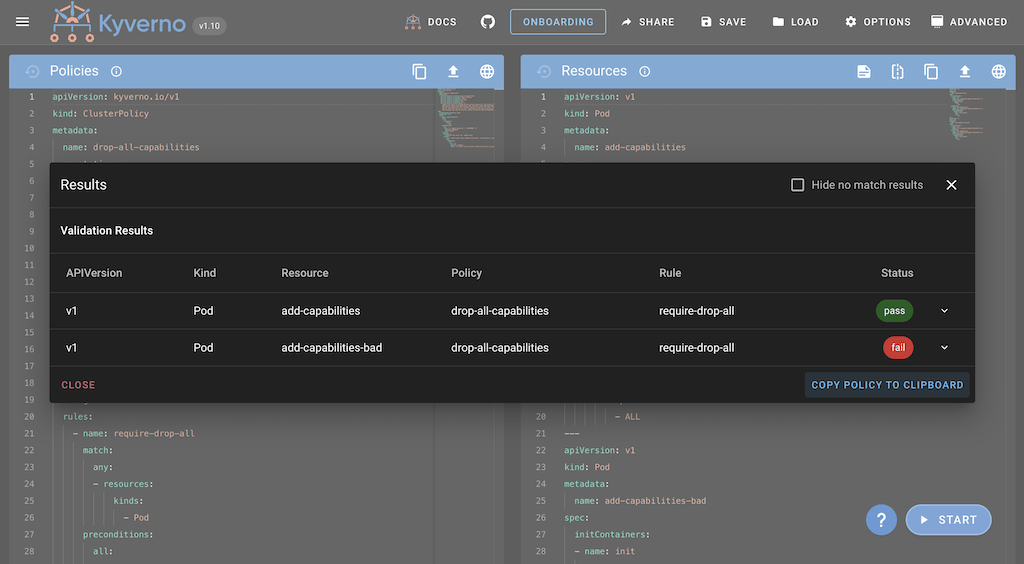
Kyverno, a mature CNCF policy engine and admission controller, is built for teams that do not want to learn a new language. Its standout is that policies are written as ordinary Kubernetes manifests in YAML, so anyone who can write a Deployment can write a policy in half an hour.
Beyond validation, it can mutate incoming resources and generate new ones, which makes it a guardrail and an automation tool at once. It is the most approachable way to enforce Pod Security Standards and default-deny patterns at the admission gate.
Key capabilities
- Validation rules that reject non-compliant workloads at admission.
- Mutation rules that inject secure defaults such as security contexts automatically.
- Generation rules that auto-create resources like default-deny NetworkPolicies per namespace.
- Image verification that enforces Cosign signatures before a Pod can run.
Limitations
- Extremely complex conditional logic is easier to express in OPA’s Rego than in Kyverno patterns.
- Heavy mutation and generation policies add admission-webhook latency at scale.
- As an admission controller, it governs deploy time, not runtime behavior.
Usage: Apply a ClusterPolicy in Enforce mode that denies any Pod running as root or lacking a read-only root filesystem, blocking insecure workloads before they schedule.
6. OPA Gatekeeper
Open Policy Agent (OPA), a CNCF graduated project, is a general-purpose policy engine, and Gatekeeper is its Kubernetes admission-controller integration. OPA evaluates requests against policies written in Rego, a purpose-built declarative language.
If Kyverno is the no-code option, OPA is the one you reach for when rules get genuinely complex, since Rego can encode logic spanning multiple resources and external data in ways YAML patterns cannot.
Key capabilities
- Rego policy language is expressive enough for cross-resource and external-data logic.
- Constraint templates that turn reusable policy logic into parameterized rules.
- Audit mode that evaluates already-deployed resources against current policy, not just new admissions.
- A unified policy engine usable beyond Kubernetes, across CI, APIs, and microservices.
Limitations
- Rego has a real learning curve, and policies are harder to debug than YAML manifests.
- It validates but does not mutate or generate resources the way Kyverno can.
- Webhook-based admission adds latency and a failure mode that needs careful configuration.
Usage: Define a ConstraintTemplate and Constraint that require all images to come from an approved registry, then run Gatekeeper in audit mode first to find violations before switching to enforce.
Best for: organizations with intricate, cross-resource policy requirements. Limitation: Rego has a real learning curve, and debugging policies is harder than reading a YAML manifest.
7. Kube-bench
kube-bench is the reference implementation of the CIS Kubernetes Benchmark, the most widely adopted baseline for cluster hardening. It inspects control-plane and worker-node configuration against the benchmark’s checks, covering whether the API server runs with insecure flags, whether kubelet authentication is enabled, and whether etcd is encrypted at rest.
Each result maps to a numbered CIS recommendation, so the output doubles as a compliance worksheet for auditors. It runs as a job on the node or as a container with host access.
Key capabilities
- Direct, scriptable implementation of the CIS Kubernetes Benchmark.
- Control-plane and node-level checks that image and workload scanners ignore.
- Per-check mapping to numbered CIS recommendations for audit traceability.
- Profile support for managed distributions, including EKS, GKE, and AKS.
Limitations
- Point-in-time node audit rather than continuous monitoring.
- Covers infrastructure configuration only, not workload posture or runtime.
- Reports findings without remediating them, so follow-up is manual.
Usage: Run kube-bench as a Job on each node and pipe the JSON output into your compliance pipeline to track CIS pass rates over time.
Best for: auditing node and control-plane configuration against CIS benchmarks.
8. Tracee
Tracee, also from Aqua Security, is an eBPF-based runtime detection engine that pairs naturally with a Trivy-centric stack. Tracee is the runtime half of an Aqua toolchain, watching live behavior the way Trivy watches static images. Its out-of-the-box signatures make it approachable for teams that want detection rules without authoring everything from scratch.
Key capabilities
- eBPF event and syscall tracing at the kernel level.
- A curated signature library covering container escapes, injection, and defense evasion.
- Coherent pairing with Trivy for teams on the Aqua ecosystem.
- Deployable as a DaemonSet with detections streamed to downstream tooling.
Limitations
- Smaller community and ruleset than Falco.
- Detection-only; enforcement requires additional tooling.
- The newer signature ecosystem means less third-party content than the Falco rules project.
Usage: Deploy Tracee as a DaemonSet and subscribe to its escape and injection signatures, forwarding detections into the same alert pipeline as your other runtime tools.
Best for: Aqua-ecosystem teams wanting runtime detection alongside Trivy.
9. KubeArmor
KubeArmor, a CNCF sandbox project from AccuKnox, enforces runtime security policy at the workload level using LSM backends such as AppArmor, SELinux, and BPF-LSM.
Where Falco and Tracee primarily detect, KubeArmor’s standout is inline prevention: it can block process execution, file access, and network operations that violate a policy before they happen. In simpler terms, it lets you whitelist exactly what a workload is allowed to do and denies the rest at the kernel.
Key capabilities
- Inline runtime prevention via LSM backends, blocking actions before they execute.
- Per-workload policy, so enforcement is scoped to individual deployments.
- Process, file, and network restrictions are expressed in a declarative KubeArmorPolicy.
- Support across Kubernetes, bare-metal, and VM hosts.
Limitations
- Enforcement depth depends on the LSM available on the underlying nodes.
- Tight allow-list policies require careful tuning to avoid breaking workloads.
- A smaller community and ecosystem than the more established runtime projects.
Usage: Apply a KubeArmorPolicy that allows only a known set of binaries and blocks writes to sensitive paths inside a deployment, enforcing a least-privilege runtime profile.
Best for: teams wanting per-workload runtime hardening with active blocking.
10. Sealed Secrets
Sealed Secrets, from Bitnami, solves the GitOps secrets problem: how to store Kubernetes Secrets in version control without exposing them. A controller in the cluster holds a private key, and developers encrypt secrets into a SealedSecret resource that only that controller can decrypt.
This lets you safely commit an encrypted secret to Git where only the cluster can unseal it, which makes secrets management compatible with a fully declarative GitOps workflow. The encryption is asymmetric, so developers never need access to the decryption key.
Key capabilities
- Asymmetric encryption that lets encrypted secrets live safely in Git.
- A cluster-side controller that decrypts SealedSecrets into standard Kubernetes Secrets.
- Per-namespace and per-name scoping that prevents secrets from being reused elsewhere.
- A simple kubeseal CLI that fits cleanly into GitOps pipelines.
Limitations
- Handles encryption-at-rest in Git, not dynamic rotation or leasing like Vault.
- The controller’s private key is a critical asset that must be backed up and protected.
- It covers the storage problem only, not runtime secret access auditing.
Usage: Encrypt a Secret with kubeseal into a SealedSecret, commit it to Git, and let the in-cluster controller decrypt it into a usable Secret at apply time.
Best for: GitOps teams needing to manage secrets in Git safely.
How Astra Can Help You
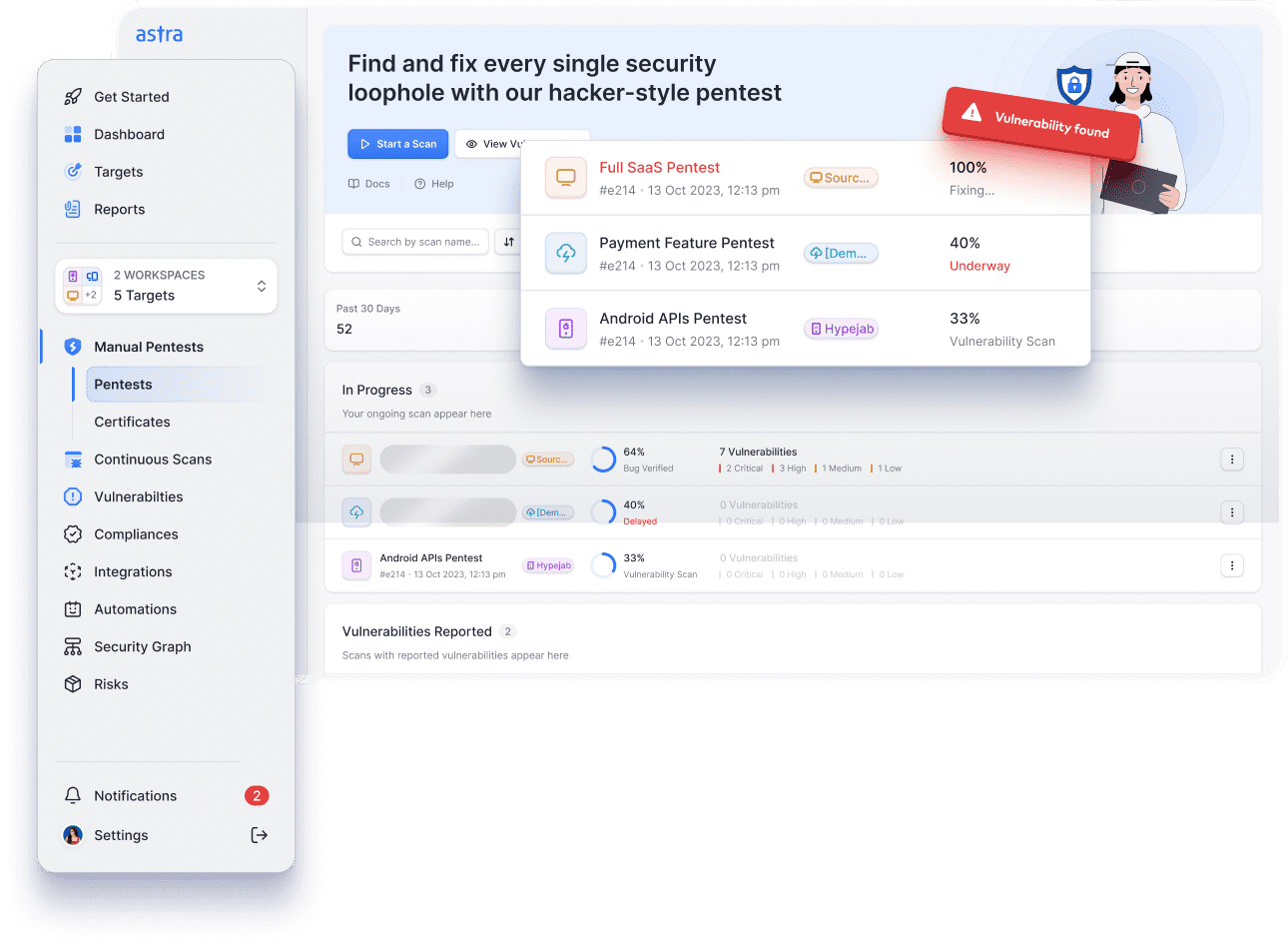
Astra’s K8s and Cloud Infrastructure Penetration Testing goes beyond automated configuration scanning. Our pentesters run realistic adversarial simulations across multi-cloud K8s environments spanning AWS EKS, GCP GKE, and Azure AKS, and every finding is demonstrated with proof.
The engagement covers cluster topology, RBAC, and cloud IAM integration (IRSA, Workload Identity, Managed Identity), container runtime and image hardening, network segmentation, secrets management, WAF bypass, and parameter-level testing across the application and infrastructure layers.
We start with reconnaissance and enumeration to map the cluster, RBAC, network policies, and cloud IAM. We then run a configuration and hardening assessment against the CIS Kubernetes Benchmark and Astra’s internal baselines. The core phase is exploitation and adversarial simulation, where we chain Phase 1 and 2 findings into real attack paths.
From there, we test post-exploitation and persistence, including detection evasion against your monitoring and SIEM, then deliver a report with full attack narratives, MITRE ATT&CK mapping, a per-domain maturity score, and a prioritized remediation roadmap.
We do not stop at the report either; our team works with your engineers on remediation, helping you fix what was found and verify the fix actually closed the gap.
If any of these describe your environment, this kind of manual penetration testing is the next step worth taking:
- You run Kubernetes in production but have never tested it against a real attack path.
- Your scanners flag hundreds of findings, and you cannot tell which are truly exploitable.
- You rely on open-source tools and want to know whether the layers actually hold together.
- You handle sensitive data or fall under a compliance regime that expects periodic third-party testing.
- You have changed the cluster, registry, or runtime configuration and want assurance that nothing has opened up.
If two or three of these apply, automated scanning alone is no longer enough to tell you where you stand. You can contact us and see how Astra validates whether your Kubernetes defenses hold against a real attacker.
Final Thoughts
There is no single open-source tool that secures a Kubernetes cluster from build to runtime, and chasing one is how teams end up with gaps. The ten tools here work because each owns a stage where clusters actually get attacked, and together they map cleanly to the four C’s: scan at build with Trivy and Kubescape, enforce at deploy with Kyverno or OPA, detect at runtime with Falco, Tetragon, Tracee, or KubeArmor, segment the network, and lock down secrets with Sealed Secrets.
The honest catch is that open source gives you coverage, not correlation.
Each tool alerts in its own format and its own dashboard, so connecting a leaked credential to a privileged pod to data exfiltration is engineering work you take on yourself. That trade is worth it for teams with the depth to run it, and most mature setups pair these tools with a commercial layer where correlation matters most.
So start small, layer by stage, and let production pressure shape the stack. Then have someone test whether the whole thing actually holds against a real attacker.
FAQS
What is the best Kubernetes security tool?
There is no single best Kubernetes security tool, because the answer depends on the layer you are securing. For posture, Kubescape leads; for runtime detection, Falco is the CNCF-graduated default; for admission policy, Kyverno is the most approachable. The strongest Kubernetes security solution layers a posture tool, a runtime tool, and a policy engine together rather than relying on any one.
What is KSPM?
KSPM stands for Kubernetes Security Posture Management. In simpler terms, KSPM tools continuously assess your cluster configuration against security baselines like the CIS Kubernetes Benchmark and NSA/CISA hardening guidance, then flag misconfigurations and compliance drift.
Do I need a CNAPP if I use open-source tools?
Not necessarily. Open-source tools match commercial detection capability at every individual layer. What a Cloud-Native Application Protection Platform (CNAPP) adds is correlation across layers, managed tuning, and audit-ready reporting in one console. If your team has the engineering depth to operate and correlate open-source tools, you can defer a CNAPP; if alert volume is overwhelming your team, that is the signal to consider one
What is the difference between container security and Kubernetes security?
Container security focuses on the image and the running container: its packages, CVEs, secrets, and runtime behavior. Kubernetes security is broader, covering the orchestration layer too: RBAC, admission control, network policy, cluster configuration, and the control plane.
.