Most engineering teams believe they solved secret scanning the day they flipped on GitHub’s default toggle, but the game doesn’t stop there. In many cases, an overlooked leak can spiral into a severe data breach, especially when an LLM is connected to sensitive data, internal APIs, or production infrastructure.
Exposed credentials are hot and always in demand, and there’s plenty left online for bad actors to hunt. Security researchers found more than 25 million new hardcoded secrets in public GitHub repos in 2025, and 60% of the valid secrets identified in 2022 remain valid four years later.
A secret scanning tool detects exposed credentials (API keys, OAuth tokens, database passwords, cloud access keys, private certificates) across source code, git history, container images, CI/CD logs, and collaboration surfaces.
In 2026, threat actors will abuse whatever they get, even the minor security issue you told yourself you’d patch in the next cycle. To make life easier for security folks and engineers, we’ve curated the best secret scanning tools in 2026.
What are the Types of Secret Scanning Tools?
The market fragments cleanly along two axes: where the tool runs (local, SaaS, or platform-native) and what it does after detection (alert, verify, remediate).
Open-source scanners run locally, in pre-commit hooks, or as a step inside your CI runner. TruffleHog, Gitleaks, and detect-secrets are the reference implementations. They are fast, free, and stop at detection. Anything past that (deduplication across branches, credential rotation, ownership routing) is your job.
SaaS scanners ingest webhooks from your VCS, run detection server-side, and layer on verification, deduplication, and remediation workflow. GitGuardian is the anchor here, with Spectral (now Check Point CloudGuard Code Security) and Nightfall competing on adjacent surfaces.
Platform-native scanners ship with the code host itself. GitHub Secret Scanning and GitLab Secret Detection are zero-setup if you already have them. They cover known patterns from partner providers and, in GitHub’s case, offer push protection that blocks a commit before the secret leaves the workstation.
Bundled detection inside broader tools counts too: SCA platforms like Snyk, CNAPPs like SentinelOne, and DLP products like Nightfall all include secret detection as a module. Useful if you’re already paying for the parent product. Rarely best-of-breed on its own.
Secret Scanning Tools Compared
| Aspect | Astra Security | TruffleHog | Gitleaks | detect-secrets | GitGuardian | GitHub Secret Scanning | Akido Security |
|---|---|---|---|---|---|---|---|
| Type | SaaS AppSec Platform + PTaaS | OSS (AGPL) + commercial | OSS (MIT) + commercial | OSS (Apache 2.0) | SaaS | Platform-native | SaaS AppSec Platform |
| Credential verification | Yes, human pentester validation on flagged findings | Yes, 800+ verifiers | OSS: No. Commercial: Yes | No | Yes, live validation across 450+ types | Yes, via partner program | Yes, live secret validation and pre-commit blocking |
| Coverage | Web app, API, cloud config (AWS/Azure/GCP), CI/CD-connected repos | Source, git history, S3, Docker, Jira, Slack, filesystems | Source, git history, files | Source, git history, baselines for legacy | Source, git history, CI/CD logs, containers, package registries, Slack, Jira, Confluence | Source, git history, GitHub-hosted only | Source, git history, IDE, CI/CD, containers, cloud, IaC |
| Deduplication | Yes | Yes | No (OSS) | Baseline file only | Yes, incident-based | Basic | Yes |
| Centralized dashboard | Yes, dashboard-based | Commercial tier only | Commercial tier only | No | Yes | Yes (limited) | Yes |
| Pricing | Scanner from $199/target/month; Pentest tier $5,999/target/year | OSS free; Enterprise custom | OSS free; Enterprise custom | Free | Free up to 25 devs; paid tiers scale by seat | Free on public repos; paid via GitHub Advanced Security | Free tier; Basic from $350/month flat |
| Best for | Teams that want secret detection inside a broader AppSec program with human validation | Deep verification without vendor lock-in | Pre-commit blocking, fastest CI scan | Auditing legacy Python monorepos with baseline files | Managed platform buyers who need remediation workflow | Teams standardized on GitHub that accept the pattern-only ceiling | Suitable for teams that want SAST+SCA+secrets+DAST on one flat-rate plan |
Best secret scanning tools in 2026
1. Astra Security
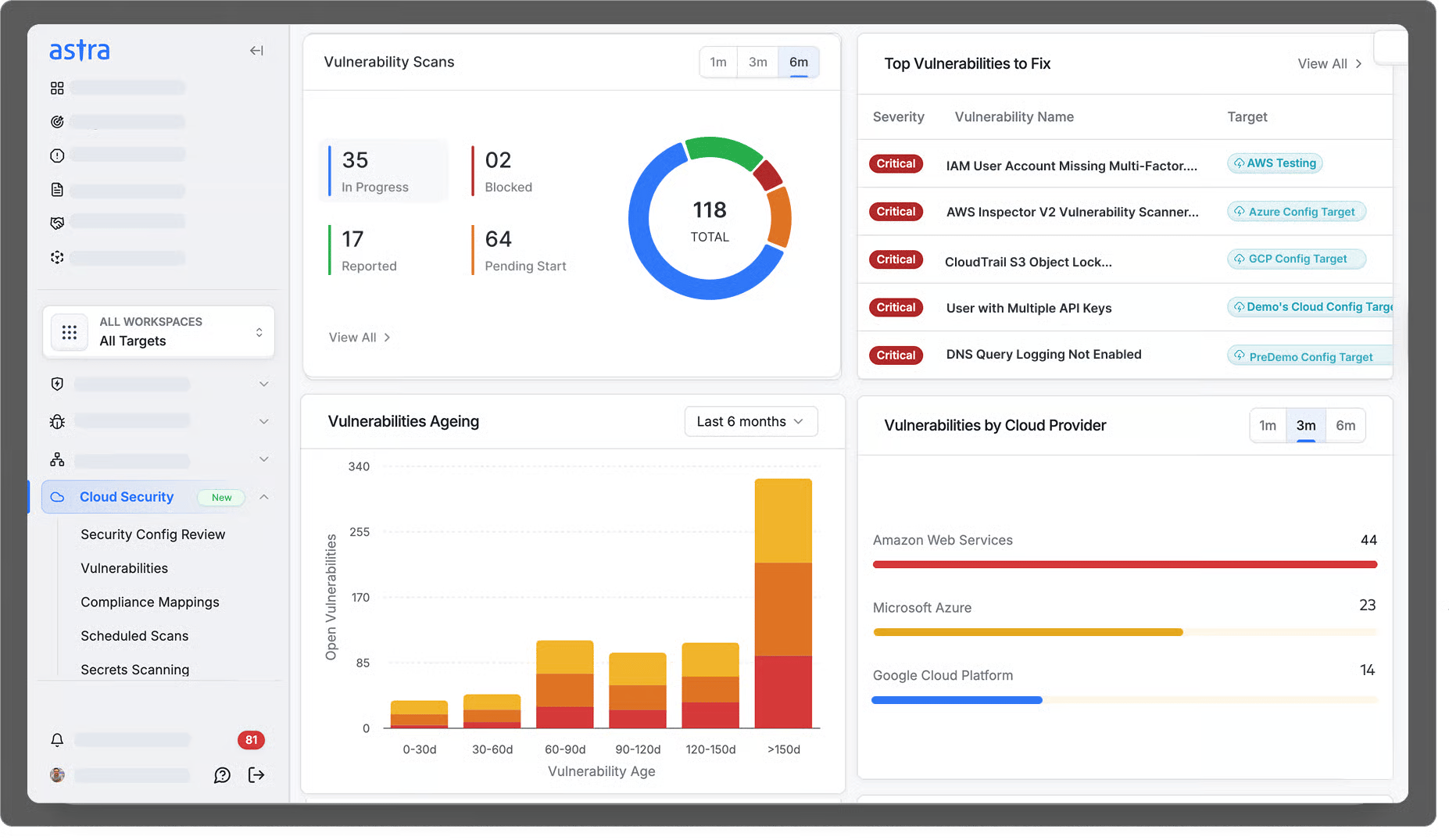
Astra Security approaches the problem from the opposite end of the market. Rather than a standalone secret scanner, it folds secret detection into a broader AppSec platform (DAST, API security, cloud scanner across AWS/Azure/GCP, PTaaS with human pentesters) running 15,000+ tests per target.
Astra security platform can surface secrets in three places: inside the DAST engine (exposed keys in JS bundles, source maps, HTTP responses), inside the cloud scanner (hardcoded credentials in IaC, environment variables, cloud config), and through CI/CD integrations with GitHub, GitLab, Jenkins, and Bitbucket. On the Pentest tier, certified testers manually verify high-severity findings.
Best for: Engineering teams that want secret detection as one control inside a validated AppSec program without false positives.
Pricing: Scanner tier from $199 per target per month or $1,999 per target per year. Pentest tier at $5,999 per target per year adds manual testing, compliance mapping, and a publicly verifiable pentest certificate.
Honest limitation: Limited trial period
2. Gitleaks
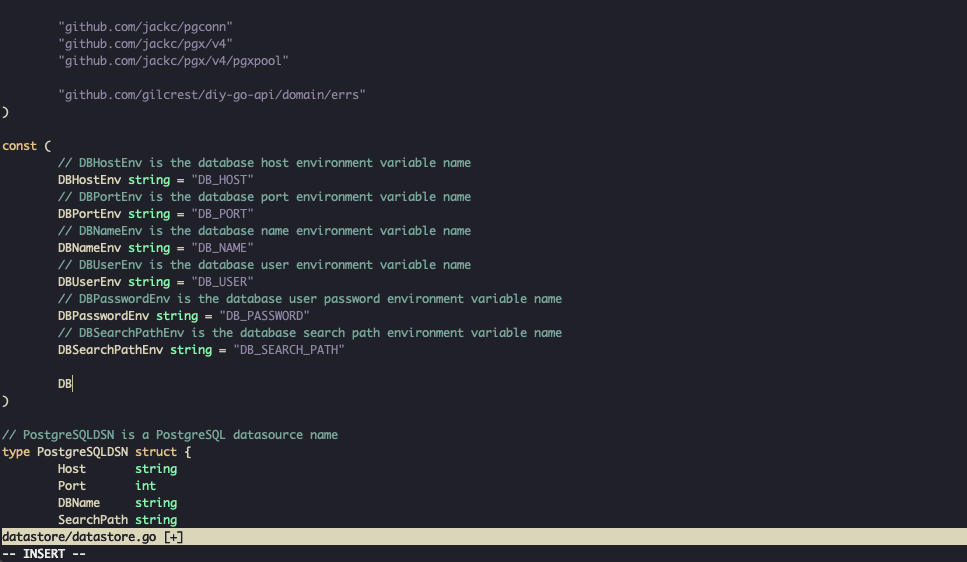
A single Go binary that scans faster than almost anything else in the category. Gitleaks is the tool most teams reach for when they want a pre-commit hook that finishes before the dev alt-tabs away. Configuration lives in a TOML file, custom regex rules are trivial to add, and the SARIF output plugs directly into GitHub code scanning.
Best for: Blocking commits at the developer’s workstation and running as a fast CI gate.
Pricing: MIT-licensed and free. Gitleaks Enterprise adds a hosted dashboard, verification, and centralized policy.
Honest limitation: The OSS build lacks credential verification and a dashboard. Every finding is a maybe until a human is brought into the loop, which is why false-positive fatigue kills Gitleaks-only programs at large-scale deployments.
3. Akido Security
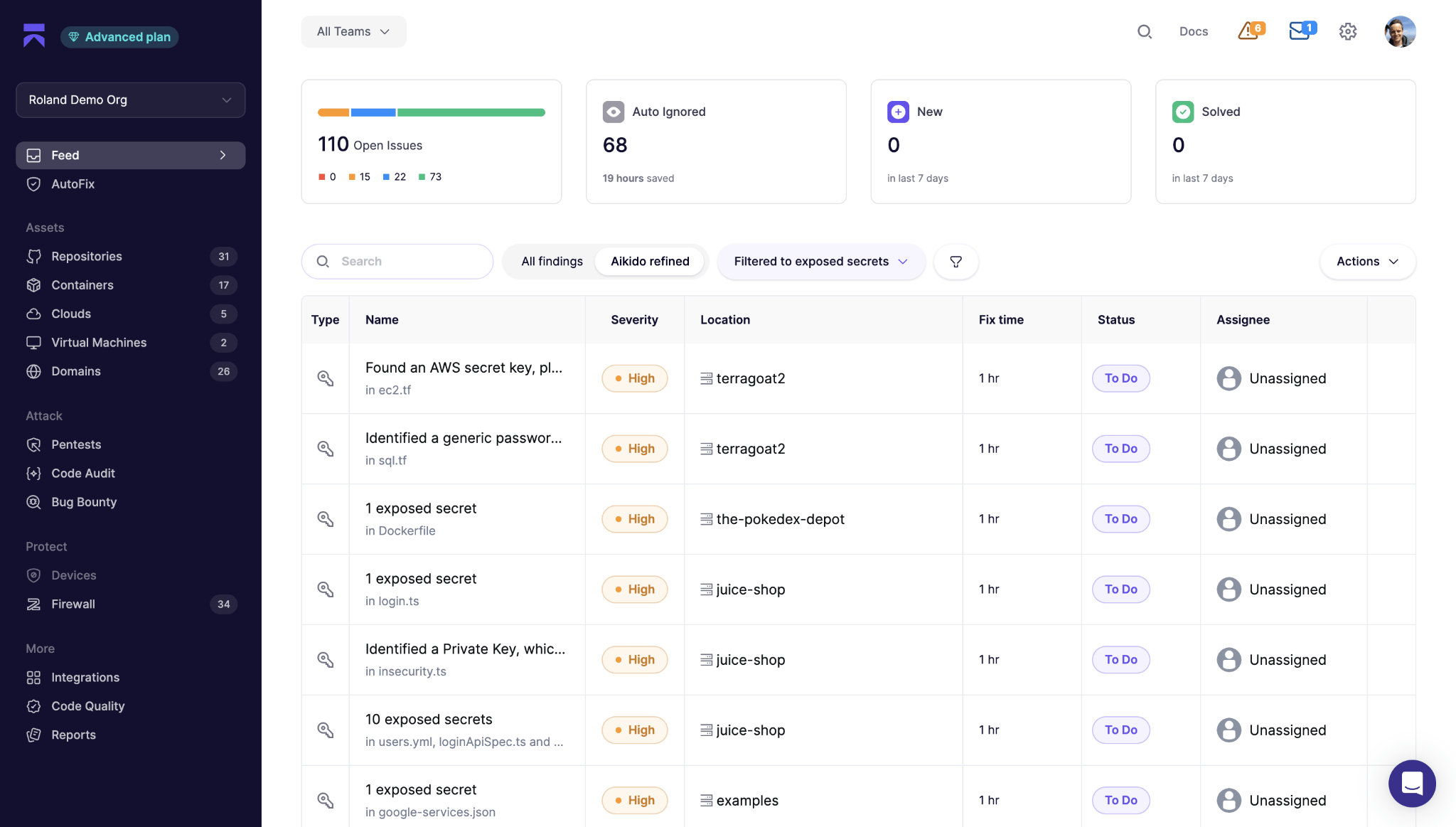
The closest structural peer to Astra Security is the all-in-one AppSec platform on the list. Akido runs secret scanning across the SDLC (IDE, CI, git), catches leaked API keys, passwords, certificates, and encryption keys, and adds live secret validation plus pre-commit blocking.
Best for: Small-to-mid engineering teams that want SAST, SCA, secrets, and DAST on one flat-rate plan without per-seat pricing surprises.
Pricing: Free tier covers 2 users, 10 repos, and full secrets detection. Basic plan from $350/month flat rate with 10 users included. Pro from $600/month adds runtime protection and IDE plugins.
Honest limitation: Consolidation is the pitch, which cuts both ways: teams needing best-of-breed depth in any single category (deep git-history verification like TruffleHog, or dedicated NHI governance like GitGuardian) will hit ceilings faster than in a specialist tool.
4.TruffleHog
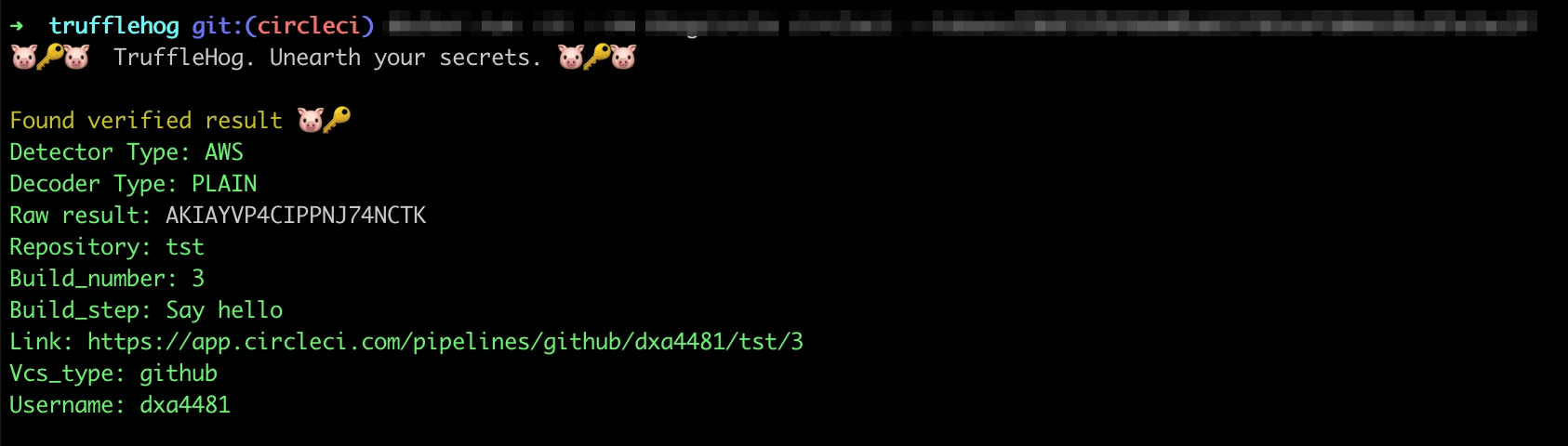
A single Go binary with the widest verifier library in the category. As of early 2026, TruffleHog ships active credential verifiers for 800+ providers, rather than regex-matching a string that looks like an AWS key. Detection combines regex, high-entropy analysis, and Go-based custom detector plugins.
Best for: Security teams that want provable exploitability before opening a ticket, without a SaaS contract.
Pricing: Open source under AGPL-3.0. Truffle Security Enterprise adds an incident dashboard, RBAC, SSO, and workflow integrations at custom pricing.
Honest limitation: AGPL-3.0 constrains commercial embedding. Read the license, not a summary of it, if you’re wrapping TruffleHog into a distributed product.
5. GitHub Secret Scanning
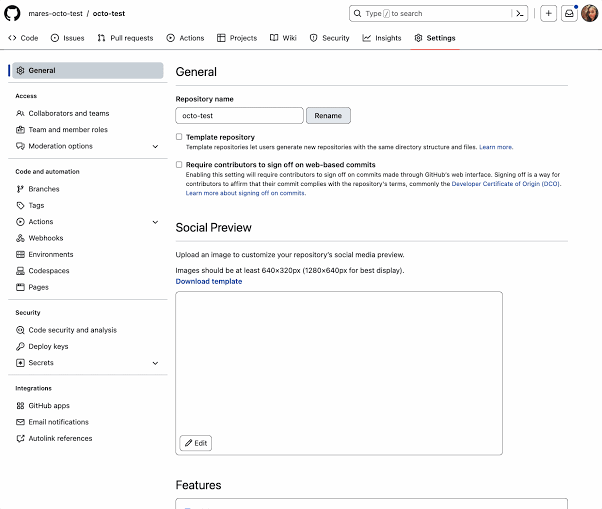
Native to GitHub, which is both its strength and its ceiling. Push protection blocks commits containing known-pattern secrets before they leave the workstation. The partner program with issuers (AWS, Stripe, Slack, Google Cloud, 100+ others) enables automated token revocation within minutes of detection.
Best for: Teams standardized on GitHub who value zero-configuration coverage over depth.
Pricing: Free on public repositories. Private repositories require GitHub Advanced Security, priced per active committer.
Honest limitation: Detection is pattern-based.
6. detect-secrets
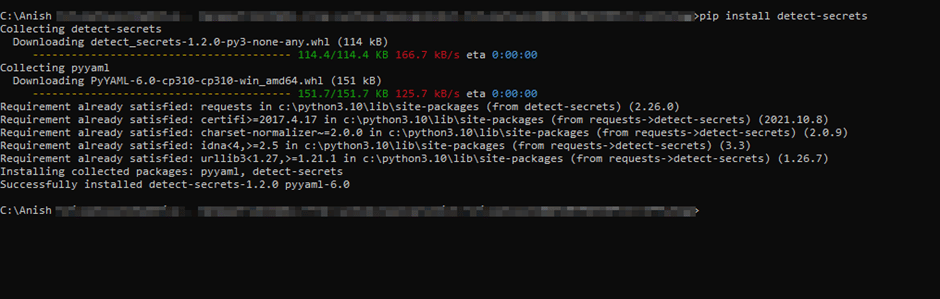
detect-secrets is a Python-based scanner that remains the go-to tool for analyzing legacy codebases. Its baseline file model (.secrets.baseline) snapshots known findings so CI only alerts on new ones, converting a ten-thousand-finding cold start into a manageable rolling audit.
Detection runs through a plugin system with detectors for AWS, JWTs, private keys, Basic Auth, Slack tokens, and high-entropy strings. Native pre-commit framework integration makes it a drop-in for Python-heavy shops.
Best for: Auditing legacy monorepos where a greenfield scan would return an unmanageable volume, particularly Python stacks.
Pricing: Free, Apache 2.0.
Honest limitation: Slower cadence, weaker coverage of newer token formats (long-form GitHub PATs, modern OAuth patterns), and no verification.
How to Set Up a Secret Scanning Tool
Setting up a working secret-scanning program is simple and easy to do. While the specific configuration varies across vendors, the underlying implementation pattern is consistent across nearly every tool on the market.
The five steps outlined below cover the core setup workflow. For deeper context on your specific tool, refer to the vendor’s official documentation or contact their support team.
- Install a pre-commit hook on every developer workstation to ship the configuration through pre-commit.com so the hook lives in the repository.
- Add a CI/CD scanning step to every push and pull request. Configure the pipeline to fail the build on verified findings and warn on unverified ones.
- Enable push protection at the platform layer to catch known-pattern secrets before they leave the workstation, even when a devs bypasses the local pre-commit hook.
- Route findings to a named owner or a generic security channel.
- Integrate remediation with your secrets manager based on the revoke-and-rotate-first policy.
How to Choose the Best Secret Scanning Tool
Every security tool procurement revolves around three factors: false positives, remediation, and coverage. Beyond that, narrowing down is tough. The market is crowded, and even AppSec platforms and broader security suites now ship secret scanning under the hood. That blurs the line between a dedicated scanner and a bundled module.
To make procurement easier, the questions below are ordered from most to least common decision drivers we hear from security and engineering leads. Work through them honestly, tally the yeses, and the right tier of tool will pick itself.
- Do you need verified findings? (Live credential validation cuts your triage queue by an order of magnitude)
- Does your attack surface extend past source code into CI/CD logs, containers, cloud configs, and collaboration tools like Slack or Jira? (Roughly 28% of 2025 incidents originated outside repos.)
- Do you need incident-based deduplication, so one leaked key across fifty commits shows up as one alert, not fifty?
- Does the tool ship a built-in remediation workflow with ownership routing, secrets-manager integrations, and rotation guidance?
- Is your team shipping code weekly or faster, with a need for continuous scanning aligned to release cycles?
- Will your scanner need to catch secrets that never touch a git commit, like exposed keys in JavaScript bundles, source maps, HTTP responses, IaC files, and environment variables?
- Are you tired of running secret detection as a silo from SAST, SCA, DAST, and cloud scanning? Consolidating into an AppSec platform (Astra, Aikido) collapses that overhead.
- Can the tool close the loop with automated rotation PRs, AI-assisted remediation, or a validated fix path?
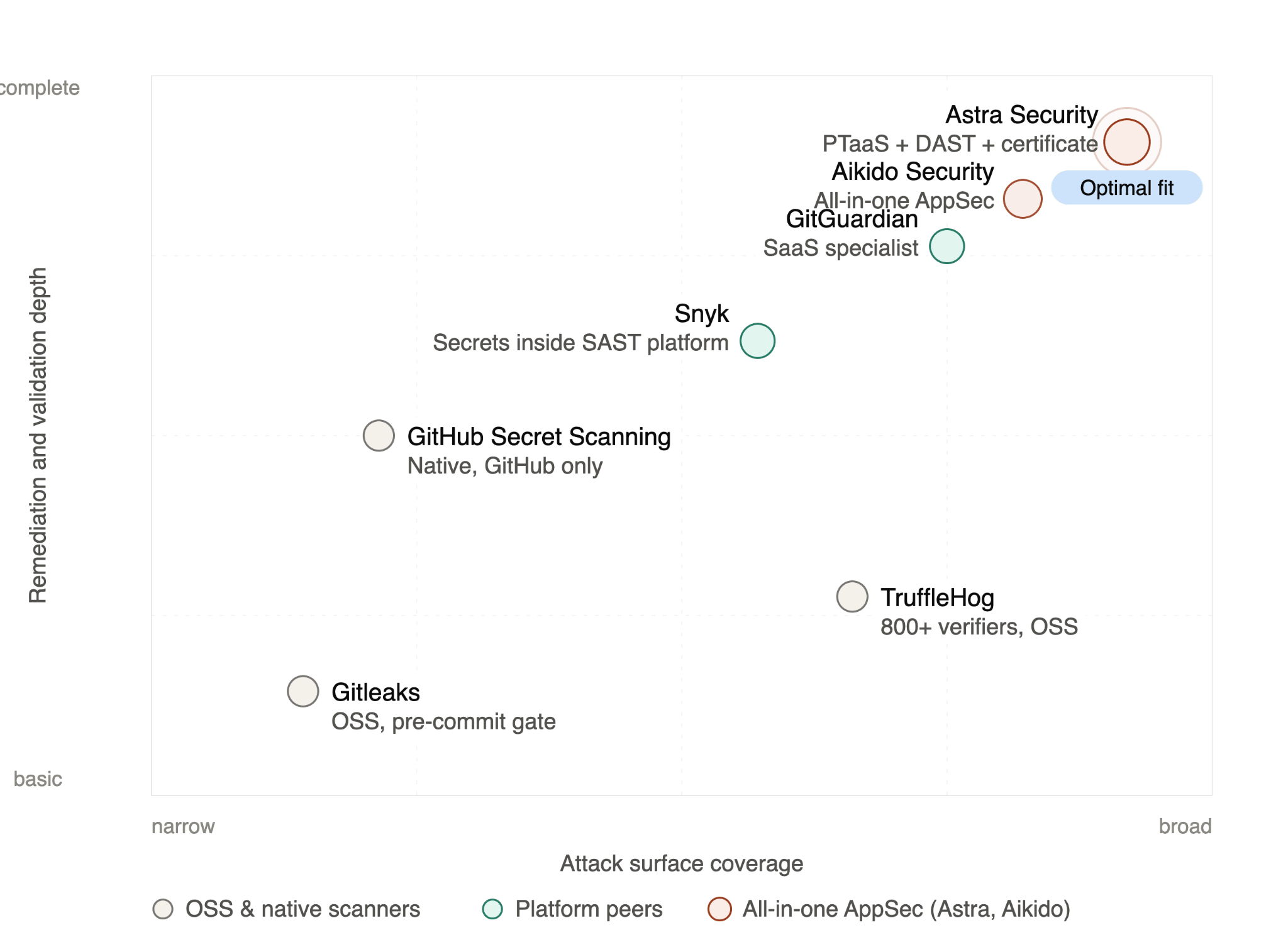
0-3 yeses: OSS scanners (TruffleHog, Gitleaks) plus GitHub Secret Scanning cover the basics.
4-6 yeses: You’ve outgrown OSS and should switch to a managed platform
7-9 yeses: You need a full AppSec platform with human validation and shareable trust. e.g., Astra Security, Aikido.
Final Thoughts
Secret scanning in 2026 is more important than ever, as multiple APIs, vibecoding, and LLM integrations have become the new normal. With the math being this tough, it shouldn’t be neglected or left to a deployment checklist handed down to devs.
The right pick depends on where your team sits on three axes: maturity curve, budget, and coverage needs. Small teams shipping to a few repos get by with TruffleHog or Gitleaks in CI plus GitHub Secret Scanning. Multi-VCS orgs that need incident-based deduplication and a remediation workflow can lean on GitGuardian for secret scanning. Teams consolidating security tooling with SAST, SCA, and DAST land on Snyk or Aikido.
If you need secret detection inside a validated AppSec program with human pentester oversight, deep DAST and cloud coverage, and a verifiable certificate for customer security reviews, Astra Security is built for exactly that profile.
Whichever tier fits, treat secret scanning as a live control that scales with your release cycle.
FAQ
1. What’s the difference between secret scanning and secret management?
Secret scanning detects credentials that have leaked outside their intended storage location, such as source code, git history, or CI/CD logs. Secret management governs how credentials are stored, rotated, access-controlled, and injected at runtime.
2. Are open-source secret scanners good enough?
For pre-commit hooks and CI enforcement, yes. TruffleHog and Gitleaks are production-grade at scale. What OSS lacks is cross-branch deduplication, ownership routing, and remediation workflow. Past roughly 50 developers or two code hosts, the operational cost of running OSS exceeds a managed platform license.
3. How much do secret scanning tools cost, and does GitHub scan private repos for free?
Open source is free. GitGuardian’s free tier covers 25 developers, with paid tiers reaching the low-to-mid five figures annually for a 200-developer organization. Aikido starts at $350 per month, flat-rate. GitHub Secret Scanning is free on public repos only; private repositories require GitHub Advanced Security, priced per active committer
4. What’s a reasonable time-to-remediation target?
For verified findings on live credentials, revocation should occur asap. Unverified findings warrant triage within hours. Automation and ownership routing are what make these targets achievable.
5. Do we still need a scanner if we use a secrets manager?
Yes. Studies show sprawl persists even inside organizations with mature secrets managers, because the manager only governs credentials teams remembered to onboard. Scanners catch the leaked, forgotten, and hardcoded credentials that never made it into the vault.