Ever wonder why security programs in most organizations fall short despite purchasing defensive cybersecurity tools, conducting offensive security scans, and meeting compliance? Simply put, their attack surface changes faster than validation does, i.e., teams add new assets, deploy code constantly, expand access, and let configurations drift.
Say you installed fire alarms and ran a safety drill. Months later, you remodel, but you’re still using the old safety checklist. How safe does that sound now?
That is exactly how security programs drift in real life as well. A control that worked last quarter would not necessarily work this quarter after a cloud change or a new SaaS integration. One key does not lock all doors. But attackers don’t wait for your next red team exercise. According to Verizon’s 2026 DBIR, 31% of breaches now start with software vulnerabilities, and Google Cloud’s M-Trends 2025 reports that exploits remained the most common initial infection vector, while the global median dwell time rose to 11 days.
That is the gap Continuous Automated Red Teaming, or CART, aims to close. In this blog, we will break down what continuous red teaming actually is, how it departs from traditional red teaming, where it delivers the most value, how to operationalize it responsibly, and why more security leaders are using continuous adversarial validation as a practical way to strengthen resilience.
What is Continuous Automated Red Teaming (CART)
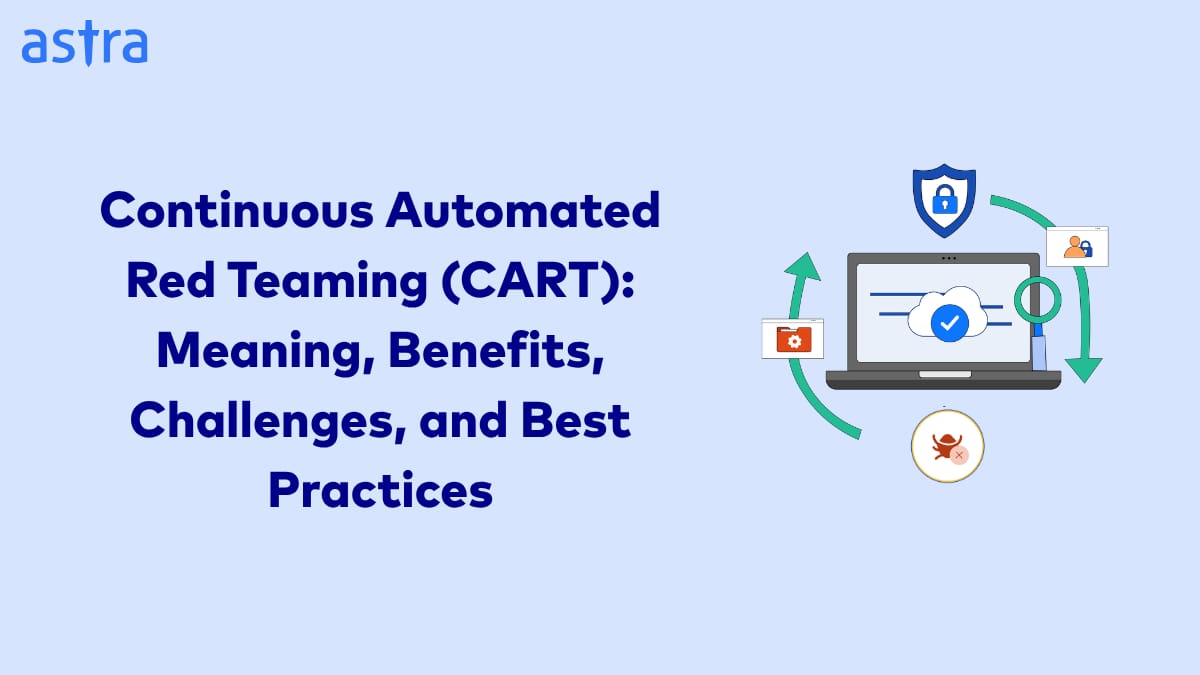
Continuous Automated Red Teaming (CART) is an offensive security process in which organizations use automated security testing tools to simulate real-world hacker-style attacks on an ongoing basis. This allows teams to validate whether their defenses prevent, detect, and respond to attacker behaviors.
In short, continuous red teaming automates the tactics and intelligence that human-led red teams use to discover assets, uncover attack paths, and prioritize findings before attackers do.
The final goal of continuous automated red teaming testing is to continuously evaluate your security posture, identify, prioritize, and remediate vulnerabilities. Continuous automated red teaming provides evidence-based security validation.
Although CART is a force multiplier for red teaming, it is not a total substitute for expert-led offensive work. Organizations opt for automated red team testing for 24/7 proactive testing, cost-effectiveness, and to enable human-led red teams to focus on complex, creative testing and business-logic abuse.
How is Continuous Automated Red Teaming Different From Traditional Red Teaming?
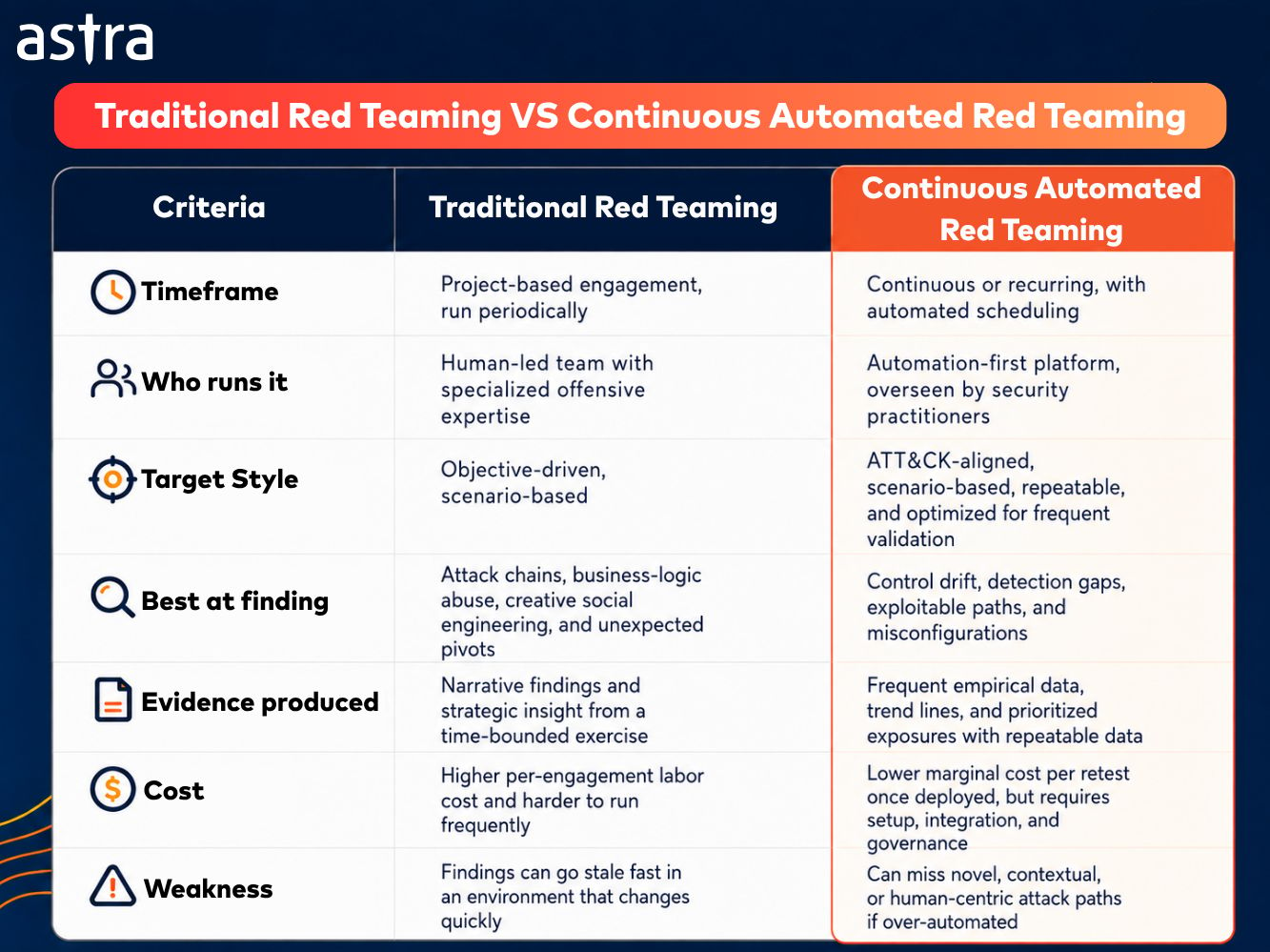
What are the benefits of Continuous Automated Red Teaming
1. Speed:
If you run a manual red team engagement and then wait six months to run another, your environment and attack surface will change drastically during that window. So when you kick-start your next engagement, you are validating an asset that no longer exists.
CART testing validates these changes quickly, catching newly exposed paths before they become the next incident. You should integrate automated security into your workflow, because when your IT infrastructure evolves continuously, so should your testing model.
2. Continuous coverage:
Most of what teams call assurance of security posture is really just a dated piece of evidence that everyone pretends is the truth until the next audit. Continuous automated red teaming
may not fix everything, but instead of relying on dated controls that falsely claim your security posture is healthy, you get ongoing evidence.
You frequently assess assets, attack surface, and controls, thereby supporting risk-based decisions.
3. Cost leverage:
Manual Red Teaming, both internal and external, is expensive. Not just based on their upfront fee, but also on the scoping, scheduling, coordination, and human expertise required to do the job. Running it frequently in the modern environment may not always be a wise financial decision for most companies.
Continuous red teaming, on the other hand, changes the math for such companies. Once deployed, the cost of retesting drops significantly. More importantly, for internal teams, it frees your best resources to work on what actually requires human judgment.
4. Risk and Compliance Support:
Continuous automated red teaming does not replace your annual pentest or any other regulatory obligations your business is subject to. But it can make them less stressful.
If you’re operating under PCI, FedRAMP’s ongoing authorization model, or DORA’s operational resilience requirements, you already know the biggest problem is that security assessments often surface surprises that require your entire team to fix them day and night. This is mainly because everything has drifted since your last compliance assessment.
5. Stronger Security Posture:
There is one class of vulnerability that even point-in-time testing is not the best at catching, it is a boring one that keeps resurfacing. They are misconfiguration, excessive access controls, broken segmentation, and outdated software. Attackers exploit these paths primarily when the aforementioned issues chain together.
CISA also focuses on the same set of issues because teams routinely miss them during engagements and remediation. Continuous red teaming is particularly good at identifying these vulnerabilities because it’s always on the watch.
6. Accuracy:
Continuous automated red teaming makes your security program more consistent, reliable, and reproducible. Thereby, it also improves the availability and accuracy of the monitored results. But one crucial factor to watch out for is false positives and false negatives.
Even with the best automation and adversary emulation, there is considerable uncertainty. So the most honest framing of automated red team testing would be: It improves consistency and accuracy of your security program, but does not make it omnipercipient.
What are the challenges faced during continuous automated red teaming?
- Production risk is real: Offensive testing can disrupt your entire IT infrastructure if you scope it poorly. The fix for this would not be to avoid testing altogether, but rather to implement a maintenance window, production-safe techniques, and defined escalation procedures when unexpected issues arise.
- More testing does not yield more findings: Most automated red team testing vendors sell dashboards full of attack paths, test counts, scenarios, and coverage percentages. But what your platform should tell you is what is exploitable, not just run multiple tests. Empirical evidence of exploitability should matter most.
- Automation still needs humans: Although continuous red teaming can execute at scale, it cannot design threat-relevant scenarios or interpret what something could actually mean for a business. The ideal model is automation for frequency and human for strategy and business logic.
What are the Best Practices for CART?
1. Pre-Implementation
Your primary instinct when evaluating a new platform would be to ask, “What can it do?” But the better question is, “What do we most need to know?”
Before you implement a tool, identify your key assets and goals, then map out the scope, threat actors, and attack paths most relevant to your business. Also, evaluate the least confident defenses and gaps that you want to test, define rules of engagement, and the operational constraints you cannot violate.
2. Integration
You can utilize MITRE ATT&CK to select and prioritize techniques. While this is a factor most teams would account for, what they actually miss out on is the integration piece.
Say, for instance, if your continuous automated red teaming findings are on a dashboard nobody checks often, then what would be the point of the whole engagement? The final output needs to flow into tools that already run in your security operations, like your ticketing system, SIEM, XDR, or remediation workflow. The findings are useful only if they are visible.
3. Execution and Monitoring
NIST’s continuous monitoring guidance recommends automating collection, analysis, and reporting wherever possible. And further clarify that manual testing and automation need to work together.
The teams that get the most out of CART are the ones that treat it as a force multiplier for human judgment, not a replacement for it.
4. Post-implementation and continuous testing
This is where many programs quietly fall apart. When the team logs a finding, tickets pop up; when the team deploys the fix, they close the ticket. What most teams fail to do here is retest the path. Teams need to complete the entire cycle: root cause analysis, mitigation, retesting, and program update.
The best continuous automated red teaming program would ideally improve its defense and the logic they use to test defenses over time.
Why Astra Security?
What most security teams require most is not another dashboard that says “something might be wrong in your attack surface.” They need testing that can actually validate what is exploitable, explain business impact, and help teams fix it before attackers find the same path. And this is precisely where Astra Security’s autonomous pentesting helps.
Autonomous pentesting continuously identifies, validates, and prioritizes real-world vulnerabilities across web applications and APIs. Our AI agents are built on application behavior, map authentication flows, explore business logic, and simulate coordinated attack paths.
With our autonomous pentesting capabilities, you can:
- Find business logic flaws, IDORs, authentication issues, workflow bypasses, and chained attack paths
- Validate vulnerabilities before they become noisy dashboard items
- Prioritize findings based on real exploitability and business risk
- Retest fixes and confirm whether exposures are actually patched
- Generate compliance-ready reports for SOC 2, ISO 27001, HIPAA, PCI DSS, and GDPR
Final Thoughts
Now, remember the secure-but-not-so-secure-in-reality house from the beginning? It’s a story that helps explain the gap between when something exactly breaks and when someone actually finds out. Continuous automated red teaming (CART) helps close the gap. It does not replace the creative and skilled work that red teamers do.
But just ensure that when your environment changes, no surprises are waiting for you during audit season, or any findings about a drifted defense system that attackers exploited.
Organizations that understand this will use CART as a continuous offensive security approach and rely on human-led red teaming where automation cannot cover.
Explore Our Autonomous Penetration Testing Series
This post is part of a series on autonomous penetration testing. You can also check out other articles below.
- Chapter 1: Autonomous Pentesting: How it Works, Benefits, Tools (2026)
- Chapter 2: Autonomous vs Traditional Pentesting: What’s More Secure in 2026?
- Chapter 3: Top 10 Autonomous Pentesting Tools in 2026
- Chapter 4: How to Evaluate Autonomous Penetration Testing Security Vendors in 2026
- Chapter 5: OWASP APTS: A Complete Guide to Autonomous Penetration Testing Standard
- Chapter 6: Agentic AI in Cybersecurity: The Complete Guide for Security Teams
- Chapter 7: Autonomous Penetration Testing as a Growth Lever for Startups
- Chapter 8: 5 High-Impact Autonomous Pentesting Capabilities That Traditional Scanners Ignore
- Chapter 9: Autonomous Pentesting vs. Red Teaming: Do You Still Need Both?
- Chapter 10: How Autonomous Penetration Testing Kills False Positives
- Chapter 11: How a Modern Autonomous Penetration Testing Framework Differs from Legacy DAST
- Chapter 12: Autonomous AI Agents for Penetration Testing: A Complete Guide
- Chapter 13: Autonomous Pentesting for Lean Security Teams: The 2026 Guide
- Chapter 14: Will an Autonomous Pentest Satisfy SOC 2, PCI, & ISO Auditors?
- Chapter 15: How Reporting with Autonomous Pentesting Reasoning Traces Eliminates Developer Friction
- Chapter 16: A Guide to Continuous Autonomous Pentesting
- Chapter 17: Autonomous Pentesting for SaaS Companies in 2026: The Complete Guide