Thank you for downloading!
You should have received it in your email.
Oops! Something went wrong while submitting the form.


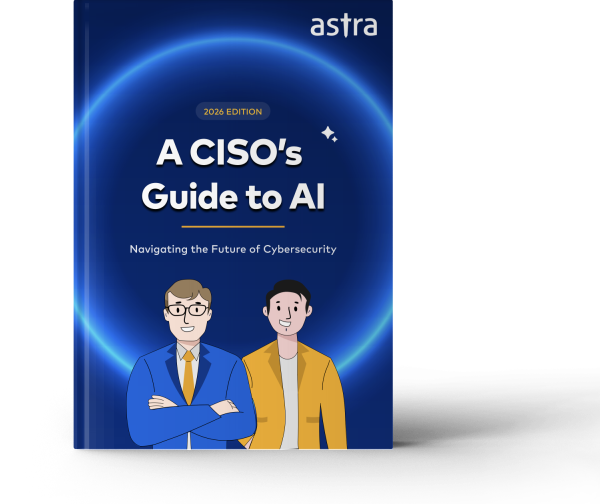
A 2026 field guide for the CISO making calls on both sides of the AI equation: which AI to deploy, which to govern, and which to treat as the next threat vector. Built on trends from thousands of Astra pentest engagements and firsthand input from CISOs at Upwind, PropertyGuru, Hindustan Coca-Cola, and Broadridge.

What's inside?
Two checklists in one, across 15 device and infrastructure types:
The current trends - what 95% of CISOs are seeing in SOC triage, phishing detection, and anomaly scoring; where generative AI, insider threats, and Shadow AI actually sit on the risk matrix.
AI applications across the stack - email security, log analysis, identity management, SOC operations, and AI in pentesting and vulnerability management.
The eight AI-powered threat vectors - deepfakes, synthetic identity fraud, model poisoning, generative phishing, AI supply chain risk, Shadow AI, autonomous attacks, and RaaS/MaaS kits.
What you’ll learn
By the end, you'll be able to:
Build a 2026 AI security roadmap that balances AI for security (automation, predictive analytics, agentic mitigation) with security for AI (AI-BOM, continuous red-teaming, data protection).
Spot Shadow AI in your org before it becomes an IP leak, especially in high-risk sectors like manufacturing where open-source models get fed proprietary data.
Build the guardrails that make AI trustworthy — explainability, auditability, human-in-the-loop reviews, and monitoring for drift.
Measure AI investments with KPIs your board will accept: MTTD, MTTR, false positive rates, automation levels, and ROSI against pre-AI baselines.
Answer the question customers and boards are now asking: "Where is AI actually used in our business, and how do we know it's safe?"
Astra's offensive AI scanners flagged 126% more web and API vulnerabilities this year than last a jump that shows how fast AI is deepening modern vulnerability detection, and how much faster attackers are moving too.
Who’s this for?
Read this if you're a…
CISO or security leader building your 2026 roadmap and need to defend both the AI you're deploying and the AI being deployed against you.
Head of security or VP of security whose board is asking where AI sits in the stack and whether it's governed.
GRC or compliance lead mapping AI controls to NIST AI RMF, ISO 42001, or an emerging internal AI policy.
Security architect designing SOC automation, AI-based threat detection, or continuous red-teaming for AI systems.