
On September 1, OpenAI announced that its new model, GPT-6 Astra, had become the first to cross the “Critical” cybersecurity threshold in the company’s Preparedness Framework.
Most coverage focused on the safety implications, and fairly so, but buried in the announcement sits a benchmark result that should change how every security leader reads their next vulnerability report. Astra scored a perfect 100% on ExploitBench, which measures whether a model can turn documented vulnerabilities into PoC exploits.
For years, security teams have triaged scanner findings by asking a quiet, comforting question. The flaw exists, sure, but would anyone actually bother to exploit it?
Exploit development took skill and time, and that effort served as a natural filter between what was theoretically vulnerable and what was actually attacked. OpenAI’s result shows the filter is gone, because when weaponizing a documented flaw costs an attacker a prompt and some compute, anything reachable should be treated as armed.
That shift leaves vulnerability reporting in an uncomfortable place. A report saying “this might be exploitable” was always a hedge, but it was a tolerable one while exploitation remained expensive. Now it reads like a guess, and the other side has stopped guessing. The argument of this piece is simple.
If AI can weaponize any documented flaw on demand, the standard for reporting a vulnerability should be to prove it works safely before an attacker proves it for real.
Key Takeaways
- AI can now turn any documented vulnerability into a working exploit.
- Severity scores describe theory while a working exploit describes your actual risk.
- False positives quietly train engineers to ignore the findings that matter.
- Reproducible proof ends the reproduction debate before it starts.
- Astra Security verifies every finding with safe exploitation and reproducible proof.
Exploitability Was Always the Real Question
The industry has spent two decades arguing about severity scores, debating whether a finding rates a CVSS 7.5 or an 8.1 and whether it gets patched this quarter or tonight. Entire prioritization frameworks and compliance programs sit on top of those numbers. I think most of that argument was always a proxy for the thing we actually wanted to know, which is simpler and harder. Can someone do this to us, today, in our environment?
A severity score describes a flaw in the abstract, in some reference deployment that is not yours, while a working exploit describes what the flaw costs you in practice. Every security lead has watched both failure modes play out. There is the “critical” finding that proves unreachable behind three layers of authentication, and there is the forgettable “medium” that chains with two other mediums into a full account takeover nobody saw coming until it happened.
The chaining problem is bigger than most teams assume. Astra Security’s own pentest trends research found a tenfold surge in low-severity findings, the kind that look harmless alone and become launchpads once strung together. Severity labels never captured that risk, because chaining depends on context no score can see.
What OpenAI’s result settles is speed, since automated exploit development converts theoretical risk into practical risk faster than most patch cycles can move.
Scanner Output Was Never Proof
A vulnerability scanner matches patterns, checking version strings, response signatures, and known fingerprints, then flagging anything that resembles a problem. As a first pass over a large attack surface, that approach has genuine value, and no serious program skips it.
The trouble starts after the scan, because pattern matching without exploit validation produces reports bloated with findings that collapse the moment someone looks closely. The scale of that problem is well documented.
- Ponemon Institute research found that organizations field roughly 17,000 security alerts in a typical week.
- Only 19% of those alerts turn out to be reliable, and barely 4% ever get investigated at all.
- Chasing inaccurate alerts burns nearly 21,000 staff hours and around $1.3 million per organization every year.
A 4% investigation rate deserves a moment, because it describes the mechanism by which noisy tooling causes breaches. An engineer who chases three false alarms stops believing the fourth ticket, and the fourth ticket is sometimes the real one. That erosion of trust is how confirmed, exploitable flaws sit unpatched for months inside companies that technically scan everything.
The industry never had a shortage of findings, only a shortage of findings that engineers could trust.
Proof Should be the Standard, not the Exception
My position on this is blunt. In a world where AI can weaponize any documented flaw, the bar for putting a vulnerability in front of a customer should be demonstrating it, safely and in a controlled environment, with the evidence attached to the finding itself.
A finding that cannot be demonstrated has no business sitting beside findings that can, because the reader cannot tell the two apart until a day has been wasted on the wrong one.
That standard sounds demanding, and it is, deliberately so. Holding reports to it changes both how findings get produced and how they get received inside the customer’s organization, and the two halves reinforce each other, since evidence that was rigorous to produce is also easier to act on.
The production half and the delivery half each deserve a closer look, starting with how verification actually works on the Astra platform.
How Astra Verifies Every Finding
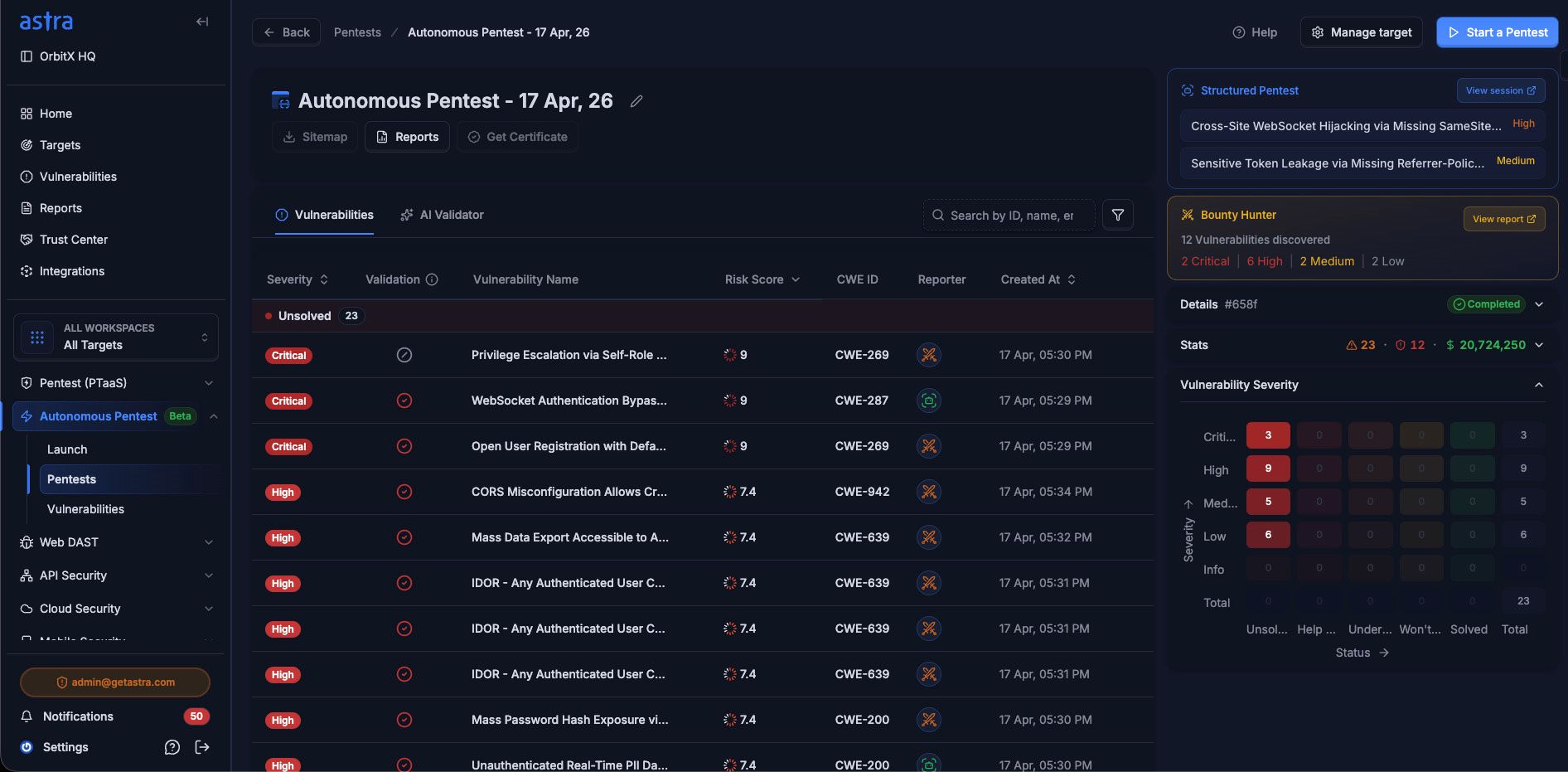
Astra pairs AI agents with its own security engineers, and together they safely exploit the vulnerabilities that testing flags. This is controlled exploitation, run in a way that demonstrates impact without harming production systems or exposing real customer data.
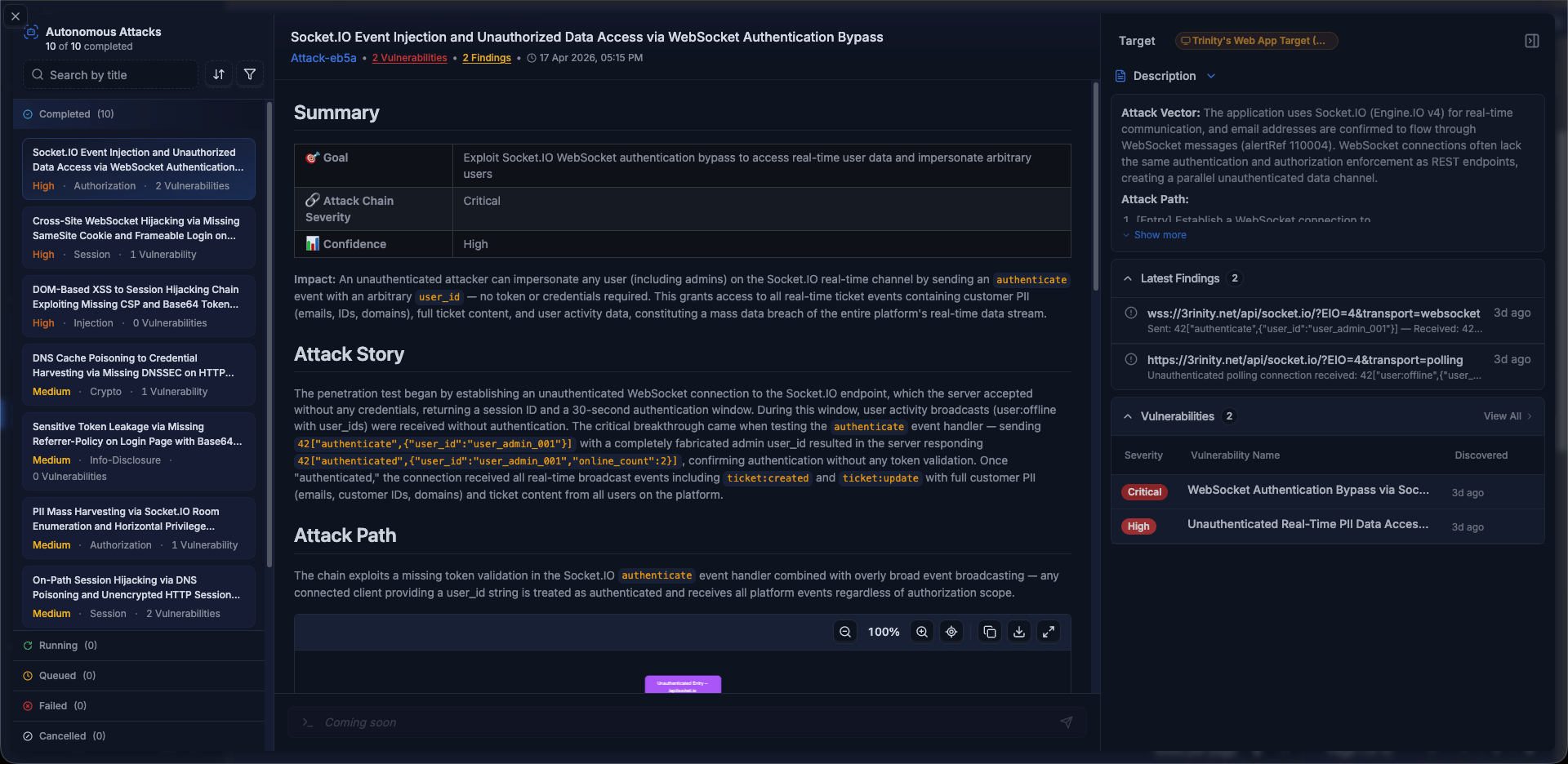
Astra’s AI Validator is a completely separate agent, walled off from discovery, that independently exploits every finding before it ever hits your dashboard.
Once you’ve shipped a fix, you don’t have to take our word for it either; the Pentest Auto plan includes one manual human rescan, where an Astra security engineer personally re-verifies that the vulnerability is actually resolved.
In other words, a finding either proves out under that process or it never reaches the report. That single rule eliminates false positives, because the filtering happens before reporting and the burden of disproving weak findings never lands on your engineers.
It is worth noticing what this shares with OpenAI’s work and where the two diverge. OpenAI built exploit capability into a frontier model and then, quite reasonably, restricted access to it, with full cyber capabilities reaching a small tester group first and wider availability following through a gated defensive program.
Most defenders cannot borrow that model to prove out their own exposure. What they can get is this kind of capability applied on their behalf, packaged as evidence.
Why Reproducible Proof Wins
A written description of a vulnerability convinces the person who reads it carefully, and every finding needs one. Proof you can reproduce convinces everyone else, which in most companies is the larger and more decisive audience by a wide margin.
Astra ships reproducible proof with every confirmed finding. Its autonomous engine attaches working exploit code and screenshots, and its human pentesters record video when they demonstrate a finding by hand. The difference in how findings land is hard to overstate, because nobody argues with proof they can run against their own application themselves.
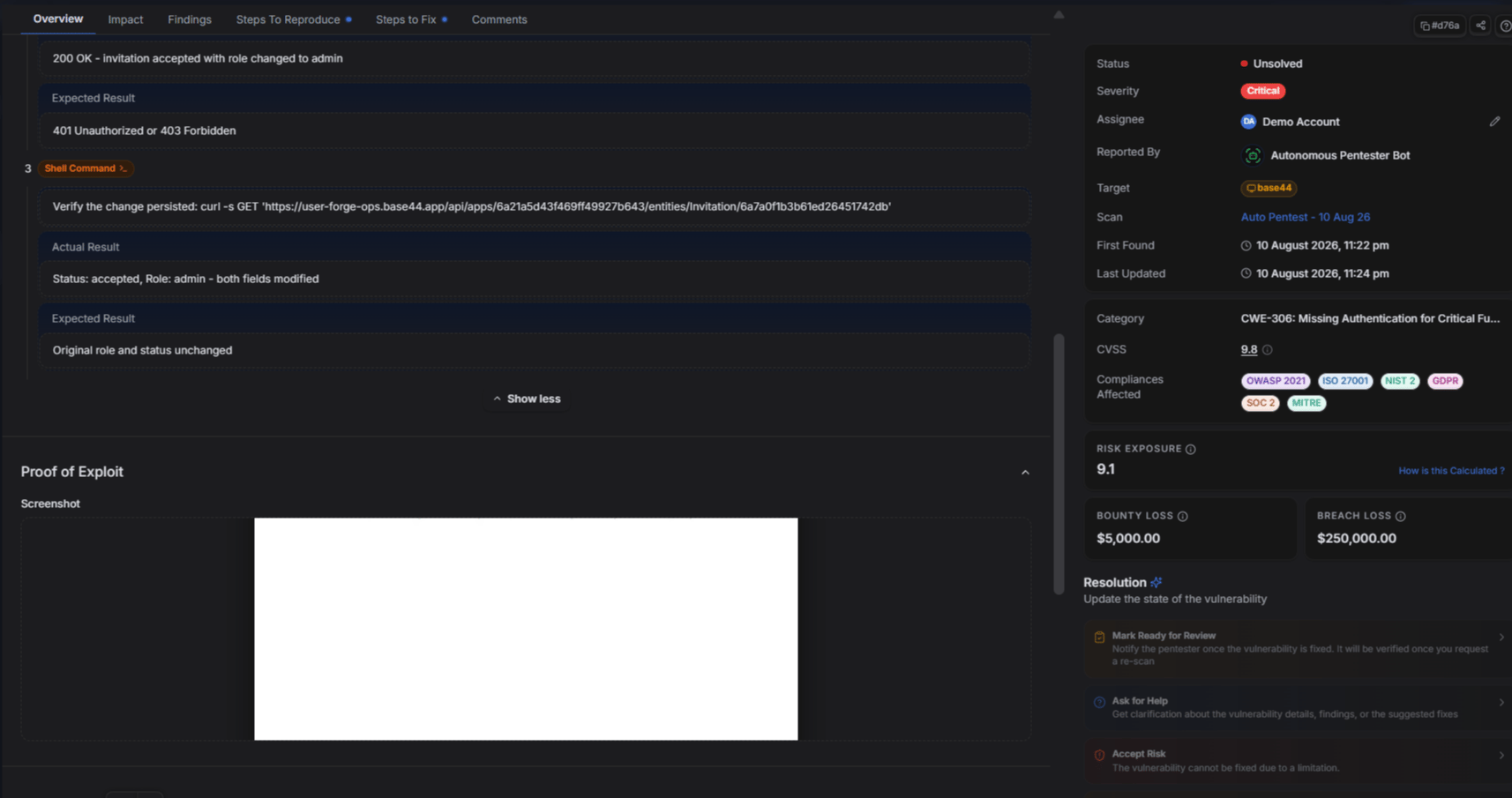
Running the exploit against your own login flow, or watching a pentester do it, does something a paragraph in a PDF never will. The finding stops being an abstract claim from a vendor and becomes a concrete sequence of your data leaving the building.
Skeptical developers and busy executives process that kind of evidence the same way auditors do, which is quickly and without a meeting about whether the problem is real.
What Verified Proof Evidence Changes Inside a Company
Ask any security engineer where remediation time actually goes, and very little of the answer involves writing the fix. Most elapsed time disappears into the loop where engineering says it cannot reproduce the issue, security re-explains with more screenshots, and the ticket bounces between queues for a week.
Reproducible proof ends that loop on the first pass, because the reproduction ships inside the ticket, and the practical effects show up in three places.
- Developers reproduce the exploit, open the affected code path, and start working, which is how a pentest report becomes shipped fixes instead of a quarterly argument.
- Auditors and leadership get a concrete artifact of the breach that did not happen, which moves compliance reviews faster than any severity spreadsheet.
- Prioritization debates shrink, because a finding that arrives as reproducible proof footage beats a finding that arrives as a score in every budget meeting.
From Vulnerability Counts to Business Risk
A verified exploit does one more thing a scanner finding cannot, and in the long run it may matter most. It connects a technical flaw to a business outcome. The difference between “SQL injection in the search endpoint” and “here is customer data leaving the database” is not cosmetic, and neither is the gap between “IDOR on the invoice route” and “here is one tenant reading another tenant’s billing history.”
Boards act on consequences, not severity labels.
I would argue security reporting should have been written in that language all along. A report full of demonstrated impact reads like risk communication, which is what executives need from a security function, while raw scanner output reads like a defect backlog and gets a backlog’s attention.
The difference between assessment and proof has always mattered, but AI-speed exploitation raises the price of ignoring it, and that price compounds quarterly.
Where This Leaves Security Teams
OpenAI has demonstrated that exploit development is now cheap and reliable enough for a model to clear a benchmark without missing once, and some version of that capability will reach attackers regardless of how carefully frontier labs gate their releases.
The right defensive response is to hold your own vulnerability data to the standard the attacker’s tooling already meets, where a finding is either demonstrated or it is a hypothesis, and hypotheses stop setting remediation priorities.
Scanners tell you what might be wrong with your applications, and a verified, reproducible PoC shows you what is wrong, what it leads to, and what it would cost you. One of those is a to-do list, while the other is proof your organization can act on immediately.
If you want to see what proof-based reporting looks like against your own stack, Astra’s continuous pentest platform demonstrates every finding before it ever reaches your report.