Key Takeaways:
- If you’re still wondering if you need AI pentesting or human pentesting, you’re on the wrong path. The right question would be what you’re actually worried about breaking.
- AI pentesting/autonomous testing covers repetitive tasks related to known CVEs, exposed APIs, cloud misconfigurations, and asset discovery at scale.
- Traditional pentesting owns the parts of testing that machines fails to understand or identify. This includes business logic flaws, broken authorization, payment journeys, and chained exploits. These show up only when someone actually understands how your product is supposed to work.
- The strongest teams don’t pick any one method; they opt for a hybrid approach. They rely on both AI pentesting for continuous coverage and human pentesting for depth and validation. This allows one to cover for what the other missed.
If there’s one thing all of us can agree about modern security, it is that penetration testing is no longer a once-a-year activity. Modern attack surfaces do not stay still. New code ships faster, cloud infrastructure is constantly changing, and APIs are multiplying across product ecosystems. To keep up, engineering teams have moved security earlier in the development lifecycle through shift-left practices.
But shift-left only works when testing can keep pace with shipping. Otherwise, it’s like a Formula 1 team skipping pit stops to keep pace with the race and calling it “efficiency.” This is why AI-led security testing is getting all the attention: it can test faster, run around the clock, with greater coverage, but speed alone does not equal security. Traditional pentesting, on the other hand, still brings business logic understanding, and most importantly, human context that automation often misses.
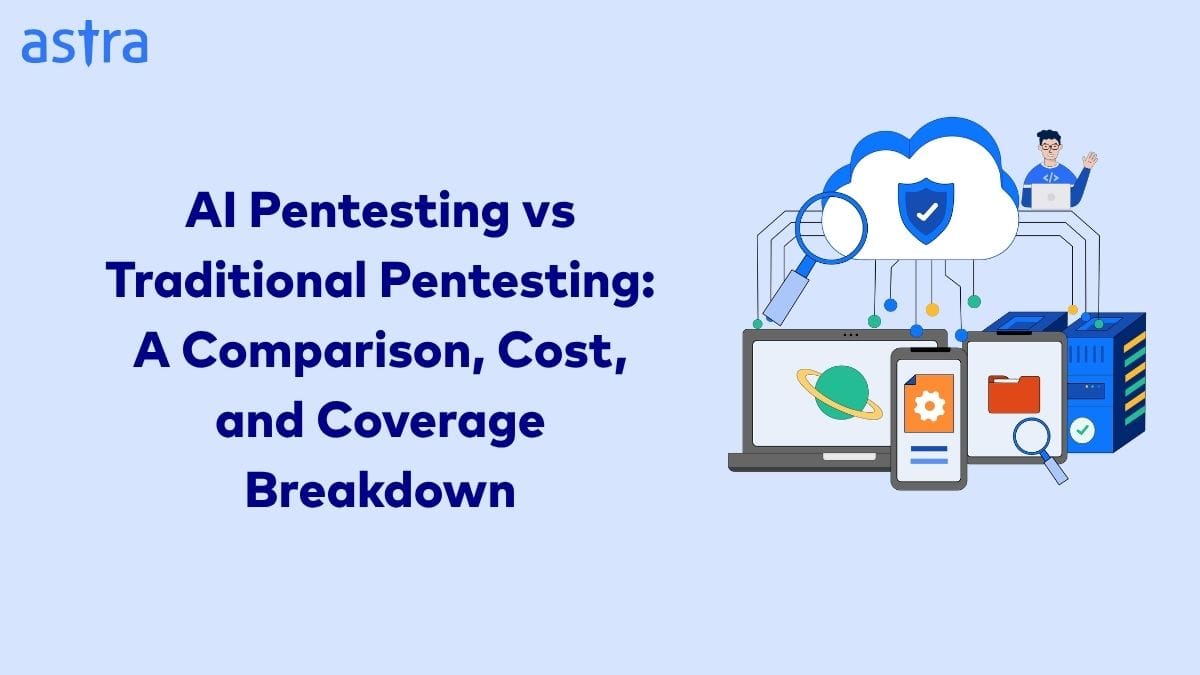
The question teams ask right now is whether they should run AI pentesting or traditional pentesting, but they are asking the wrong question. What they should be asking is: what are you actually worried about breaking, and which kind of test is built to catch it?
This blog breaks down AI pentesting and traditional pentesting across cost, coverage, scalability, accuracy, compliance, and ROI, so CISOs, CTOs, and security leaders can make a practical decision rather than chase hype.
What is Traditional Penetration Testing?
Traditional penetration testing is a human-led security assessment. Humans conducting the test are ethical hackers who simulate real-world attacks. They don’t just identify vulnerabilities but also validate whether they can be exploited and the potential impact on your business. The traditional pentest process usually includes scoping, reconnaissance, manual testing, exploitation, validation, reporting, remediation guidance, and usually retesting. It covers applications, APIs, networks, cloud, and mobile apps.
What is AI Pentesting?
AI pentesting refers to using AI-assisted systems and automations to discover, prioritize, and even simulate attacks across digital assets. However, AI pentesting requires a clear definition, owing to the fragmented use of the term.
Unlike vulnerability scanners that identify problems in your attack surface, AI pentesting goes the extra mile and also helps decide what to fix first based on estimated exploitability and how it could actually affect the business. The process for AI pentesting includes automated reconnaissance, vulnerability correlation, attack path mapping, LLM-assisted analysis, and continuous vulnerability discovery.
AI Pentesting vs Traditional Pentesting: Quick Comparison Table
Confused about which approach is right, AI pentesting or the human kind? AI is great at the boring, repetitive half: monitoring your entire attack surface around the clock and flagging known issues before they turn into an incident at 2 a.m. Humans are great at the part a machine can’t do: abused workflows and broken logic.
So the table below is not to pick a winner, but to understand what each one is actually good at.
| Factor | AI Pentesting | Traditional Pentesting |
|---|---|---|
| Speed | Very fast - can run continuously or frequently | Slower - depends on engagement scope and tester availability |
| Coverage | Broad coverage across assets, APIs, cloud, and known vulnerabilities | Deep coverage within a defined scope |
| Accuracy | Strong when paired with validation, but may produce noise | Stronger contextual accuracy after expert review |
| Business Logic Testing | Limited - struggles with business context | Strong - ideal for workflow abuse and logic flaws |
| Continuous Testing | Built for frequent or continuous validation | Usually point-in-time |
| Scalability | High - can test many assets repeatedly | Limited by human bandwidth and budget |
| Human Creativity | Limited | High |
| False Positives | Possible without human validation | Usually lower after manual verification |
| Compliance Readiness | Useful for continuous monitoring of evidence | Stronger for formal pentest reports and audits |
| Cost | Subscription or platform-based | Per engagement, consultant-led, often higher per test |
| Reporting | Dashboard-driven, fast, and often prioritized | Detailed narrative reports with business impact |
| Remediation Guidance | Good for recurring fixes and retesting | Better for nuanced engineering guidance |
Cost Breakdown: AI Pentesting vs Traditional Pentesting
Traditional pentesting is priced per engagement, whereas AI pentesting is billed on a subscription or usage-based pricing model.
Costs in traditional pentesting depend on scope, complexity, and number of assets, compliance needs, and whether retesting is included. But on the downside, every additional test usually requires more human hours.
In AI Pentesting, you would be paying for the convenience of continuous testing, automated vulnerability assessment, attack surface monitoring, and AI-assisted prioritization. The cost of an AI pentesting tool would depend on the number of assets, scan frequency, human validation, and add-on features such as integrations and compliance.
While pricing for both methods varies primarily by vendor and scope, most teams can think about the cost difference this way: traditional pentesting is priced around human-led engagements, AI pentesting is priced around recurring coverage, and hybrid pentesting combines both.
What Would Be the Ideal Approach for You?
| Company Size | Traditional Pentest | AI Pentesting | Hybrid Approach |
|---|---|---|---|
| Startup SaaS | Ideal for annual compliance or launch validation, but expensive if repeated often | Cost-effective for continuous visibility and early detection | AI testing plus one manual pentest is usually practical |
| Mid-market SaaS | Useful for deeper web, API, and cloud assessments | Helps monitor fast-changing assets and reduce repeated testing costs | Strong balance of cost, coverage, and validation |
| Compliance-first industries | Important for audit-ready reports, customer assurance, and testing sensitive workflows involving PII, PHI, payments, or financial data | Useful for continuous monitoring between formal assessments | Best fit: AI-led pentesting plus human-led pentests for compliance, business logic, and sensitive data flows |
| Enterprise | High cost due to large scope, multiple environments, and specialized testing | Scales better across broad attack surfaces | Best fit: continuous AI testing plus scheduled expert-led pentests |
Coverage Breakdown: Which Finds More Vulnerabilities?
AI pentesting is best known for finding issues that are repeatable and discoverable at scale, such as known CVEs, exposed services, cloud misconfigurations, exposed APIs, and large-scale asset discovery.
Human-led penetration testing, on the other hand, is better at identifying issues that require human judgment and an understanding of the business to identify business logic flaws, privilege escalation, chained vulnerabilities, and authentication bypasses.
In short, AI may find more vulnerabilities across a larger surface area. Humans are more likely to find vulnerabilities that require understanding how the application is supposed to behave.
Vulnerability Coverage Table
| Vulnerability Type | AI Pentesting | Traditional Pentesting |
|---|---|---|
| Known CVEs | Strong | Moderate |
| Configuration issues | Strong | Strong when context matters |
| Missing headers | Strong | Moderate |
| Cloud misconfigurations | Strong | Strong for exploit chaining |
| Exposed APIs | Strong | Moderate |
| Business logic flaws | Weak to moderate | Strong |
| Multi-step attacks | Moderate | Strong |
| Privilege escalation | Moderate | Strong |
| Chained vulnerabilities | Moderate | Strong |
| Workflow abuse | Weak | Strong |
| Authentication bypasses | Moderate | Strong |
Continuous Security Testing vs Point-in-Time Testing
Traditional pentesting happens once a quarter, once a year, or for some other who still lives in 2016, right before an audit. The report is accurate the day it’s delivered, but it’s outdated the moment your next deploy goes out. The results of a traditional pentest reflect the state of your IT environment during that testing window.
Say a new code ships and a new API goes live on a Tuesday afternoon without anyone filing a ticket about it. AI pentesting fills that gap. It watches out for exposure drift, flags new issues as they show up, and checks whether last month’s fix actually held.
Compliance
AI pentesting is usually priced as a subscription, platform license, or usage-based model. The cost depends on factors such as asset count, scan frequency, API coverage, cloud coverage, integrations, compliance features, and whether human validation is included.
For example, Astra’s Autonomous Pentest plan starts at $1,999/year or $199/month for 1 target. It includes autonomous pentesting, a compliance-ready pentest report, same-day first report, and one human re-scan by experts to verify fixes.
In most cases, AI pentesting is more cost-efficient when testing needs to be repeated across fast-changing apps, APIs, and cloud environments.
Challenges in AI Pentesting
AI pentesting is very useful and highly regarded, but it is not a fix for all your security problems. Security teams still need to account for scanner fatigue, AI hallucinations, validation challenges, and a lack of human context.
The other risk runs in the opposite direction: AI missing something because it doesn’t understand your payment flow, your access rules, or what a normal user action looks like for your specific product.
A few other things worth watching for:
- Finding overload – Most scanners provide a list of all patches to be made and call it a day. No prioritization means your team’s stuck triaging instead of fixing what actually matters.
- False positives – AI may sometimes flag issues that look bad on paper but aren’t exploitable in your actual environment. Chasing those burns hours nobody has.
- False negatives – AI walks right past anything that needs business context or user intent to catch.
- AI-generated explanations – Findings and remediation advice are useful, but they still need a human glance before engineering acts on them.
- Chained exploit validation – Confirming a multi-step attack path requires humans going through it themselves. AI can point at the path, but it can’t always prove it holds.
- Sensitive data handling – Credentials, logs, and test data should be stored and accessed properly. Automated testing doesn’t make that optional.
Future of AI in Penetration Testing
The future of AI in penetration testing is not a topic of whether AI will replace pentesters. Rather, we are moving towards AI-augmented security teams which would foster better division of labor.
AI copilots will keep getting better at the grunt work: summarizing log output, drafting payload ideas, mapping attack paths, and writing the first pass of remediation guidance. Autonomous pentesting will keep improving on the repeatable stuff: known CVEs, exposed assets, cloud misconfigs, and API discovery.
The interesting move is AI shifting from “here’s what’s wrong” to “here’s why, and here’s a fix you can validate.” The category will likely shift toward agentic security testing and continuous offensive security, in which AI runs recurring checks, and humans step in for high-risk validation.
The strongest teams will not be choosing between AI and human expertise. They will build workflows that improve each other.
Conclusion
So, should you choose AI pentesting or traditional pentesting?
That is still the wrong question.
The better question is the one we started with: what are you actually worried about breaking, and which kind of test is built to catch it?
If your biggest problems are speed, scale, and a constantly changing attack surface, autonomous pentesting tools provide broader, recurring coverage at a lower cost per test cycle. It helps teams keep up with new code, new APIs, cloud changes, and exposure drift before the next scheduled pentest.
But if your biggest risk lives inside business logic, authorization flows, payment journeys, user roles, or chained exploits, human-led pentesting vendors are still hard to replace. Some vulnerabilities do not show up just because a tool scanned for them. They show up when someone understands how your product is supposed to work and then tries to make it behave differently.
That is the real cost and coverage tradeoff. AI pentesting reduces the cost of repeated testing and improves visibility across a broader portion of your attack surface. Traditional pentesting costs more per engagement, but gives you deeper validation where human context matters.
The strongest security teams do not choose one side and call it strategy. They run automated pentesting for continuous and cost-efficient coverage and human pentesters for depth, context, validation, and confidence.
FAQs
Is AI pentesting better than traditional pentesting?
AI pentesting wins when it comes down to speed, scale, and continuous visibility. It helps teams test and frequently monitor more assets and identify recurring issues much faster than a one-time engagement. Traditional pentesting is better for activities that require a human eye, such as business logic testing, complex exploit validation, and contextual risk analysis. Most modern teams greatly benefit from a hybrid approach.
Can AI replace human pentesters?
No, AI can only automate repetitive work and widen coverage, but it cannot fully replicate human creativity, business context, or expert judgment. Human pentesters are still needed to validate complex risks, test logic-heavy workflows, understand real-world impact, and confirm whether a vulnerability can actually be exploited.
How much does AI pentesting cost?
AI pentesting is usually priced as a subscription, platform license, or usage-based model. The cost depends on factors such as asset count, scan frequency, API coverage, cloud coverage, integrations, compliance features, and whether human validation is included.
Astra’s Autonomous Pentest plan starts at $1,999/year or $199/month for 1 target. It includes autonomous pentesting, a compliance-ready pentest report, same-day first report, and one human re-scan by experts to verify fixes.
In most cases, AI pentesting becomes more cost-efficient when testing needs to happen repeatedly across fast-changing apps, APIs, and cloud environments.
What vulnerabilities can AI miss?
AI can miss vulnerabilities that require business context, human intuition, or a deep understanding of how a product is supposed to work. This includes business logic flaws, workflow abuse, chained vulnerabilities, complex privilege escalation, and authentication bypasses. That is where human-led validation becomes important.
Is AI pentesting compliant with SOC 2?
AI pentesting can support SOC 2 by strengthening continuous monitoring, vulnerability management, remediation tracking, and security evidence. It helps teams identify and fix issues more frequently, rather than waiting for an annual pentest. However, most organizations still rely on human-reviewed pentest reports as the stronger piece of audit evidence. The best approach is often AI-led monitoring combined with human-led reports for audit readiness.
What is the difference between vulnerability scanning and AI pentesting?
Vulnerability scanning mainly identifies known issues such as missing patches, misconfigurations, and known CVEs. AI pentesting goes a step further by adding prioritization, attack path analysis, exploitability checks, correlation across findings, and remediation guidance.
Should startups use AI pentesting?
Yes, startups opt for AI pentesting, considering it gives them continuous visibility without needing to run expensive manual tests every time something changes. This is especially useful for startups that ship fast, add endless APIs, expand cloud infrastructure, or prepare for customer security reviews.
However, for startups handling sensitive healthcare/financial data, payments, or preparing for SOC 2, they should still run manual pentests for deeper validation. AI pentesting will help them move faster, but human-led testing helps them prove security with more confidence.
What is hybrid penetration testing?
Hybrid penetration testing combines AI-driven or automated security testing with human-led penetration testing. AI covers scale and continuous checks; humans cover creativity, exploit validation, business logic, and compliance-ready reporting. This model gives teams the best of both worlds: continuous coverage from AI and deeper confidence from human expertise.