Ever wonder why a codebase that passes every test in CI still shows up in a breach report six months later? Simply put, tests check whether code works. They rarely check whether code can be abused.
Say you build a house with a solid lock on the front door but leave a window unlatched around back. The house still works as a house. It just isn’t secure, and nobody notices until someone climbs through that window. That’s the gap a code security review is built to close.
Broken Access Control has held the number one spot in OWASP’s Top 10 since 2021, and it still affects 3.73% of tested applications in the 2025 edition. Most of that is exploitable code that nobody stopped to read with an attacker’s eyes.
In this guide, we’ll break down what a code security review actually is, how it differs from penetration testing and security audits, what a review should catch, and where AI fits into the process today.
What Is a Code Security Review?
A code security review is a systematic look at an application’s source code, dependencies, and configuration, aimed specifically at finding what an attacker could exploit rather than what a user might complain about. You’ll see it called secure code review, source code security review, or just security code review. The label changes; the goal doesn’t.
Teams run it manually, with automated tools like SAST scanners, or through some mix of both. It covers three layers: your own source code, the third-party libraries you depend on, and the configuration files nobody remembers to revisit. That third layer trips up more teams than it should. A hardcoded credential sitting in a config file is exactly as exploitable as a SQL injection bug, it just never shows up in a typical pull request diff.
Why Do Code Security Reviews Matter?
A few reasons this keeps showing up on security roadmaps every year.
1. Late fixes cost more than early ones
You’ve probably seen the claim that fixing a bug in production costs 100x what it costs in development. That specific number traces back to internal IBM training material with no real study behind it, so treat it skeptically. What’s actually measurable: the Consortium for Information and Software Quality put the cost of poor software quality in the US at $2.41 trillion a year in 2022. Catching a flaw in review avoids paying into that number at all.
2. Most breaches trace back to something reviewable
An injection flaw, a hardcoded secret, an auth check that only covers some code paths, these are the boring, well-understood bugs that keep causing expensive incidents. IBM’s 2025 report puts the global average breach cost at $4.44 million, with phishing and supply chain compromise as the leading entry points. None of that requires a sophisticated attacker. It just requires an unreviewed pull request.
3. It’s the cheapest point in the SDLC to catch a problem
In a DevSecOps model, review happens right after a pull request opens, before it merges into anything else. The developer still has full context on what they wrote, and nothing downstream depends on the flawed code yet. Push the same fix into a pre-release audit or a pentest, and it’s now competing with a release deadline. Our guide to DAST and OWASP Top 10 compliance covers how continuous testing fits alongside this review-stage work.
How Does Code Security Review Compare to Other AppSec Methods?
Code security review overlaps with a few other terms teams use loosely, and mixing them up leads to gaps nobody notices until an audit.
They’re not competing approaches; they cover different gaps. A review can catch a logic flaw a pentest never triggers, while a pentest surfaces issues that only exist once code, infrastructure, and third-party services are wired together. SAST, DAST, and SCA are the automated tools a review can lean on without being defined by them, since none of them understand what an application is actually supposed to do. For more on the automated side, see our breakdown of SAST vs. DAST testing approaches.
| Code security review | Penetration testing | Security audit | SAST / DAST / SCA | |
|---|---|---|---|---|
| Access to code | Full | Usually none | Full | Full (SAST) or none (DAST) |
| Timing | Continuous, per PR | Periodic | Point-in-time | Continuous, automated |
| Who or what does it | A reviewer, plus tools | A tester or platform | A formal audit team | Automated tooling |
| Best at catching | Logic flaws in new code | Runtime, chained exploits | Systemic, legacy issues | Known-pattern bugs at scale |
Manual vs. Automated vs. Hybrid Code Review
A human reviewer brings something no scanner has: an understanding of what the application is actually supposed to do. That’s what lets someone catch an endpoint that checks whether a user is logged in but never checks whether they’re logged in as the right user, a bug automated tools routinely miss. The tradeoff is speed. Manual review doesn’t scale with codebase size, and its quality depends entirely on who’s doing it and how much time they’re given.
Automated tools flip that trade. SAST scanners and linters run on every commit in seconds, catching well-understood, pattern-based bugs without asking anyone to stop what they’re doing. What they can’t do is reason about intent, so business-logic flaws sail through clean.
| Manual review | Automated review | |
|---|---|---|
| Speed | Slow | Seconds |
| Scales with codebase size | Poorly | Well |
| Catches business logic flaws | Yes | Rarely |
| Runs on every commit | Impractical | Standard |
Most mature programs run both. Automated scanning handles volume, manual review handles the smaller set of high-risk changes, authentication, payment flows, access control, where judgment actually changes the outcome.
What Does a Code Security Review Actually Look For?
A reviewer, human or automated, is hunting for a fairly consistent set of patterns. Here’s what shows up most often:
- Injection flaws: SQL, command, NoSQL, and XXE injection all share the same root cause, untrusted input treated as executable code. It’s one of the oldest, best-documented bug classes, and it still carries the most associated CVEs of any category in OWASP’s 2025 data.
- Broken authentication and authorization: tokens that never expire, reset flows that skip identity checks, or an endpoint that confirms you’re logged in but never confirms you own the resource you’re requesting. Broken access control has held OWASP’s top spot since 2021.
- Hardcoded secrets: API keys and passwords pasted directly into source instead of pulled from a secrets manager. Once committed to version control, they’re effectively permanent.
- Weak cryptography: MD5 or SHA-1 for password hashing, a hardcoded encryption key, or a homegrown scheme instead of a vetted library, affecting 3.80% of tested applications.
- Security misconfiguration and SSRF: default credentials left active, debug modes exposed to the internet, or a server that can be tricked into reaching internal systems it shouldn’t.
- Vulnerable dependencies: a vulnerability in one open-source package becomes a vulnerability in every application that uses it, which is why supply chain risk now carries the highest average exploit and impact score of any OWASP category.
- Business logic flaws: a checkout that never confirms the final price server-side, a coupon usable more than once, a race condition where two requests both pass a balance check before either deducts funds. None of these trip a syntax rule, which is exactly why they need a human eye.
The fix for injection is almost always the same: stop building queries by pasting user input into a string.
# Vulnerable

query = "SELECT * FROM users WHERE email = '" + user_email + "'"

# Safer

query = "SELECT * FROM users WHERE email = %s"

cursor.execute(query, (user_email,))
The Code Security Review Process, Step by Step
- Scope and threat model: decide what’s being reviewed and flag the highest-risk areas, authentication, payment handling, anywhere user input reaches a database.
- Run automated scans: SAST and SCA go first, clearing pattern-based issues before anyone spends time manually.
- Manually review high-risk areas: focus on what tools can’t reason about, authorization logic and business rules.
- Triage and prioritize: rank findings by exploitability and impact, not just by count.
- Remediate: developers fix confirmed issues, ideally with the reviewer available to clarify intent.
- Verify and re-test: confirm the fix actually closes the gap, then re-run scans.
- Document: a short record speeds up the next review and gives auditors something concrete.
Secure Code Review Checklist
A checklist won’t replace judgment, but it catches the basics when time is tight:
- Input validation: all input validated server-side, checked against an allow-list, file uploads restricted by type and size.
- Authentication: passwords hashed with bcrypt, scrypt, or Argon2, never MD5 or SHA-1; sessions expire and invalidate on logout.
- Authorization: every endpoint returning user-specific data checks ownership; role checks happen server-side, not client-side.
- Cryptography: keys live in a secrets manager, never hardcoded; TLS enforced with no unencrypted fallback.
- Error handling and logging: user-facing errors don’t leak stack traces; logs never capture passwords or full card numbers.
- Dependencies and secrets: dependencies scanned against a known-vulnerability database; no credentials committed to version control.
- Configuration: default credentials changed before deployment; debug modes disabled in production.
AI in Code Security Review (and Reviewing AI-Generated Code)
Traditional SAST tools match code against known patterns, fast, but rigid enough to miss an unusual way of writing a vulnerable function. Large language model-based tools read code more like a human reviewer would, following data flow across files and reasoning about what a function is trying to do. Anthropic’s security-review command for Claude Code is a public example: it analyzes pull request diffs for injection risks, auth flaws, and business-logic issues, then posts findings as inline PR comments.
Where this genuinely helps is speed and coverage. An AI reviewer runs on every pull request, in every repository, without waiting on anyone’s schedule, and it explains findings in plain language instead of a cryptic rule ID. It’s also consistent in a way humans aren’t. A reviewer’s attention drifts by the fiftieth diff of the day; an automated one doesn’t.
Where it falls short: an AI reviewer hasn’t executed the code or confirmed an exploit actually works, and it can misjudge context the same way a human can. Using the same technology that may have written the code to also secure it means the blind spots in each role aren’t guaranteed to be independent. That’s not an argument against using it, it’s a reason to keep a human and a runtime layer like pentesting in the loop regardless of how good the model gets.
There’s a second, newer wrinkle worth naming. A meaningful share of code today starts as an AI suggestion, and accepting it quickly because it compiled and looked reasonable is its own risk category. That code deserves the same review rigor as anything else, arguably more.
Best Practices for Effective Code Security Reviews
1. Prioritize by risk, not volume
Spend the most reviewer attention on authentication, authorization, and anywhere user input touches a database, not on treating every line of every diff equally. A logging tweak and a change to your payment flow don’t deserve the same level of scrutiny, but in a lot of review queues they get it anyway.
2. Integrate scanning early and continuously
Automated checks belong in CI/CD on every commit, not as a step someone remembers to trigger before a release. Bolt it on at the end and it turns into a pre-launch scramble instead of a routine part of shipping code.
3. Adopt a shared standard
The OWASP Application Security Verification Standard gives teams a consistent, testable baseline instead of relying on whatever an individual reviewer happens to remember that day. It also gives new reviewers something concrete to work from instead of absorbing tribal knowledge over a few months.
4. Keep reviews small and frequent
A 50-line pull request gets reviewed properly. A 3,000-line one, dropped at the end of a sprint, invites rubber-stamping. If a change is genuinely too large to review carefully, that’s usually a sign it should have been split up in the first place.
5. Track what gets found
A finding that never gets logged or followed up on might as well not have been found at all. Keep a running record of what turns up and how it got fixed, since that history is also what makes the next audit faster instead of another scramble.
Code Security Review Tools
Most teams stitch together a few categories such as SAST scanners for source code, SCA for dependencies, secret scanners for credentials, and increasingly, AI-powered reviewers layering semantic reasoning on top of pattern matching. Well-known SAST and SCA names include SonarQube, Semgrep, and Snyk Code, each with different tradeoffs around language support and noise.
| Category | What it does | Where it fits |
|---|---|---|
| SAST | Scans source code for known-bad patterns | Every commit, in CI/CD |
| SCA | Checks dependencies against vulnerability databases | Every build |
| Secret scanners | Flags hardcoded credentials and keys | Pre-commit and CI/CD |
| AI-powered reviewers | Semantic analysis of pull request diffs | Every pull request |
| DAST | Attacks a running application from the outside | Staging and production |
Why Astra Security?
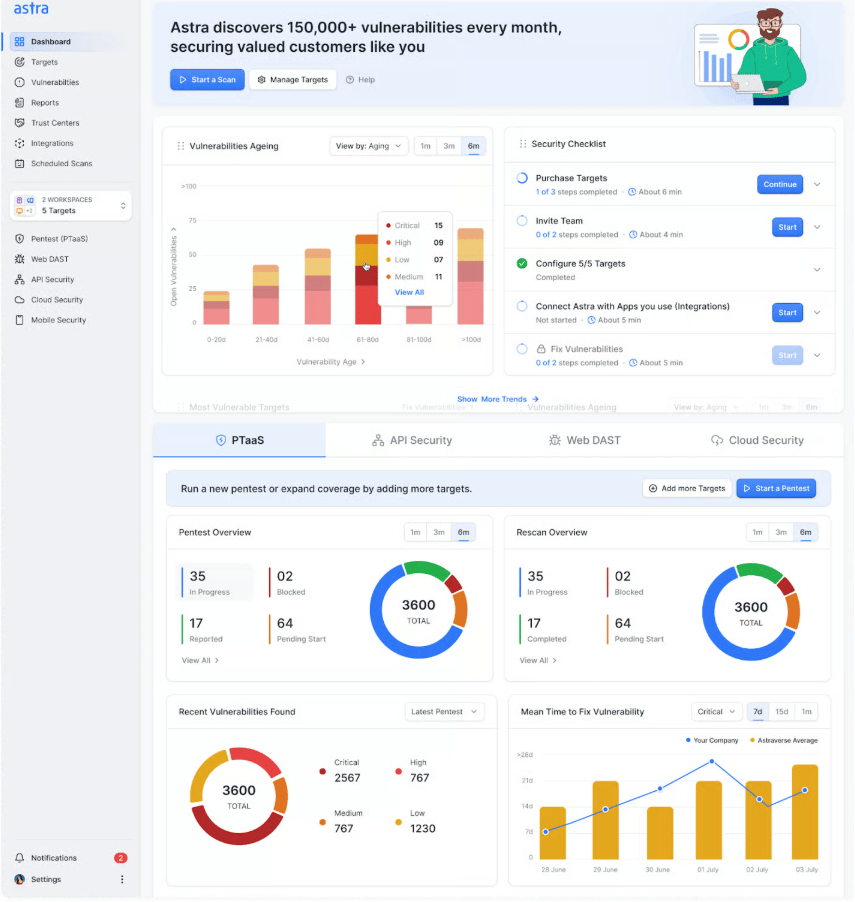
What most engineering teams actually need isn’t another dashboard flagging things that might be wrong. They need confirmation of what’s actually exploitable, and a way to catch what static analysis misses once code is running in the real world.
Astra doesn’t build a SAST product, and we’re not going to pretend otherwise. Where we fit is downstream and complementary: continuous DAST scanning against 10,000+ checks including every OWASP Top 10 category, paired with manual penetration testing for the business-logic and chained-exploit findings that static analysis alone never catches. With Astra, you can:
- Catch business logic flaws, IDORs, and authentication issues that pattern-matching tools miss
- Validate findings against real exploitability instead of theoretical risk
- Retest fixes and confirm exposures are actually closed
- Generate compliance-ready reports for SOC 2, ISO 27001, PCI DSS, and HIPAA
Want a second opinion on what your pipeline might be missing? Talk to an Astra security expert about pairing code review with continuous testing.
Final Thoughts
Remember the house with the unlatched window from the start of this guide? A code security review is how you find that window before someone else does, while it’s still cheap to fix. It won’t catch everything on its own. Pair it with automated scanning for the pattern-based bugs, manual review for the ones that need judgment, and penetration testing for what only shows up once the application is actually running.
None of these layers replace each other. Together, they’re what keeps a codebase that “works” from also being one that’s easy to break into.
FAQs
1. What is secure code review?
The practice of examining source code, dependencies, and configuration to find security vulnerabilities, not functional bugs. It’s usually done on every pull request, combining automated tools with manual inspection.
2. How is secure code review different from a security audit?
A review is ongoing and tied to pull requests. An audit is a point-in-time, comprehensive look at an entire codebase, usually for compliance or after an incident.
3. Is secure code review the same as penetration testing?
No. Review is white-box and looks at source code directly. Penetration testing attacks a running application from the outside.
4. How long does a secure code review take?
A single pull request usually takes minutes to an hour. A full-codebase audit can take days to weeks.
5. Can AI replace manual secure code review?
Not currently. AI reviewers like Claude Code’s /security-review catch context-dependent issues scanners miss, but they haven’t executed the code or confirmed an exploit works.
6. How often should we run a secure code review?
Continuously, on every pull request. Pair that with periodic, more comprehensive testing like an annual audit or continuous pentesting.