Your board wants a pentest, your compliance team needs a SOC 2, and you’ve got 47 browser tabs open, comparing penetration testing companies, where every vendor in the $2–3 billion market claims they’re ‘comprehensive’ and ‘best in class.’
Yet after 2 hours, 3 videos, and 7 guides, you are still not sure which provider fits your situation.
On a surface level, picking the wrong provider seems to just come with a few thousand-dollar cost, but in real life, it translates to GTM delays, compliance blockers, and actual exposure to hackers, lawsuits, and penalties. So how do you choose the right provider for you?
Here’s the answer: three questions. That’s all it takes to know which penetration testing company you need, about your budget, your timeline, and what’s actually driving this decision. This article, as such, walks you through the 3-question framework, a deep dive into the top 8 providers like Astra and Rapid7, and a checklist of red flags to watch for during sales calls.
Top Pentest Providers
- Astra Security – Continuous/AI-led (4.6★)
- NetSPI – Enterprise PTaaS (4.9★)
- Rapid7 – Platform-integrated (4.3★)
- Secureworks – Threat-led PTaaS (4.3★)
- Synack – Crowdsourced (4.5★)
- CrowdStrike – Intel-driven (4.6★)
- Bishop Fox – Specialist consulting (4.8★)
- Redbot Security – OT/ICS specialist (No reviews)
What is the 3 Question Decision Framework?
Instead of wasting weeks comparing penetration testing providers, this framework cuts decision time to 72 hours by clarifying what actually matters: your constraint, capital, and calendar.
Question 1: What’s Driving This?
While it sounds philosophical, your driver determines your timeline, budget, and what “passing” even means. Some common controls include:
- Compliance mandates require reports mapping to frameworks (CC6.1, A.12.6.1) with evidence trails and attestation letters that auditors accept
- Post-incident recovery demands red team validation costing $75K+ with executive summaries showing gap closure, not just technical jargon
- Continuous deployment needs CI/CD integration, delivering JIRA tickets for daily releases, quarterly tests leave 89-day exposure gaps for your DevOps team
Question 2: What’s Your Budget?
Be brutally honest here. The $15K quote, once you add retesting, scope, adjustments, remediation, and validation, becomes a $43K budgetary approval meeting. Don’t believe us?
Hidden costs destroy financial planning: retesting adds 15-25%, mid-engagement scope expansion adds 20-40%, and emergency delivery premiums hit 30-50% before you even start.
- Under $15K is the floor for quality pentesting: you’re getting overseas teams with no compliance expertise or automated-only scans with 90% false positives.
- $15K – $50K gets mid-market standard: experienced testers, compliance-ready reports, integrations covering single apps (fits Series A-C SaaS companies).
- $50K-$100K buys enterprise-grade senior researchers handling complex multi-clouds with white-glove service & strategic remediation roadmaps.
- $100K+ delivers elite teams that publish CVEs, conduct red team exercises, and maintain retainer relationships, all required for F500 and credible post-breach validation.
Question 3: What’s Your Timeline?
Your timeline eliminates 60% of providers immediately because most can’t flex their delivery model to match your constraint. One-week emergencies need platform providers with global tester pools, trading comprehensive coverage for speed.
Standard compliance cycles run 2-4 weeks with proper scoping, while deep adversary simulation needs 4-8 weeks because recon & persistence testing can’t be rushed without missing critical attack vectors.
- 1-2 weeks is emergency mode with speed premiums, acceptable for deal blockers, never for post-incident deep dives or OT/ICS.
- 2-4 weeks fits standard compliance with proper scoping & initial remediation windows, works for SOC 2, minimal time for complex validation.
- Continuous delivery integrates with CI/CD, providing 365-day coverage. It often costs less annually than 4 quarterly tests while eliminating exposure gaps.
Your answer combination = Your provider
Your three answers eliminate 95% of the market immediately.
- SOC 2 + $25K + 3 weeks = compliance platforms.
- Post-breach + $120K + 6 weeks = elite red teams.
- Enterprise deal + $35K + 1 week = fast platforms with brand recognition.
Shortlist 2-3 providers where all three align, run parallel POCs, and decide in 72 hours based on execution, not sales decks or SEO performance.
Which are the Top 8 Pentesting Providers to Choose From?
These eight providers dominate the market across different use cases, budgets, and technical requirements. The table below compares them on the factors that determine fit: who they serve, what they cost, and how fast they move.
| Provider (Level) | Best For | Estimated Budget & Timeline |
|---|---|---|
| Astra Security (Level 3) | Continuous validation for SaaS shipping daily, unified web/API/cloud coverage, compliance automation | $5K–$10K/year, 2–3 weeks + continuous |
| NetSPI (Level 4) | Multi-cloud enterprises, post-breach validation, board-level reporting, attack-path visualization | $75K–$200K+/engagement (estimated), 4–8 weeks |
| Rapid7 (Level 2) | InsightVM users needing unified vuln + pentest views, compliance mapping | $25K–$75K/engagement, 2–4 weeks |
| Secureworks (Level 3) | Enterprise security teams needing threat intelligence-driven validation, organizations already using Taeis MDR platform, businesses requiring continuous strategic testing backed by real adversary insights | Project/retainer pricing (custom), 2–4 weeks |
| Synack (Level 3) | Large dynamic attack surfaces, continuous crowdsourced testing, always-on validation | $50K+/year, Continuous |
| CrowdStrike (Level 4) | Falcon EDR users, adversary emulation, SOC tuning, threat-intel-driven red team | $60–$185/device/yr, 3–6 weeks |
| Bishop Fox (Level 4) | IoT/mobile/embedded systems, complex custom architectures, long-term security partnerships | $50K+/engagement, 2–12 weeks |
| Redbot Security (Level 4) | Critical infrastructure (power/water/manufacturing), SCADA/ICS safe testing, OT/IT convergence | $5K+/per engagement /engagement, 3–6 weeks |
Here’s what sets each provider apart: their delivery model, specific strengths, when to choose them, and when they’re the wrong fit for your situation.
1. Astra Security [Get Started]
https://www.astra-security.com | ⭐ 4.6/5 (G2)
Best For: SaaS companies shipping daily that require CI/CD-integrated testing, teams wanting continuous validation without platform switching costs, and firms looking for unified security
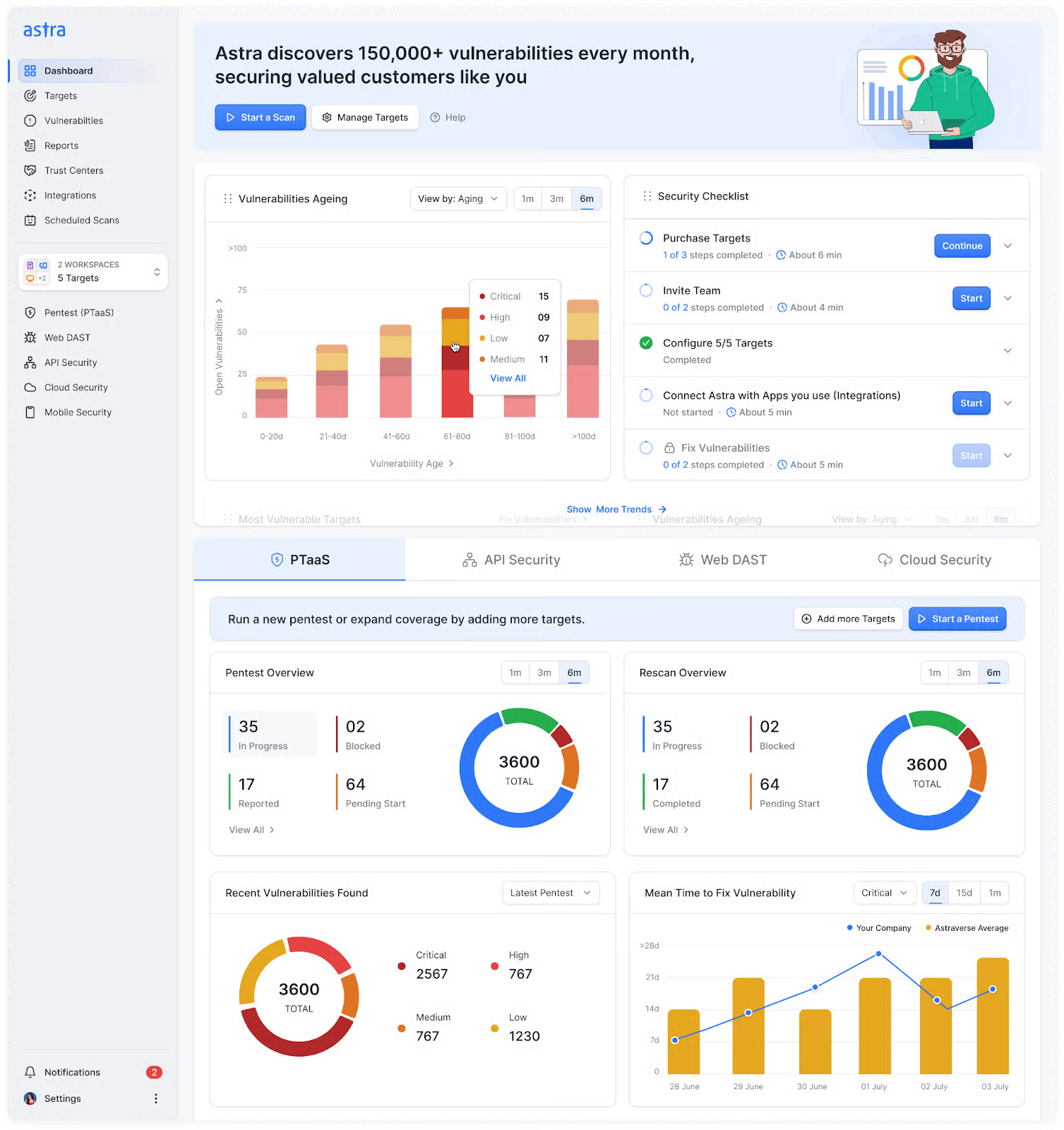
Astra Security combines AI-powered continuous scanning with in-house certified pentesters (OSCP, CEH, eWPTXv2), delivering zero false positives. Our Attack AI engine runs 15,000+ test cases across web apps, APIs, and cloud infrastructure, with findings flowing directly into Jira/Slack/GitHub, eliminating quarterly PDF cycles that leave 89-day exposure gaps.
The penetration testing provider handles authenticated DAST scans that crawl JS-heavy SPAs, discover shadow APIs from live traffic, and validate AWS/GCP/Azure misconfigurations while certified pentesters manually verify business logic flaws that automated tools miss.
Your Series B company gets enterprise-grade coverage starting at $5,999/year instead of paying three vendors $60K for fragmented point solutions.
Choose for:
- CI/CD native integration triggering scans on every commit via GitHub, GitLab, Jenkins, CircleCI, without breaking deployment velocity or requiring separate security pipelines
- Unified attack surface coverage testing web apps, APIs, & multi-cloud configs in one platform instead of juggling three separate vendors
- Developer-first workflows with AI-assisted remediation chatbots, video PoCs, instant rescans on individual vulnerabilities, and fix validation in minutes, not weeks
- Transparent subscription pricing starting at $5,999/year for PTaaS (1 target) or $199/month for continuous DAST scanning with no hidden fees or usage surprises
- Compliance automation with findings auto-mapped to SOC 2, ISO 27001, HIPAA, PCI DSS frameworks, plus publicly verifiable certificates in tailored Trust Centers after remediation
Skip if:
- You want a self-service platform with zero human interaction: Astra includes certified pentesters validating findings, not a pure DIY scanner for teams preferring fully automated-only testing
- You prefer rotating external consultants over platform consistency: Astra’s model uses dedicated in-house pentesters via their platform, unlike crowdsourced models offering diverse external researcher perspectives
Budget: $6K–$10K/year (PTaaS) or $199–$499/month (continuous scanning) | Timeline: 2–3 weeks initial + continuous | Maturity: Level 3 (Continuous validation)
2. NetSPI
https://www.netspi.com/ | ⭐ 4.9/5 (11 reviews)
Best For: Multi-cloud enterprise environments, post-breach validation with board-level reporting, organizations needing PCI DSS/SOC 2/HIPAA attestation-ready deliverables
NetSPI delivers enterprise-grade PTaaS through their Resolve™ platform, combining automated attack-path discovery with white-glove consulting. They excel at translating complex technical findings into executive narratives, critical when your CISO needs to present remediation roadmaps to the board after an incident.
Choose for:
- Attack-path visualization that maps multi-cloud lateral movement from initial access to crown jewels, instead of isolated vulnerability lists
- Compliance-ready artifacts with findings mapped directly to PCI DSS requirements, SOC 2’s TSC, and HIPAA safeguards that your auditors accept without translation
- Breach & attack simulation (BAS) validating your detection stack against real adversary TTPs, proving your $2M SIEM investment actually works
Skip if:
- You’re a Series A SaaS startup needing fast app testing. NetSPI’s 4-8 week engagements and enterprise sales motion don’t match weekly sprint cycles
- You want self-service platform access. NetSPI’s model is high-touch consulting with dedicated engagement managers, not DIY PTaaS portals
Budget: $75K–$200K+ per engagement | Timeline: 4–8 weeks | Maturity: Level 4 (Adversary simulation)
3. Rapid7
https://www.rapid7.com | ⭐ 4.3/5 (255 reviews)
Best For: Organizations already using InsightVM for vulnerability management, teams wanting unified vuln + pentest risk views, Metasploit-heritage custom exploit development
Rapid7’s pentest services integrate tightly with InsightVM, creating a single pane of glass where vulnerability scans and manual pentest findings flow into unified risk dashboards. Their Metasploit research heritage means they can develop custom exploits for unique architectures, not just run Burp Suite against your API.
Choose for:
- InsightVM integration that correlates pentest findings with continuous vulnerability data, showing which pentest discoveries matter most, given your actual asset exposure
- Metasploit DNA brings custom exploit development for unusual tech stacks like IoT devices, legacy protocols, and proprietary APIs where commercial tools fail
- Mid-tier pricing flexibility at $25-75K per engagement, more accessible than NetSPI’s enterprise minimums while maintaining consulting-grade depth
Skip if:
- You’re not in the Rapid7 ecosystem, as integration benefits disappear if you use Qualys, Tenable, or other vulnerability management platforms
- You need a 1-week emergency turnaround, as standard 2-4 week timelines don’t support enterprise deal blockers with urgent deadlines
Budget: $25K–$75K per engagement | Timeline: 2–4 weeks | Maturity: Level 2 (Regular compliance testing)
4. Secureworks (now part of Sophos)
https://www.secureworks.com | ⭐ 4.3/5 (5 reviews)
Best For: Enterprise security teams needing threat intelligence-driven validation, organizations already using Taeis MDR platform, businesses requiring continuous strategic testing backed by real adversary insights
SecureWorks delivers threat intelligence-driven PTaaS through its Counter Threat Unit (CTU) research team, which simulates real-world adversary attacks reflecting current and emerging threats. Findings flow through the Taegis platform to provide real-time visibility and streamline collaboration, eliminating the disconnect between traditional pentest reports and ongoing security operations.
Choose for:
- Threat intelligence-backed testing that reflects actual adversary tactics, not just vulnerability scanning
- Continuous strategic validation with a real-time findings platform, ideal for security teams already invested in the Taegis MDR ecosystem
- Broad testing coverage, including cloud, external/internal, wireless network, device/hardware, and physical security testing
Skip if:
- You need fast 1-2 week turnaround for sales-driven compliance.
- Your team prioritizes DevOps/Jira integration as SecureWorks focuses on security operations, not developer workflow integration.
Budget: Project/retainer pricing (custom) | Timeline: 2–4 weeks | Maturity: Level 3 (Enterprise security operations with continuous validation)
5. Synack
https://www.synack.com | ⭐ 4.5/5 (2 reviews)
Best For: Large, rapidly changing attack surfaces requiring continuous testing, enterprises wanting diverse researcher perspectives, organizations shifting from quarterly to always-on validation
Synack, as a penetration testing provider, combines 1,500+ vetted researchers with SARA AI that steers human effort toward high-impact areas while filtering noise. Their platform model stores findings as searchable intelligence, not static PDFs, enabling continuous testing programs that adapt as your infrastructure evolves daily.
Choose for:
- Continuous testing model for enterprises deploying infrastructure changes daily, where quarterly pentests leave 89-day exposure gaps Synack eliminates
- Dynamic scope flexibility, where adding new APIs, cloud accounts, or acquisitions doesn’t trigger contract renegotiations or 6-week rescoping cycles
- Platform-centric findings management with searchable vulnerability history, trend analysis, and proof that this quarter’s fixes actually closed last quarter’s attack vectors
Skip if:
- You want a single dedicated lead tester. A crowdsourced model means program managers coordinate researchers, not one senior consultant owning your engagement
- Your team lacks triage capacity. Continuous findings require internal resources to prioritize and route discoveries, not wait for quarterly consultant delivery
Budget: $50K+/year | Timeline: Continuous (days to weeks for triage) | Maturity: Level 3 (Continuous validation)
6. CrowdStrike
https://www.crowdstrike.com | ⭐ 4.6/5 (573 reviews)
Best For: Organizations using Falcon EDR wanting adversary emulation, SOC maturity validation through detection tuning, threat-intel-driven red team exercises
CrowdStrike delivers intel-driven adversary emulation using Falcon telemetry and MITRE ATT&CK-aligned campaigns. Exercises are goal-oriented around reaching crown jewels, not running every possible script, i.e., reports focus on attack chains and detection-tuning opportunities that improve your SOC’s effectiveness.
Choose for:
- Falcon EDR integration validating whether your $2M endpoint investment actually detects lateral movement, privilege escalation, and data exfiltration in practice
- Threat-intel-driven scenarios emulating APT29, FIN7, or ransomware groups your industry actually faces, not generic pentesting methodologies
- SOC tuning deliverables with Board-friendly brand recognition showing which detection rules fired, which failed, and specific configuration changes to close blind spots before real adversaries exploit them
Skip if:
- You need basic SOC 2 or PCI compliance validation: CrowdStrike’s adversary emulation is overkill for checkbox compliance, not cost-effective for audit requirements
- You don’t use Falcon EDR: Integration benefits and telemetry-driven testing disappear without CrowdStrike’s existing visibility into your environment
Budget: $75K+ per engagement | Timeline: 3–6 weeks | Maturity: Level 4 (Adversary simulation)
7. Bishop Fox
https://www.bishopfox.com | ⭐ 4.8/5 (5 reviews)
Best For: IoT/mobile/embedded systems requiring specialized expertise, complex custom architectures standard PTaaS underserves, long-term red team program partnerships
Bishop Fox is an offensive security consultancy specializing in hard technical problems that platform-based providers can’t solve. Their Cosmos platform supports continuous pentesting, but their real value lies in deep expertise in IoT cryptography, mobile application security, and custom attack surfaces where automated tools fail.
Choose for:
- IoT and embedded systems expertise testing industrial sensors, medical devices, connected vehicles, where one mistake bricks $500K equipment
- Mobile application cryptography analyzing iOS/Android apps with custom encryption, certificate pinning bypasses, and reverse engineering obfuscated code
- Research-driven team depth with consultants publishing CVEs, speaking at Black Hat, and bringing cutting-edge techniques to complex problems
Skip if:
- You need fast turnaround for enterprise deals. Boutique consulting model with 2-12 week engagements doesn’t support 1-week emergency compliance validation
- You want self-service platform testing. Bishop Fox is hands-on consulting, not a PTaaS portal where you click “start test” and wait for findings
Budget: $50K–$150K+ per engagement | Timeline: 2–12 weeks | Maturity: Level 4 (Adversary simulation)
8. Redbot Security
https://www.redbotsecurity.com | ⭐ NA/5 (No reviews)
Best For: Critical infrastructure operators (power, water, manufacturing), SCADA/ICS environments requiring safe testing protocols, OT/IT convergence security validation
Redbot Security is an OT/ICS penetration testing provider for industrial control systems, where standard pentesting methodologies cause unplanned outages or safety incidents. They emphasize manual, senior-level testing with safe protocols and scenario-based attack simulations that assume adversaries have already breached IT networks.
Choose for:
- Assumed breach scenarios testing what happens when ransomware operators pivot from IT into OT networks, validating segmentation and detection controls
- Critical infrastructure expertise for utilities, manufacturing plants, and industrial operators, where downtime costs millions per hour
- Regulatory compliance support for NERC CIP, IEC 62443, and other industrial cybersecurity frameworks requiring specialized OT security validation
Skip if:
- You’re testing standard web/API/cloud infrastructure. Redbot’s OT specialization is wasted on SaaS applications, enterprise IT networks, or cloud-native architectures
- You need a fast turnaround under 3 weeks, as safe OT testing requires extensive coordination, phased approaches, and maintenance window scheduling
Budget: $30K–$100K+ per engagement | Timeline: 3–6 weeks | Maturity: Level 4 (Adversary simulation for OT)
I got a Pentest. What went Wrong?
Now that you know which pentesting providers fit your situation, here’s what to watch for during evaluation. The pentest itself rarely fails—these five things do:
1. Nobody read the report
Your team gets a 200-page PDF with no prioritization. Developers can’t translate “SQL injection in the user_auth endpoint” into actionable work, so the report sits untouched.
2. 500 findings, but 490 were noise
Scanner spam drowns the three critical issues that actually matter. Your developers waste weeks triaging false positives instead of fixing real vulnerabilities.
3. The test broke production
Pentest takes down your live environment during business hours, costing you customers and revenue. This happens when providers skip safety protocols or proper scoping discussions. Ask every provider explicitly how they prevent outages before signing anything.
4. It costs 3x the quote
Your $15K pentest becomes $45K after retesting fees, scope adjustments, and hidden charges. Vague initial scoping and separate retest fees are the most common culprits.
5. Fixed everything, audit still failed
You remediated every finding, but your auditor rejects the report because it doesn’t align with the SOC 2 trust service criteria or the PCI DSS requirements. Generic security testing isn’t the same as compliance-focused validation.
Sales Call Evaluation Checklist
Warning Signs:
- “We can start tomorrow” (no scoping)
- “We test everything” (vague = scope creep)
- Won’t share sample reports
- Offshore-only, no overlap
- Rock-bottom pricing
- Retesting costs extra
- No certified testers
- Generic sales pitch
What Serious Providers Do:
- Detailed tech stack questions
- Asks about your architecture
- Discusses safety protocols upfront
- Sample reports available
- Transparent pricing, retesting included
- Industry references
- Certified testers (OSCP, CEH, CREST)
- Clear remediation process
Which Penetration Testing Provider is the Best for Which Compliance?
Most pentest buyers are here because an auditor said, “Show me proof.” This table maps what your specific compliance framework requires of providers delivering those exact artifacts, without translation headaches.
| Compliance | Key Requirements | Ideal Providers |
|---|---|---|
| PCI DSS | - Quarterly external vulnerability scans by ASV - Annual penetration testing of network/applications - Findings mapped to PCI DSS requirements (e.g., Req 11.3) | Astra Security, NetSPI, Rapid7 |
| SOC 2 | - Findings mapped to Trust Service Criteria (CC6.1, CC7.1) - Evidence trails for auditor review - Attestation letters and compliance-ready reports | Astra Security, Rapid7, NetSPI |
| HIPAA | - Technical safeguards testing (§164.312) - ePHI access controls validation - Risk analysis documentation for covered entities | Astra Security, NetSPI, Rapid7 |
| ABHA | - Health data security testing for ABDM integration - PHR/EHR app security validation - API security for health information exchange | Astra Security, Rapid7, NetSPI |
| ISO 27001 | - Controls testing mapped to Annex A (A.12.6.1, A.18.2.3) - Evidence for certification audits - Regular testing cadence documentation | Astra Security, Rapid7 |
| GDPR | - Data protection impact assessments (DPIA) - Privacy by design validation - Data breach prevention testing | Astra Security, Rapid7, NetSPI |
| NIS2 (EU) | - Critical infrastructure security measures - Supply chain risk assessments - Incident response validation | NetSPI, Bishop Fox, Rapid7 |
| DORA (EU Financial) | - ICT risk management testing - Third-party dependency assessments - Operational resilience validation | NetSPI, Rapid7, CrowdStrike |
Final Thoughts
You opened 47 tabs to find the right pentest provider. Now you have three questions that eliminate 95% of them in under an hour.
In other words, your compliance driver, budget tier, and timeline immediately narrow the field to 2-3 qualified providers, such as Astra Security, NetSPI, and others, instead of comparing an infinite number of features.
From there, it’s execution. Run parallel POCs, evaluate on delivery against your primary constraint, and decide in 72 hours. GTM delays and compliance blockers come from mismatched expectations, not “wrong” providers.
FAQs
1. What assets generally get pentested by these pentesting vendors?
Typical assets include external-facing networks, internal networks, web and mobile applications, APIs, cloud services, databases, and even IoT/embedded devices, depending on the scope.
2. What is the average cost of a penetration test?
A standard penetration test usually ranges between US $10,000-30,000, though simpler projects may start around $5,000, and complex engagements can exceed US $100,000. This usually depends on factors such as scope, complexity, target assets, testing depth, and whether it’s a one-time assessment or part of a continuous engagement.
3. Do penetration testing firms also support compliance like HIPAA, ISO 27001, and PCI DSS?
Yes, leading penetration testing companies like Astra Security help you meet major compliance requirements by mapping your engagement to them. Their services therefore provide the documented evidence needed for audits against standards like PCI DSS, HIPAA, ISO 27001, and more.
4. Why do I need a penetration testing provider despite having an internal security team?
Yes, you need a penetration testing company even with an internal security team. An external provider brings an independent “attacker’s” perspective, specialised expertise, and a fresh set of eyes to uncover blind spots your internal team may miss due to familiarity or bias.