
Key Takeaways
- Outsourced penetration testing evolved from an annual compliance checkbox to a continuous integration partner model.
- Specialized expertise justifies outsourcing; skills such as blockchain, mainframe, and iOS testing are rarely in-house.
- Avoid the one-time trap as single annual tests become obsolete; validation requires ongoing retesting after remediation.
- Manual + automated testing delivers both breadth and depth; pure automation misses logic flaws and chained vulnerabilities.
- The right model for your context? Traditional, Outsourced, or PTaaS each serve different needs based on development speed and testing cadence.
The traditional model to outsource penetration testing was to engage a consultant to perform a once-a-year test, receive a lengthy PDF report, and then start the cycle again. This model today means something quite different: organizations are hiring external security professionals as continuous partners who constantly test, integrate into development pipelines, and deliver results in real time.
It has grown from a check-the-box compliance activity to an integral part of a serious security program.
The significance of this shift is increasing as attack surfaces become more complex. Today, organizations are simultaneously running cloud infrastructure, APIs, mobile applications, and third-party integrations, and the breadth of expertise available internally is seldom enough to test all of it end-to-end with adequate coverage.
This need for specialized external offensive security professionals, who operate across environments and threat scenarios that cannot be replicated in-house, is exactly what outsourced penetration testing addresses.
Why Organizations Outsource Penetration Testing
The decision to outsource penetration testing is seldom a single-factor decision, but rather a combination of limited in-house resources, compliance pressures, and a need for objectivity that in-house teams cannot provide structurally.
Organizations that outsource typically understand that in-house red team capability requires talent, tooling, training, and maintenance, and that the ROI of that investment is seldom cost-justifiable at scale.
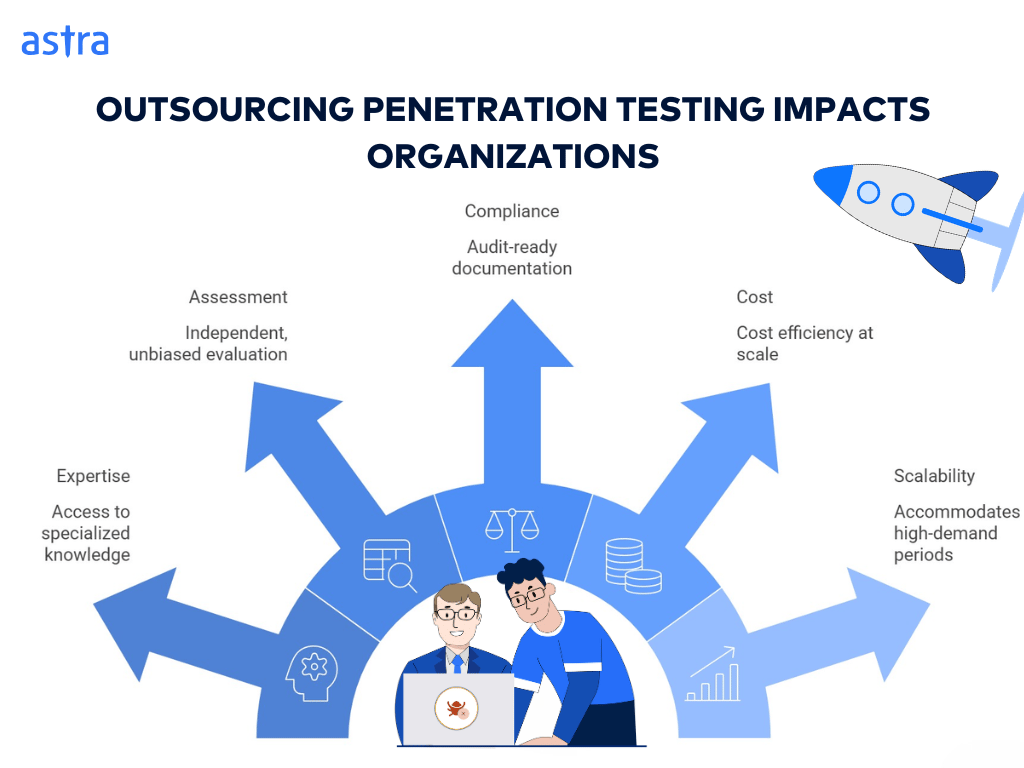
Access to specialized expertise:
With external penetration-testing companies, businesses gain access to highly specialized knowledge across narrowly defined areas such as blockchain, mainframe systems, iOS apps, and hardware. Skills that are nearly impossible to source and keep in-house.
Independent, unbiased assessment:
Third-party testers have no prior expectations for how systems will function. This means they will be assessing your environment in the same manner as a real-life attacker, without blind spots that come from familiarity.
Compliance and audit readiness:
Regulatory frameworks such as PCI DSS, HIPAA, and SOC 2 often require third-party validation, but external providers offer standardized, audit-ready documents that meet these needs straight away.
Cost efficiency at scale:
Using an external service provider on a project or subscription basis is much cheaper than having an in-house full-time testing function (especially for companies that do not need testing in all their systems continuously).
Scalability during high-demand periods:
An outsourced provider can quickly ramp up to accommodate bursts of testing demand, for example, after an acquisition or prior to a major launch.
When Outsourcing Makes More Sense Than In-House Testing
Not all organizations need an in-house penetration testing team, and many that already have one benefit from supplementing externally.
The choice will largely depend on the organization’s size, the maturity of its security, the budget at its disposal, and the sensitivity of the systems being tested. Realizing where your organization falls on that spectrum is the first key to creating a functional testing program.
In particular, outsourcing makes sense when the scope of testing exceeds internal capacity, whether in technical depth, specialist knowledge, or simply volume.
There is also a clear business case in instances where regulations require independent third-party validation or when an organization is undertaking a significant change, such as a merger, acquisition, or large infrastructure migration that calls for an unbiased security assessment.
| Scenario | Recommended Approach | Reason |
|---|---|---|
| Annual compliance audits | Outsource | Third-party reports satisfy most regulatory requirements |
| M&A due diligence | Outsource | Independent validation ensures objectivity |
| Continuous CI/CD pipeline testing | In-house or automated platform | Speed and integration requirements favor internal tools |
| Niche technology testing (mainframe, IoT, OT) | Outsource | Specialized expertise is rarely available internally |
| Highly sensitive internal systems | In-house | Retains full control over data access during testing |
| Pre-production application launch | Hybrid | Combine internal SAST with external dynamic testing |
| Incident response readiness | Hybrid | External offensive testing paired with internal detection teams |
| Limited internal security resources | Outsource | More cost-effective than building a full testing team |
Common Mistakes Companies Make When Outsourcing
The effectiveness of outsourcing penetration testing is only as good as the process behind it. Only a handful of organizations view it as more than a procurement exercise, resulting in vendors being chosen solely on price, poorly defined scope, and remediation of findings becoming a long-term problem rather than a short-term risk once the engagement closes.
These mistakes not only make the test less valuable but also engender a misleading sense of confidence that may be more dangerous than not testing at all.
Treating the Pentest as a One-Time Event
One of the most common and serious mistakes organizations make is signing off on an annual penetration test and then moving on. Threat landscapes change constantly, code is written and deployed continuously, and vulnerabilities that did not exist in January may very well be there by June.
If a testing program does not account for this change rate, it will always be several steps behind real-world risk.
Failing to Define Scope Clearly
Unfocused outputs are hard to act on due to either vague or overly broad scopes, while overly narrow scopes end up leaving critical assets untested. Organizations must clearly document the systems, applications, and environments, as well as the business objectives and success criteria, before engaging any external provider.
Even the best solution vendor cannot deliver what the organization truly needs without this clarity.
Ignoring Remediation After the Report
A detailed findings report received without remediation, whether due to budget, time, or other considerations, may be even worse than not testing at all. It leaves behind written proof of exploitable vulnerabilities without a documented plan to fix them.
High-quality outsourced testing should include retesting after remediation to confirm that identified issues have been resolved. Skipping this step is like buying a list of problems and never going back to check whether they were fixed.
Need a outsourcing penetration testing partner who offers detailed reports and guidance?

What High-Quality Outsourced Penetration Testing Looks Like
The distinction between a good and a bad outsourcing penetration test is seldom obvious. They both generate reports and assess vulnerabilities. The difference comes down to how deep the methodology goes, the quality of the testers, and how actionable the findings are for the remediation teams.
Knowing these markers helps organizations set the right expectations and assess results appropriately before they seek a provider.
A Blended Methodology of Manual and Automated Testing
While automated scanning tools can quickly scan a large surface area, they, without exception, miss logic flaws, chained vulnerabilities, and context-specific weaknesses that require human reasoning to uncover.
The best providers use automation for breadth and expert manual testing for depth, so coverage is broad and deep but meaningful. Organizations should treat with suspicion any provider, no matter how well-known or reputable, whose methodology is rooted entirely in automated tooling, no matter how advanced or comprehensive that tooling is purported to be.
Clear, Actionable Reporting for Both Technical and Executive Audiences
If a penetration test report can only be interpreted by a security engineer, then it misses a big chunk of its target audience.
Good deliverables should include an executive summary that describes risk in business language, technical findings with proof-of-concept evidence presented in an easily readable report, and prioritized remediation guidance mapped to industry frameworks such as OWASP or NIST.
Some of the best providers also offer a walkthrough session so that both technical and non-technical stakeholders can understand the findings and what they mean.
Retesting and Remediation Validation
A penetration test that stops at report delivery fails to answer the most critical question: were the vulnerabilities remediated? Trusted providers such as Astra Security include retesting in the engagement by default to verify that identified vulnerabilities have been remediated before formally closing the engagement.
This changes the exercise from a one-time audit to a closed-loop process with a measurable outcome.
Outsourced Penetration Testing vs PTaaS vs Traditional Pentests
The terminology around external penetration testing has expanded significantly, and the distinctions between traditional pentests, outsourced penetration testing, and Penetration Testing as a Service (PTaaS) matter more than many organizations realize. Each model has a different delivery structure, cadence, and use case, and choosing the wrong one for your context can mean paying for a service that doesn’t match your actual security needs.
Traditional pentesting is still a project-based, time-boxed engagement, where a dedicated team of testers researches a defined scope and produces a static report. In contrast, PTaaS is a subscription-based model that seamlessly integrates ongoing or on-demand testing into development workflows and provides real-time access to findings through a platform.
The overall category is called outsourced penetration testing, which consists of both models, and the right one depends on how often the organization wants to be tested, how quickly it is developing internally, and where the budget falls.
| Dimension | Traditional Pentest | Outsourced Pentest | PTaaS |
|---|---|---|---|
| Engagement model | One-time project | Project or retainer | Subscription/continuous |
| Testing cadence | Annual or semi-annual | Flexible, defined upfront | On-demand or continuous |
| Findings delivery | Static PDF report | Report + optional walkthrough | Real-time platform dashboard |
| CI/CD integration | None | Limited | Native |
| Best suited for | Compliance snapshots | Complex or specialized assessments | Fast-moving development teams |
| Cost structure | Fixed per engagement | Variable by scope | Monthly/annual subscription |
| Remediation support | Often limited | Typically included | Ongoing, built into the platform |
How to Evaluate Outsource Penetration Testing Providers
Selecting an outsourced penetration testing provider is one of those decisions that has an immediate and direct impact on the quality of the intelligence you will use when making any kind of security investment in your organization.
A provider that produces shallow reports, rotates testers frequently, or lacks relevant experience in your industry and technology stack will generate noise rather than insight. Evaluating providers rigorously before signing anything is not optional; it is a foundational step that determines whether the rest of the program succeeds.
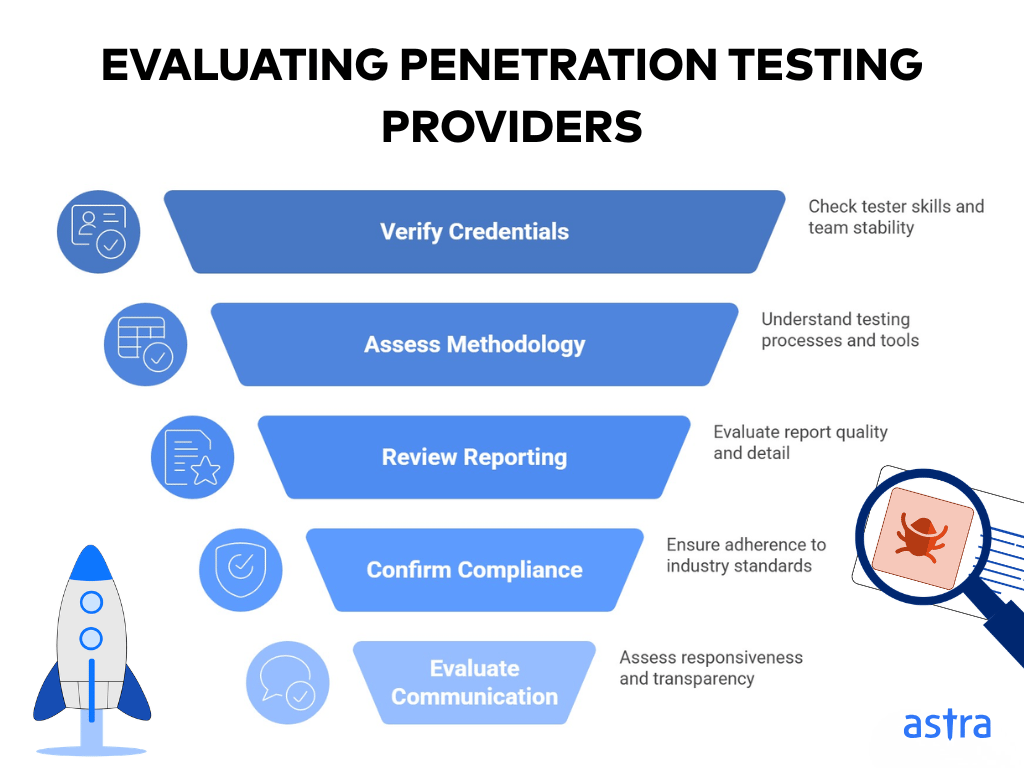
Verify Tester Credentials and Team Stability
OSCP, OSCE, CREST, and GPEN are great indicators of technical skill, but you want them with a stable staff, not a team of contractors. Be sure to inquire with providers about their security testers’ retention rates and ensure the same team will work on your engagement from scoping to final delivery.
When testers consistently interact with the same client environments, the quality of the generated findings improves.
Assess Methodology Depth and Transparency
A good provider will be able to explain exactly how they conduct their tests, which tools and frameworks they use, and how their manual testing differs from automated scanning. A major red flag is a vendor that is evasive when explaining its methodology or cannot discuss in-depth technical details in a sample report.
Transparency in the process is valuable evidence of confidence in quality.
Review Reporting Quality Before Committing
Asking for a sample report is possibly one of the simplest yet most underrated steps in vendor assessment.
Pay attention to the executive summary quality, the granularity of technical findings, the quality of remediation guidance within the findings, and whether findings are mapped to recognized frameworks such as OWASP, MITRE ATT&CK, or NIST.
Confirm Compliance Coverage and Mapping
For organizations that work in a regulated industry or require testing to comply with a specific framework, be sure to confirm the provider has direct experience in those requirements prior to engagement.
Each standard, such as PCI DSS, HIPAA, SOC 2, and FFIEC, comes with its own testing expectations, and a provider not versed in what a standard requires will generate findings at a technical level that are unlikely to meet auditor requirements.
Evaluate the Responsiveness and Communication Process
The way a vendor communicates (or fails to) during pre-sales is an excellent predictor of how that vendor will communicate (or fail to) during an actual engagement when critical risks are identified.
Outline expectations for reporting cadence, escalation of critical vulnerabilities found in the middle of the test, and post-delivery consulting availability. A vendor who stays quiet between kickoff and the final report is not a true partner in a robust security program.
How to Make Outsourced Penetration Testing Actually Improve Security
Outsourcing pentesting is easy; turning the findings into actual security improvements requires internal discipline that many organizations lack. The engagement is just one piece; equally important are processes for remediation, official ownership of findings, and closing the loop to ensure vulnerabilities are addressed before the next test cycle starts. Without it, the best pentest report will collect dust in a folder while issues persist and are still attackable.
The most successful organizations when it comes to deriving value from outsourced penetration testing are those that treat it as a program, not a project. They keep an eye on their findings over time, using them to pinpoint systemic weaknesses, inform developer training and secure coding practices, and set a testing cadence that works within their development-and-release schedule.
Much further down the line, this form of penetration testing transforms from a reactive audit process into a proactive risk-control engine for businesses.
Final Thoughts
The penetration testing outsourcing process is not a shortcut or a cost-cutting approach but an intentional strategic move to bring external expertise, objectivity, and scale into a security program that an in-house team simply cannot cover on its own.
The organizations that do it right see their provider as a long-term partner, invest in scoping and remediation processes, and leverage findings to drive measurable change, not just to check an audit box. When done well, it yields a better picture of organizational risk than almost any other security practice.
Gone are the days when the question is whether penetration testing should be outsourced; now it’s about how to do it so it actually improves your defenses.
This means not only choosing the right providers, but calibrating your testing models, whether traditional, PTaaS, or hybrid, to match how your organization actually operates. This means security programs that excel at this not only identify vulnerabilities more quickly, but they also remediate them more quickly.