Key Takeaways
- Cloud security has affected most orgs since early 2025, with breaches resulting in significant financial losses.
- Your cloud provider secures the infrastructure (hardware, networks, data centers), while you’re responsible for everything you put in the cloud: your data, applications, access controls, and configurations
- Misconfigurations are your biggest enemy, with human error as their leading cause.
- Breach costs can be substantial, with healthcare orgs facing especially high exposure per incident. Compliance failures further increase total breach impact.
- Multi-cloud needs unified visibility, as firms use far more cloud services than they realize (hello, shadow IT).
- APIs are the new attack surface. API vulnerabilities are widely cited as a top security concern, necessitating authentication, rate limiting, input validation, and continuous security testing.
- Modern cloud security tools (esp. Agentless scanners) validate risks the way attackers exploit them, immediately and not during next month’s scan or audits.
From customer data to proprietary applications and even employees, businesses have migrated massive amounts of critical information to cloud platforms led by AWS, Google Cloud, and Azure. But with over 100 billion terabytes of data on the cloud at the end of 2025, you can go from cloud9 to under the clouds in a matter of seconds.
On one hand, cloud offers incredible flexibility, scalability, cost optimization, and asset-lightness; it also opens up multiple new security risks that traditional cybersecurity tools haven’t caught up to yet (especially when 115 vulnerabilities were discovered for each cloud asset at least in 2025).
That is 115 ways a hacker has to cost you $4.44 million, folks.
Whether you’re a startup moving your first workloads to the cloud or an enterprise managing complex multi-cloud environments, this guide walks you through the basics of Cloud Security to help you secure your cloud infrastructure.
Wanna know more about what’s going on in the world of Cloud Security? Check out the top trends in Cloud Security by Astra Security
What is Cloud Security?
Cloud security is defined as a culmination of technologies, policies, controls, procedures, along with human expertise, all designed to protect your cloud computing environment’s data, applications, and infrastructure from nuanced cyber threats, hackers, and the resulting unauthorized access, data loss, & much more.
An indispensable aspect of cloud security is a tailored security framework that addresses your unique challenges of protecting resources that look inside from outside of your traditional on-premises data centers. If any.
Today, cloud security is required to operate in a dynamic, distributed environment, since your data is stored across multiple geographic locations, your applications run on shared infrastructure, and your users access resources from Croydon to Mumbai and Seattle.
Thus, another crucial element that defines Cloud security is its adaptability and/or agility under such evolving work environments. Besides, it ought to:
- Protect the confidentiality, integrity, and availability of your data in the cloud.
- Ensure that only authorized users and services can access your resources.
- Maintain compliance with industry regulations and standards, from HIPAA to PCI DSS.
Scan vulnerabilities with Astra Security’s modern, agentless, multi-cloud, and expert-led vulnerability cloud security scanner today.

How Does Cloud Security Work?
Cloud security works through the “shared responsibility model,” which fundamentally divides security responsibilities between your CSP (Cloud Service Provider) and your organization. That is why understanding who’s responsible for what is crucial to maintaining a secure cloud environment.
To unpack this crisply, your CSP handles security “of” the cloud: the physical infrastructure, networking, storage, and foundational services. For instance, AWS, Azure, and Google Cloud manage their data center security, hardware maintenance, and the virtualization layers that power their services.
In simple terms, they ensure their facilities are physically secure and their network architecture is protected.
You on the other hand, are responsible for security “in” the cloud, i.e., everything you put into the cloud environment, including your data, applications, access management, encryption keys, and security configurations. So even a misconfigured storage bucket or weak access controls fall squarely on your shoulders, not your provider’s.

Now, cloud security involves scanning for vulnerabilities, misconfigurations, and threats via continuous monitoring and automated tools, which is why API integrations are increasingly becoming a common part of modern cloud security as they help you assess your cloud posture in real-time, identifying risks like publicly exposed databases, unencrypted data, or overly permissive identity policies.
Don’t leave your cloud security to chance. Get expert validation of your security controls with Astra Security’s manual + automated cloud penetration testing services
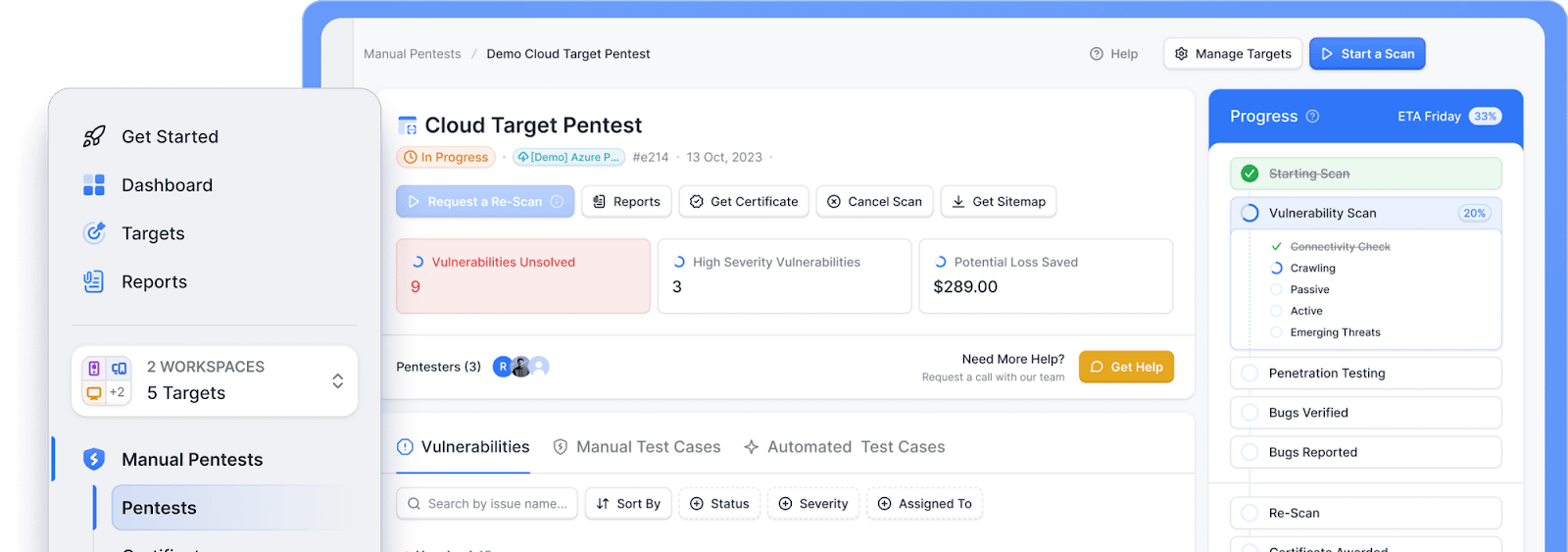
Why is Cloud Security Important?
We don’t even need to spare words to emphasize its importance; numbers speak for themselves.
Research shows that 60% of data breaches now involve data that is either stored or processed on the cloud, with >45% of organizations citing API vulnerabilities as one of their top 3 cloud security concerns.
Moreover, IBM’s 2025 Cost of a Data Breach Report reveals that even though the average cost dropped to $4.44 million (down from $4.88 million the previous year), breaches involving multiple environments still averaged north of $5.05 million, with healthcare breaches costing even more, ~$8 million per incident. These costs cripple most businesses out of the market.
Then you have regulatory compliance tightening its scrutiny, and compliance failures can add $1.22 million to your total breach costs, according to Bright Defense’s 2025 statistics.
If you operate in healthcare, finance, government, or any regulated industry, cloud security becomes a legal mandate. HIPAA, GDPR, PCI DSS, and SOC 2 all mandate specific security controls, and thus, beyond money and compliance, your business reputation also hangs in the balance.
Cloud Security Benefits
We have supplemented enough numbers in the preceding paras that underscore the indelible role cloud security plays in your security posture. With threat actors working around the clock to penetrate your systems and crack your defenses, you simply can’t rely on your CSP to take care of your entire cloud infra.
That is why implementing a comprehensive cloud security program enables your business to scale confidently.
As Cisco points out, cloud-delivered security solutions protect everything, everywhere, and when you add new cloud applications, devices, or users, your security scales automatically, allowing you to shift left.
With better visibility across your entire cloud environment, your security team responds faster to threats. Moreover, modern cloud security platforms provide centralized dashboards that deliver actionable insights into your security posture across AWS, Azure, GCP, and other cloud platforms in real time. This consolidated view eliminates blind spots.
Cloud Security Advantages
Cloud security has changed the way firms are protecting their digital assets. By leveraging distributed infrastructure and automated security controls, businesses are now achieving better protection at lower costs. Below we list some of the key advantages of the same:
- Rapid Deployment and Updates: When things move at cloud speed, updating and deploying new protections take minutes rather than weeks. When a new vulnerability emerges, cloud security platforms are able to push updates across your entire environment almost instantly
- Cost Efficiency and Predictable Budgeting: With the pay-as-you-go/use model, you shift your security from a capital expense to an operational expense, enhancing the predictability of your budgeting processes more predictable, freeing up capital
- Access to Cutting-Edge Technologies: Cloud security of today is equipped with AI-powered threat detection, behavioral analytics, and advanced machine learning models that would otherwise be cost-prohibitive to implement in-house, continuously improving with minimal manual intervention
- Secure Remote Work Enablement: The flexibility to work from anywhere is perhaps cloud security’s most visible advantage. Your remote workforce has access to applications and data safely from any location, made possible via solutions like zero-trust network access that verify every request
Concerned about your cloud attack surface? Identify your blind spots with real-world attack simulations tailored to your environment.
Types of Cloud Security Solutions
Modern cloud security involves multiple specialized solutions that work in tandem, like the pistons that fire up your cloud engines, and thus it becomes incumbent to understand these categories that help you create a comprehensive cloud security posture.
Cloud Security Posture Management (CSPM)
Think of CSPM tools as automated inspectors for your cloud configurations. They continuously scan your cloud environment against best practices and compliance standards and identify misconfigurations, such as an S3 bucket that may have been accidentally public, or whether MFA is enabled on all accounts. They automatically sort these out for you.
According to Gartner, CSPM tools can curb your misconfiguration risks by up to 80%. How? By integrating with your cloud providers’ APIs, they offer them visibility into every resource you’ve deployed. And when they spot a problem—like an unencrypted database or an overly permissive firewall rule—they alert your team and suggest remediation options.
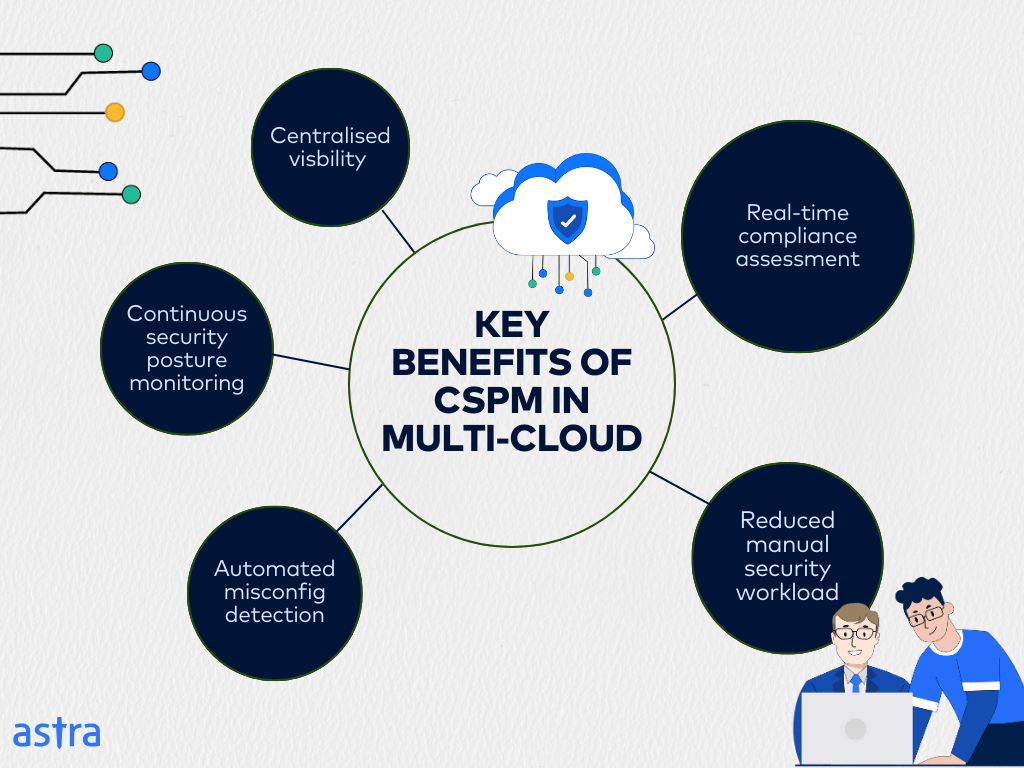
Some of the leading vendors in this space include CSPM solutions such as Wiz, Prisma Cloud by Palo Alto Networks, Microsoft Defender for Cloud, and AccuKnox.
Cloud Workload Protection Platform (CWPP)
CWPP, conversely, protects your actual compute resources such as virtual machines, containers, and serverless functions. Think of it as security that lives inside your workloads, monitoring them during runtime for threats and vulnerabilities.
CWPP solutions scan your OS and apps for vulnerabilities, detect malware, and monitor workload behavior for suspicious activity. Moreover, they become indispensable in environments where workloads fluctuate rapidly.
According to Orca Security’s 2025 State of Cloud Security Report, 89% of organizations have neglected assets accessible from the internet, and CWPP helps identify and protect these exposed workloads.
Top CWPP platforms include CrowdStrike Falcon Cloud Security, Prisma Cloud, and Sysdig. Deploying both CSPM and CWPP together would entail securing both the environment configuration and the workloads themselves, but then you need to keep an eye out for costs and the degree of customization your vendor can offer.
Cloud-Native Application Protection Platform (CNAPP)
Soon enough, with the expansion of industrial cloud solutions, a clear majority of enterprises will adopt CNAPPs to consolidate their cloud security tools. Why? CNAPP represents the evolution of cloud security—a unified platform that combines CSPM, CWPP, and additional capabilities into one solution.
What makes CNAPP powerful is its contextual approach. Rather than generating isolated alerts, CNAPP solutions connect the dots across your entire cloud environment. They show you attack paths that help prioritize the risks that actually matter.
CNAPPs also extend security into your development process, scanning Infrastructure-as-Code (IaC) templates and container images before they’re deployed. This “shift-left” approach catches security issues during development, when they’re cheapest and easiest to fix.
Data Security and Encryption
Cloud data security encompasses encryption at rest (when data is stored), encryption in transit (when data moves between locations), and encryption in use (when data is being processed).
However, encryption is only as good as your key management. You need to deploy additional best practices, such as storing encryption keys separately from the encrypted data (key management service (KMS)), rotating keys regularly, and maintaining strict access controls over who can use keys.
Data loss prevention (DLP) tools monitor how sensitive data moves through your cloud environment. They can detect and block attempts to upload sensitive information to unauthorized locations or share it with external users. This blocks both malicious exfiltration and accidental data leaks to a considerable extent.
Network Security Controls
Cloud network security tools control traffic flow between your cloud resources and the internet. Virtual firewalls, web application firewalls (WAF), and network segmentation form the core toolkit here. Moreover, microsegmentation divides your cloud environment into isolated zones, which prevents lateral movements in case attackers breach an area.
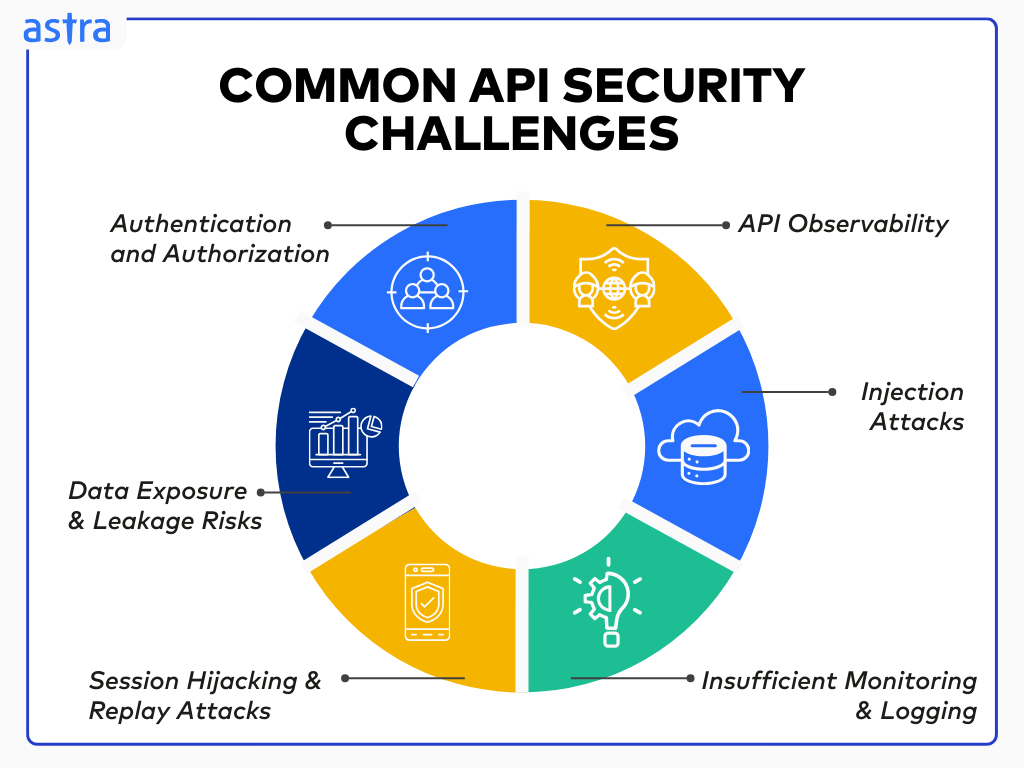
Secondly, API security in today’s times is a no-brainer. You need to deploy API gateways that use rate limiting, authentication, and input validation to protect critical interfaces.
Implementing the right tools is just the first step. Verify they’re configured correctly and actually protecting your cloud expert-led pentesting.
Cloud Security Risks and Solutions
As organizations move more workloads to the cloud, new security risks naturally follow. Understanding where these risks emerge is the first step toward controlling them.
| Risk Category | Key Statistics/Impact | Core Solutions |
|---|---|---|
| Misconfiguration Vulnerabilities | 23% of all cloud security incidents 82% caused by human error Example: Capital One breach (100M customers exposed) | Deploy CSPM tools for real-time scanning against CIS Benchmarks Implement Infrastructure as Code (IaC) scanning pre-deployment Use policy-as-code tools (e.g., Open Policy Agent) for automated enforcement Establish and monitor configuration baselines |
| Data Breaches & Exposure | 82% of breaches involve cloud-stored data Average cost: $4.44M Healthcare breaches cost $10M+ Public storage buckets are frequently exposed | Encrypt all data (at rest & in transit) with customer-managed keys Deploy DLP tools to prevent unauthorized data movement Classify data by sensitivity and apply appropriate controls Automated scanning for publicly accessible storage Enable access logging and anomaly detection |
| Insufficient IAM | Credential stuffing and privilege escalation attacks are common | Enforce MFA universally—no exceptions Apply the principle of least privilege with RBAC Deploy CIEM tools to eliminate excessive permissions Implement just-in-time access for privileged operations Regular permission audits and zero-trust architecture |
| Insecure APIs & Interfaces | Top threats to cloud environments Primary management interface = attractive attack vector Lack of proper authentication, rate limiting, and validation | Use API gateways for authentication, authorization, and rate limiting Implement OAuth 2.0 (avoid static API keys) Validate all input; sanitize all output Deploy API security testing pre-deployment Comprehensive logging with anomaly monitoring Maintain complete API inventory |
| Insider Threats & Compromised Accounts | Malicious insiders + negligent users Cloud accessibility amplifies risk Difficult to distinguish from legitimate activity | Deploy UEBA to detect anomalous behavior Use PAM solutions for privileged session monitoring Enforce separation of duties Comprehensive audit logging (who, what, when, where) Alerts for suspicious activities (bulk downloads, unusual locations) Regular access reviews and prompt deprovisioning |
| Shadow IT | Organizations use 10x more cloud services than they realize (Cisco) Bypasses security controls Creates compliance blind spots | Implement CASB for complete visibility Create a streamlined approval process for new services Provide approved alternatives to meet business needs Employee education on shadow IT risks Automated policies: block high-risk, allow low-risk apps |
| Inadequate Disaster Recovery | Multi-region outages occur Ransomware targeting cloud backups "Always available" assumption = dangerous | Automated backups to separate regions/providers Regular DR testing—verify backups actually work Implement immutable backups (ransomware-proof) Define and monitor RTO/RPO targets Multi-cloud failover strategies Document and train on DR procedures |
| Compliance & Regulatory Violations | Average additional breach cost: $1.22M GDPR, HIPAA, PCI DSS, SOC 2 requirements Multi-cloud = multiple jurisdictions | Leverage provider certifications but own your configurations Continuous compliance monitoring tools Data residency controls for geographic requirements Comprehensive audit trails for assessments Encryption/tokenization to reduce compliance scope Compliance-as-code through policy engines |
Facing a compliance audit or certification requirement? Ensure your cloud security meets regulatory standards with Astra Security’s compliance-focused penetration testing.
How Can Astra Security Cloud Pentest & Vulnerability Scanner Help?
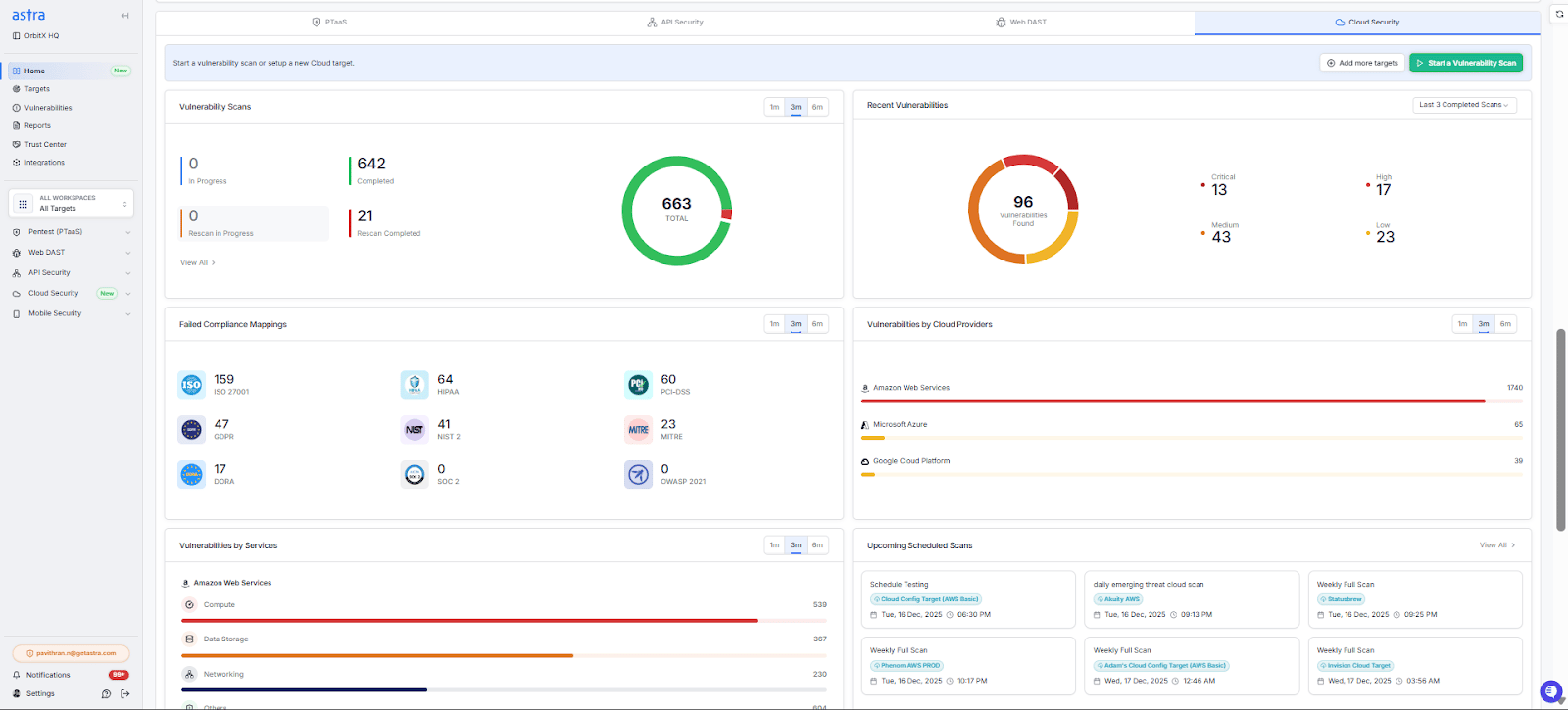
Real-Time Detection That Thinks Like an Attacker
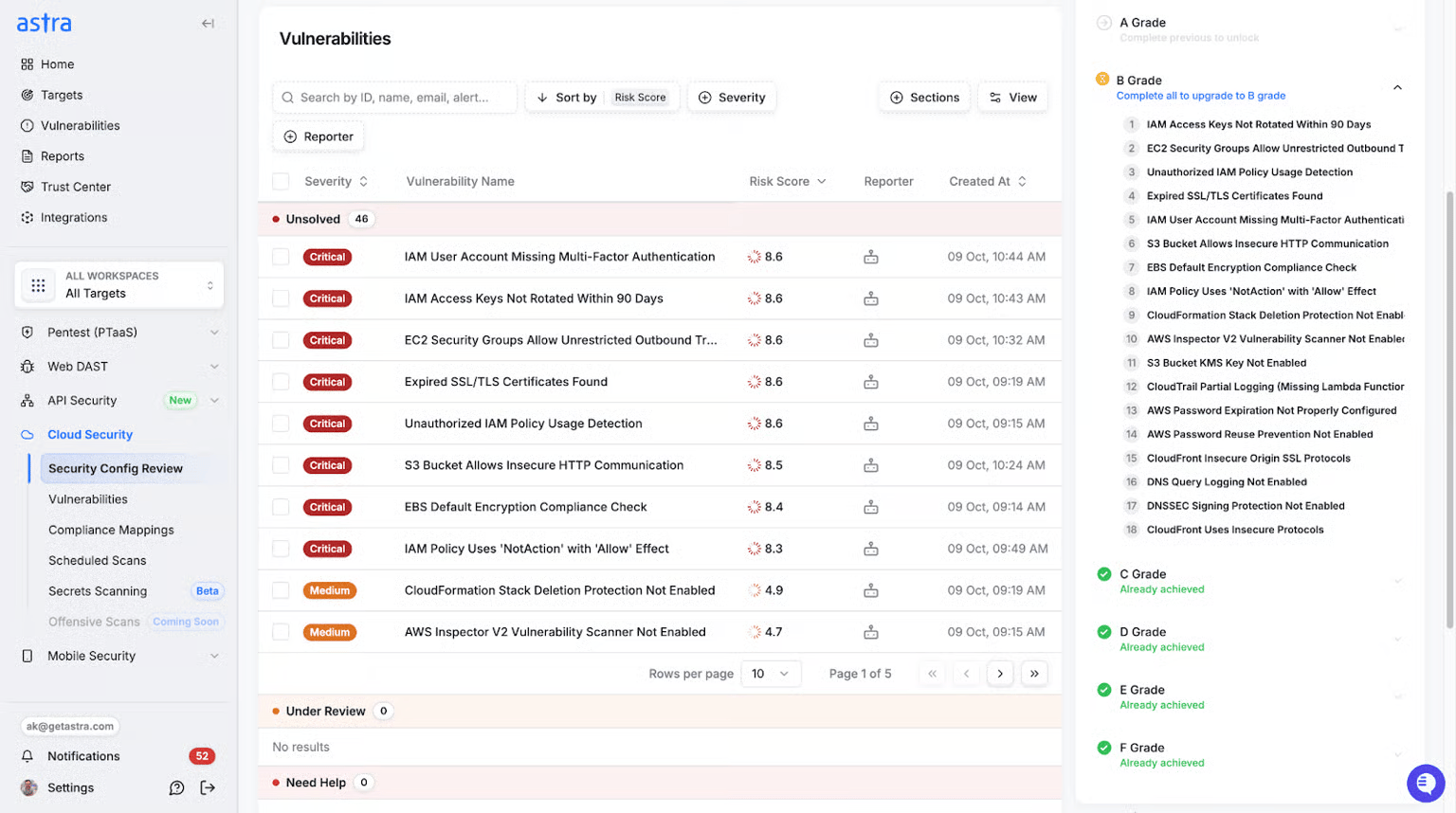
Astra Cloud Vulnerability Scanner connects to your AWS, Azure, and GCP environments in under three minutes with read-only access, no agents, no performance hits, and no “the scanner just killed our production cluster” panic.
Powered by our Offensive Security Engine, it immediately builds a living map of your cloud: every IAM role, service account, S3 bucket, network route, and temporary exceptions included.
Moreover, we validate risks by how attackers exploit them. Each change triggers 400+ cloud-native hardening checks and 3,000+ offensive test patterns trained on 2M+ real vulnerabilities and thousands of actual penetration tests.
From Detection to Fix in Minutes, Not Meetings
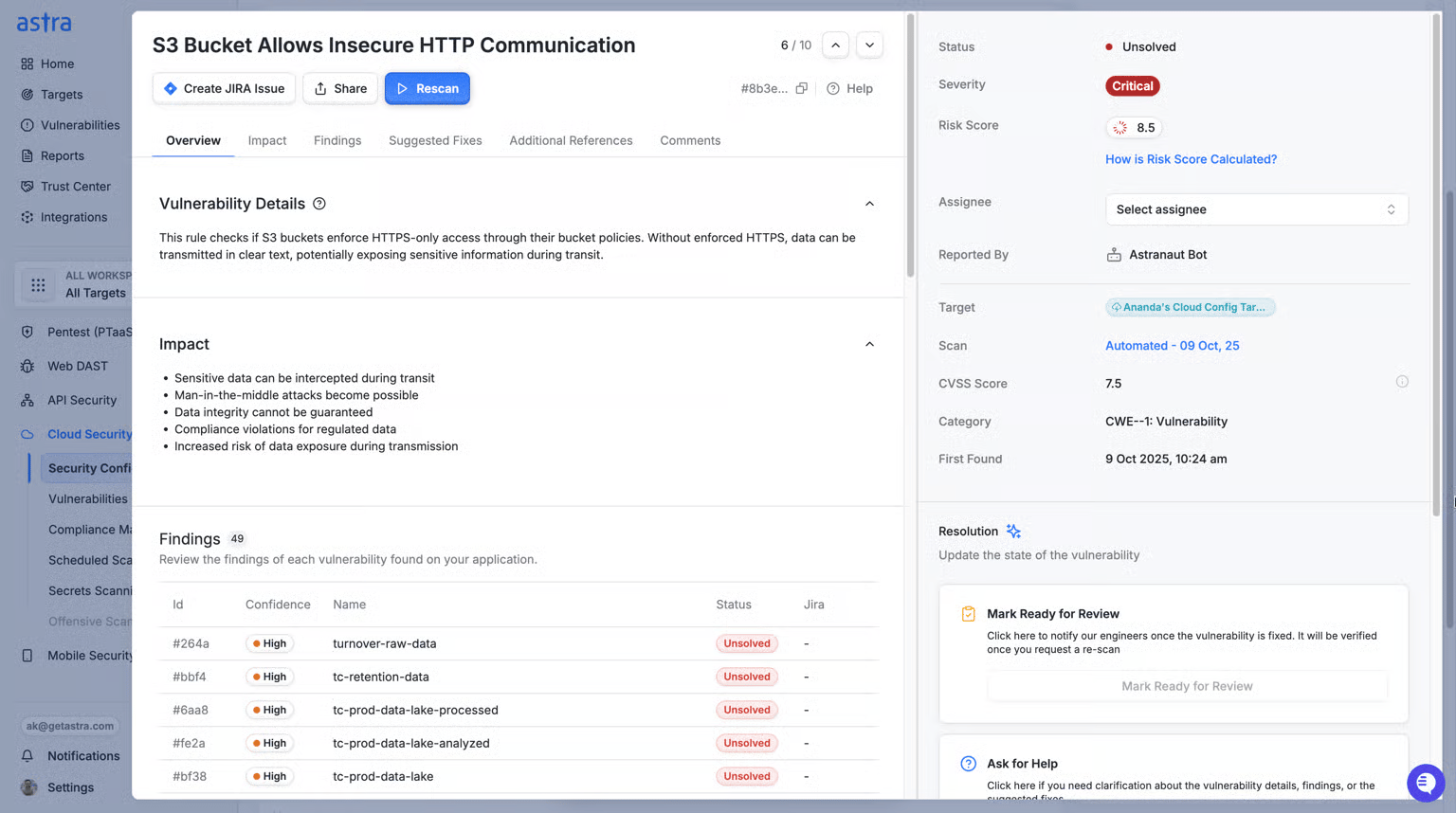
Every validated finding arrives with everything your engineers need to patch it fast:
- Root cause analysis that explains exactly what broke and why
- Blast radius quantification showing who and what’s exposed
- Compliance mappings to SOC 2, ISO 27001, GDPR, PCI-DSS, HIPAA frameworks
- Configuration-aware remediation with actual CLI commands, Terraform snippets, and one-line fixes
- Optional PoC videos demonstrating the attack chain (because sometimes “show me” beats “trust me”)
- Instant re-validation after you patch; click to confirm the fix worked and update your posture score
No waiting for scheduled scans. No endless Slack debates about whether something’s real. Just fix it, validate it, and move on.
Built for Teams That Ship Fast
| Challenge | How Astra Solves It |
|---|---|
| Multi-cloud chaos | Single unified dashboard for AWS, Azure, GCP—no more console-hopping or duplicate findings |
| CI/CD bottlenecks | Scans run out-of-band without slowing pipelines; integrate checks into your build process seamlessly |
| Alert fatigue | High-signal, low-noise findings validated through offensive testing, not just policy syntax |
| Compliance overhead | Automated mapping to frameworks cuts audit prep from weeks to hours with verifiable evidence |
| Resource drain | Agentless architecture means zero performance impact on your workloads |
| Tribal knowledge | Centralized visibility breaks down silos between security, DevOps, and engineering teams |
Key Advantages That Actually Matter
Offensive-grade validation filters out the noise, i.e., you only see what attackers can actually exploit, backed by evidence that even skeptical engineers and auditors accept.
Continuous monitoring catches IAM drift, privilege escalation paths, storage exposures, and network misconfigurations the moment they happen, not during next month’s scan.
Multi-cloud mastery gives you a single, accurate, deduplicated risk view across your entire cloud footprint, whether you’re AWS-native, Azure-heavy, or spread across all three.
Developer-friendly remediation means your engineers get precise fixes they can implement immediately, not vague suggestions that require three meetings to decode.
Unified platform approach integrates cloud scanning with DAST, API security, and penetration testing for end-to-end visibility from commit to production.
Audit-ready reporting automatically ties validated issues to compliance controls, generating documentation that satisfies regulators without manual evidence collection.
Final Thoughts
The good news for you amidst the multiple scary attack vectors and threat actor stats is that today’s cloud security tools are more sophisticated than ever, with AI-powered solutions having proven to cut costs for organizations that adopt them. Success here demands a multi-layered approach that combines the best of visibility, continuous monitoring, strong identity controls, and regular testing that validate your defenses against persistently evolving threats.
What this means is that developers must write secure code and configure resources safely. Secondly, operations teams must monitor and respond to alerts. Thirdly, the leadership, such as yourself, ought to prioritize security investments and foster a security-conscious culture.
Start with the fundamentals—enable MFA, implement least-privilege access, encrypt sensitive data, fix critical misconfigurations, and perform periodic pentests and continuous vulnerability scans. As your cloud ecosystem expands laterally and longitudinally, layer on advanced capabilities like CSPM, CWPP, and advanced penetration testing.
Astra Security’s agentless scanner validates 400+ security checks across AWS, Azure, and GCP.
FAQs
What is an example of cloud security?
A cloud vulnerability scanner is perhaps the most immediate and crucial aspect of your cloud security posture. Such a scanner continuously scans AWS, Azure, and GCP for misconfigs, IAM risks, exploitable vulnerabilities, etc., validating each finding before it reaches security teams or triggers remediation.
What are the categories of cloud security?
Key categories of cloud security include IAM, data security & encryption, network security controls, app security, infrastructure security, security monitoring and logging, compliance and governance, incident response, and disaster recovery. A strong vendor should provide unified coverage across all these areas.
Which tool is commonly used in cloud security?
One of the most critical tools is vulnerability scanners & offensive pentest engines that cover your entire ecosystem, adapt to your needs, & offer scalable multi-cloud security. Astra’s modern, agentless, multi-cloud offensive scanner with AI-based hybrid pentests help you shift left & secure your data continuously.
What are the biggest threats to cloud security?
Misconfigurations and compromised credentials form a big chunk, while others include data exposure through public storage, insecure APIs, insider threats, shadow IT, and inadequate disaster recovery. Besides the above, human error remains the most common & critical factor contributing to these security incidents.
How much does a cloud security breach cost?
The average cost of a data breach globally was $4.44 million in 2025. Multi-environment breaches average $5.05 million, while healthcare breaches exceed $10 million. Organizations using AI and automation see costs drop by 70%, to $3.05 million. Moreover, compliance failures add $1.22 million to total costs.