With 5+ vulnerabilities being discovered every minute, a SOC 2 (System and Organization Controls 2) compliance certificate demonstrates to customers and partners that the organization is committed to security and adheres to industry best practices for safeguarding data.
Apart from customer trust, it can help organizations find and fix security vulnerabilities before attackers can exploit them. In this blog, you’ll learn how SOC 2 vulnerability scanning helps meet compliance requirements, as well as how to build out an effective scanning program.
What SOC 2 Actually Requires
SOC 2 is based on Trust Service Criteria (TSC), which comprise five main risk-based categories: Security, Availability, Processing Integrity, Confidentiality, and Privacy. Security focuses on preventing unauthorized access to system resources. Availability guarantees that systems are running as promised or contracted.
Processing Integrity examines whether the processing is valid and has been authorized. Confidentiality keeps information confidential, that which is marked as such. Privacy provides the assurance that collected, used, and stored personal information is safeguarded as per the promises made.
Most companies focus on the Security criterion at a minimum, with vulnerability scanning directly supporting this area.
Ensure audit readiness fast with SOC 2 compliance software that automates evidence collection and risk tracking.

Map Scanning to SOC 2 TSC (What Auditors Expect)
Vulnerability scanning directly supports several SOC 2 controls. CC7.1 mandates that organizations have detection and monitoring in place to identify changes to configurations, unauthorized modifications to software and hardware, and both known and unknown security threats.
CC7.2 requires organizations to assess security vulnerabilities. According to CC8.1, entities are required not only to authorize software but also to design, develop, and modify it for the purpose of achieving objectives and mitigating risks.
Regular vulnerability scanning enables businesses to demonstrate that they have ongoing mechanisms to identify security vulnerabilities and resolve them before they result in breaches.
1. Frequency and Scope Requirements
Vulnerability scans should be performed on a scheduled basis with SOC 2 compliance. Any system that is facing the internet should be scanned, at a minimum, on a quarterly basis to ensure there are no vulnerabilities that an outside attacker can exploit.
Internal systems also need scanning at least quarterly to identify any weaknesses that could be exploited should perimeter defenses fail. Furthermore, it’s a good idea to scan after important system modifications to ensure that new deployments haven’t introduced new security risks.
2. Remediation & Follow-up
SOC 2 criteria (especially CC7.2) aren’t satisfied by just scanning. Auditors expect to see that vulnerabilities are not just identified but also prioritized, assigned, and remediated within a reasonable timeframe.
3. Risk-Based Coverage
Frequency and scope are covered, but auditors also expect that critical systems and high-risk assets are prioritized. Aside from just quarterly scanning, what’s also important is showing that the organization’s approach to scanning is tied to its risk assessment (CC3.2, CC3.3 connections).
4. Integration into Broader Controls
Scanning ties into change management (CC8.1) and incident detection/response (CC7.3). Auditors may look for whether scan findings feed into these broader processes.
Type I vs Type II: Scanning Evidence Requirements
| Requirement | SOC 2 Type 1 | SOC 2 Type 2 |
|---|---|---|
| Focus | Point-in-time assessment | Assessment over a period (typically 6-12 months) |
| Scanning Evidence | Recent scan results and remediation plans | Historical scanning records showing consistent execution |
| Documentation | Current vulnerability management policies | Policies plus evidence of ongoing implementation |
| Remediation | Plan to address findings | Evidence of timely remediation over the audit period |
| Exception Process | Documentation of current risk acceptances | Historical exception documentation and reviews |
Scanning Types & Coverage (What Gets Tested)
1. External vs. Internal Vulnerability Scanning
External scanning scans publicly accessible internet assets from an outside perspective. While this type of scanning does not identify software misconfigurations that are invisible to a potential attacker, it reveals to organizations the extent of their exposure on the public internet. External scans are often performed without authentication and are essential for detecting perimeter security issues.
Internal scanning scans systems inside the perimeter of the corporate network. These scans identify gaps that an attacker could exploit if perimeter defenses fail. Internal scanning is often more detailed than external scanning and can identify misconfigurations and patching issues that are not visible from the outside.
2. Authenticated vs. Unauthenticated Scanning
Unauthenticated scans are those that mimic an external attacker with no access rights. This method can only find externally visible vulnerabilities, but it is fast and non-intrusive. It offers an outsider’s perspective on how security measures stack up.
Authenticated scanning utilizes an authorized set of credentials and examines the system in a more comprehensive manner. This approach also discovers login-required weaknesses and offers a broader perspective on the system’s security posture. By combining these two options, organizations can gain comprehensive visibility into their security posture from all angles.
3. Asset Discovery and Inventory Management
According to SOC 2, organizations must be aware of the inventory of systems where customer data is processed or stored. Vulnerability scans should regularly identify and log all assets in your network, ensuring that nothing is overlooked.
All of these assets, including traditional servers and cloud resources, containers, and virtual machines, should be included in the evergreen scanning process, and any changes in the environment should be scanned. Periodic discovery scans check that all discovered assets are in security assessments.
4. Vulnerability Prioritization and Risk Scoring
Not all vulnerabilities pose the same risk. SOC 2-compliant scanning programs should use standard scoring systems, such as the Common Vulnerability Scoring System (CVSS), to rate vulnerabilities.
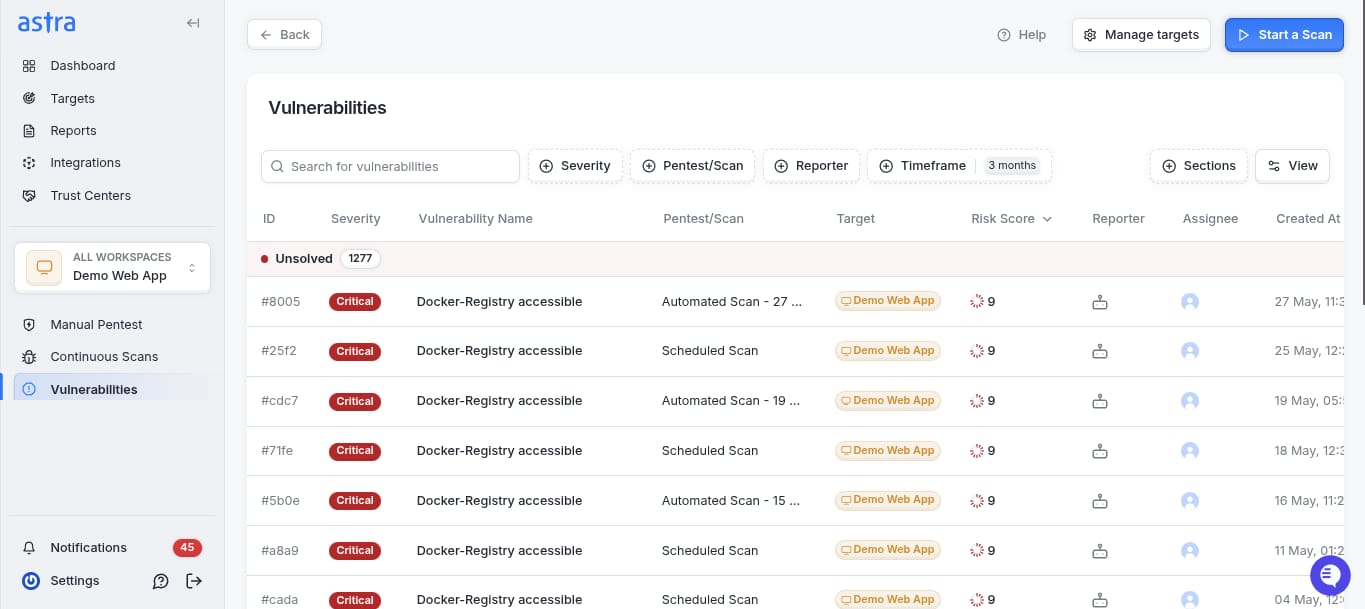
When prioritizing fixes, companies should consider both business context and technical severity. Security teams should prioritize their efforts on the critical and high-severity problems that present the biggest risk. It is also essential to document the risk assessment process for audit purposes.
5. Remediation Tracking and Documentation
SOC 2 compliance requires companies to demonstrate that they track vulnerabilities from discovery through reporting and remediation. High-risk findings are needed to be remediated within a predetermined timeframe, with evidence accompanying the remediation process.
All exceptions to remediation time frames require appropriate approval and documentation. The procedure for correcting should be standard and deniable for the requirements of the auditors.
Building an Effective SOC 2 Vulnerability Management Program
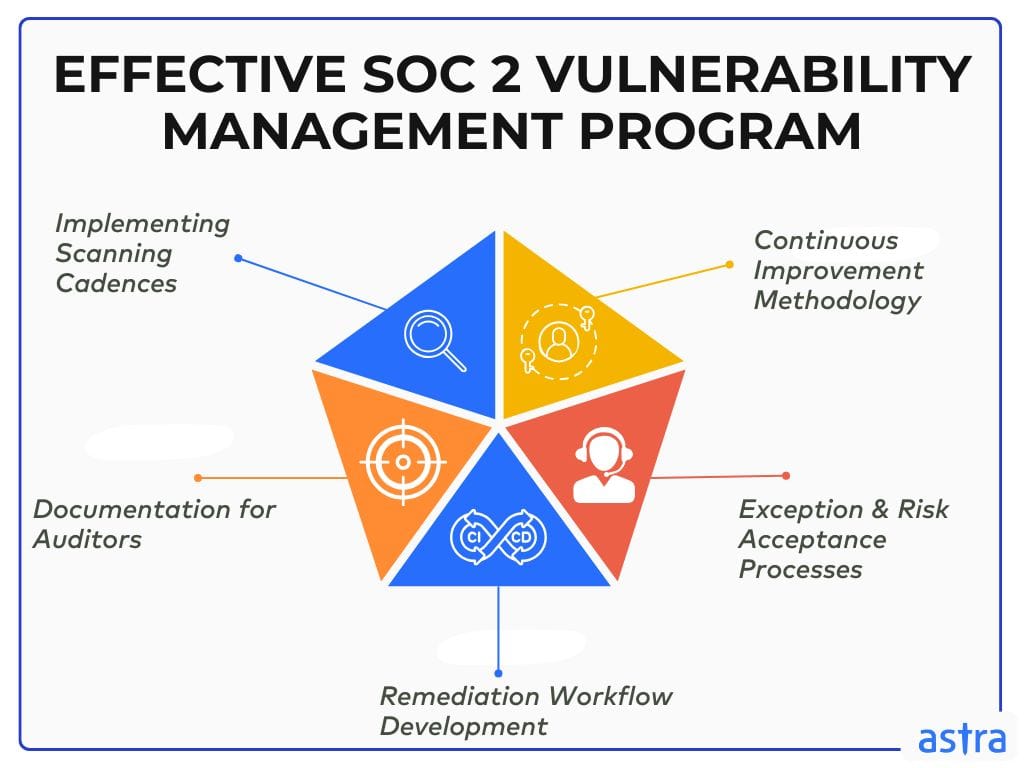
1. Implementing Scanning Cadences
A compliant plan includes regularly scheduled scans that are performed at least every three months. Event-based scans should be engaged after significant changes or security events. For critical assets, continuous monitoring is necessary to ensure maximum protection. The software also needs to have well-defined scans and coverage for a clear and seamless strategy.
2. Documentation for Auditors
Prepare complete documentation for SOC 2 audits, which includes having a policy and procedure for vulnerability management that describes how you will implement this process. Keep a record of scans that you have completed, showing the results and evidence of completion for all covered systems.
Maintain explicit logs of remediation steps taken on known issues. Document risk acceptance for any deviations from your normal remediation timeframes. Keep change management logs related to security scans that detail the steps taken to respond.
3. Remediation Workflow Development
Establish a disciplined remediation process that begins with identifying and validating vulnerabilities. Risk assessment and prioritization should be done after discovery to concentrate on the most critical issues first.
Allocate remediation to accountable teams with defined deadlines or SLAs. Establish resolution tracking and verification to verify issues have been resolved. Use post-fix validation scanning to determine if vulnerabilities have been fixed.
4. Exception and Risk Acceptance Processes
Log business justification if you cannot address vulnerabilities immediately. Seek authorisation from the appropriate levels of management depending on the level of severity of the risk. Implement compensating controls where possible to reduce exposure while working on a permanent solution.
Establish review dates in order to review exceptions on a routine basis. Maintain a master record of all agreed-upon risks for transparency and audit purposes.
5. Continuous Improvement Methodology
Analyze the program to identify trends in vulnerability over time. Get an understanding of which bugs tend to be common in the program. Modify scan schedules according to what is found, and scan more often in problem spots.
Modernize policies to respond to new threats and evolving technology environments. Train teams on secure coding and configuration to avoid vulnerabilities. Make prioritization more efficient by optimizing according to real-world impact.
Scan vs Pentest for SOC 2 (Know the Difference)
Vulnerability scans and penetration tests are often confused, but auditors see them as very different. Scans are automated checks run regularly to flag known weaknesses across systems. They give you breadth and continuous visibility.
Penetration tests, on the other hand, go deeper. Testers mimic real-world attackers, manually probing for ways to exploit vulnerabilities and move laterally.
For SOC 2, both matter. Scans demonstrate that you have ongoing monitoring in place, while a pentest shows that your defenses hold up under targeted attacks. Together, they provide the evidence auditors expect around CC7.1 and CC7.2.

Tools & Integrations (Comparison + What Evidence They Export)
| Tool | Type | Key Features | Best For |
|---|---|---|---|
| Astra Security Vulnerability Scanner | Commercial | Pre-configured SOC 2 compliance scans, authenticated & unauthenticated scanning, remediation guidance, audit-ready reports | Organizations seeking a complete SOC 2 scanning solution with minimal setup |
| OpenVAS | Open Source | Comprehensive vulnerability testing, customizable scan configs, and active community | Budget-conscious companies with security expertise |
| OWASP ZAP | Open Source | Web application security-focused, integration with CI/CD, API scanning | Development teams integrating security into the SDLC |
| Nessus Essentials | Free (limited) | Comprehensive checks, easy to use | Small businesses or testing environments |
| Burp Suite Community | Free (limited) | Web application focused, proxy functionality, manual and automated testing | Web app security testing with hands-on control |
Common Pitfalls (and How to Avoid Them)
Many teams stumble during SOC 2 audits because of avoidable gaps:
- Treating scanning as a checkbox. Running a scan without fixing findings leaves you exposed. Always document remediation and closure.
- Poor frequency. Annual or ad-hoc scans don’t meet the “ongoing monitoring” expectation. Quarterly is the minimum; critical systems may need more.
- Limited scope. Ignoring internal systems or cloud resources creates blind spots. Auditors expect risk-based coverage.
- No evidence trail. Policies aren’t enough. Keep scan reports, tickets, and proof of remediation handy for your auditor.
Final Thoughts
Vulnerability scanning plays a crucial role in SOC 2 compliance, enabling a company to identify and address security gaps before a threat actor can exploit them. By implementing scanning, prioritizing remediation, and establishing documentation around their security procedures, companies can satisfy the SOC 2 mandate while simultaneously enhancing their overall security.
Developing a strong vulnerability management program requires some investment, but the security payoff goes well beyond compliance.
FAQs
1. What are the 5 criteria for SOC 2?
The five Trust Services Criteria for SOC 2 are Security, Availability, Processing Integrity, Confidentiality, and Privacy. These principles ensure a service organization’s systems are secure, available, process data correctly, protect confidential information, and handle personal data responsibly and privately.
2. What are the SOC 2 vulnerability management controls?
SOC 2 vulnerability management controls include identifying vulnerabilities through scans, assessing risks, prioritizing remediation, applying timely patches, and continuously monitoring systems. These controls ensure threats are managed proactively to protect systems and data, aligning with the Security Trust Services Criteria.
3. Does SOC 2 require vulnerability scanning?
Yes. SOC 2’s Trust Services Criteria (especially CC7.1 and CC7.2) expect ongoing processes to detect vulnerabilities. Regular scanning demonstrates proactive monitoring, helping organizations identify and remediate risks before they escalate into incidents that impact security, availability, or confidentiality.
4. Is a penetration test required for SOC 2, or is scanning enough?
While SOC 2 doesn’t explicitly mandate penetration testing, auditors expect deeper assurance beyond automated scans. A pentest shows your controls withstand real-world attack techniques. Together, scans and pentests provide stronger evidence of effective monitoring, detection, and remediation practices under SOC 2.
5. How often should we run vulnerability scans for SOC 2 (e.g., quarterly, post-change)?
Quarterly scanning is the common baseline, but frequency should align with risk. Internet-facing systems, sensitive data stores, and critical applications may need monthly scans. Auditors also expect scans after major changes or deployments to ensure new vulnerabilities aren’t introduced.
6. How do scanning and pentesting reduce residual risk for SOC 2?
Scans identify known weaknesses continuously, while penetration testing uncovers complex or chained attack paths that tools miss. By addressing both, organizations close gaps faster, strengthen defenses, and reduce residual risk, showing auditors their security controls are practical and effective.