


Key takeaways:
- SMBs are now primary targets for attackers owing to their negligence in cybersecurity.
- The evolution of AI has also remodeled cybersecurity; it has propelled attackers to uncover vulnerabilities rapidly, and on the other hand, it has also helped small businesses oppose AI-equipped attacks.
- Ransomware is one of the biggest threats that SMBs should stay wary of, and most attacks don’t involve malware in 2026.
- LLM-generated phishing attacks have seen a 4.5x increase in effectiveness, which calls for SMB owners to learn, follow & implement cybersecurity etiquette and measures.
- While cost is the number one factor for SMBs not implementing effective cybersecurity measures, the loss incurred by a breach is far higher than what could have been budgeted.
- Cybersecurity is a continuous operation rather than an annual checkbox. SMBs currently fall between the gap of having some tools and actually being protected.
Every year, multiple actors in the cybersecurity industry publish a fresh set of statistics, bigger numbers, and higher breach costs, all targeting SMBs. This initially creates unease amongst small business owners, one that fails to translate into any significant behavior change. Possibly because many don’t entirely comprehend whether their business is truly at risk, how those risks could impact them, and what doom the statistics actually forecast.
The numbers below are not just merely figures meant to make cybersecurity sound more alarming for a two-second marketing gimmick, and ignore the impact on the bigger picture. The purpose of this article is to explain what’s actually happening: why 1SMBs are being targeted at four times the rate of large enterprises, why 292% of breached businesses had security tools in place when it happened, and why the gap between having protection and being protected keeps widening despite growing awareness and growing spend.
Top Small Business Cyber Security Statistics 2026
Here are the top cyber security statistics for small businesses 2026, involving small businesses’ data breaches and cyber attacks:
- 331 in 4 SMBs were breached in the past year, despite 92% having security tools in place. (Proton AG, Feb 2026)
- 4Cyberattacks (75%) have overtaken inflation (54%) as the #1 SMB business concern, for the first time ever. (VikingCloud, Feb 2026)
- 584% of SMB owners still self-manage cybersecurity despite growing AI-driven threats. (VikingCloud, Feb 2026)
- 640% of SMBs would be put out of business by an attack costing $100,000 or less. (VikingCloud, Feb 2026)
- 742% of SMBs say AI attack speed has made traditional patching and response times effectively obsolete. (VikingCloud, Feb 2026)
Are SMBs a Prime Target?
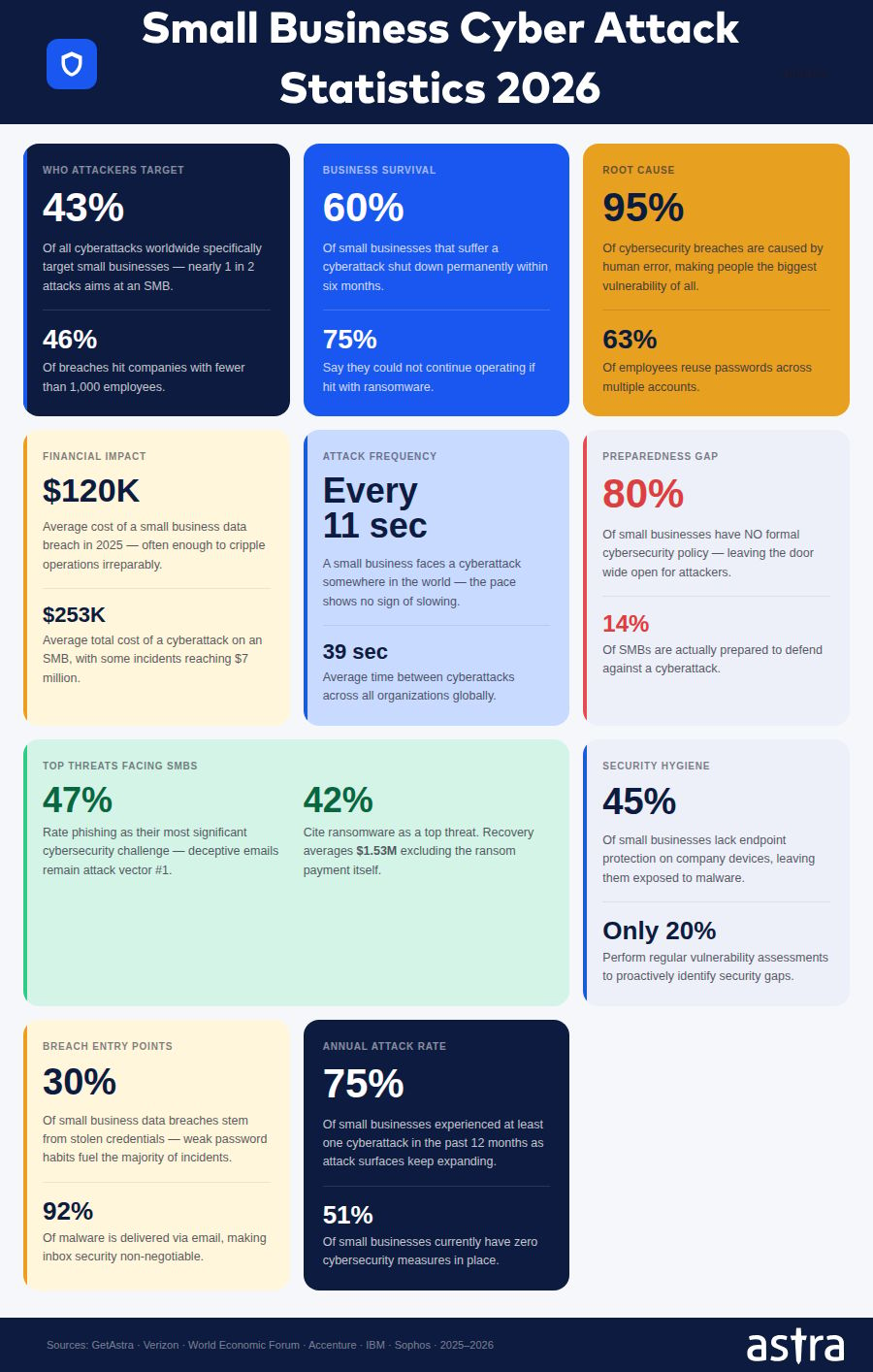
Proton’s SMB Cybersecurity Report 2026 declared that SMBs now account to 863% of all data breaches tracked since January 2025, and 942% of those are large-scale exposures.
This underscores the delusion that attackers still believe they are too small to hack, but rather one of the primary targets. The Verizon 2025 Data Breach Investigations Report tells a similar story, with 10SMBs being targeted nearly four times as often as larger organizations.
The real question here is, why have small businesses become the key focus of late? Because the math adds up for attackers. RaaS (Ransomware-as-a-Service) groups rent sophisticated infrastructure to break into systems, 11growing at 50% YOY.
Meanwhile, smaller businesses have fewer defenses to safeguard their systems due to tight budgets and a lack of a dedicated security team to handle the high volume of attacks. 12On average, organizations faced 1,968 cyber attacks per week in 2025. 13This has increased by almost 70% since 2023, driven by advances in AI.
A combination of valuable data with limited defenses and predictable security gaps makes security at SMBs the most obvious target.

Is Your Pentester Keeping Up with Attack AI?
14AI has entirely reshaped cybersecurity on both the attacker’s and the defender’s sides. 165.33 vulnerabilities per minute. That’s how fast weaknesses are being uncovered across real environments, and small businesses aren’t the exception anymore. 17Additionally, Check Point’s 2026 report found that medium and large-scale attacks increased by 20.8% in 2025, totaling 13.15 billion globally.
On the defense side, 18IBM’s 2025 data show that breach lifecycles were reduced by 80 days and that companies using AI and automation extensively saved an average of $1.9 million. 19But, only 11% of SMBs have adopted AI-powered defenses (CrowdStrike 2025), and 2090% of organizations lack the ability to oppose AI-equipped attacks.
21Although 69% of small businesses use AI platforms, 45% still remain unclear on how data is stored or processed by those tools (Proton’s 2026 SMB report). This clearly underlines that employees are highly likely to feed sensitive data into AI prompts.
Overview Of Small Business Cyber Attacks in 2026
The image of a hacker with a hood pulled over his head, furiously typing away code into the terminal, is more dated than the last security audit you probably ran. Modern attacks on SMBs are very different, making it crucial to understand what could possibly come at you.
Ransomware is one of the most prevalent threats today, and it has taken a heavy hit on SMBs. 22The Verizon 2025 DBIR found that ransomware accounted to 88% of SMB breach incidents, and only 39% of large-enterprise incidents. This indicates that mall businesses are ideal targets for malicious actors.
23Data encryption by attackers has dropped from 70% to 50% YOY. 24Attackers threatening to publish data have doubled, from 3% to 6%. So even if you restore backup data, the underlying threat of the data they are holding on to remains.
AI has made phishing significantly more dangerous. 25LLM-generated phishing emails gained a 54% click-through rate when compared to just 12% for human-written phishing. That’s a drastic improvement for attackers, owing to automation-driven decrease in obvious markers (such as grammar, font, etc.), 26a 4.5x increase in effectiveness.
27VikingCloud 2026 also reports that 46% of SMBs encountered AI-generated phishing in the past 12 months. 28And voice phishing grew 442% between the first and second half of 2024.
So now it’s not just the poorly written emails with suspicious grammar or with a banner saying “You just won $1000” that awareness training taught employees to steer clear of. The tells are gone, and your guards should be higher than ever.
Most attacks don’t involve malware in 2026, so you cannot just rely on your antivirus software anymore. 29CrowdStrike’s 2025 Global Threat Report found that 79% of attacks detected were malware-free and instead relied on credential abuse, social engineering, and remote tools. 30And with 79% of attacks targeting them, antivirus software is essentially a bystander.
31Verizon’s 2025 DBIR found that third-party involvement in breaches doubled to 30% YOY. SMBs that rely on SaaS platforms, managed service providers, and shared cloud infrastructure are bound to their vendors’ security failures. The breach doesn’t have to start in your environment to end there.
3286% of SMBs rely on business cloud storage services (Google Cloud, Microsoft Azure). 33And less than half of SMBs use a VPN to secure endpoints. The US is the only country with a majority of VPN adoption.
These alarming statistics reveal the dire need for SMB owners to learn, follow & implement cybersecurity etiquette and measures that would help secure their businesses.
With an estimate for cybercrime costs in the coming year in billions, some highly recommended appropriate security measures for SMBs include:
- Secure code and regular review of code
- Implementing proper access control measures like MFA & strong passwords
- Conducting regular vulnerability scans and pentests
- Use strong anti-malware programs and maintain firewalls.
Preparedness Gaps: Budgets, Staffing, Awareness, Tools, Training
There’s a huge difference between knowing you are at risk and actually preparing yourself for it. Most SMBs fall into the former category, and that is precisely how they become bait for attackers.
The problem here is a lack of execution and not merely being devoid of knowledge or awareness. 3493% of SMBs say they are aware of cybersecurity risks, and 83% say they have a plan. 35But, only 36% are investing in new tools, and just 11% have adopted AI-powered defenses.
36The situation for businesses with fewer than 50 employees is even worse; only 47% have a security plan, while more than half allocate less than 1% of their annual budget to cybersecurity.
For businesses that do have a cybersecurity plan, 3784% of SMB owners are still self-managing their cybersecurity. 38And the human cost for it is real: 56% of cyber leaders report increased anxiety, and 53% report burnout from managing security demands alone. 3957% say those demands are actively delaying or preventing business growth.
As for the tools, they don’t seem to be efficient either, with over 3934% of SMBs admitting their cybersecurity technology is outdated. Only a third actually have vulnerability scanning, penetration testing, or security awareness training in place. The presence of legacy tools creates a false sense of coverage, while the attacks exploit your attack surface.
40Cost remains the #1 stated barrier, cited by 66% of SMBs. But the numbers no longer support doing nothing. 41When 53% of breached SMBs say their losses matched or exceeded their entire annual cybersecurity budget, avoiding the spend turns out to be the costlier choice.
Cost of SMBs Cyberattack Statistics
Risks seem entirely conceptual until there’s actual money involved. For SMBs that already have very little budgeted for cybersecurity, this becomes an expensive lesson. 4267% of breached SMBs reported losses between $10,000 and $100,000, and 14% exceeded $100,000.
43SonicWall’s 2026 Cyber Protect Report found that when factoring in system downtime, data recovery, and reputational damage, a single SMB data breach can easily exceed $4.91 million, i.e., not just a bad quarter; it is a business-ending incident.
4440% of SMBs say a cyberattack costing $100,000 or less would put them out of business. 45But the previous year’s report found that 19% would close after any successful cyberattack, with 32% saying losses under $10,000 would be enough to shut them down.
Meanwhile, 46Sophos’s 2025 report found that the average ransomware recovery cost for SMBs with 100–250 employees was $638,536, excluding any ransom payment. 47And the median time for a breach to go undetected is 181 days. This means that businesses are still dealing with the after-effects six months later.
In other words, cybersecurity cannot just be considered as another IT expense. It is precisely what keeps the business running when something goes wrong, a truth many small businesses fail to see.
Explore the top 10 penetration testing companies
Future Predictions: The Bigger Picture
The numbers also feel large, and they will only get larger.
48The cost of global cybercrimes is predicted to reach $12.2 trillion by 2031. For your context, this would mean cybercrime is set to be the third-largest economy in the world, behind the US and China.
Investment in small businesses appears to be rising, with 49cybersecurity spending expected to reach $109 billion worldwide by the end of 2026, growing at a 10% compound annual rate.
Supply chain attacks are expected to become more frequent and more harmful because attackers know that breaching a single vendor can affect dozens, or even hundreds, of SMBs at once. 50Gartner had projected that 45% of organizations worldwide would experience a supply chain attack by 2025, and that point has likely already been reached.
Additionally, SMBs are likely to face rising insurance premiums and stringent eligibility requirements due to the rise in exploits. 51The cyber insurance market is forecasted to grow from $8.5 billion in 2021 to over $34 billion by 2031. As a result, proof of MFA, endpoint protection, and regular vulnerability assessments before issuing policies is becoming mandatory. Hence, the market will technically force the security standards that awareness failed to achieve.
All predictions are directed at one thing: treat cybersecurity as a continuous operation rather than an annual checkbox. SMBs currently fall between the gap of having some tools and actually being protected.
What “Good” Actually Looks Like for an SMB in 2026
Your response to all of this statistical data should not be to panic-buy a stack of security tools. What the data points towards is to focus on a set of priorities:
- Understand your attack surface: 52Third-party breaches doubled to 30% of all incidents in 2025. Which means your attack surface is simply not limited to your own systems. It is also subject to vendors, platforms, and integrations that your business touches. 53VPN CVEs increased by 82.5% over the same period, so if you are running legacy VPN infrastructure and haven’t assessed it recently, that’s a known gap with potential exposure.
- Unpatched vulnerabilities are your top priority: 54Exploited vulnerabilities were the number one root cause of ransomware for the third consecutive year in 2025, keeping the median remediation time at 32 days, with some being exploited even at day zero. So, running vulnerability scans quarterly is not enough.
- Verify your fixes work: It’s common to fix a vulnerability and move on. Confirming if your fix actually worked, not so much. Rescanning after remediation should not be optional; it should be the only way to close the loop.
- Test for what scanners don’t find: 5579% of attacks were malware-free, meaning they relied on credential abuse and legitimate tools rather than malware signatures that a scanner would flag.
Business logic flaws such as payment flow manipulation, role escalation, and access control abuse do not always show up in automated scan reports. They require pentesters who understand how your application is supposed to work before they can find how to break it.
This is where Astra’s Pentest Suite comes in. With 15,000+ test cases, AI-assisted testing, Astra, offers a clear ROI for every vulnerability detected by the scanner. Our automated scanners also allow you to scan your website, cloud, APIs, etc., on a daily basis.
Since the vulnerabilities are vetted for authenticity by experts, there is little to no chance for you to waste resources on false positives. Remediation is super efficient with video PoCs and contextual collaboration offered by Astra Security.
Bottom Line
Small businesses are often easier to target owing to their smaller security ihabudgets and situationally driven inability to prioritize security over other aspects of a business.
That said, with the growing focus on returns, security needs by clients, and compliance, embracing a different lens for cybersecurity is an unavoidable choice, the only question is will you make the same before you end up as a case study or before?





Very impactful and informative.