Key Takeaways:
- Shift left to proactive protection by mapping threats to business-critical assets.
- Prioritize risks using a quantitative matrix (Likelihood × Impact × Asset Value) and address higher-level threats, including rare and high-impact ones.
- Define responses (accept, avoid, transfer, reduce), assign owners, and track KPIs.
- Utilize continuous monitoring (MTTR, detection times, asset exposure) to identify and close gaps, demonstrating progress.
- Leverage AI-driven threat modeling, predictive analytics, and Gen-AI agents for real-time forecasting and developer-friendly fixes.
You are the CISO of a mid-sized enterprise that is experiencing rapid growth, i.e., your security stack is becoming increasingly complex by the month, compliance auditors are asking more challenging questions, and your board wants measurable proof that security investments are actually reducing risk.
Meanwhile, attack vectors are evolving daily, and your current risk assessments consistently lag behind. With high-severity vulnerabilities rising by 83% in 2025 alone, you need more than periodic scans; you need a systematic and continuous risk management process that actually works.
That’s what we will discuss in this blog. By the end, you’ll get a clear, step-by-step guide to turn abstract risk theory into real security actions.

Why is Astra Vulnerability Scanner the Best Scanner?
- We’re the only company that combines automated & manual pentest to create a one-of-a-kind pentest platform.
- Vetted scans ensure zero false positives.
- Our intelligent vulnerability scanner emulates hacker behavior & evolves with every pentest.
- Astra’s scanner helps you shift left by integrating with your CI/CD.
- Our platform helps you uncover, manage & fix vulnerabilities in one place.
- Trusted by the brands you trust like Agora, Spicejet, Muthoot, Dream11, etc.

What is the Risk Management Process?
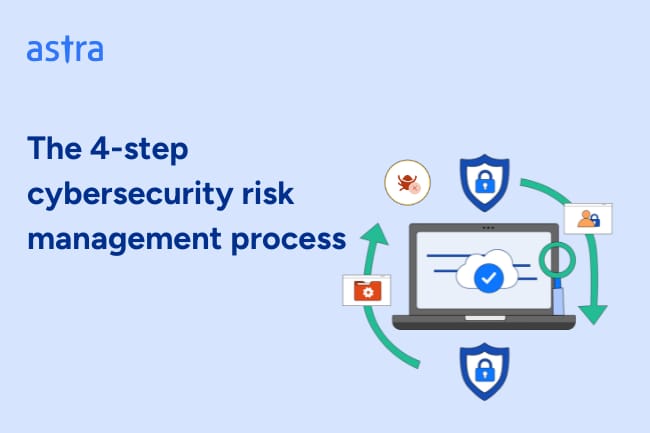
The risk management process is your systematic approach to identifying, analyzing, and controlling cybersecurity threats to your networked systems, data, and users. It’s a repeatable framework that helps minimize potential risks and protect your organization’s assets.
Managing risks in a structured manner allows you to shift from reactive security to proactive protection. This means you handle vulnerabilities before they cause business-critical problems.
Why is Risk Management Important?
The numbers paint a pretty alarming picture. By 2025, cybercrime costs are projected to reach $10.5 trillion globally, growing at 15% year-on-year. But here’s what’s even more concerning: 40,000+ CVEs were published in 2024 alone, a whopping 38% increase from 2023.
Today’s threat landscape has shifted significantly. Attackers use AI to craft phishing campaigns in 30 seconds and crack passwords or generate malware at scale. These fast-moving threats make traditional risk management phases irrelevant, making automated and continuous risk monitoring the best available option.
In short, if you don’t adapt, you’re setting yourself up for sophisticated, AI-driven attacks that will use the gaps in your risk management cycle. And by the time you react with patches, it might just be too late. Businesses must adapt with AI-aware workflows or continue chasing blurry shadows of yesterday’s security.
4 Steps of an Effective Risk Management Process
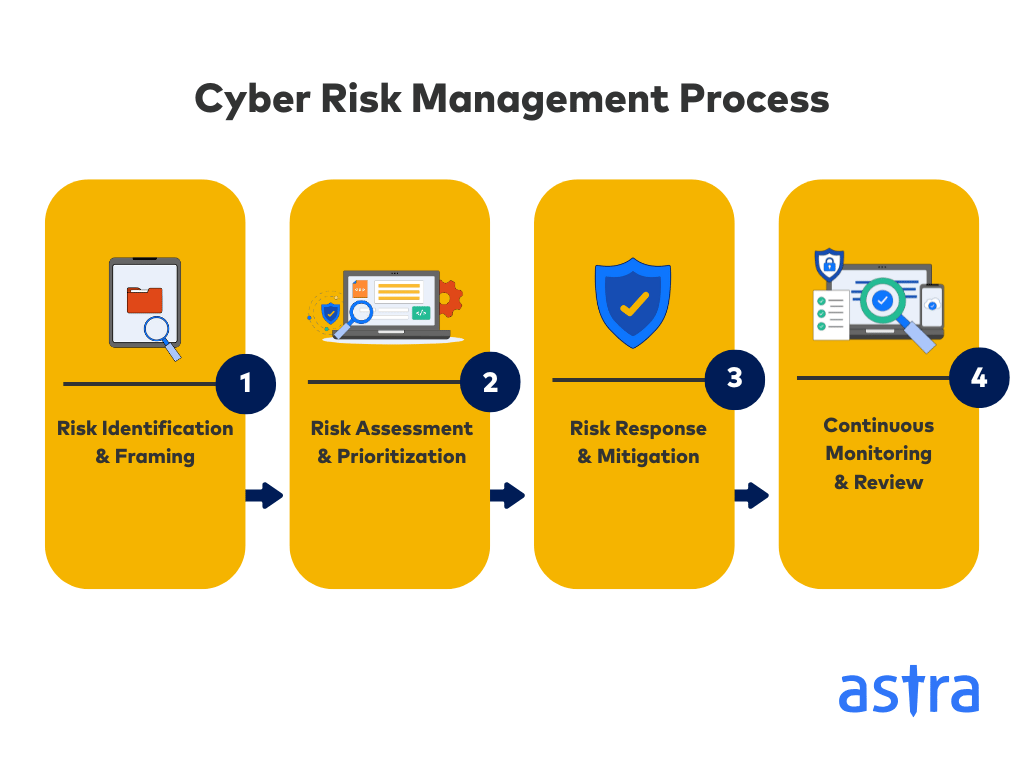
1. Risk Identification & Framing:
The foundation of any solid risk management workflow starts with knowing what you are protecting and what threatens it.
Start by cataloging your critical assets: applications, databases, network infrastructure, and yes, those forgotten initial APIs everyone is afraid to touch. But don’t stop there. Map how these assets connect to your business processes.
For example, if your customer payment system fails, what happens next? How does it affect your revenue, compliance, and customer confidence? This business context transforms technical vulnerabilities into strategic risks.
Pro Tip: Use comprehensive automated discovery tools like Tropic or BetterCloud to identify shadow IT and forgotten assets. In our experience, organizations typically find 30-40% more internet-facing assets than they initially knew about. Also, this should not be a one-time affair but rather a continuous activity integrated into your CI/CD pipeline.
Next, establish your risk tolerance and scope.
2. Risk Assessment & Prioritization:
Now comes the critical part of the risk management lifecycle. Turning that long list of potential threats into a prioritized action plan. Many businesses often struggle here, but the solution is actually clear and straightforward.
Blend qualitative insights with quantitative data. For each identified risk, assess:
- Likelihood: How probable is this risk considering current protections and threat info?
- Impact: What’s the financial impact if this risk occurs?
- Velocity: How quickly could this threat cause damage once triggered?
Create a risk matrix that plots likelihood against impact. High-probability, high-impact risks get immediate attention. But don’t ignore high-impact, low-probability events, these often represent your “black swan” scenarios that could damage the business.
Hot Take: Traditional risk scoring often fails because it treats all “high” risks equally. Instead, calculate the risk value for each risk: Likelihood × Impact × Asset Value. This gives you a quantitative risk analysis and prioritization criteria that speaks the board’s language.
3. Risk Response & Mitigation:
Using your prioritized risk list, pick the most suitable of the four approaches per threat, considering your business context and risk tolerance level.
| Method | Action | Example |
|---|---|---|
| Risk Acceptance | For low-impact risks where mitigation costs exceed potential losses. Document these decisions clearly as acceptance doesn't mean ignoring. | Accepting low-priority risks for non-critical systems. |
| Risk Avoidance | Eliminate the risk entirely by changing processes or eliminating vulnerable traditional systems. | Deciding not to store sensitive data in certain cloud environments. |
| Risk Transfer | Transfer risk through insurance, contracts, or third-party services. But remember, you can transfer financial impact, not accountability. | Purchasing cyber liability insurance or outsourcing security monitoring. |
| Risk Reduction | Implement controls to reduce likelihood or impact. This is where most security teams spend their time, and for good reason. | Implementing MFA, deploying firewalls, regular software updates. |
Every mitigation strategy should have a clear plan with defined owners, deadlines, and measurable KPIs. Avoid broad goals like “improve network security,” as they don’t drive results. Specific actions, such as “deploy MFA across all admin accounts by month-end,” do.
Real-Life Success Story: By focusing on critical issues and incorporating Astra into their workflow, WireMock reduced the “time to fix” by ~50%, enabling them to remediate vulnerabilities faster than with traditional penetration tests.
4. Continuous Monitoring & Review:
Here’s where traditional risk management steps often fail. Treating risk assessment as a quarterly task rather than an ongoing process. Modern threats can occur between review cycles, causing significant damage.
Establish KPIs that actually matter:
- Vulnerability detection speed: Rapid identification shrinks attack windows, minimizing breach damage.
- MTTR for critical fixes: Low remediation time showcases your team’s responsiveness to emerging threats.
- Percentage of assets under continuous monitoring: Broad monitoring scope prevents overlooked attack surfaces.
- Risk exposure trending over time: Tracking trends reveals if your risk management process flow is truly improving or falling behind.
With Astra’s risk management process, you get access to a dynamic dashboard that informs strategic decisions by lining out all the critical issues on the go via an automated DAST scanner and doesn’t just provide decorated reports. This helps your executives understand whether you are getting more secure over time or if new threats are outpacing your defenses.
No other pentest product combines automated scanning + expert guidance like we do.
Discuss your security
needs & get started today!

Schedule regular risk reviews, but make them strategic. Don’t just update spreadsheets; evaluate whether your risk appetite and priorities have shifted based on business changes, threat intelligence, or incident learnings.
Most importantly, tie your risk management procedure into change management. New deployments, system changes, and business initiatives should all trigger risk assessments, as prevention beats remediation every time.
What is the Goal of a Cyber Security Risk Management Process?
Your risk management process serves three critical business functions that go far beyond just “staying secure.”
1. Protects Your Most Valuable Assets
By ensuring resources focus on threats that actually matter to your business. Instead of spreading security efforts thin across every possible vulnerability, you are making strategic investments based on real business impact.
2. Enables Informed Decision-Making Across Your Business
It enables informed decision-making across your business. So, when executives ask whether to approve a cloud migration or new vendor integration, you have frameworks to assess and communicate associated risks clearly.
3. Ensures Compliance
It drives compliance without reducing security to box-checking. Strategic risk management phases in NIST, ISO 27001, and SOC 2 frameworks make compliance a natural outcome of solid security practices, not an overhead.
Bottom line? Converting cybersecurity from a cost burden to a strategic growth driver.
Which Security Standards Require a Risk Management Approach?
Today’s cybersecurity standards recognize that effective security isn’t about implementing every possible control; it’s about implementing the right controls based on systematic risk analysis.
Here’s how major frameworks approach this:
1. NIST Cybersecurity Framework:
The NIST CSF’s five functions naturally align with risk management steps:
| Function | Steps |
|---|---|
| Identify | Catalog assets and business processes (risk identification) |
| Protect | Deploy safeguards based on risk priorities (risk mitigation) |
| Detect | Monitor for threats and vulnerabilities (continuous monitoring) |
| Respond | Execute incident response plans (risk response) |
| Recover | Restore capabilities and learn from incidents (risk review) |
2. ISO 31000
ISO 31000 provides a universal enterprise risk management benchmark, prioritizing systematic risk processes and integration into business decision-making.
Continuous improvement through ongoing monitoring and review remains key. Central to the framework is accountability, requiring transparent governance structures that define organizational roles and responsibilities for effective risk management.
3. COSO ERM Framework:
COSO integrates strategic risk management across five components:
- Governance and culture that supports risk-aware decision making.
- Strategy development that considers risk appetite.
- Performance management with risk-adjusted metrics.
- Review processes that adapt to changing conditions.
- Information systems that enable risk visibility.
4. CIS Critical Security Controls:
The CIS Controls provide tactical implementation guidance, mapping the top 18 controls to your risk management procedure:
- Basic controls for all organizations (inventory, configuration, access management)
- Foundational controls for enhanced security (data protection, incident response)
- Organizational controls for mature programs (penetration testing, security training)
AI in Cyber Security Risk Management
Artificial intelligence is transforming how organizations approach risk identification and risk monitoring, moving from reactive assessments to predictive security operations.
And here’s how they are doing it:
1. Enhanced AI-Powered Threat Modeling
AI analyzes your app’s architecture and workflows to generate contextual threat scenarios rather than generic scans. This targeted approach pinpoints vulnerabilities critical to your business environment, minimizing false positives while capturing essential risks.
Astra’s AI-driven threat modeling evaluates your application’s features, workflows, and architecture during pentesting, auto-generating relevant test cases and vulnerability patterns for comprehensive security coverage.
2. Predictive Risk Analytics
In this, machine learning models analyze historical attack data, vulnerability trends, and environmental factors to forecast where threats are most likely to emerge. This risk assessment evolution enables organizations to allocate resources proactively rather than reactively.
Predictive analytics also enhances project risk management by identifying security implications of planned changes before implementation. New deployments can be assessed for risk exposure based on similar past implementations.
3. Gen-AI Powered Chat Agent for Vulnerability Resolution
AI chatbots deliver round-the-clock vulnerability remediation guidance with contextual, step-by-step solutions. These intelligent agents translate complex security concepts into developer-friendly explanations while auto-escalating critical issues for immediate response.
Astra’s Gen-AI-powered vulnerability resolution chatbot acts as your developers’ round-the-clock security assistant. It explains vulnerabilities in your application’s specific context and provides technical remediation steps, accelerating fix times while building your team’s security knowledge.
How Can Astra Help?
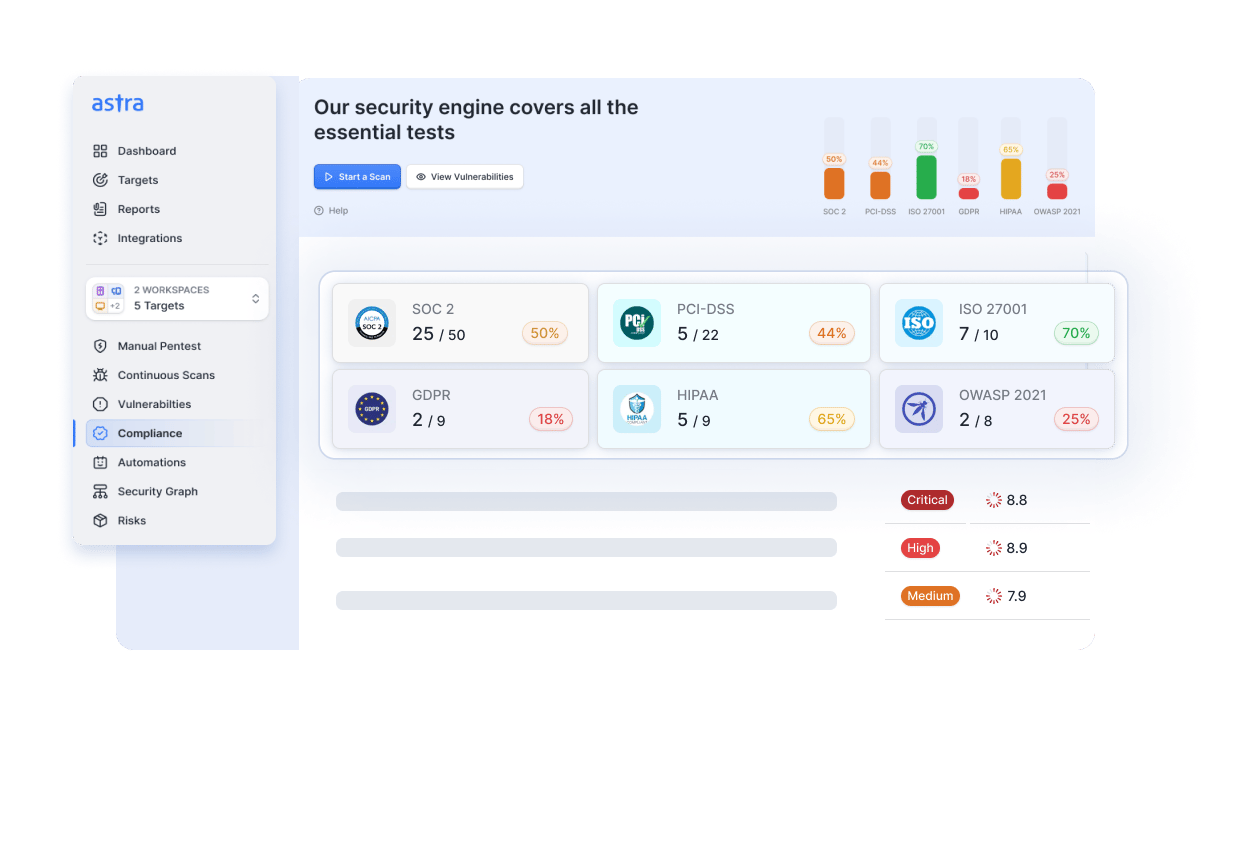
Key Features:
- Pentest Capabilities: Web and Mobile Applications, Cloud Infrastructure, API, and Networks
- Manual Pentest: Yes
- Accuracy: Vetted scans for zero false positives
- Scan Behind Logins: Yes
- Compliance: PCI-DSS, HIPAA, SOC2, ISO 27001, and CERT-IN
- Cost: Starting at INR 16,000
- Best for: Vulnerability assessments, penetration tests (both manual and automated), and compliance scans for multiple digital assets.
Astra modernizes risk management via automated, AI-powered penetration testing aligned with the business pace. Our platform addresses each stage of the risk lifecycle with precision automation. With 15,000+ automated test cases updated fortnightly, we detect business logic vulnerabilities and complex attack chains that static assessments miss entirely.
Our AI contextualizes vulnerabilities within your business environment, helping prioritize remediation on threats that actually matter. Rather than drowning in severity scores, you get business-impact analysis connecting technical risks to operational consequences. This transforms overwhelming data into actionable intelligence.
During mitigation, our platform integrates directly into development workflows through Slack, Jira, GitHub, and Jenkins. Security fixes happen where teams already work, with expert guidance available through dedicated specialists and continuous monitoring for real-time risk visibility.
Astra Pentest is built by the team of experts that helped secure Microsoft, Adobe, Facebook, and Buffer

Final Thoughts
The organizations that survive tomorrow’s threats aren’t the ones with perfect security; they’re the ones with systematic risk management. This four-step approach doesn’t just eliminate cyber risk; it makes it measurable, manageable, and aligned with business reality.
Remember that risk management works best when it is integrated into business operations, not treated as a separate security function. Your risk assessment processes should inform strategic decisions, your risk mitigation strategies should enable business objectives, and your risk monitoring should provide actionable intelligence, altogether.
FAQs:
What are the 5 T’s of risk management?
The five T’s of risk management, i.e., transfer, tolerate, treat, terminate, and take the opportunity, define response options. Transfer shifts risk externally, tolerate and monitor low‑impact threats, treat applies controls to reduce exposure, terminate removes the hazard, and take opportunities to utilize positive outcomes.
How to create a risk management framework?
Start by defining your objectives and scope, identifying key assets, and understanding your risk tolerance. Then connect threats to assets, assess likelihood, impact, and velocity, and prioritize using a quantitative matrix.
Finally, design response strategies (accept, avoid, transfer, reduce), assign ownership, track KPIs, and incorporate continuous monitoring and feedback loops.
What is 5X5 risk management?
A 5×5 risk matrix is a visual grid ranking both likelihood and impact on a scale of 1 (low) to 5 (high), creating 25 different risk levels. Multiplying the two scores yields a risk rating that’s color-coded (green to red), enabling you to quickly prioritize threats, particularly those with high impact or probability.