
Key Takeaways:
- SOC 2 vulnerability assessments are crucial as 66% of B2B customers require compliance for contracts.
- Continuous vulnerability scanning and monitoring ensure alignment with SOC 2’s trust services criteria, specifically CC4.1 and CC7.1.
- Manual validation and automated scanning balance accuracy with comprehensive security coverage for SaaS companies.
- Integration with compliance and DevSecOps platforms streamlines the collection of audit evidence and accelerates SOC 2 readiness.
- Leading tools offer tailored reports mapped directly to SOC 2 audit requirements, easing auditor reviews.
- Startups benefit from AI-driven automated tools, while enterprises leverage hybrid scanning for depth and precision.
- Successful SOC 2 compliance depends on ongoing vulnerability management, transparent remediation processes, and continuous monitoring.
With 66% of B2B customers now checking for SOC 2 vulnerability compliance before signing contracts, vulnerability assessment and continuous security monitoring are now expected not just during annual audits, but as regular operational exercises.
While the CC4.1 trust services criteria requires you to detect and mitigate loopholes in processing through continuous oversight, the CC7.1 mandates that you “conduct vulnerability scans designed to identify potential vulnerabilities or misconfigurations periodically and after any significant change in the environment”.
Don’t mistake these for suggestions; auditors from firms like BDO, Grant Thornton, and Moss Adams also request vulnerability scan reports as supporting evidence, and 67% of organizations that eschew them receive management letter comments for monitoring deficiencies during Type II audits.
How Can You Choose the Right SOC 2 Assessment Tool?
Under such tight scrutiny, finding the right vulnerability assessment tool for SOC 2 compliance is not just a matter of picking from the chits.
Your vendor ought to hold dexterity in balancing automation with manual validation, providing continuous monitoring rather than point-in-time assessments, integrating seamlessly with your existing security stack, and generating auditor-compliant documentation that maps directly to Trust Services Criteria.
That is why we have curated our guide of the nine best SOC 2 vulnerability assessment tools based on their SOC 2-specific capabilities, proven track records with SaaS companies, and ability to satisfy auditor requirements while supporting your development velocity.
Get ahead of your SOC 2 audit, and try Astra’s continuous vulnerability management today
List of Top 7 SOC 2 Vulnerability Assessment Tools for SaaS
- Astra Security (Pentest + VA Platform)
- Beagle Security
- Intruder
- Qualys VMDR
- Tenable.io
- Rapid7 InsightVM
- Detectify
- Invicti
- Sprinto
- Acunetix
- OpenVAS
Top 3 SOC 2 Vulnerability Assessment Tools for SaaS Compared
| Feature | Astra Security | Beagle Security | Intruder |
|---|---|---|---|
| G2 Rating | 4.6/5 (155 reviews) | 4.7/5 (88 reviews) | 4.8/5 (194 reviews) |
| Scan Type | Hybrid (Automated + Manual) | Automated AI-driven DAST | Automated Continuous |
| Best For | Comprehensive SOC 2 Type II compliance | Startups with limited security resources | Continuous perimeter security |
| Starting Price | Custom pricing | $359/month | Monthly per-target pricing |
| False Positives | Zero (manual verification) | AI-validated | Curated checks |
| Coverage | Web, API, mobile, cloud, network | Web apps, APIs | Network, cloud, web apps |
| Compliance Integration | Vanta, Drata, Secureframe | DevSecOps pipelines | Native Drata/Vanta integration |
| Manual Testing | Included with security engineers | Not included | Optional (Vanguard tier) |
| Setup Time | Rapid and flexible implementation | 15-20 minutes | Rapid implementation |
| Audit Evidence | OWASP-mapped reports, Video POCs, and other detailed reports | OWASP-mapped reports | Automated evidence to GRC |
1. Astra Security (Pentest + VA Platform)
G2 Rating: 4.7/5 (154 reviews)
Key Features:
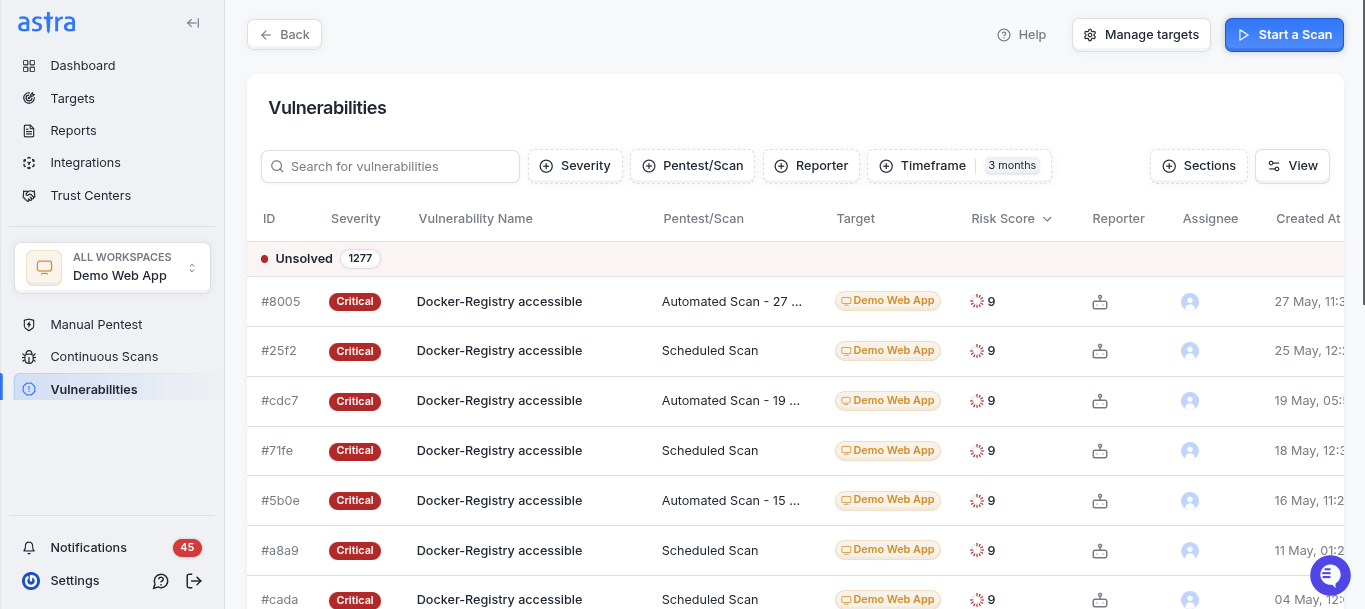
- VA Capabilities: Web applications, APIs, mobile apps, cloud infrastructure (AWS, GCP, Azure), network infrastructure
- SOC 2 Compliance: Direct mapping to CC4.1 and CC7.1 with audit-ready reports, compliance dashboards for SOC 2, ISO 27001, PCI DSS, HIPAA
- Scan type: Hybrid (automated scanning + manual penetration testing by security engineers)
- Accuracy: Zero false positives guaranteed with manual verification of all findings
- Continuous monitoring: 24/7 automated scanning with real-time alerts for new vulnerabilities
- Integration capabilities: CI/CD pipelines (Jenkins, GitLab, GitHub Actions), Jira, Slack, compliance platforms (Vanta, Drata, Secureframe)
- Reporting & evidence collection: Auditor-compliant reports with video proof-of-concepts, remediation guidance, retest validation, executive summaries
- API access: REST API for programmatic access to scan results and vulnerability data
- Cost: Custom pricing based on assets; competitive for comprehensive hybrid approach
- Best For: SaaS companies seeking continuous vulnerability management with human expertise for SOC 2 Type II compliance
At the forefront, we at Astra Security have built a platform that combines automated vulnerability scanning with expert manual penetration testing. This hybrid approach directly addresses SOC 2’s requirement for both systematic detection and validated remediation.
Secondly, our AI-infused platform runs over 8,000 automated tests covering OWASP Top 10, SANS 25, and known CVEs, while our certified security engineers manually verify findings and test business logic vulnerabilities that most automated scanners miss.
But what sets us apart as an SOC 2 vulnerability assessment tool is our audit-focused design. We build flexible compliance dashboards that map directly to CC4.1 and CC7.1 requirements, and generate reports ready for use as evidence during audits.
Our DAST scanner provides 24/7 automated scanning to discover new vulnerabilities as they emerge, while integration with Vanta, Drata, and Secureframe automatically sends compliance evidence to your GRC platform. This approach shifts vulnerability management from a pre-audit scramble to a more continuous compliance setup.
Pros
- Zero false positives through manual verification by security engineers
- Comprehensive asset coverage, including APIs, cloud configurations, and business logic flaws
- Direct auditor support with compliance reports specifically formatted for SOC 2 Type II evidence
- Developer-friendly remediation with detailed steps, video POCs, and direct engineer consultation
- Smooth compliance integration with major GRC platforms for automated evidence collection
Limitations
- Only a 1-week trial is available, starting at $7
Why Choose Astra Security?
We directly address the core challenge of SOC 2 vulnerability management: proving to auditors that you not only detect vulnerabilities but also validate their severity and remediate them effectively.
Our hybrid approach provides continuous monitoring as required by CC7.1 while delivering the accuracy and evidence quality that auditors demand. Our platform’s SOC 2-specific compliance features, combined with its Type 2 certification, position it uniquely to guide SaaS companies through the audit process.
Customer Testimonial
“The combination of pentesting for SOC 2 & automated scanning that integrates into our CI pipelines is a game-changer.“
- Jack Collins, Head of Product Engineering, Naro
2. Beagle Security

G2 Rating: 4.7/5 (87 reviews)
Key Features:
- VA Capabilities: Web applications, REST APIs, GraphQL endpoints, authentication systems, processing customer data
- SOC 2 Compliance: OWASP-mapped reports for SOC 2 Type II, pre-built compliance documentation
- Scan type: Automated AI-driven DAST (Dynamic Application Security Testing)
- Accuracy: AI-powered validation to minimize false positives
- Continuous monitoring: Scheduled recurring scans with emerging threat monitoring
- Integration capabilities: DevSecOps pipelines, API testing frameworks, compliance platforms
- Reporting & evidence collection: Audit-compliant documentation with remediation evidence and retest validation
- API access: Full API access for automation and integration
- Cost: Starting at $359/month for the Advanced plan with compliance reporting
- Best For: Startup development teams without dedicated security personnel seeking affordable SOC 2 compliance
Beagle Security offers you AI-driven Dynamic Application Security Testing specifically engineered for SOC 2 Type II audit requirements.
The platform excels at API security validation, conducting comprehensive testing of REST APIs and GraphQL endpoints that handle customer data. This includes authentication bypass scenarios, data exposure vulnerabilities, and business logic testing.
Pros
- Extremely affordable at $359/month compared to $10,000-$25,000 consultant engagements
- No security expertise required, designed for developers without a penetration testing background
- Strong API testing capabilities for modern SaaS architectures
- Pre-built compliance reports specifically formatted for SOC 2 auditors
Limitations
- An automated-only approach lacks manual validation for complex business logic vulnerabilities
- Limited infrastructure testing focuses primarily on web applications and APIs
- Potential false positives without a manual verification layer
- Less comprehensive coverage compared to hybrid solutions
Why We Chose Beagle Security?
For SOC 2 compliance specifically, they provide pre-built penetration test reports with OWASP mapping, remediation evidence, and retest validation required by Type II auditors. With a setup time of just 15-20 minutes and minimal technical requirements, they offer quite an accessible solution in this space for development teams that lack penetration testing expertise, a significant advantage for startups navigating their first SOC 2 audit.
3. Intruder
G2 Rating: 4.8/5 (194 reviews)
Key Features:
- VA Capabilities: Network infrastructure, cloud environments, web applications, emerging threats
- SOC 2 Compliance: Direct integration with Drata and Vanta for automated compliance evidence, SOC 2-certified platform
- Scan type: Automated continuous scanning with optional penetration testing (Intruder Vanguard)
- Accuracy: Curated vulnerability checks to reduce false positives
- Continuous monitoring: Automatic detection of new assets and vulnerabilities with instant alerts
- Integration capabilities: Cloud accounts (AWS, GCP, Azure), SIEM systems, ITSM platforms, Drata, Vanta
- Reporting & evidence collection: Comprehensive, auditor-friendly reports with clear remediation guidance
- API access: Full API for automated workflows and integrations
- Cost: Pro version starts at $240 per license, free trial available
- Best For: Organizations requiring continuous perimeter security with strong compliance automation
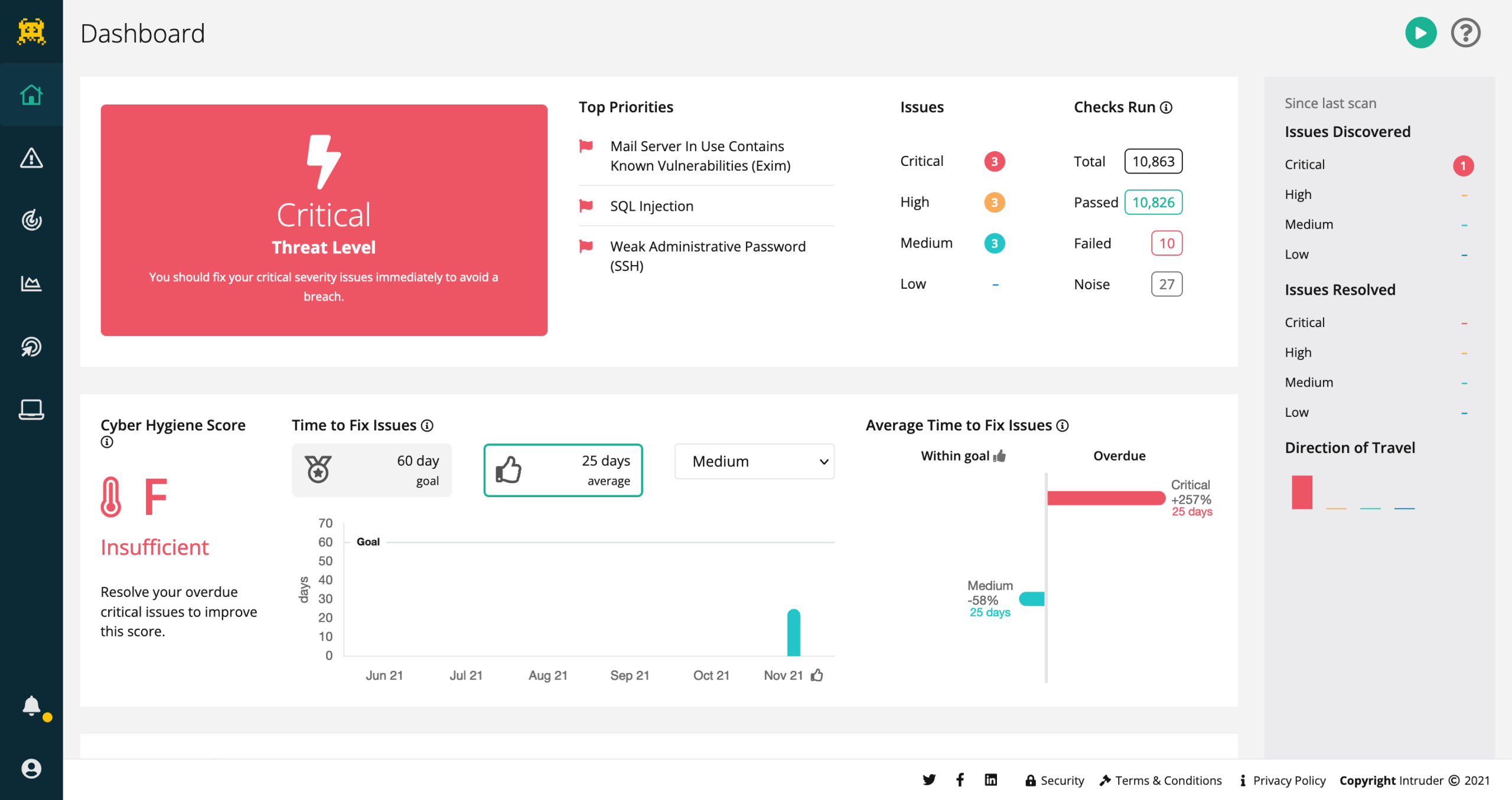
Intruder’s platform automatically discovers assets in your environment and checks for 140,000+ infrastructure weaknesses and 75+ application vulnerabilities, while emerging threat scans proactively look for newly released vulnerabilities.
As an SOC 2 vulnerability assessment tool, especially when it comes to compliance, you can connect Intruder with Drata or Vanta to automatically send evidence of your scans and prove compliance, eliminating manual evidence collection during audits.
Pros
- Native compliance integration with Drata and Vanta for automated evidence collection
- Emerging threat scanning proactively checks for newly released vulnerabilities
- SOC 2 certified platform demonstrates its own compliance effectiveness
- Clear, auditor-friendly reports that are both comprehensive and easy to understand
Limitations
- Requires monthly scanning minimum for effective continuous monitoring
- Network-focused may need supplementation for deep application testing
- Vanguard tier required for manual penetration testing capabilities
- Per-target pricing can become expensive for large environments
Why We Chose Intruder?
They readily monitor your network for changes or additions, and timely alert you as soon as new vulnerabilities appear. This continuous approach breaks away from the limitations of periodic penetration tests and offers ongoing visibility into your security posture, which isexactly what typically SOC 2 Type II auditors want to see.
Integrate Astra Security with Drata or Vanta to eliminate manual evidence collection and simplify continuous compliance.

4. Qualys VMDR
G2 Rating: 4.4/5 (166 reviews)
Key Features:
- VA Capabilities: On-premises systems, cloud infrastructure (AWS, GCP, Azure), virtual assets, containers, endpoints
- SOC 2 Compliance: Pre-built compliance reports for SOC 2, ISO 27001, HIPAA, PCI DSS; mapping to CC7.1 requirements
- Scan type: Automated continuous vulnerability assessment and detection
- Accuracy: Threat intelligence-backed risk prioritization to reduce noise
- Continuous monitoring: Real-time vulnerability detection across hybrid environments
- Integration capabilities: SIEM systems, ITSM platforms, patch management tools, cloud security platforms
- Reporting & evidence collection: Comprehensive compliance reporting with configuration and vulnerability management evidence
- API access: Extensive API for automation and third-party integrations
- Cost: Starting at $199 per asset per year; $19,900 annually for 100 assets
- Best For: Medium to large enterprises with complex hybrid environments requiring comprehensive vulnerability management
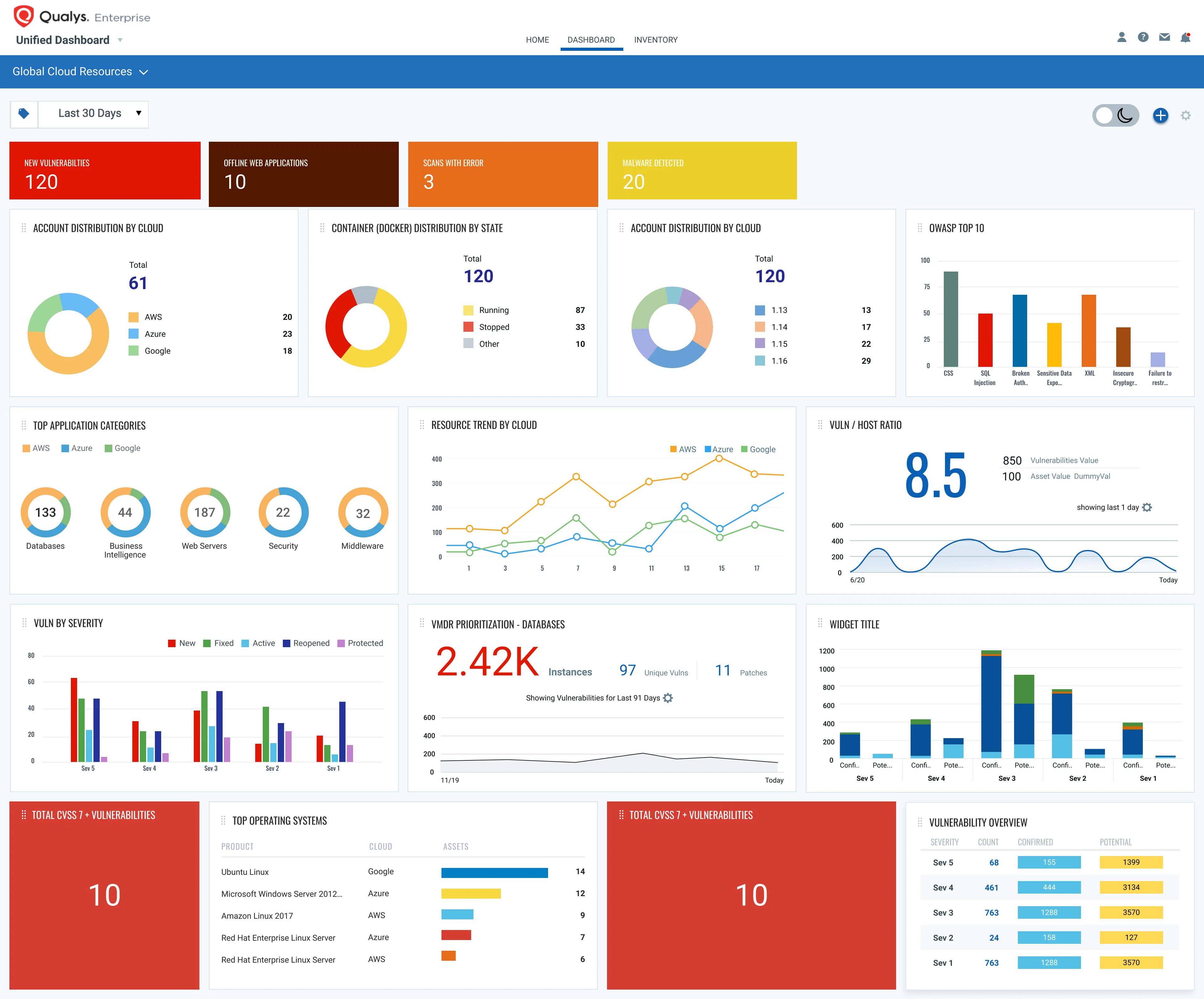
Qualys VMDR is mainly known to provide enterprise-grade solutions for comprehensive vulnerability management that cover both hybrid cloud and on-premises environments.
Their platform deploys risk-based prioritization that uses threat intelligence feeds to focus on vulnerabilities actively exploited, helping you allocate resources during SOC 2 preparation. Qualys also offers pre-built compliance reports that are specifically mapped to SOC 2 requirements, with detailed evidence for CC7.1’s trust criteria.
Pros
- Comprehensive coverage across on-premises, cloud, and virtual environments
- Risk-based prioritization focuses remediation on actively exploited vulnerabilities
- Automated patching that streamlines remediation with documented workflows
- Integrations with SIEM, ITSM, and security platforms
Limitations
- High cost at $199 per asset per year becomes expensive quickly
- Complex implementation requires significant setup and configuration
- Steep learning curve for users new to the platform
- Potential for false positives requires tuning and validation
- Limited third-party application patch management capabilities
Why We Chose Qualys VMDR?
Qualys VMDR’s automated patch deployment capability helps you streamline remediation efforts, which in turn supports an effective vulnerability management strategy for your SOC 2 auditors. Also, the platform can automatically deploy patches across your environment, alongside documenting when vulnerabilities were identified, assessed, and remediated. This automated workflow creates the audit trail that Type II assessments seek.
5. Tenable.io
G2 Rating: 4.5/5 (114 reviews)
Key Features:
- VA Capabilities: Cloud infrastructure, on-premises networks, web applications, containers, IoT devices
- SOC 2 Compliance: Compliance templates for SOC 2, PCI DSS, NIST, CIS; vulnerability reporting mapped to frameworks
- Scan type: Automated continuous vulnerability scanning with agent and agentless options
- Accuracy: Predictive prioritization reduces false-positive investigation time
- Continuous monitoring: Real-time asset discovery and continuous vulnerability assessment
- Integration capabilities: Cloud platforms, ticketing systems, SIEM tools, GRC platforms, development tools
- Reporting & evidence collection: Customizable compliance dashboards and detailed audit reports
- API access: Comprehensive API for automation and custom integrations
- Cost: Subscription-based pricing per asset; enterprise quotes required
- Best For: Organizations requiring comprehensive visibility across cloud-native and traditional infrastructure
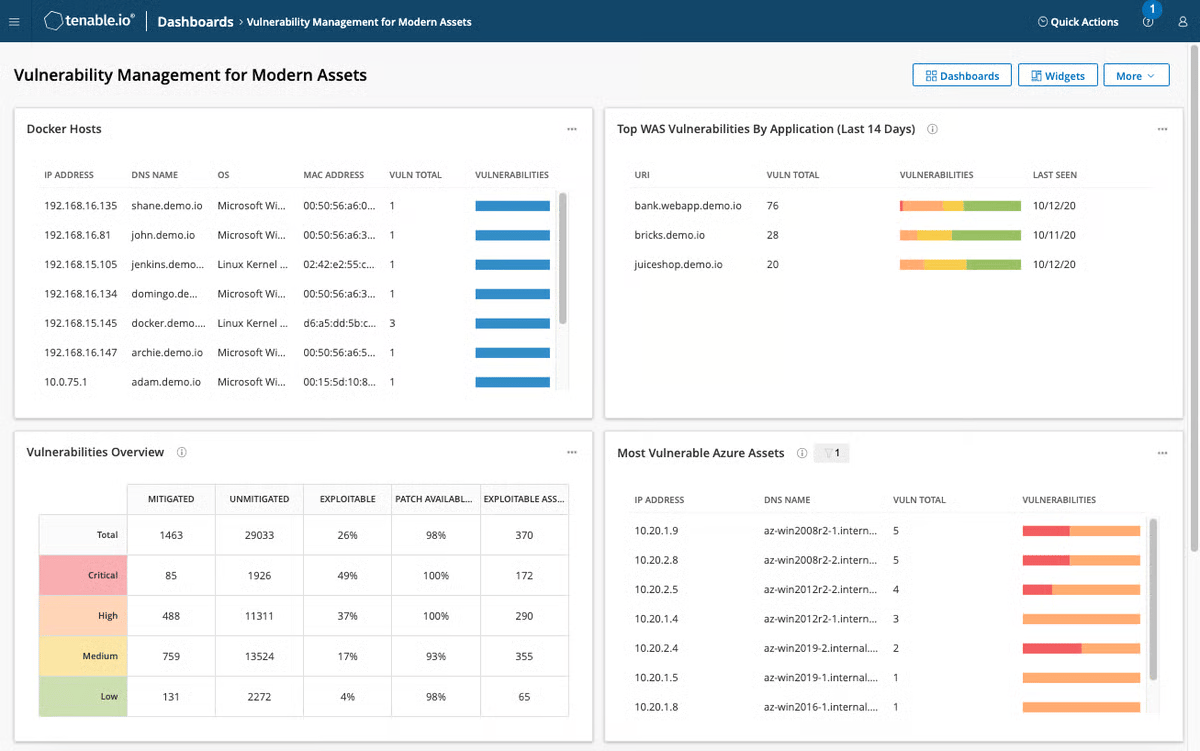
Tenable.io’s strength lies in the unified visibility it provides across diverse technology stacks—critical for modern SaaS companies that run microservice architectures across multiple cloud providers.
When it comes to SOC 2 compliance, it offers pre-built compliance templates that fulfil the trust criteria and predictive prioritization that uses machine learning to assess which vulnerabilities pose the greatest risk to your specific environment, helping you focus efforts into the most impactful areas, especially during SOC 2 preparation.
Pros
- Broad asset coverage across cloud, traditional, and container environments
- Predictive prioritization uses ML to assess real-world risk
- Flexible deployment with agent and agentless scanning options
- Strong cloud integration for AWS, Azure, and GCP
- Comprehensive API enables extensive automation
Limitations
- Enterprise pricing can be significant for smaller organizations
- Configuration complexity requires expertise to optimize
- Learning curve for advanced features and customization
- Report customization may require additional effort for SOC 2 specifics
Why We Chose Tenable.io
Tenable.io’s continuous asset discovery automatically identifies new infrastructure as it’s deployed, ensuring that vulnerability assessments cover your entire SOC 2 ecosystem. This automated discovery stands out specifically for cloud-native SaaS companies that undergo frequent infrastructure changes via CI/CD pipelines and auto-scaling.
Discover what full-stack visibility looks like with Astra Security: unified scanning across your apps, APIs, and cloud.
6. Rapid7 InsightVM (Nexpose)
G2 Rating: 4.4/5 (77 reviews)
Key Features:
- VA Capabilities: Network infrastructure, cloud environments, virtual machines, containers, web applications
- SOC 2 Compliance: Built-in compliance reporting for SOC 2, PCI DSS, HIPAA; risk scoring aligned with frameworks
- Scan type: Automated continuous vulnerability assessment with live monitoring
- Accuracy: Real-time risk scoring reduces false positive noise
- Continuous monitoring: Live vulnerability monitoring with instant alerts
- Integration capabilities: Cloud platforms, development tools, SIEM systems, ticketing platforms, orchestration tools
- Reporting & evidence collection: Detailed compliance reports with remediation tracking and evidence collection
- API access: Full REST API for automation and custom workflows
- Cost: Significantly lower per-asset costs than Qualys; subscription-based pricing
- Best For: Organizations seeking modern vulnerability management at a lower cost than legacy enterprise solutions
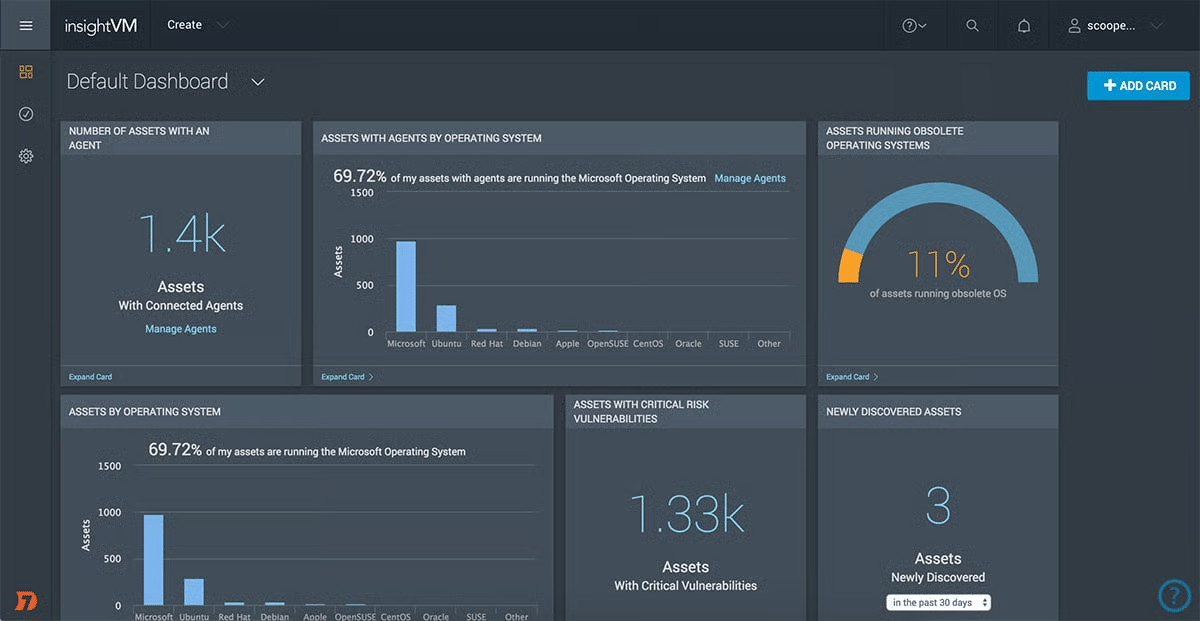
Rapid7 InsightVM’s value lies in delivering real-time risk scoring and remediation tracking attuned to cloud-first organizations.
Their platform’s modern architecture supports rapid integration with DevOps tools and cloud platforms, scoring them brownie points with SaaS companies that practice continuous deployment. Moreover, InsightVM can automatically trigger vulnerability scans when new code is deployed, ensuring that significant environment changes, as specified in CC7.1, trigger the required security assessments.
Pros
- Lower cost than Qualys with similar vulnerability management capabilities
- Real-time monitoring provides instant visibility without scan delays
- Strong DevOps integration supports CI/CD security testing
Limitations
- Less mature than established enterprise platforms
- Coverage gaps may exist for some specialized environments
- Reporting customization may require additional configuration
- Implementation support varies by subscription tier
Why We Chose Rapid7 InsightVM?
It provides enterprise-grade VM capabilities at a considerably lower cost than other solutions like Qualys. Moreover, its real-time monitoring and DevOps integrations increase its appeal to fast-moving SaaS companies seeking shift-left cybersecurity solutions.
7. Detectify
G2 Rating: 4.5/5 (51 reviews)
Key Features:
- VA Capabilities: Web applications, external attack surface, subdomain discovery, API endpoints
- SOC 2 Compliance: Compliance reporting for external security monitoring requirements
- Scan type: Automated continuous vulnerability assessment with live monitoring
- Accuracy: Automated external scanning leveraging crowdsourced vulnerability research
- Continuous monitoring: Ethical hacker-validated tests reduce false positives
- Integration capabilities: Slack, Jira, PagerDuty, webhooks for custom integrations
- Reporting & evidence collection: Executive summaries and detailed technical reports for audit evidence
- API access: API available for automation and integration
- Cost: Subscription-based pricing by domain/application
- Best For: Organizations focused on external attack surface monitoring and web application security
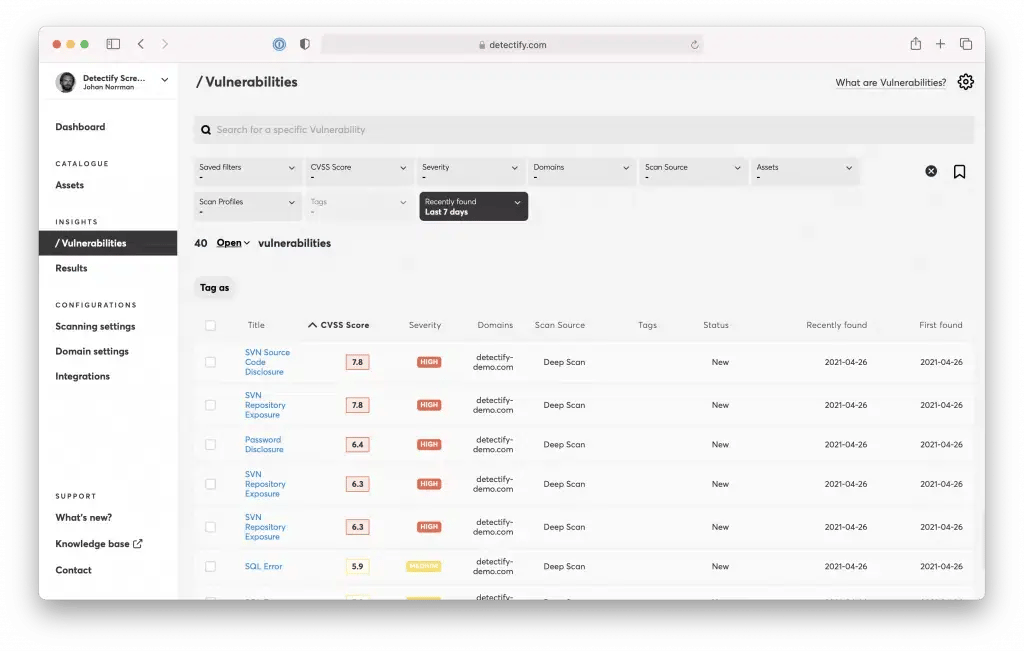
Detectify takes a unique approach to vulnerability assessment by leveraging crowdsourced security research from ethical hackers. Their platform continuously scans your attack surface: public-facing web applications, APIs, and subdomains, to identify vulnerabilities before attackers do. This external perspective validates your public-facing systems, which can prove quite helpful during your SOC 2 audits.
This model also means that their vulnerability checks are continually updated as security researchers discover new attack techniques, covering CC7.1’s “detect susceptibilities to newly-discovered vulnerabilities” requirement.
Pros
- Crowdsourced intelligence from ethical hackers keeps checks current
- External perspective validates public-facing security posture
- Daily automated scanning ensures continuous monitoring
- Strong web/API focus aligns with SaaS architectures
- Easy setup with minimal configuration required
Limitations
- External-only scanning doesn’t cover internal infrastructure
- Limited customization compared to enterprise platforms
- No agent-based scanning for internal network assessment
- Narrower scope than comprehensive vulnerability management platforms
Why We Chose Detectify
For SaaS companies, especially, their focus on web applications and APIs makes them strong contenders. Moreover, their platform’s capabilities for identifying configuration errors, authentication issues, and API vulnerabilities are critical when SOC 2 auditors assess your security controls.
Stay one step ahead of attackers. Monitor your public-facing assets 24/7 with Astra Security’s hybrid scanning engine.
8. Invicti
G2 Rating: 4.6/5 (61 reviews)
Key Features:
- VA Capabilities: Web applications, APIs (REST, SOAP, GraphQL, gRPC), containers, cloud-native microservices
- SOC 2 Compliance: Audit-ready reporting mapped to SOC 2, PCI DSS, and other standards; proof-based validation to minimize auditor queries
- Scan type: Automated Dynamic Application Security Testing (DAST) and industry-leading ASPM; supports CI/CD and SDLC integration
- Accuracy: Proof-Based Scanning™ validates findings with over 99.98% accuracy, drastically reducing false positives
- Continuous monitoring: Continuous scanning configured via CI/CD pipeline; dynamic application and API discovery
- Integration capabilities: Full SDLC support, integrates with Jira, GitHub, GitLab, Azure DevOps, Slack, and custom workflows
- Reporting & evidence collection: Automated risk scoring, remediation guidance with code-level details, compliance dashboards for SOC 2 audits
- API access: Full-featured API for extracting results, automating workflows, and integrating with external systems
- Cost: Tiered subscription; affordable for SMBs and scalable for enterprises
- Best For: Organizations needing comprehensive, developer-friendly DAST coverage with validated results for compliance
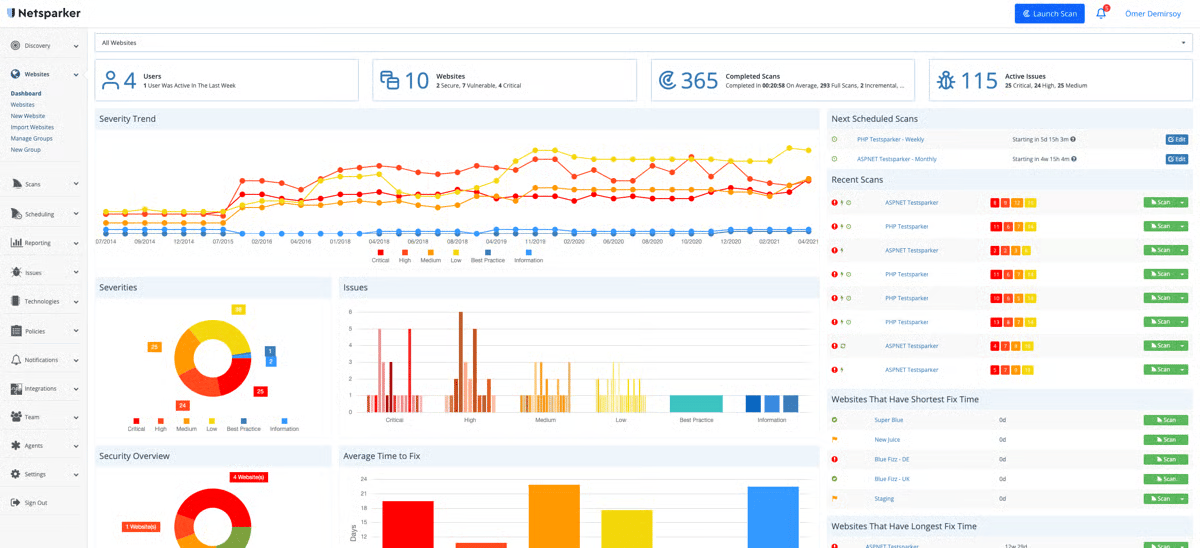
Invicti’s DAST-first vulnerability scanning, packaged as an Application Security Posture Management (ASPM) solution, provides a complete web application and API security package that supports automated discovery, deep integration into CI/CD pipelines, and proof-based validation with audit-level accuracy.
When it comes to SOC 2, Invicti offers audit-ready reports, risk scoring, and continuous compliance dashboards that map directly to CC4.1 and CC7.1 criteria. Moreover, its Proof-Based Scanning™ delivers exploit validation for each result via developer-centric workflows, all of which is complemented by AI-powered remediation recommendations that allow for swift bug fixing in live production environments.
Pros
- Proof-based validation erases time wasted on false positives
- Full API security (REST, SOAP, gRPC, GraphQL, etc.)
- Audit-ready, compliance-focused reports
- CI/CD-native; easy for modern SaaS engineering teams
- Developer integrations streamline remediation tracking and fixes
Limitations
- Automated only, no manual pentesting layer by default
- Subscription costs can increase for large-scale deployments and many apps
- Does not cover on-prem infrastructure and network scanning needs
Why We Chose Invicti?
Invicti is known for identifying even undocumented or shadow APIs, as well as pinpointing code. This comes in handy, especially in complex SaaS deployments that require frequent updates. Moreover, Invicti is scalable to both small teams and large enterprises and is well known for ease of use and actionable reporting.
9. Sprinto
G2 Rating: 4.8/5 (1454 reviews)
Key Features:
- VA Capabilities: SaaS platform security assessments, risk management, continuous controls monitoring
- SOC 2 Compliance: SOC 2 automation toolkit: mapping, evidence collection, workflow management, and auditor collaboration
- Scan type: Policy-driven automated monitoring and evidence gathering
- Accuracy: Optimized for compliance controls tracking; relies on integrations for technical false positive reduction
- Continuous monitoring: Automated, always-on controls tracking across cloud environments
- Integration capabilities: 100+ integrations with cloud/SaaS apps, HR, ticketing, SCM, and security tools
- Reporting & evidence collection: One-click auditor packages, customizable documentation for SOC 2, ISO, GDPR, PCI DSS
- API access: Rich RESTful API for connecting evidence sources and automating audit preparation
- Cost: Subscription-based, quote on request
- Best For: SaaS companies requiring out-of-the-box SOC 2 automation, especially for first-time audits or scaling compliance functions
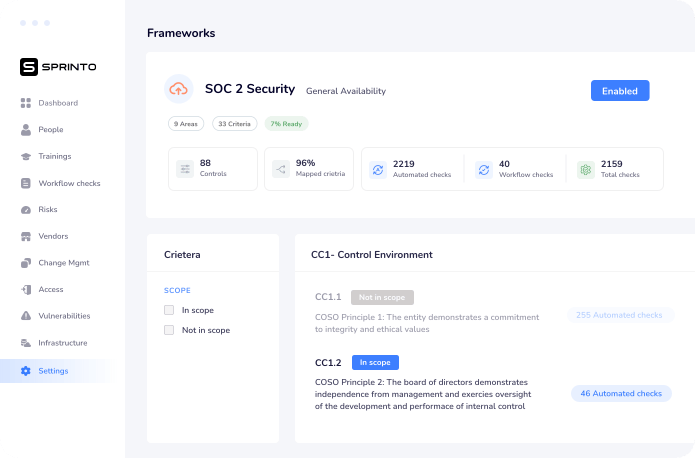
Sprinto is a compliance automation platform that aims to simplify the compliance journey of SaaS businesses (SOC 2, ISO 27001, GDPR, PCI DSS, etc.). While it is not a vulnerability scanner, it automates the management of SOC 2 controls via integration with existing technical tools (e.g., Astra, Qualys, CrowdStrike).
Sprinto’s strength lies in ensuring continuous surveillance of SOC 2 controls, automated evidence collection, and smooth collaboration with auditors.
Pros
- SOC 2 compliance automation reduces manual work
- An extensive integration suite covers most SaaS ecosystems
- Real-time controls monitoring supports Type II audits
- Fast time to value for non-technical compliance owners
- Consolidates audit-readiness across frameworks
Limitations
- Not a vulnerability scanner, relies on upstream tools for technical tests
- Requires correct configuration for effective evidence consolidation
- Higher cost versus DIY compliance tracking for tiny startups
Why We Chose Sprinto?
It renders audit failures due to missing evidence obsolete through its platform, which ensures regular vulnerability assessments and automatic documentation. Moreover, Sprinto handles checklists, reminders, and evidence requests and provides “one-click” audit packages, eliminating mundane manual work.
Unify your compliance automation. Let Astra Security handle SOC 2 scanning, evidence collection, and verification seamlessly.
10. Acunetix
G2 Rating: 4.1/5 (99 reviews)
Key Features:
- VA Capabilities: Deep web app, API, and container security; OWASP Top 10 and custom business logic flaws
- SOC 2 Compliance: Audit-mapped reporting, automation for Type II evidence, CIS benchmarks
- Scan type: Automated DAST/SAST/IAST, continuous or scheduled
- Accuracy: Heuristic + signature scans, validated AI-powered findings, low FP rate
- Continuous monitoring: Supports recurring, scheduled, or CI/CD-triggered scans
- Integration capabilities: CI/CD tools, Jira, Jenkins, GitHub, GitLab, ServiceNow
- Reporting & evidence collection: Prebuilt SOC 2 and ISO 27001 formats, customizable exports
- API access: Full REST and CLI access
- Cost: Tiered licenses; affordable for SMBs, scalable to enterprises
- Best For: AppSec teams wanting rapid web/API coverage and strong dev integration
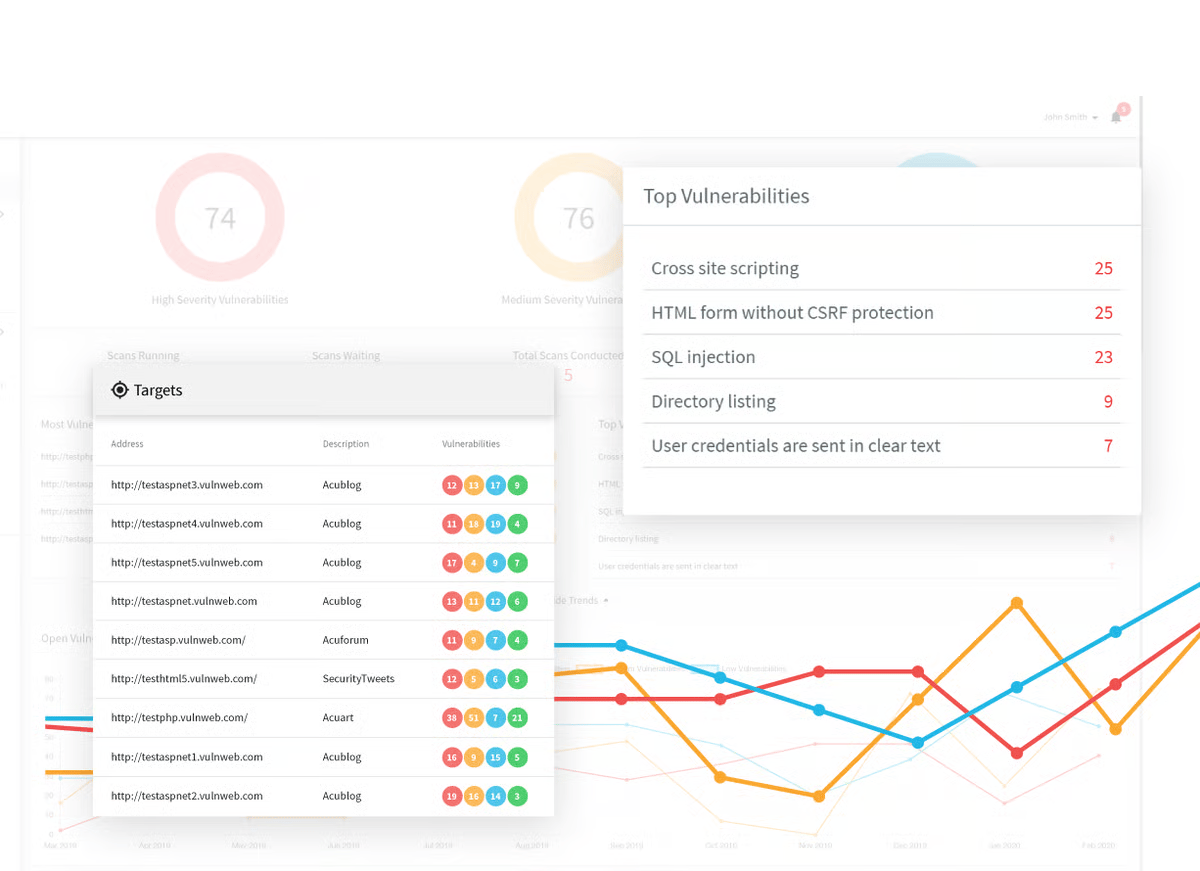
Acunetix excels at automated, in-depth scanning for modern web apps and APIs, including REST, SOAP, GraphQL, and container workloads. Not only does its platform cover OWASP Top 10, business logic, and zero-days, but its audit-ready reporting and detailed remediation evidence increase its affinity in the SOC 2 Type II space, with single-click exports, especially for auditors. Moreover, Acunetix integrates fully into your DevSecOps workflows, allowing for developer self-service, real-time alerts, and rapid fix verification.
Pros
- Best-in-class web DAST for AppSec use cases
- Fast SaaS deployment and CI/CD compatibility
- SOC 2-specific reporting formats
Limitations
- Lacks infrastructure/network coverage (web/API focus)
- Manual customization recommended for complex test cases
Why We Chose Acunetix?
Acunetix is a market leader for fast-moving dev teams needing web and API SOC 2 compliance, especially when combined with other infra/network scanning tools.
11. OpenVAS
G2 Rating: 4.4/5 (32 reviews)
Key Features:
- VA Capabilities: Hosts, network devices, web servers, databases, and cloud environments
- SOC 2 Compliance: Comprehensive vulnerability database, audit-friendly reports, open core for customization
- Scan type: Automated, scheduled, and on-demand network scanning
- Accuracy: Signature and heuristic, community validated, requires tuning for FP minimization
- Continuous monitoring: Automated periodic scans, network-wide asset discovery
- Integration capabilities: Extensible via plugins, API, and SIEM/SOAR compatible
- Reporting & evidence collection: Detailed CSV/PDF, mapped to NIST, CIS, SOC 2 controls (requires config)
- API access: RESTful and CLI endpoints available
- Cost: Free and open source
- Best For: Security teams seeking flexible, no-cost scanning with deep customization
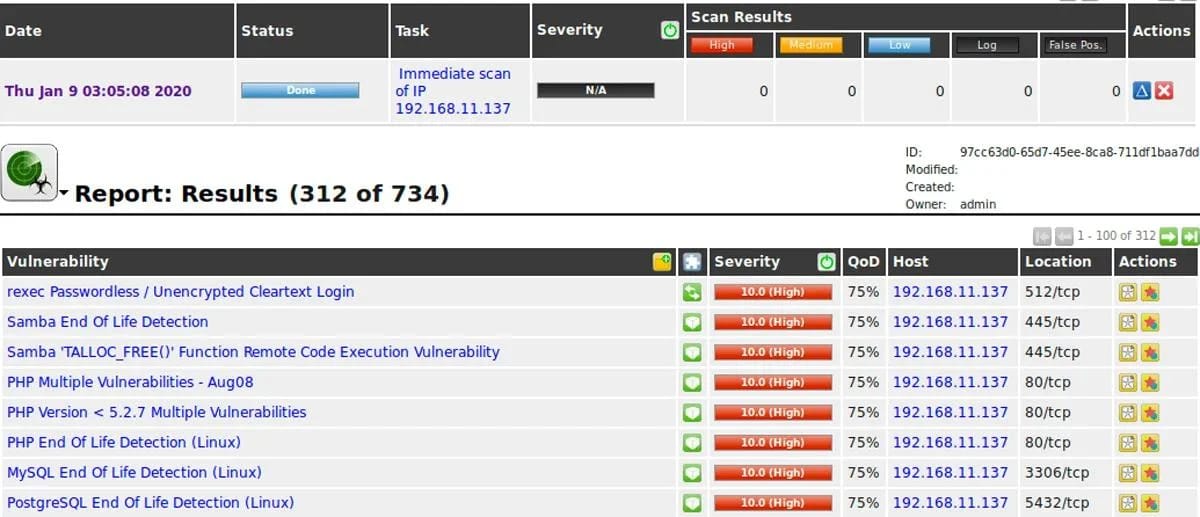
OpenVAS, an open-source descendant of Nessus, is a crowd favorite for robust vulnerability scanning. It can assess a wide array of environments: on-prem, cloud, IoT, and more, and is particularly known for its plugin-rich, customizable approach. When it comes to SOC-2 mapping, manual configuration is required, but it’s an excellent option for SaaS firms that need strong internal security expertise to support automated evidence generation for Type II audits at zero licensing cost.
Pros
- Free, open, and actively maintained
- Broad vulnerability family coverage
- API/plugin extensibility
Limitations
- Requires more tuning than commercial tools
- UI and reporting may be less user-friendly for auditors
Why We Chose OpenVAS?
OpenVAS democratizes vulnerability scanning, enabling SaaS companies to build robust SOC-2 defenses, even on a tight budget.
Automate your first SOC 2 vulnerability scan with Astra Security and get instant, validated results that auditors trust
What to Look for in a SOC 2 Vulnerability Assessment Tool for SaaS?
1. SOC 2 Trust Service Criteria Alignment
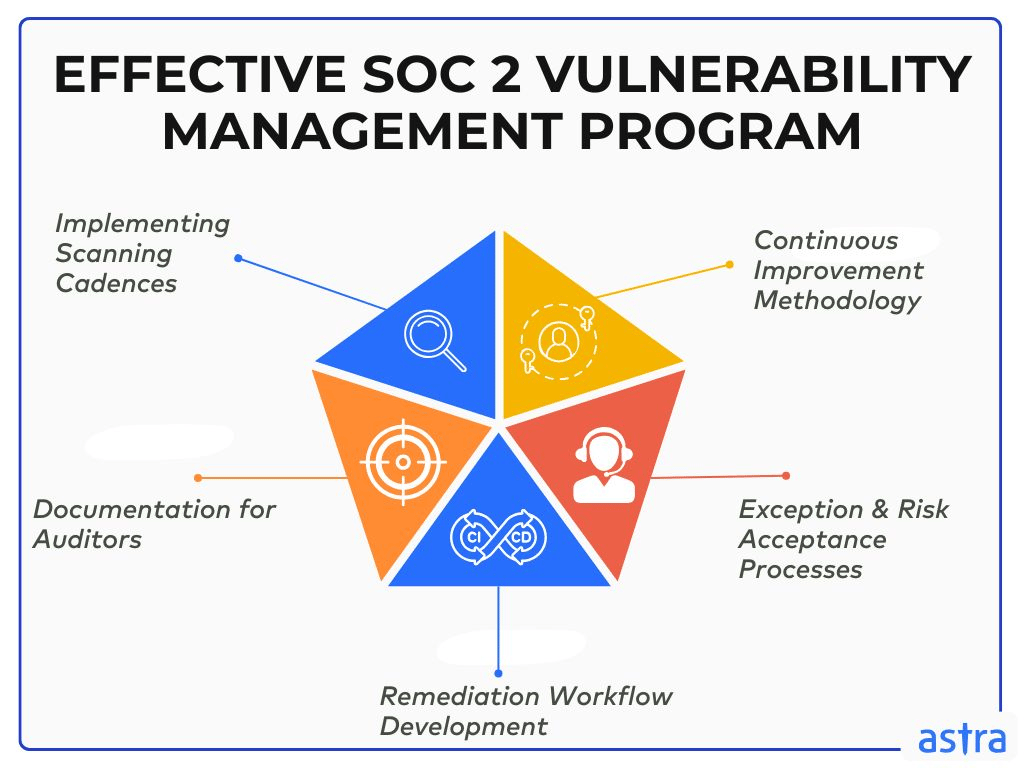
Besides providing reports that directly map vulnerabilities to the trust criteria and provide auditor-proof evidence, your SOC 2 VA tool should document not just what, when, why, and how of the discovered vulnerabilities, but also the remediation timeline.
Moreover, how well a tool aligns your security posture with the SOC 2’s VA-related trust criteria depends heavily on its experience. An experienced, well-certified team would cater to the tiniest of your requirements, quickly grasp your nuances, and offer better remediation and audit support.
Pro Tip: Request sample audit reports during vendor evaluation. Make sure it is customizable since different audit firms have varying preferences for evidence format and detail level.
2. Asset Coverage & Scan Depth
Your SOC 2 VA tool needs to provide comprehensive coverage of your entire technology stack: web apps, APIs, cloud infrastructure, databases, and any other 3rd party vendors that could impact your customer data security.
Even there, checking only for known CVEs isn’t sufficient; your checks ought to cover configuration errors, business logic flaws, and authentication vulnerabilities.
Pro Tip: Map your SOC 2 system boundary before selecting tools. Create an inventory of all assets that handle customer data, then evaluate whether each vendor can comprehensively scan your specific technology stack. Don’t just assume that a “web application scanner” would test your GraphQL API or serverless functions; verify explicitly.
3. Automated Evidence Collection
To avoid wasting time and human capital on manual evidence collection, choose tools that integrate directly with your GRC platform and automatically generate scanned results, vulnerability reports, and remediation evidence. Also, make sure your platform provides a timestamp for all scans, document configuration changes, and maintains historical data that displays your vulnerability trends over time.
Pro Tip: Automated evidence collection, though almost necessary, comes at a considerable cost premium. So, do perform a cost-benefit analysis of the hourly cost of your team manually gathering, formatting, and uploading evidence during audits vs automated evidence collection and presentation. Most organizations find that automation pays for itself before the end of the first audit cycle, with massive time savings in subsequent years.
3. Integration with Compliance Platforms
Seamless integration with compliance automation platforms helps reduce and potentially remove duplicate work. The best SOC 2 vulnerability assessment tools push evidence directly to Vanta, Drata, or your chosen GRC platform, which means that when you complete a vulnerability scan, the evidence immediately appears in your compliance dashboard, no manual data entry, no upload delays, no formatting inconsistencies.
Pro Tip: If you’re already using Vanta or Drata, look for VA tools with native integrations with these platforms. This bidirectional sync, where your GRC platform can also trigger scans and track remediation, creates a unified compliance workflow that curbs your admin burden.
4. Continuous vs. Point-in-Time Scanning
The tools in this guide all support automated recurring scans, but it’s imperative to evaluate how they handle “significant changes”, i.e., whether they can automatically trigger scans when new code is deployed. Do they detect new assets as they’re provisioned?
Pro Tip: Configure your tool to automatically scan new deployments via CI/CD integration, document your scanning frequency in your vulnerability management policy, and ensure your actual practice aligns with the policy. Auditors will verify this alignment.
5. Reporting for Auditors
Ensure that your VA reports clearly specify what was scanned and when, including the vulnerabilities found, their severity ratings, remediation status, timelines, and mapping to CC4.1 and CC7.1.
Pro Tip: Generate and review sample audit reports before your audit begins. If you find it challenging to extract insights and understanding from it, your auditor will struggle too.
Final Thoughts
Selecting the right SOC 2 vulnerability assessment tool is about curating your own package of technical capabilities, audit requirements, and operational nitty-gritties. The tools we’ve covered are some of the strongest options for SaaS companies in 2026, each with its own USPs and constraints.
But these tools are only as effective as the processes they work under, so make sure you have a well-defined vulnerability management policy and clear remediation SLAs. Besides, the key lies in integrating scanning into your development workflows rather than treating it as a separate step.
The goal is to shape an agile security posture, and we hope this endeavour has helped you on your journey towards it.
FAQs
1. Which tool is commonly used for vulnerability assessments?
While multiple tools cover different aspects of vulnerability assessments, you need to carefully evaluate each tool to determine which best fits your firm’s requirements. A comprehensive vulnerability assessment tool is the DAST scanner from Astra Security, which performs over 10,000 tests and provides automated scanning with CXO-friendly, compliance-ready reports.
2. What is SOC 2 compliance for SaaS?
SOC 2 compliance for SaaS primarily ensures that cloud-based companies securely manage customer data. This is done via their five Trust Services Criteria: Security, Availability, Processing Integrity, Confidentiality, and Privacy.
3. What is SOC 2 compliance for SaaS?
SOC 2 compliance ensures SaaS companies securely manage customer data across five trust criteria: Security, Availability, Processing Integrity, Confidentiality, and Privacy. Continuous oversight and vulnerability assessments are mandatory.