
Key Takeaways:
- CERT-In SBOM Guidelines 2025 have made SBOMs mandatory. You are now responsible for your entire supply chain, not just your code.
- You need a complete, machine-readable inventory of every component, preferably in SPDX/CycloneDX format, updated with each release/component data change.
- A key goal is VEX integration, which tells you which vulnerabilities in your stack are actually exploitable, allowing your team to focus on what matters.
- Start by mapping critical payment and customer-facing apps first, then enforce SBOM requirements in all new vendor contracts.
- Accurate SBOM combined with expert pentesting is what proves compliance and builds trust with enterprise partners and auditors.
UPI fraud spiked 85% in FY 2024, reaching ₹1,087 crore. Most of it traced back to vulnerabilities in third-party APIs and unpatched components that fintechs didn’t know they were running. As such, in July 2025, CERT-In released SBOM Guidelines 2.0, making Software Bills of Materials mandatory for all government, public, and essential services orgs, while encouraging others to adopt it as best practice.
For CTOs and CISOs, the message is direct. You are now responsible for the security of your entire software supply chain, not just the code your team writes. Every vendor library, every API integration, every AI model, and cryptographic dependency must be inventoried, tracked, and mapped to vulnerability feeds.
This article walks through what CERT-In SBOM guidelines 2025 actually require, how to implement it across your fintech stack, and why the companies that build SBOM discipline now will handle audits faster and close enterprise deals cleaner than those playing catch-up later.
What is an SBOM (and Why Does it Matter)?
A Software Bill of Materials is a detailed, machine-readable inventory of all components in a software application. It lists every library, module, and dependency, along with metadata like version numbers, suppliers, licenses, and known vulnerabilities.
It maps component relationships, tracks cryptographic hashes for integrity verification, and documents encryption methods used.
But here’s why it matters:
- Enables rapid identification and remediation of vulnerabilities: When a new CVE is detected, a complete SBOM tells you instantly whether you are affected or not. No guessing, no manual code reviews, or waiting for vendor confirmation.
- Strengthens supply chain risk management and vendor accountability: You are not just trusting vendor certifications anymore. You are verifying what’s actually inside the software they deliver, including their dependencies and transitive libraries.
- Provides transparency that supports compliance and builds customer trust: For regulated entities, SBOMs are becoming standard audit artifacts. They prove you know what you are running and that you are managing it actively.
Expert Tip: Apply RBAC, separate public and private SBOMs, and restrict vulnerability details to authorized parties. Do not expose sensitive exploitability data publicly and limit access to operational teams.
For Indian fintechs, this framework aligns directly with the RBI’s expectations around continuous vulnerability monitoring and third-party risk management. CERT-In’s guidelines make SBOMs the primary documentary evidence for proving diligence in software supply chain security.
What Do the New CERT-In SBOM Guidelines 2025 Require?
CERT-In SBOM guidelines 2025 establish clear, mandatory requirements for how SBOMs must be structured, delivered, and maintained across essential services organizations, including all BFSI and fintech sectors.
In the section ‘Necessity and Utilization’ (2.1): “Departments and organizations are encouraged to make the creation and provision of Software Bill of Materials (SBOM) a mandatory standard practice as part of software procurement and software development.”
What this means: Firstly, every vendor must supply a complete SBOM. Procurement contracts must now define the required data elements, delivery timeframe, and delivery method. The accountability shifts to the supplier organization from day one.
In the section ‘Recommendations and Best Practices’ (7.1.11): “Security teams of user organizations should include SBOM inventory in the workflow of vulnerability management.”
What this means: SBOM is now your foundational asset register for security. It must integrate with existing VAPT and DAST tools to validate component presence and inform remediation strategies. It’s a live operational feed, not a static document.
Expert Tip: Use HTTPS, digital signatures, encryption, and ensure secure storage of SBOMs and advisories. Protect SBOM integrity and ensure only authorized systems can consume them.
In the section ‘Recommendations and Best Practices’ (7.1.2): “All software supplied to the government, public sector & essential services organizations must be accompanied by a complete SBOM.”
What this means: As a regulated essential service, fintech must assume this is mandatory, backed by RBI’s existing push for supply chain transparency. CERT-In also mandates a “Complete SBOM” with exhaustive component tracking. Here’s a complete list of 21+ data fields that must be documented for every single component:
| Component Data Field | Description & Fintech Relevance |
|---|---|
| Component Name | The recognized name of the software component |
| Component Version | The specific version number or identifier |
| Component Description | A brief summary of functionality and purpose |
| Component Supplier | The entity (vendor, open-source project) that supplied the component |
| Component License | The license governing distribution (critical for legal compliance) |
| Component Origin | Whether proprietary, open-source, or obtained from a third-party vendor |
| Component Dependencies | All components that the current one relies upon (multi-tier visibility) |
| Known Vulnerabilities | Information on known security weaknesses (severity, CVE references) |
| Patch Status | Whether patches are available to address known issues |
| Release Date | Date the component was made available |
| End-of-Life (EOL) Date | Date when support or maintenance is scheduled to end (critical for obsolescence planning) |
| Criticality | Importance of the component (Critical, High, Medium, Low) for functionality/security |
| Usage Restrictions | Limitations, such as export control restrictions or IP rights |
| Checksums or Hashes | Cryptographic hashes (e.g., SHA-256) for integrity and authenticity verification |
| Comments or Notes | Additional relevant annotations |
| Author of SBOM Data | The entity or person creating the SBOM data |
| Timestamp | Date and time of SBOM data assembly |
| Executable Property | Attributes indicating whether the component can be executed |
| Archive Property | Characteristics denoting if the component is stored as an archive/compressed file |
| Structured Property | Descriptors defining the organized data format within the component |
| Unique Identifier | Distinct code for tracking ownership and version changes (e.g., PURL format) |
Expert Tip: Track all licenses via SPDX to avoid legal and reputational risks. Make license checks part of the build and procurement restrictions.
The inclusion of EOL dates, criticality ratings, and cryptographic hashes signals increased regulatory scrutiny. Auditors will use SBOMs not just to check for vulnerabilities but to look at operational resilience and lifecycle management.
The CERT-In guidelines have also made machine-readable formats like CycloneDX and SPDX a must to ensure easier data exchange and automation. PDFs are not sufficient for automation, though they can still be used for manual review or reporting.
In the section ‘Vulnerability Tracking and Analysis’: “The supplier should provide a Vulnerability Exploitability eXchange (VEX) document… informing customers about the exploitability status.”
What this means: Suppliers must now provide a Vulnerability Exploitability eXchange (VEX) document promptly upon discovering a vulnerability. The VEX specifies the status using four categories:
- Not Affected: No remediation required (eliminates false positives)
- Affected: Actions recommended to remediate
- Fixed: Product versions contain a patch
- Under Investigation: Impact unknown, update coming
Following the VEX, suppliers must provide a Common Security Advisory Framework (CSAF) advisory with technical details that include vulnerability description, affected versions, CVSS score, and mitigation steps.
This moves security teams beyond raw vulnerability counts to an intelligent, prioritized list of confirmed, exploitable risks.
In the section ‘Classification of SBOM’ (3.3.2): “A unique identifier is a distinct code assigned to each software component, structured as ‘pkg:supplier/OrganizationName/ComponentName@Version?qualifiers&subpath,’ aiding in tracking ownership changes and version updates.”
What this means: Standardized unique identifiers force you to map and track complex histories. This includes vendor rebranding, open-source forks, and version ambiguity. This ensures security advisories for older, critical components standard in legacy banking systems aren’t missed.
Expert Tip: Integrate SBOMs into your vulnerability workflows and use VEX and CSAF for accurate status updates. This reduces noise and focuses engineering on confirmed exploitable issues.
CERT-In SBOM Guidelines 2.0 Implementation Roadmap for Fintech
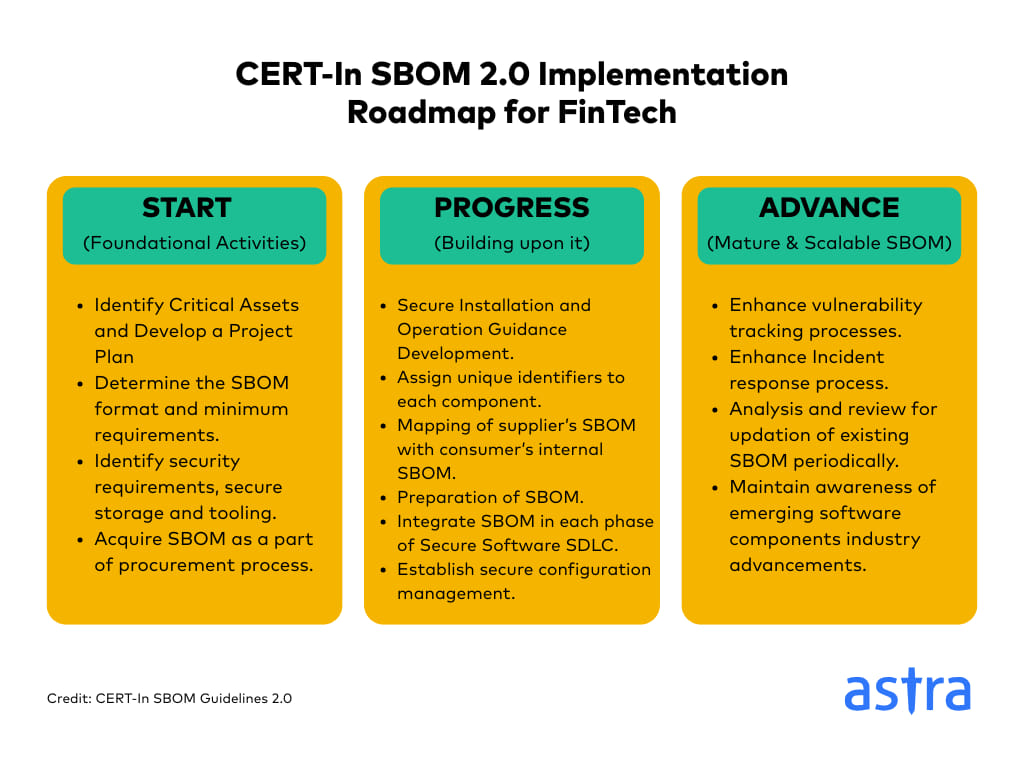
Phase 1: Start (Immediate – 3 months)
- Map critical assets by business priority. List payment gateways, UPI integrations, core banking, vaults, and high-transaction APIs so efforts focus where impact is highest.
- Update procurement contracts. Require vendor SBOMs (SPDX/CycloneDX), VEX docs, and timely updates as contract non-negotiables.
- Choose SBOM management tools. Pick SCA/SBOM platforms that normalize vendor SBOMs, integrate with CI/CD, and feed vulnerability platforms.
- Form governance. Create a cross-functional team (Security, Legal, Procurement, Engineering) to set SLAs, handling rules, and audit owners.
Expert Tip: Start with customer-facing apps and payment systems. Prioritize assets that directly affect money movement and customer trust.
Phase 2: Progress (3–12 months)
- Create internal SBOMs from vendor data. Enhance supplier SBOMs with config, deployment context, and criticality tags so you control the truth.
- Integrate with vulnerability management. Map SBOM components to NVD/CERT-In feeds, feed VEX/CSAF into ticketing, and assign owners for remediation.
- Automate SBOM generation and signing. Generate SBOMs on every CI/CD build, sign artifacts, and store fixed versions for traceability.
- Implement unique identifiers. Use PURL/UUIDs and canonical naming to resolve version ambiguity and maintain lineage across releases.
Expert Tip: Build internal SBOMs from vendors and add audit trails for traceability. Do not treat supplier SBOMs as the final truth and log every remediation step.
Phase 3: Advance (12+ months)
- Enable real-time monitoring. Deploy runtime SBOM tools to detect drift, dynamically loaded libs, and shadow components not present at build-time.
- Integrate SBOM into incident response. Make SBOM the first reference in IR playbooks. Pre-mapped impact lists and targeted remediation steps speed response.
- Automate advisory ingestion. Connect CERT-In, NVD, and vendor CSAF feeds to trigger prioritized alerts and VEX-driven workflows.
- Quarterly audits & validation. Run scheduled internal checks and third-party reviews to verify completeness, access controls, and post-remediation evidence.
Expert Tip: Schedule regular internal and third-party audits to maintain SBOM accuracy and regulatory trust. Treat audits as evidence, not just checkbox exercises.
What Specialized BOMs Do Fintechs Need to Care About?
CERT-In 2.0 broadens supply chain visibility beyond software, mandating SBOMs that address critical, emerging risks for payments, AI governance, and infra.
Cryptographic BOM (CBOM)
A CBOM is an inventory of all cryptographic assets, i.e, algorithms, keys, protocols, certificates, and dependencies, documenting usage patterns and expiration dates.
Fintech Relevance: CBOM is important for securing high-value transactions like UPI, card networks, and internal data vaults. It tracks algorithm strength, TLS configs, key lifecycle management in Hardware Security Modules, and ensures adherence to secure protocols across API gateways.
AI BOM (AIBOM)
An AIBOM is a comprehensive inventory of all elements used in building, training, and deploying AI models, spanning hardware, software frameworks, and data sources.
Fintech Relevance: Critical for fraud detection, credit underwriting, and risk forecasting systems. AIBOM documents the dataset origin and versioning to address bias and privacy concerns. Defines intended usage to prevent misuse and helps identify vulnerabilities in ML frameworks targeted by model poisoning attacks.
Hardware BOM (HBOM)
An HBOM is a structured inventory of all physical components, sub-components, integrated devices, and associated materials, i.e, servers, networking equipment, storage devices, or ATM terminals.
Fintech Relevance: Tracks firmware versions in servers, network gear, and ATMs for prompt patching. Documents manufacturer details to mitigate counterfeit parts or hardware implant risks. Combined with SBOM, provides full-stack visibility for end-to-end vulnerability management.
Compliance & Risk Management Impact of CERT-In SBOM Guidelines 2025
| Area | What Changes/Impact |
|---|---|
| Regulatory Compliance | SBOMs become auditable regulatory artifacts aligned with RBI expectations. Procurement must demand complete SBOMs in SPDX/CycloneDX and accompanying VEX/CSAF. Auditors will verify checksums, EOL, provenance, and traceability as standard evidence. Boards must receive software supply-chain risk reports with executive sign-off on remediation. Non-compliance can block procurement and increase insurance/contractual liability. |
| Risk Assessment Changes | Risk scoring moves from CVSS-only to SBOM-driven, exploitability-focused triage using VEX/CSAF. Vendor risk is judged by SBOM completeness, update cadence, and transitive exposure. Components are assessed for criticality, EOL, and cryptographic vulnerability. Multi-tier dependency mapping is now required to detect hidden compromise paths and quantify supply-chain financial exposure, including planning for post-quantum migration where CBOM gaps appear. |
| Operational Impact on Fintech | Dev teams must generate signed SBOMs in CI/CD and shift-left component visibility. Procurement enforces SBOM clauses and scores vendors on SBOM accuracy. Security owns the SBOM inventory, ties it to VAPT/DAST results, and prioritizes fixes via VEX-driven workflows. IT Ops manages secure SBOM storage, EOL-based patch scheduling, and runtime drift detection. Together, these changes shorten detection time and produce audit-grade evidence. |
How Should Fintechs Detect and Maintain SBOM Accuracy?
For an SBOM to be useful, it must be accurate, timely, and verifiable. Treat it as a living artifact, generated in the pipeline, which can be patched up at runtime, and audited regularly.
Levels of SBOM Granularity:
Organizations must select the appropriate level based on context and risk exposure:
- Top-level: High-level inventory for executives and procurement.
- Transitive: Includes direct + indirect dependencies. Required for meaningful supply-chain visibility.
- Complete: Exhaustive list with hashes, licenses, timestamps, and EOL, audit-grade for regulators.
SDLC alignment:
SBOM generation must align with SDLC stages to capture evolving component states:
- Design SBOM: Captures planned components and risk flags early in the cycle (component selection).
- Build SBOM: Machine-readable SPDX/CycloneDX produced and signed on every CI/CD build for automated accuracy.
- Runtime SBOM: Live inventory from runtime monitoring to catch post-deployment risks like config drift or malicious external API dependencies.
Detection & maintenance methods:
- Automate SBOM generation and signing in CI/CD on every release.
- Integrate feeds (CERT-In, NVD) and VEX/CSAF to convert CVEs into actionable status.
- Run DAST or runtime monitoring to detect drift and shadow components.
- Patch vendor SBOMs vs internal SBOMs regularly, use PURL/UUIDs and checksum validation, and schedule periodic audits.
Detect runtime gaps and verify SBOM accuracy with continuous VAPT aligned to CERT-In guidelines.

How Can Astra Security Help with CERT-In SBOM Guidelines 2025?
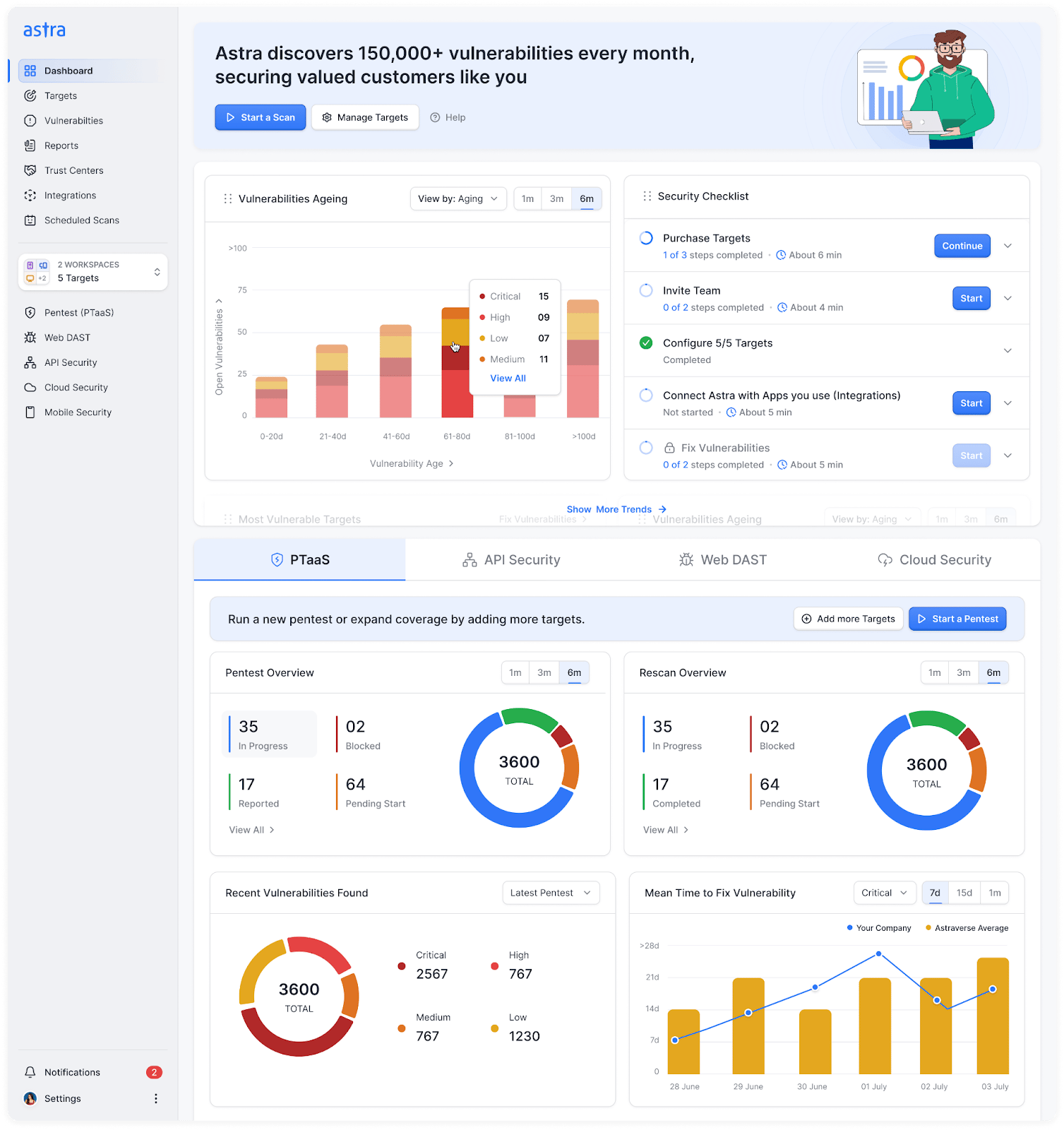
Astra Security’s PTaaS for Fintech connects declared SBOMs to real-world assurance by testing what papers alone cannot tell. However, pentesting is a supporting mechanism, not the sole proof of SBOM compliance. We emulate attacker behavior using a blended manual + automated approach across 15,000+ test cases via hacker-style pentests to surface logic flaws, payment bypasses, and runtime gaps that SBOMs can miss.
Every finding is human-verified by certified experts, and AI-assisted threat modeling increases depth and reduces oversight, so VEX/CSAF statuses reflect reality, not just hope. As a CERT-In enlisted member, we also run scheduled pentests aligned to your release frequency and map results to CERT-In compliance requirements.
Outcomes include risk-based scoring, exportable audit-ready PDFs, and a publicly verifiable certificate post-remediation. Our advanced resolution center lets you assign, track, and fix issues via Slack/Jira and CI/CD integrations, with automated and manual rescans to prove fixes.
Final Thoughts
CERT-In SBOM Guidelines 2.0 changes accountability. You must prove what’s inside your software, not just claim it. Build that proof by combining accurate, machine-readable SBOMs with continuous VAPT or DAST, VEX/CSAF-driven remediation, and runtime validation.
Prioritize high-risk payment systems, enforce vendor SBOM contracts, and automate generation and monitoring. Do this consistently, and SBOMs become more than compliance artifacts. They become the backbone of supply chain security, reducing vendor blind spots, shortening MTTR, and earning the regulatory and customer trust your fintech needs.
FAQs
How does CERT-In SBOM compliance impact BFSI and digital payment providers?
SBOMs are now auditable artifacts that align with RBI’s expectations for third-party risk management . For payment providers, this means you must know and prove the security of every component in your transaction stack. Compliance shifts vendor security from a model of ‘trust’ to one of ‘verify and enforce’.
Do fintech vendors need to provide SBOMs for third-party APIs under CERT-In 2025 rules?
Yes, the guidelines make SBOMs essential for all software procurement, which includes the third-party APIs integrated into your platform. You are expected to enforce SBOM generation and retention from your vendors as part of your risk management.
How does CERT-In SBOM help in managing vulnerabilities in fintech supply chains?
An SBOM acts as your foundational asset register for security . When a new vulnerability is detected, it lets you instantly identify all affected systems instead of conducting manual code reviews . This sharpens your vulnerability management and drastically shortens incident response times.
What role do SBOM audits play in BFSI compliance and governance?
SBOM audits provide traceability, checksum verification, and proof of lifecycle management. Regulators and auditors use them as standard artifacts for vendor risk assessments, board-level reporting, and third-party validation.