Key Takeaways
- Define what your trust center must include by mapping buyer needs and security requirements.
- Clarify why you’re building it by aligning goals to sales velocity, transparency, and compliance efficiency.
- Establish how it will work through content architecture, access controls, and real-time integrations.
- Ensure long-term impact by designing scalable workflows that keep evidence fresh and verifiable.
In a world where 86% of enterprise buyers bail if they can’t verify security early, the demand for transparency has reached a critical point. Every vendor claims to have security certifications, compliance badges, and rock-solid infrastructure, but how can buyers verify these claims when they’re hidden behind emails or buried in 400-page PDFs?
This verification challenge has only intensified with the rise of fake news and deepfakes, where anyone can create convincing-looking badges and certificates; buyers need verifiable proof. The same skepticism that makes people fact-check news articles now applies to security claims. A badge on your website means nothing if it can’t be verified instantly.
This is why trust centers have become essential. They provide real-time, verifiable proof of your security posture, rather than static documents that become outdated the moment they’re created.
Understanding a Trust Center
Trust Center is a technical hub that automates security documents and compliance verification. Where security portals have been known to gather dust with stale PDFs, modern trust centers have become a source of live, real-time proof of your security posture.
How to Build Your Trust Center Strategy
A step-by-step approach to building a trust center that delivers the right security information at the right time, helping buyers move confidently through their evaluation process.
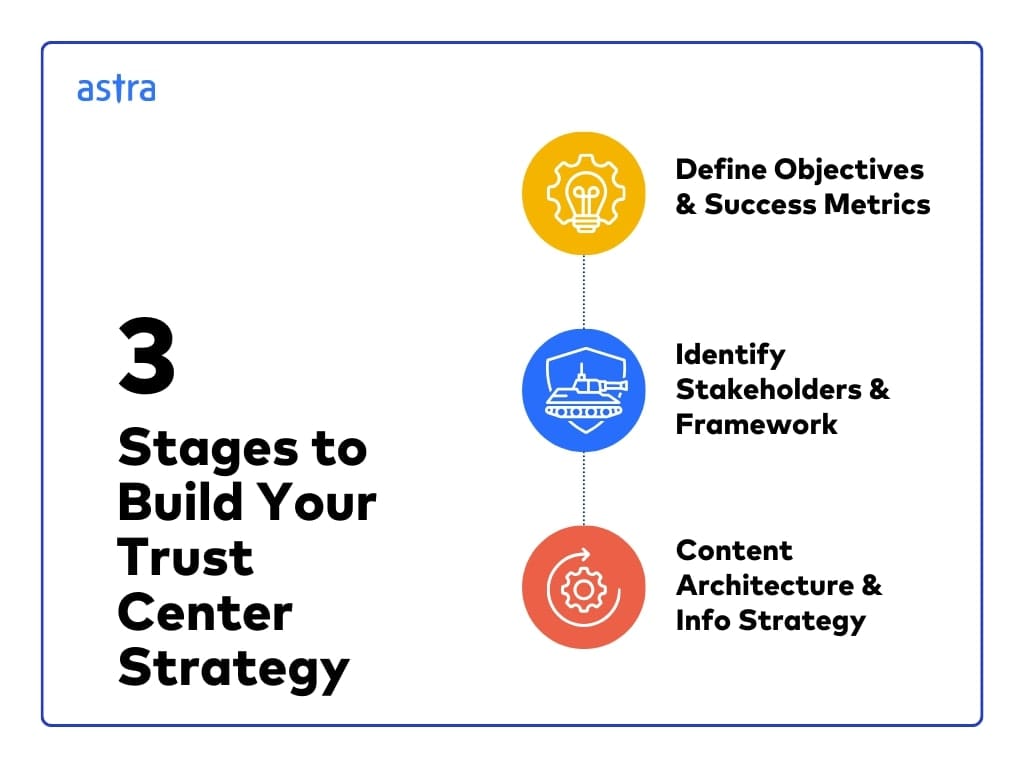
Step 1: Define Objectives and Success Metrics
In addition to operational efficiency, it needs to be aligned with business outcomes and part of your trust center strategy. Begin with a thorough baseline assessment in three key areas: sales speed, operational overhead, and competitive position.
Sales Impact Metrics
Identify where friction is happening within current deals by tracking metrics such as
- How long do security reviews take
- Conversion rates of deal stages after security reviews
- How long enterprise deals take to close (time-to-close)
Establish targets like reducing security questionnaire response time from 2-3 weeks to 24-48 hours, or increasing enterprise deal velocity by 35%.
Operational Efficiency Targets
To measure current resource outlay, assess the time spent on redundant security documentation requests, the number of ad hoc compliance document preparations, and the cross-team coordination overhead.
A more concrete approach is to set measurable goals, such as reducing full security engagement in sales processes by 70% or automating 80% of manual questionnaire responses.
Competitive Differentiation Objectives
Assess how security transparency can become a competitive advantage. Track metrics like win rate against competitors without cloud trust centers, buyer engagement with security documentation, and time-to-trust establishment with prospects.
Many organizations discover that superior security transparency increases win rates by 15-25% in competitive deals.
Step 2: Identify Stakeholders and Decision Framework
Building an effective trust center requires orchestrating diverse stakeholders with often competing priorities. Create a stakeholder matrix that maps influence, interest, and decision-making authority across all affected parties.
Executive Leadership
CEOs and CFOs care about revenue impact, competitive positioning, and operational efficiency. Present the auto trust center ROI in terms of deal acceleration, cost reduction, and market differentiation. CTOs focus on technical implementation complexity, integration requirements, and ongoing maintenance overhead.
Revenue Teams
Sales representatives need instant access to credible security proof without depending on technical teams. Sales engineers require detailed technical documentation for complex enterprise deals. Marketing teams need security positioning that differentiates without creating compliance risks.
Security and Compliance Organizations
CISOs need to balance transparency versus information security, keeping sensitive information safe while providing enough peace of mind to the buyers. Auditors should have frameworks to remain compliant (be audit-ready) and adhere to regulations; compliance teams should have frameworks to support audit readiness.
Technical Implementation Teams
Integration into existing security tools and monitoring systems falls into the hands of DevOps teams. Access controls, user provisioning, and ongoing technical maintenance are managed by IT teams. Data teams ensure information accuracy and real-time synchronization.
Step 3: Content Architecture and Information Strategy
How to structure, govern, and maintain security information in your corporation’s trust center to ensure accuracy, consistency, and clarity at scale.
Buyer Journey Mapping:
Design content layers for different buyer stages and trust requirements. Early-stage prospects need high-level security overviews and industry-standard compliance proof, while mid-stage buyers require detailed technical specifications, architectural diagrams, and specific control implementations.
That said, late-stage enterprise buyers need granular evidence, audit reports, and custom security assessments.
Information Classification Framework
Create four content levels with varying degrees of access:
- Public information available to all visitors (high-level compliance badges, general security policies)
- Registered access for registered and qualified prospects (detailed security frameworks, architecture overviews)
- Authenticated enterprise content (audit reports, penetration test results)
- Restricted documentation requires individual approval (Detailed vulnerability assessments, Incident response procedures)
Content Lifecycle Management
Implement automated content freshness protocols. Security certifications should be automatically updated by the issuing authorities, while vulnerability scan results must be refreshed in real time from your security tools.
To make these complex topics more digestible for buyers, many companies are now utilising AI business tools to transform dense technical policies into scannable infographics and video walkthroughs that clearly demonstrate their security maturity.
Technical Documentation Standards
As an alternative to standardized security topic templates, create templates that address specific buy-side concerns rather than generic security topics. Documentation should include secure development lifecycle practices, code review processes, and testing methodologies, as well as physical security, incident response, monitoring, and business continuity.
Verification and Credibility Systems
Every claim in your trust center must include verifiable proof. Link compliance badges to official registry entries, and include direct verification URLs for certificates and attestations. Provide contact information for a third-party audit firm for report verification, as well as implement digital signatures on security documents to prevent tampering and ensure authenticity.

How Trust Centers Work at Scale
A breakdown of the operational practices that allow centers for trust as a service to support thousands of buyers, complex compliance needs, and continuous product evolution.
Self-Service Access and Transparency
When prospects land in your Trust Center, they see everything at a glance (live scans, pentest seals, and compliance evidence) without having to hunt through attachments or chase emails. This self-service approach means buyers can complete their security review without involving your sales or security teams.
Implement graduated access levels: public information for early-stage buyers, registered access for qualified prospects, and private sections for enterprise customers. This balances transparency with security while providing value at each stage of the buyer journey.
Automated Workflows and Integration
Modern trust centers integrate directly with your security infrastructure. Modern trust centers plug directly into infrastructure monitoring tools that pull real-time data about security controls, system status, and incident metrics. This automation ensures your trust center stays up to date without manual updates.
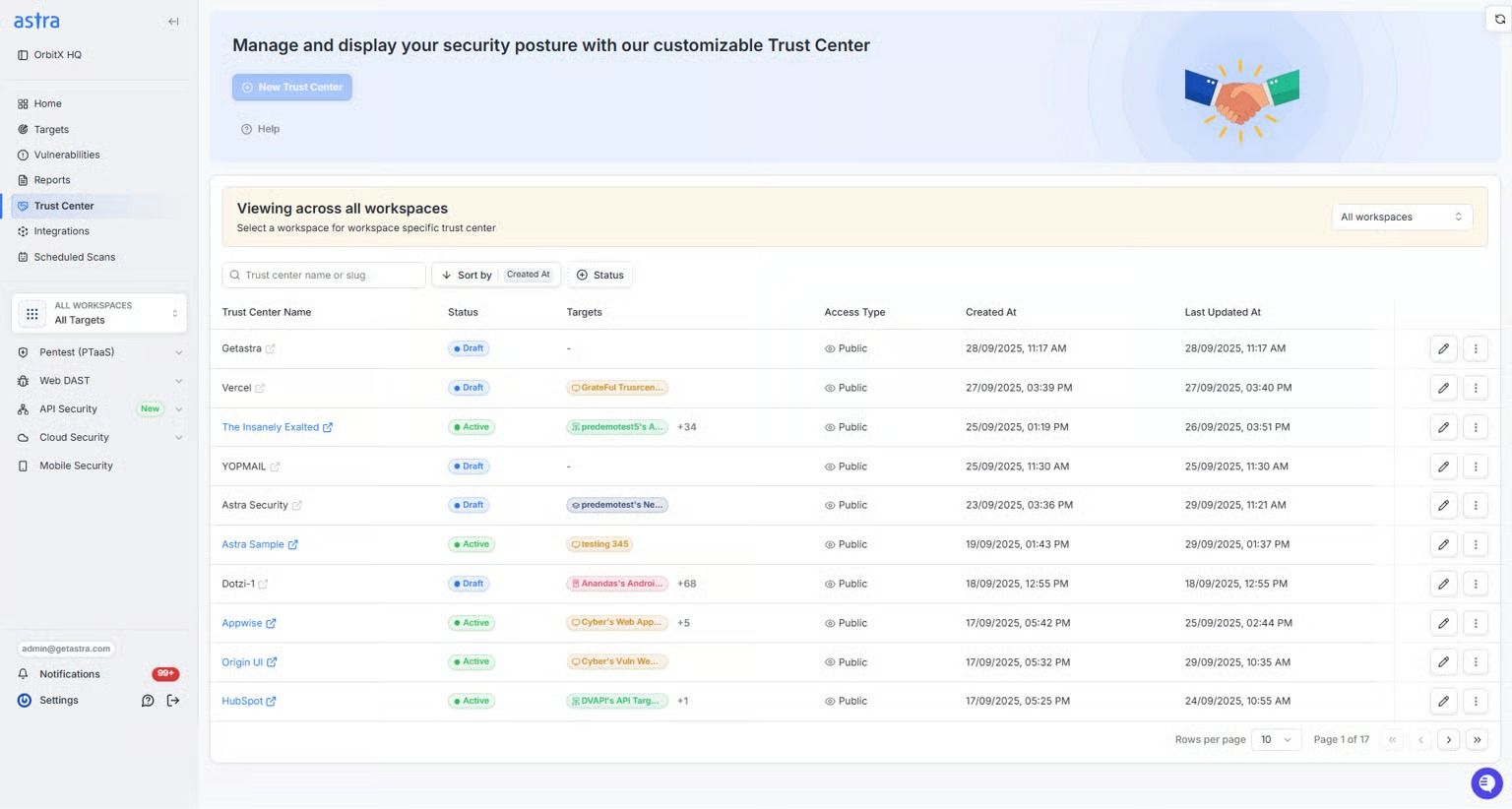
Connect your trust center to your CRM system to track which prospects are reviewing which documents. This data helps sales teams understand buyer concerns and provides security teams with visibility into documentation usage.
Analytics and Measurable Impact
Track key metrics like visitor engagement, document download rates, and time spent in different sections. Questions are answered almost before they’re asked, freeing teams from repetitive requests and allowing them to focus on meaningful work, while deals move forward with fewer bottlenecks.
Monitor correlation between trust center usage and deal progression. Companies typically see reduced sales cycles, higher win rates, and decreased security team involvement in deals after implementing effective trust centers.
What are the Benefits of Trust Center?
A modern trust center delivers value across the entire buyer journey and internal security ecosystem, boosting transparency, reducing friction, and helping organizations scale their security communications efficiently.
| Benefit Area | Description |
|---|---|
| Faster Sales Cycles | Provides buyers with immediate access to security and compliance information, reducing bottlenecks and repetitive inquiries. |
| Stronger Credibility | Demonstrates transparency and maturity, helping build confidence with prospects, partners, and auditors. |
| Operational Efficiency | Centralizes documentation and automates responses to common requests, reducing the load on security, legal, and compliance teams. |
| Regulatory Alignment | Ensures security evidence, certifications, and disclosures remain current and auditable across frameworks. |
| Consistent Buyer Experience | Delivers standardized, up-to-date content that supports every stage of the buyer evaluation process. |
| Scalable Security Communication | Enables organizations to share the right level of detail at scale without increasing manual effort. |
How Astra Trust Center Can Help
Astra Trust Center platform is built for the people stuck in the middle: the sales rep scrambling last-minute PDFs, the security lead answering the same questions for the fifth time, the founder asking for proof in every pitch, and, most importantly, the buyer waiting weeks for a straight answer.
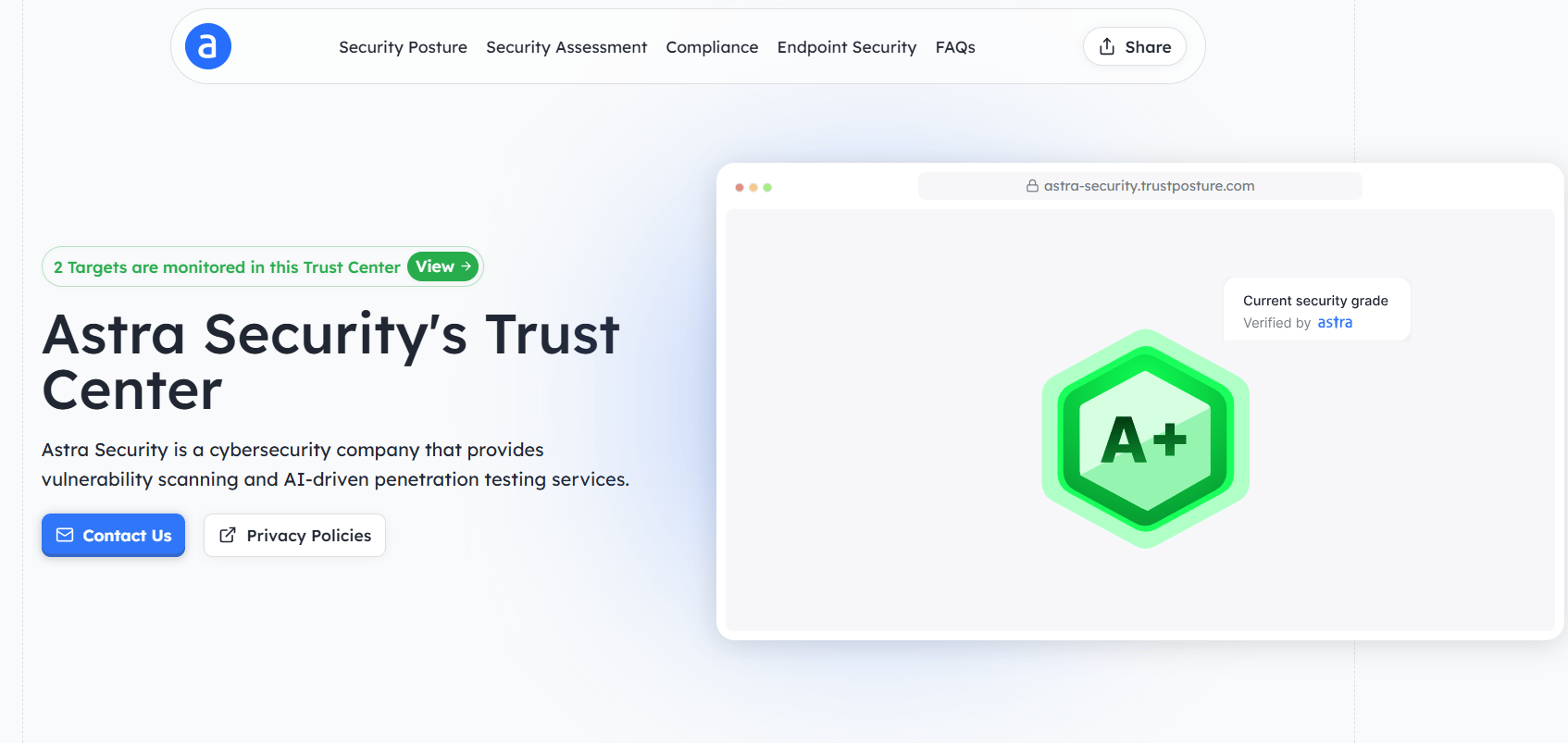
Astra Security’s platform stands out by providing continuous, live security evidence rather than static documents. Instead of static documents or hidden portals, we offer live, verifiable security proof with continuous scans, automated updates, and a one-click Trust Seal that turns compliance from a checkbox into a growth engine.
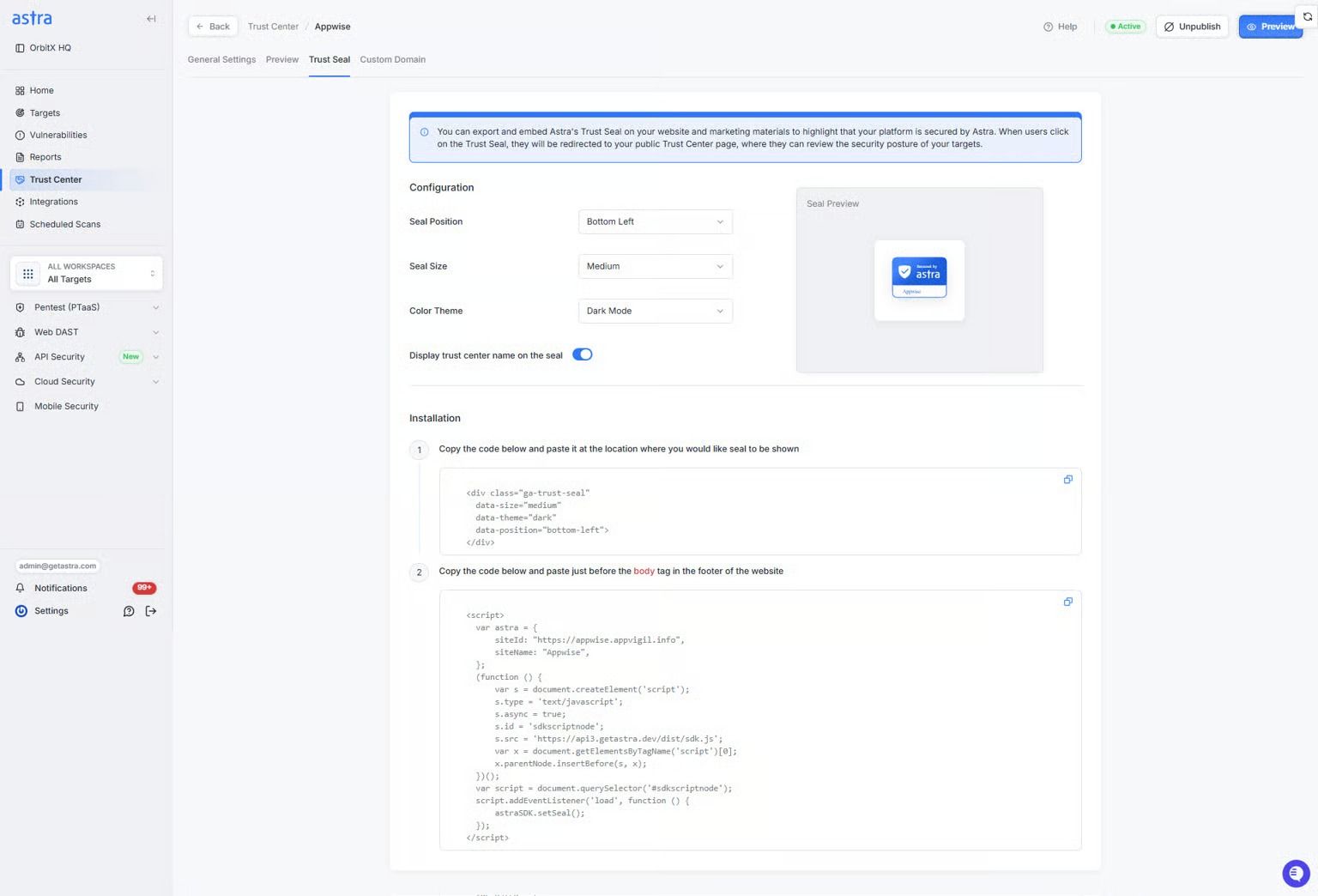
The platform integrates with your existing security tools to pull real-time data, eliminating the manual effort of keeping documentation up to date. Centralize evidence once, map it to frameworks, and generate programmatic responses rather than repeatedly addressing the same questions.
Key Components of an Effective Trust Center
In addition to content, controls, workflows, and monitoring, which enable a high-performing trust center, the key components of a customer trust portal, from compliance badges to request functionalities, include:
1. Compliance Certifications and Badges
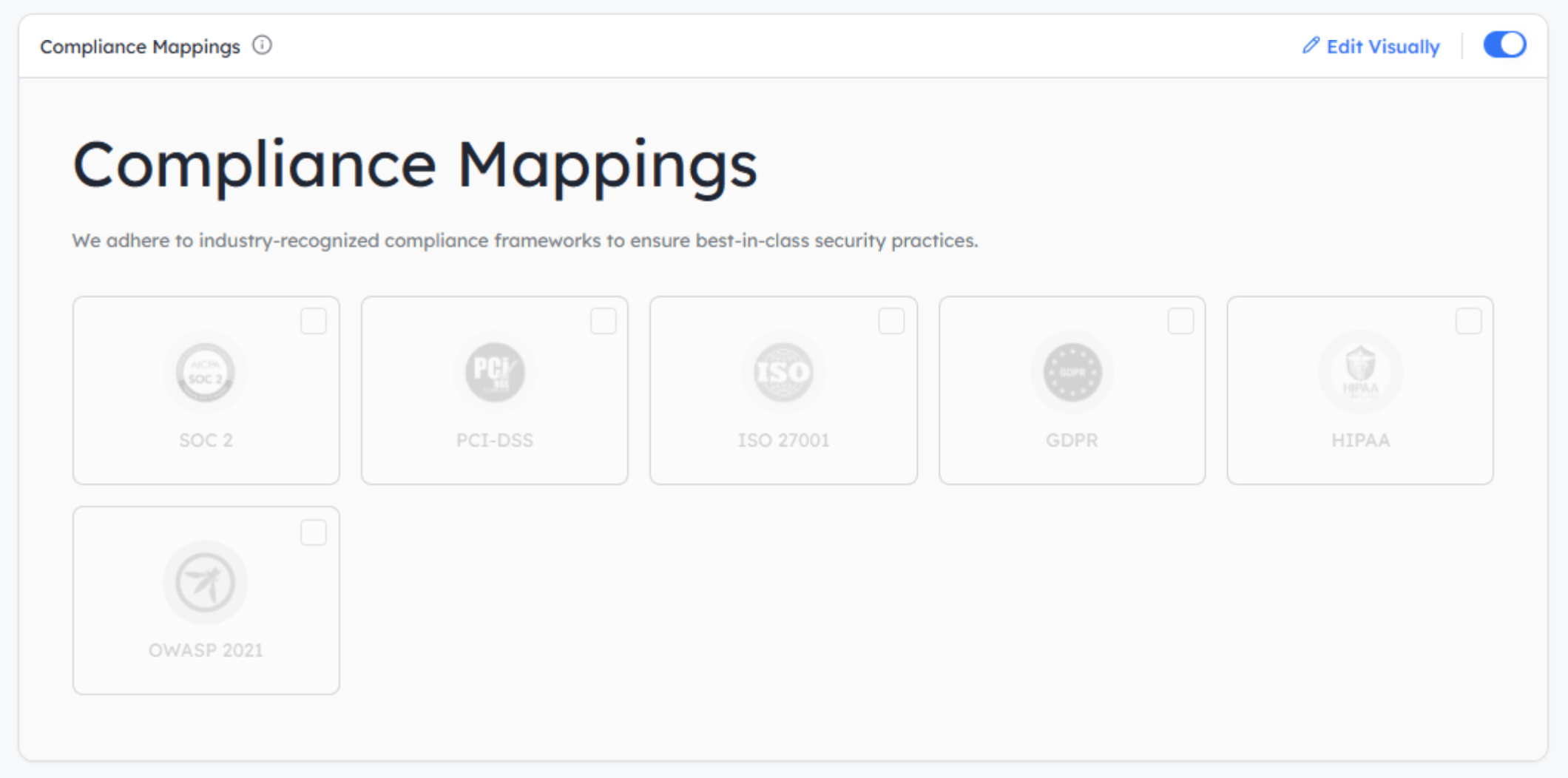
The trust center should provide all compliance frameworks, along with verifiable links to their original certificates, such as SOC 2 Type II reports, ISO 27001 certifications, statements of GDPR compliance, HIPAA attestations, and PCI-DSS validations.
2. Security Policies and Privacy Practices
Rather than providing generic data protection policies and documents, good trust centers provide detailed, helpful guidance on security hardening. Things such as encryption of data, access controls, response to breaches, and privacy (see: GDPR, CCPA, etc.) standards across environments, supported by well-defined policies and procedures.
The goal is to make these policies buyer-centric and scannable.
3. Audit Reports and Attestations
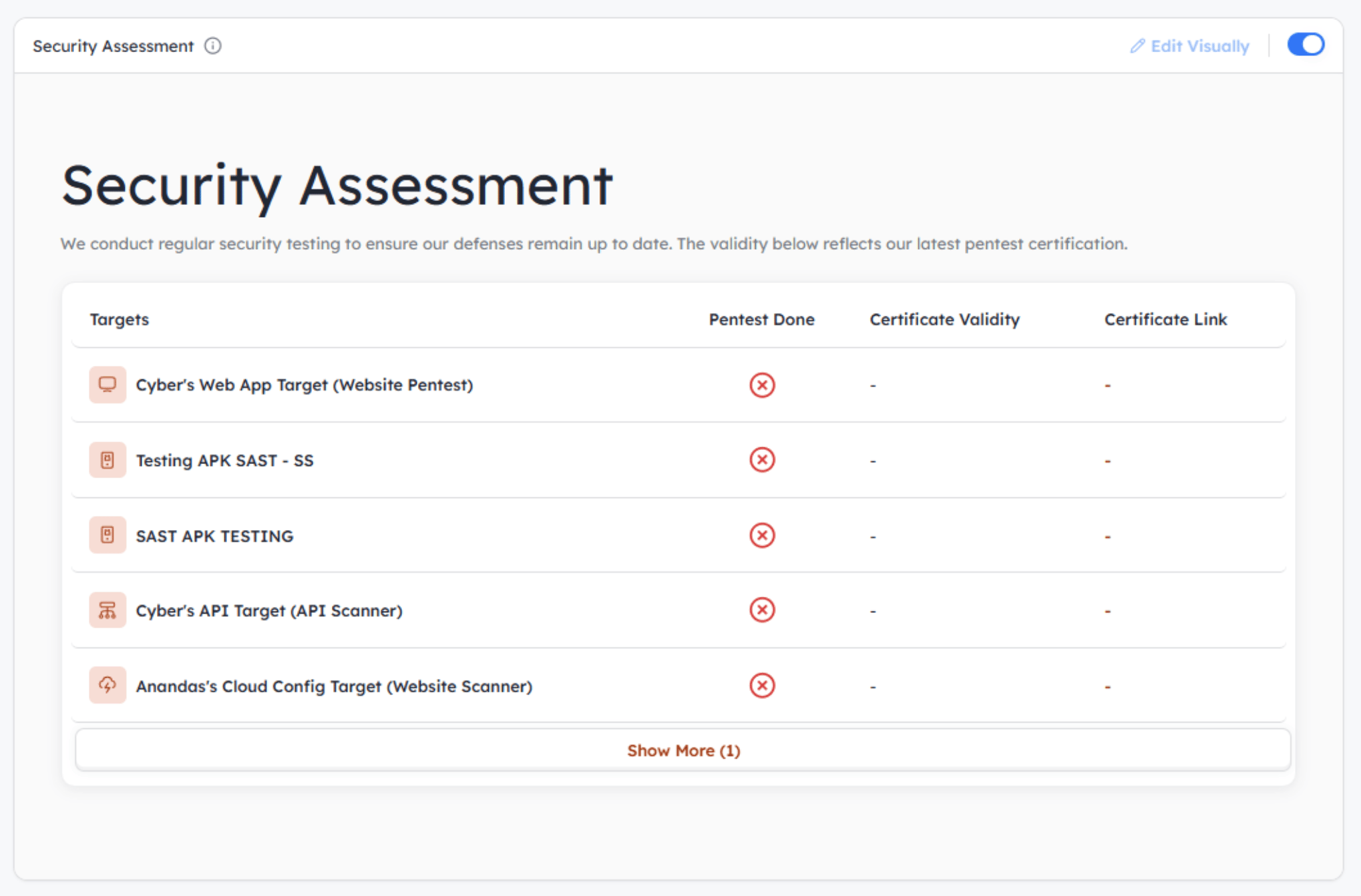
Static audit reports are replaced with live scans, pentest PDFs, and other real-time compliance evidence. Modern trust centers are powered by continuous intelligence pulling real-time data from security monitoring tools, displaying instantaneous vulnerability scan results, penetration test certificates, and continuous security assessment results.
4. Customizable FAQ Sections
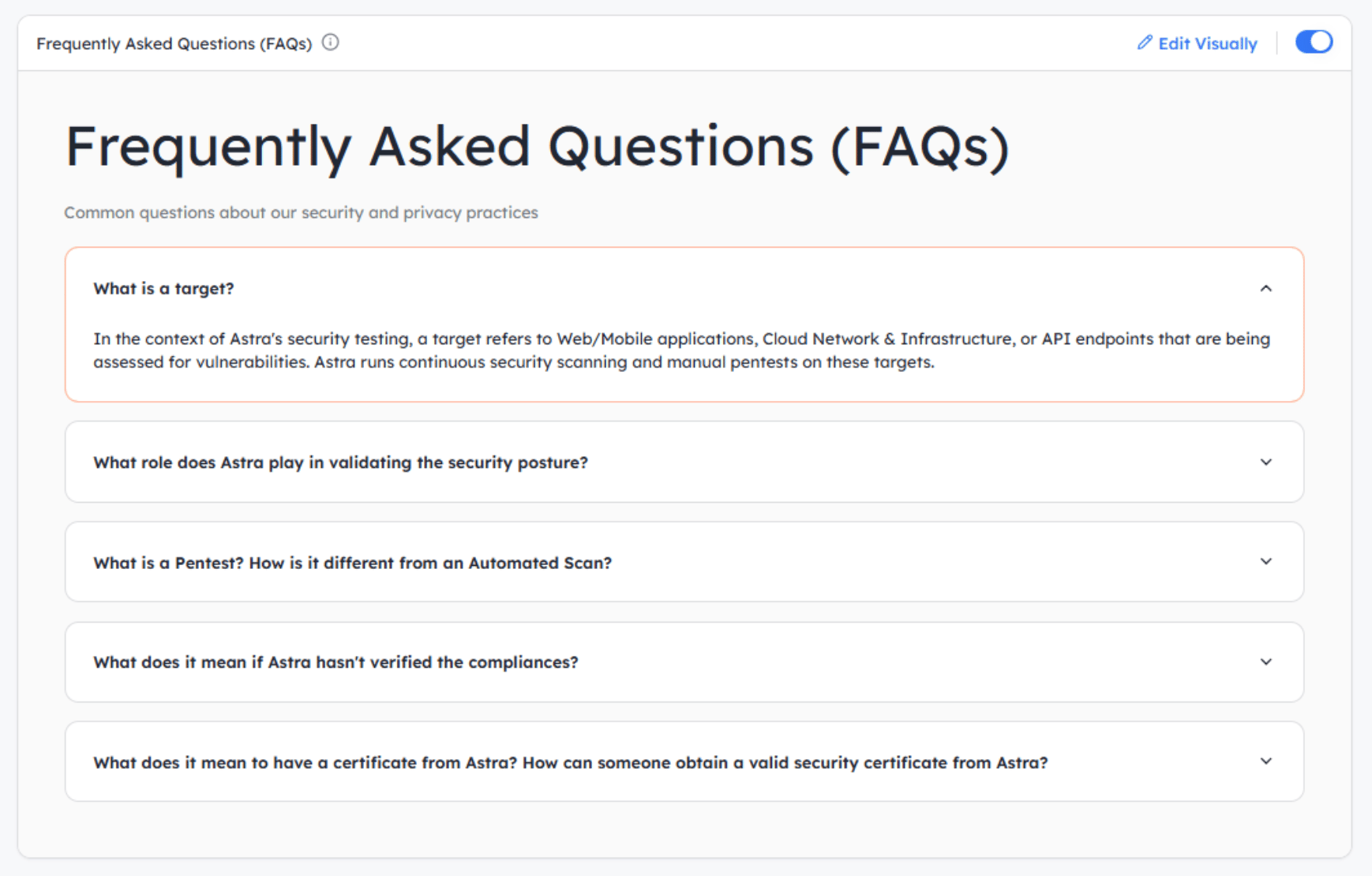
A knowledge base of frequently asked buyer questions, whether published publicly or kept internal, helps eliminate repetitive responses to security questionnaires. These frequently asked questions should address your infrastructure, how data is handled, and the security controls in place.
5. Document Request Functionality
For highly sensitive documents that cannot be made public, the trust centers must include secure document sharing capabilities with access controls, download logging, and expiration dates.
Final Thoughts
Trust centers have evolved from nice-to-have marketing tools to business-critical infrastructure. In an environment where security breaches make headlines daily, and buyers demand instant verification, static security documents no longer suffice.
The most effective trust centers provide live, verifiable proof of security posture while reducing the burden on internal teams. It turns security into a competitive advantage by demonstrating transparency and confidence in your security practices.
In the current phase of evolving security challenges for CTOs and CISOs, the question isn’t whether you need a trust center, but how quickly you can implement one that serves both your buyers’ need for verification and your team’s need for efficiency.
FAQs
What is a trust center?
A trust center is a centralized, customer-facing hub that provides transparent, up-to-date security, compliance, and privacy information, which helps organizations build credibility, streamline assurance processes, and give buyers the evidence they need to evaluate products with confidence.
How long does it take to build a trust center?
Building a trust center typically takes between four and twelve weeks, depending on the organization’s complexity, the maturity of its security documentation, and how quickly stakeholders can align on content, governance, and workflows.
With Astra Security, get started in thirty minutes of completing your pentest.
What is the cost of building a trust center?
Building a trust center typically costs $20,000 to $250,000+, depending on scope and approach. Using a trust-center platform usually falls between $20,000–$80,000 per year, while building in-house can range from $120,000–$250,000+ when factoring in engineering time, design, security review, and ongoing maintenance.
The final cost depends heavily on required features, integrations, automation, and the maturity of your existing security content.