Key Takeaways
- SaaS attack surfaces evolve too fast for annual testing.
- Point-in-time pentests leave critical, fast-growing blind spots.
- Autonomous pentesting makes security continuous and deployment-driven.
- Continuous security evidence reduces risk and accelerates enterprise sales.
You ship to production every day while your last pentest happened 11 months ago. Just say that sentence out loud, and we ought to rest our entire case of autonomous pentesting for SaaS companies right there. Everything below is just the supporting evidence.
The mismatch isn’t subtle. Your engineers deploy continuously, your infrastructure reshapes itself weekly, and your security validation still runs on a calendar designed for software that shipped twice a year. In 2025, a critical vulnerability surfaced every 48 seconds on Astra’s platform. An annual report cannot describe that world, let alone defend it.
Thus, in this guide, we’ll walk through why your attack surface is pummeling your point-in-time testing, how autonomous pentesting can be your ultimate power card, why multi-tenancy deserves its own testing discipline, and how continuous security evidence quietly turns into a sales asset.
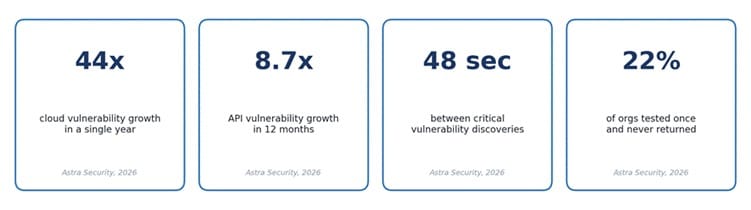
The 2025 numbers behind the cadence mismatch. (Source: Astra Security, State of Continuous Pentesting Report 2026)
Your Attack Surface Changes With Every Deploy
Astra’s State of Continuous Pentesting Report 2026, built on 6.8 million findings from 150K+ scans and 8,000+ pentests, reads like a description of a typical SaaS stack under stress. Four layers moved faster than anyone’s testing in 2025, and each one failed differently. They’re also the four layers autonomous pentesting for SaaS platforms are built to watch.
APIs Are Multiplying Faster Than Anyone’s Tracking
Every feature you ship adds an endpoint, and many of them never make it into the API spec. API vulnerabilities grew 8.7x in twelve months, and the API layer sits at the junction between your cloud infrastructure and the web application you’ve already tested, making it the least-tested part of the most consequential connection in your stack.
The flaw that thrives here is IDOR. It was the only vulnerability class in 2025 present across all six tested surfaces simultaneously, with $1.1M in tracked financial exposure— the highest of any class. Since it regenerates so frequently, people mistake it for a petulant bug in the library; rather, it’s a consequence of how developers reason about data ownership every time they write a new endpoint.
The trajectory makes this worse before it makes it better. Astra’s API scanner, launched in August 2025, projects roughly 185K automated API findings in 2026, with tracked API financial exposure heading toward $3.3M, and both are conservative floors because every API environment that predates the scanner is still an untested backlog. If your product has been shipping APIs for 3 years without testing them promptly, the first serious look will disturb your entropy quite palpably.
Cloud Misconfiguration Risk
Cloud vulnerabilities grew 44x in a single year and accounted for 39% of all findings, overtaking the web as the primary attack surface in three separate months of 2025 (Astra State of Continuous Pentesting Report 2026). This is the layer where a single toggle becomes an exposure: one bucket policy flipped to public, one IAM role with a wildcard, one credential baked into a build.
The coverage math is worse than the growth math. Cloud vulnerabilities grew 37x faster than manual testing coverage, and the average cloud pentest returned 7,480 findings, 2.4x the yield of a web test. Your cloud is not quiet because it’s clean; it’s quiet because nobody has looked recently.
There’s a SaaS-specific twist in the data, too. 80% of tracked S3 and AWS credential exposure in 2025 was discovered inside iOS and Android apps, not by cloud infrastructure scans, meaning the keys to the backend were sitting in shipped binaries the whole time. If your SaaS ships a mobile client, your cloud perimeter includes the app store, whether your testing scope admits it or not.
CI/CD as a Target
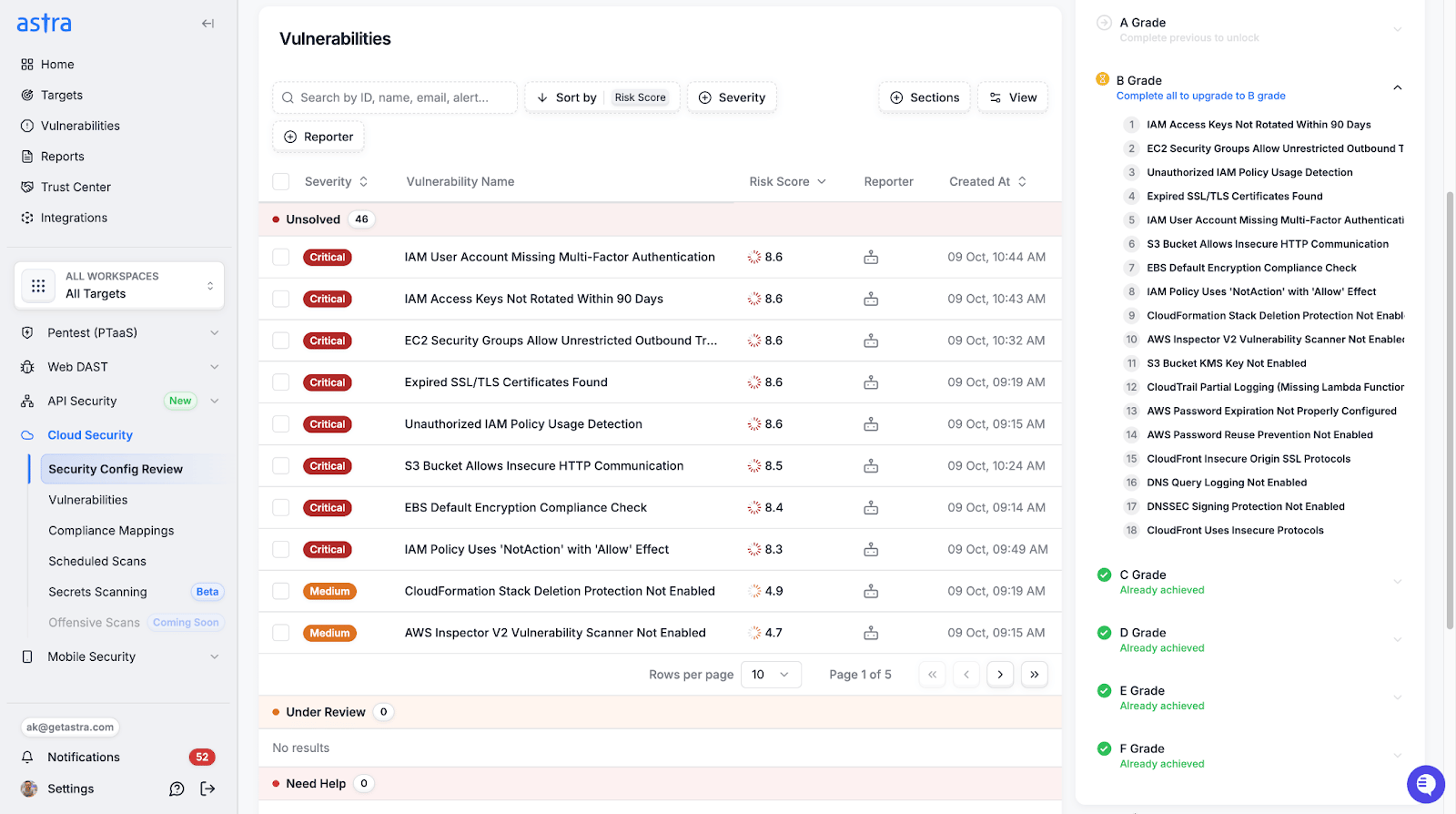
The pipeline that ships your product is now part of the product’s attack surface. Secrets in runner environments, poisoned dependencies, and over-privileged build steps all sit upstream of production, and a compromised pipeline inherits your deploy privileges by design. If an attacker owns your build, they own every deploy after it, and the right CI/CD security controls only matter if something validates them continuously.
This is also the layer where a point-in-time test is least useful. Pipelines change with every new integration, runner image, and third-party action you adopt, and the blast radius of a compromise is your entire release history going forward.
Put the pipeline inside your autonomous pentesting scope and treat it like production, because to an attacker it’s better than production— it’s production with write access.
The Boundary That Keeps You Up at Night
Then there’s the one that’s uniquely yours: tenant isolation. Every customer in your database sits one logical boundary away from every other customer, and that boundary is enforced by application code you refactor constantly. It deserves its own section, and it gets one below.
For now, hold this thought: it’s the boundary your entire business model depends on, and it almost never appears as a named item in an annual pentest scope.
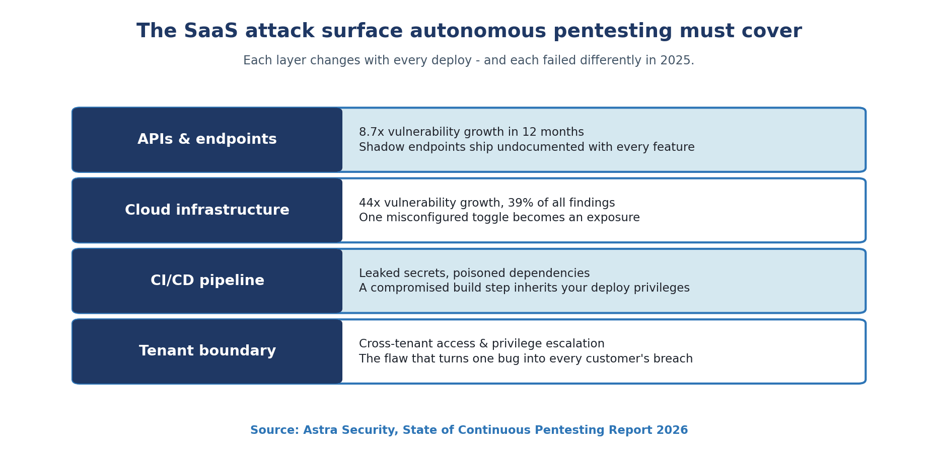
Four layers, four failure modes: the moving SaaS attack surface. (Source: Astra Security, State of Continuous Pentesting Report 2026)
See it the way an attacker does: map your full attack surface with Astra’s Pentest Platform.
Why the Annual Pentest is Theater at Your Velocity
None of this means annual pentests were always a bad idea. They were built for a world where the system under test held still long enough to be described. That world is gone for SaaS.
It’s Stale Before the Report Lands
A typical engagement scopes in week one, tests in weeks two and three, and delivers a report a few weeks later. By then, the services it examined have been refactored, twice in some cases, and the endpoints it enumerated have new siblings. You’re reading a well-written history book and calling it a threat model.
The 2025 data shows how expensive that lag gets. 22% of organizations ran a single pentest and never returned, and the year’s most dangerous window, the August-to-September critical surge, arrived after most of those one-time engagements had already concluded. The organizations that tested in Q1 were blind precisely when it mattered.
Moreover, in 2025, 1 in every 10 findings was critical, up from 1 in 40 the year before, and forecast models point to at least 2.7x vulnerability growth in 2026. Now you needn’t be a Sir Turing to understand that the longer you delay tests, the more the critical share rises and accumulates unseen in your backlog, sitting ducks for threat actors.
Point-in-Time Can’t Describe a Moving Target
Say it plainly: an annual pentest is a snapshot of a system that no longer exists. Every cloud service deployed, every API shipped, and every release cut after the test creates a surface the report has never heard of. The certificate on your trust page stays valid for twelve months; the system it certified lasted about a sprint.
One finding that defines the purpose of this article best is the 30-day blind spot.
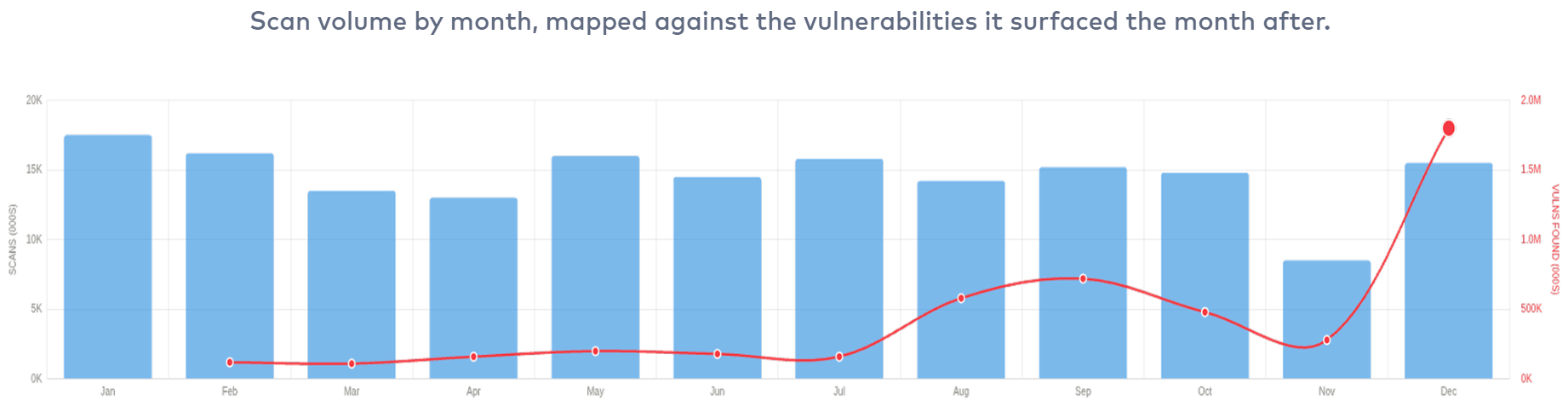
November 2025 was the quietest scanning month of the year; December then produced 1.8 million findings, more than all of 2024 combined.
The teams reacting to December’s surge were responding to a dip in program spend during November’s planning reviews. Point-in-time prothey accumulateulnerabilities and systematically misread risks as they accumulate. Continuous autonomous pentesting never leaves the window, securing your tech stack round the clock.
Testing shouldn’t expire faster than milk: read our guide to continuous autonomous pentesting.
Testing That Keeps Pace With Your Pipeline
This is the problem autonomous pentesting for SaaS teams was built to solve. AI agents trained on thousands of real pentests map your attack surface, build threat models, and chain vulnerabilities contextually, the way a human pentester reasons, except they do it continuously, across every surface, on every deployment.
The result is testing that’s roughly 80x faster: first findings in minutes, not weeks. If you’re wondering how that differs from the scanners you already run, we’ve broken down how an autonomous penetration testing framework differs from legacy DAST separately.
Continuous and On-Demand Validation
The operating principle of autonomous pentesting is simple: test on every meaningful change, not on a calendar. Shipped a new API? It gets probed before your customers find it. Spun up new cloud infrastructure? It enters scope automatically instead of waiting for next year’s engagement letter. Your testing cadence finally matches the only cadence that matters, the one your pipeline already runs at.
It also matters for the newest shipments. If your product now has AI features, you own a vulnerability class that didn’t exist in 2024— prompt injection and exposed system prompts appeared in production pentests in 2025 with no CVE, no vendor patch, and no established remediation playbook. A model that treats the AI layer as an independent, continuously tested surface is the only one that keeps pace with a roadmap that now includes LLMs.
For such a critical yet nascent category, governance is indelibly incumbent, and that’s why Astra helped author the OWASP Autonomous Penetration Testing Standard (APTS), with 173 requirements, three compliance tiers, and four defined autonomy levels governing how an autonomous system behaves on production infrastructure when nobody’s watching.
Catch Security Regressions Like Functional Ones
You’d never ship a release that reintroduced a bug your test suite caught last quarter. Yet reintroduced vulnerabilities sail through because nothing retests for them. Autonomous pentesting treats a resurfaced IDOR the way your CI treats a failing unit test: caught at the change that reintroduced it, assigned to the engineer who made the change, fixed while the context is still fresh.

One expectation worth setting: your first continuous engagement will look dramatic. Organizations bringing cloud or API surfaces under coverage for the first time in 2025 saw 30-70x the findings of a repeat engagement, because the opening run harvests years of accumulated debt in a single pass. That spike is real, and it’s also non-repeating; the steady state that follows is the point.
Here’s how the two models compare for a team that deploys daily:
| Annual pentest | Autonomous pentesting | |
|---|---|---|
| Cadence | Once a year, calendar-driven | Continuous, triggered by every meaningful change |
| Coverage | A scope frozen at kickoff | Full surface, including endpoints shipped yesterday |
| Time to first finding | Weeks | Minutes (80x faster) |
| Regression detection | Next year, if the scope matches | Caught like a failing test, at the change |
| Evidence produced | A PDF that ages for 12 months | Always-current, audit-ready proof |
Match your testing to your deploy cadence: talk to us about continuous pentesting.
The Multi-Tenancy Question, Tested
Now, the boundary we promised to come back to. Multi-tenancy is the reason SaaS economics work, and it’s also the reason a single authorization flaw scales into an existential event.
Cross-Tenant Access
The vulnerability class most likely to recur is also the one your architecture amplifies the most.
In a single-tenant world, an IDOR leaks one customer’s data. In yours, since every tenant sits behind the same code path, the flaw can lead to every customer’s breach. This is why IDOR’s presence across all six surfaces in the 2025 dataset should worry SaaS leaders more than anyone else.
Isolation and Privilege Escalation Between Accounts
Tenant isolation cannot be an assumption, but rather a test that runs. You need to probe the specific boundary your architecture depends on: can account A read account B’s objects by manipulating identifiers? Can a low-privilege user in one workspace escalate into an admin of another? Can a trial account reach data belonging to your largest enterprise customer?
The classes behind these failures, authentication bypass ($344K in tracked exposure) and privilege escalation ($290K), carry no CVE and no vendor patch.
They’re actually consequences of design, which is why scanners that match known signatures will miss them and why autonomous pentesting is needed to probe them the way an adversary would, repeatedly, contextually, and after every change to your access-control logic. There’s a practical checklist we’ve hid in the last sentence you read:
- Map every object type in your API to an ownership rule
- Turn each rule into a repeatable test case:
- Identifiers swapped across tenants
- Role tokens replayed across workspaces
- Invitation and export flows probed for state manipulation.
Then let autonomous pentesting run those cases on every change to your authorization code.
Your isolation model deserves proof, not hope: get a pentest that targets the tenant boundary.
Turning Security Into a Sales Asset
Here’s the part that gets the CEO into the room: continuous testing doesn’t just reduce risk. It compresses the slowest, least predictable stage of your enterprise sales cycle. Read along to know how.
Feed Enterprise Questionnaires With Real Evidence
Every enterprise deal arrives with a security questionnaire, and most vendors answer it with adjectives. A SaaS company running autonomous pentesting answers with evidence: here’s when the boundary was last tested, here’s what was found, here’s the verified fix. Tested proof beats promises in every procurement conversation, and reviewers can tell the difference instantly.
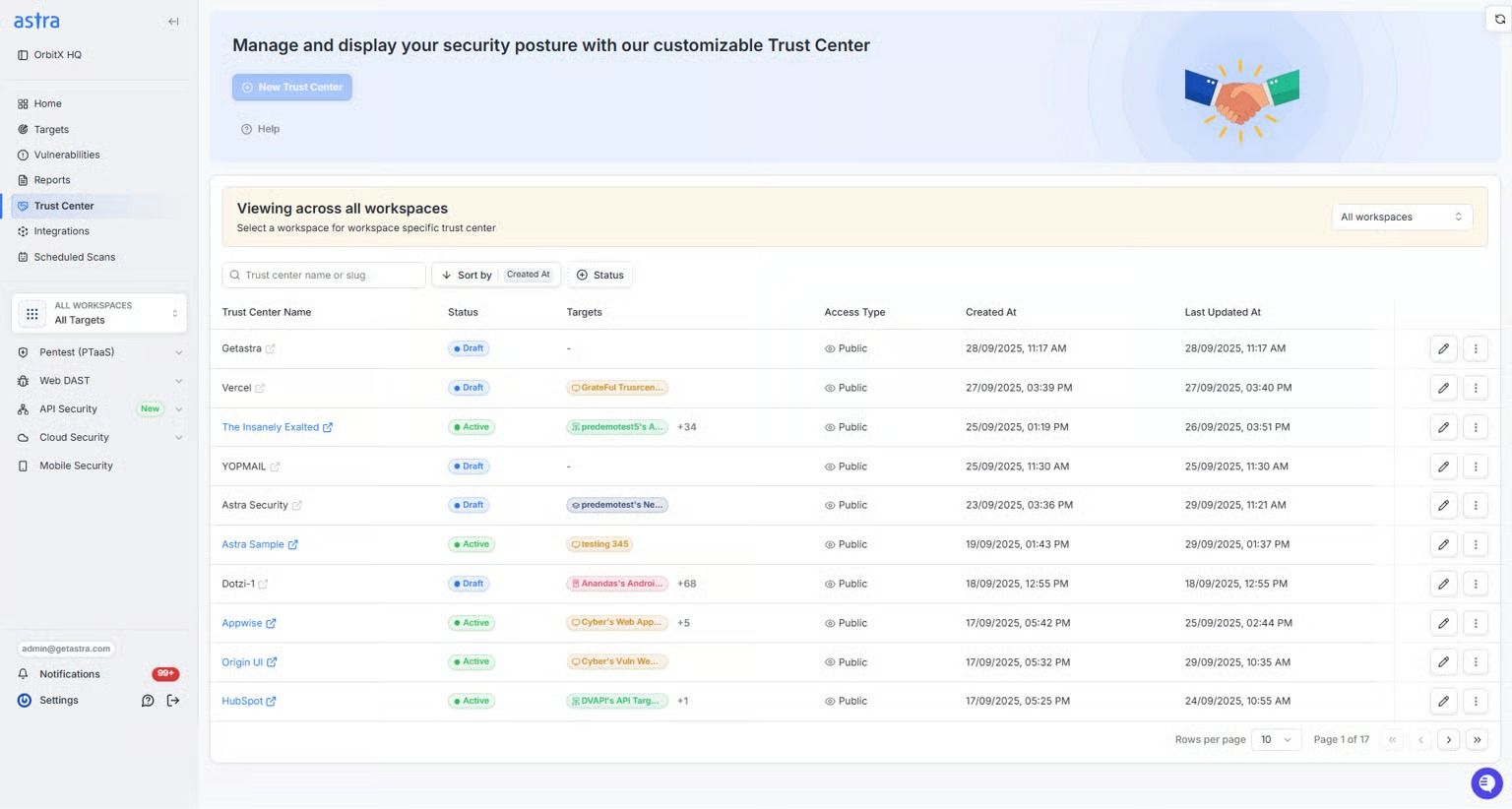
The difference shows up in the details reviewers actually check: dates, scope, and retest evidence. Saying you pentest annually invites a follow-up meeting; showing that your platform was tested this week, with the current report and a fix-verification trail attached, ends the thread. The vendor that answers fastest with the freshest evidence sets the pace of the deal.
Support SOC 2 and ISO 27001
For both SOC 2 and ISO 27001, while continuous autonomous pentesting is not mandatory, they may expect or request such a security posture depending on your digital and financial stakes.
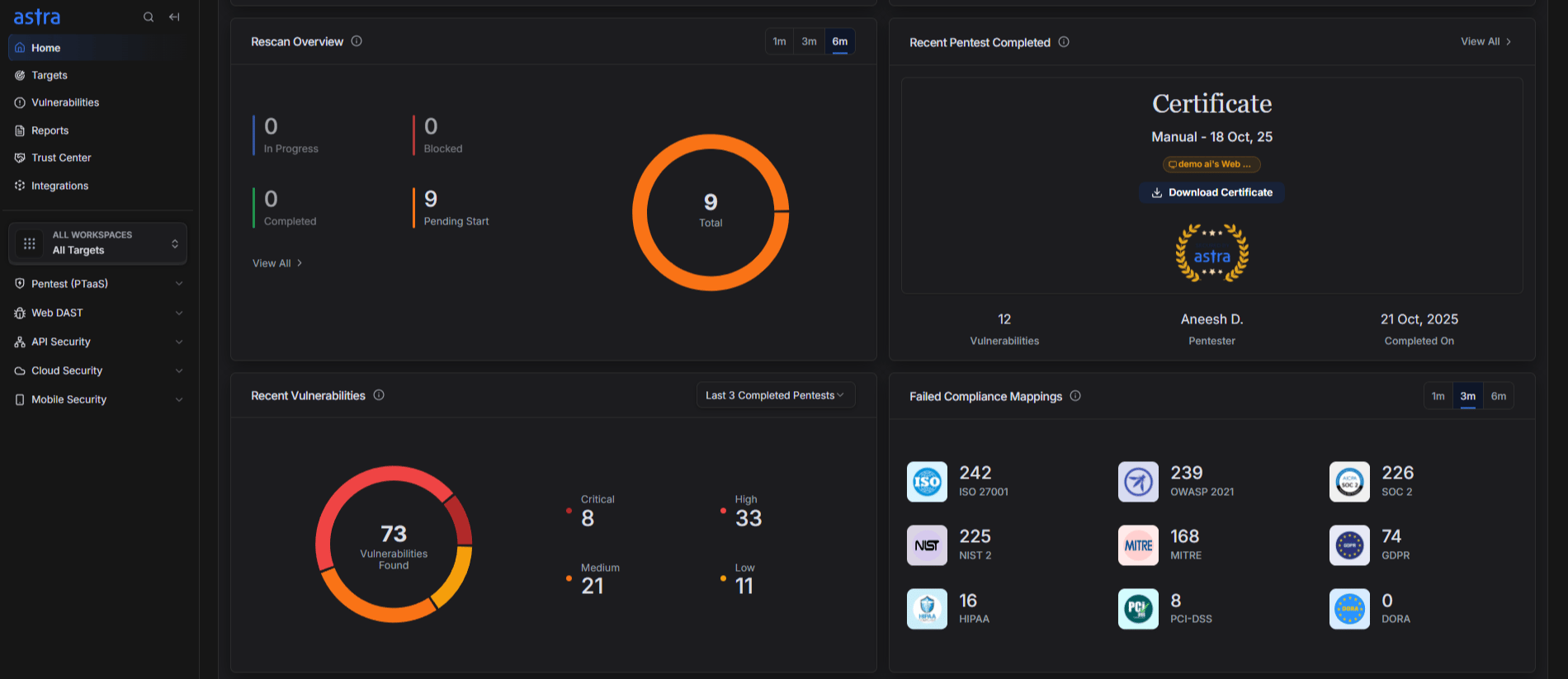
Autonomous pentesting for SaaS generates evidence as a by-product of simply running: a living record of what was tested, when, and what was remediated. Your next audit then becomes just a matter of exporting history rather than reconstructing it, and the certificate reflects a practice instead of an event.
Moreover, you can now point the auditor to a living timeline, shifting the conversation from proving you did something to walking through everything you did. Auditors notice the difference, and so do the enterprise buyers who read the resulting report.
Shorten the Review That’s Stalling Deals
Security reviews stall deals for weeks, and for a growing SaaS company, that’s revenue sitting in someone else’s approval queue.
With an almost real-time report rather than an eleven-month-old PDF, your review cycles shrink and deals close sooner. That’ll sound like the sweet sirens of The Odyssey to your board.
You need to present autonomous pentesting not as a burden on the cost center, but as a growth lever that unblocks your sales team’s pipeline.
Stop losing weeks to security reviews: see how Astra’s continuous evidence speeds up enterprise deals.
Final Thoughts
The cadence mismatch is the Achilles’ heel crippling your ship velocity and compliance walls. A SaaS company that deploys autonomous pentesting versus one that tests annually isn’t 364 days behind; it’s operating on a picture of a system that stopped existing at the first deployment after the test.
With every deployment tested, every regression caught, the tenant boundary proven rather than presumed, and as a by-product, continuous, audit-ready evidence, autonomous pentesting for SaaS firms such as yours turns security from the department that says “not yet” into the one that unblocks the quarter’s biggest deal.
The attack surface is already continuous. The only question is whether your testing is.
FAQs
What is autonomous pentesting for SaaS companies?
Autonomous pentesting uses AI agents trained on real-world pentests to continuously map a SaaS company’s attack surface, build threat models, and find chained, contextual vulnerabilities across web, API, cloud, and CI/CD, on every deployment rather than once a year. It delivers first findings in minutes and keeps testing in step with continuous delivery.
How is autonomous pentesting different from vulnerability scanning?
Scanners match known signatures and stop there, whereas Autonomous pentesting reasons about your application’s architecture the way a human pentester does, chaining findings, testing business logic, etc.
How often should a SaaS company run penetration tests?
It depends on your shipping velocity. If you deploy daily or weekly, you need continuous autonomous pentesting coupled with periodic in-depth human-led assessments.
Does autonomous pentesting replace human pentesters?
No, it changes what they spend time on. Autonomous systems handle breadth, whereas human experts handle depth: verifying findings, probing novel business-logic and isolation flaws, and governing the autonomous layer itself.
Can autonomous pentesting help with SOC 2 or ISO 27001 compliance?
Yes. Both frameworks expect evidence of ongoing vulnerability management and autonomous pentesting.
Explore Our Autonomous Penetration Testing Series
This post is part of a series on autonomous penetration testing. You can also check out other articles below.
- Chapter 1: Autonomous Pentesting: How it Works, Benefits, Tools (2026)
- Chapter 2: Autonomous vs Traditional Pentesting: What’s More Secure in 2026?
- Chapter 3: Top 10 Autonomous Pentesting Tools in 2026
- Chapter 4: How to Evaluate Autonomous Penetration Testing Security Vendors in 2026
- Chapter 5: OWASP APTS: A Complete Guide to Autonomous Penetration Testing Standard
- Chapter 6: Agentic AI in Cybersecurity: The Complete Guide for Security Teams
- Chapter 7: Autonomous Penetration Testing as a Growth Lever for Startups
- Chapter 8: 5 High-Impact Autonomous Pentesting Capabilities That Traditional Scanners Ignore
- Chapter 9: Autonomous Pentesting vs. Red Teaming: Do You Still Need Both?
- Chapter 10: How Autonomous Penetration Testing Kills False Positives
- Chapter 11: How a Modern Autonomous Penetration Testing Framework Differs from Legacy DAST
- Chapter 12: Autonomous AI Agents for Penetration Testing: A Complete Guide
- Chapter 13: Autonomous Pentesting for Lean Security Teams: The 2026 Guide
- Chapter 14: Will an Autonomous Pentest Satisfy SOC 2, PCI, & ISO Auditors?
- Chapter 15: How Reporting with Autonomous Pentesting Reasoning Traces Eliminates Developer Friction
- Chapter 16: A Guide to Continuous Autonomous Pentesting
- Chapter 17: Autonomous Pentesting for SaaS Companies in 2026: The Complete Guide