Key Takeaways
- Scanners match patterns; autonomous pentesters reason about behavior, which is where BOLA and logic flaws hide.
- Statefulness is where real attacks happen, so agents chain actions across accounts that scanners test in isolation.
- Use both layered scanners for breadth, and autonomous pentesting for depth.
- Prioritize by exploitability, not alert count, because the attack path matters more than the raw number.
The pitch is familiar enough that most security leaders tune it out. It sounds like marketing language, just an updated way of saying “a better scanner.”
This post is here to bust the myth behind that framing.
Both scanners and autonomous pentesting agents look the same from the outside. Both crawl your application, both send payloads, and both produce findings. But they operate on completely different assumptions of what constitutes a vulnerability. A scanner is a tool designed to identify patterns it has encountered in the past.
An autonomous pentester is like someone who has never seen your app until today, but behaves like an attacker who keeps state, formulates ideas and hypotheses, retries when blocked, and chains small flaws into a real exploit.
The most destructive bugs live in that distinction. Attacks such as BOLA, workflow abuse, and race conditions can be executed within the application scope, so they are not shown on signature-based dashboards (such as web app firewalls) or traditional security monitoring tools. They appear in breach reports.
Why Scanners Miss the Hardest Bugs
Vulnerability scanners were created in a time when the term “vulnerability” generally applied to a known weakness with a known signature. They are good at that job. Run a scanner against any application, and it will reliably expose out-of-date libraries, common injection sinks, missing security headers, and CVEs that you should already be patching.
What scanners are not designed to do is reason about meaning.
To a scanner, GET /api/v1/invoices/4471 and GET /api/v1/invoices/4472 are two requests that have the same structure. It doesn’t think “Invoice 4471 is mine and 4472 is not.” This distinction is the literal definition of a BOLA vulnerability, and BOLA has occupied a place at the head of OWASP API Security Top 10 (API1:2023) as it continues to be the most frequently exploited class of API flaw in the wild.
This same blind spot extends into business logic as well. For example, a scanner can verify that the /checkout endpoint accepts the quantity parameter. It cannot tell that a negative quantity could reduce the customer’s bill. It can also verify that a coupon endpoint returns an HTTP 200 response. It cannot be reasoned that if the same coupon is applied seventeen times simultaneously, it stacks, i.e., behavioral failures.
The deeper issue is statelessness, which is intrinsic to real applications and, indeed, to real attacks. An exploitable vulnerability could require logging in as user one, creating a resource, switching to user two, modifying an identifier, and then returning to the original session to verify the impact. That sequence is not present in any payload library, because it is specific to your application.
What Autonomous Pentesting Does Differently
The transition from scanning to autonomous pentesting tools is better framed not as “more checks” but as a different model. An autonomous pentester is a junior penetration tester with unlimited bandwidth. It observes, theorizes, tests, retests, and learns.
A few capabilities define the category.
| Dimension | Scanners | Autonomous Pentesting |
|---|---|---|
| Operating model | Works from a checklist of known patterns | Works toward an objective, like reading another user's data |
| Per-request view | Treats each request as an isolated test case | Maintains state across hundreds of requests |
| What it detects | Vulnerable inputs: signatures, CVEs, surface flaws | Vulnerable behavior: authorization gaps, logic flaws, workflow abuse |
| Handling blocks | Skips blocked requests | Asks why it was blocked and tries another angle |
| Findings format | Isolated, individually scored issues | Connected attack chains with the full exploit path |
| Proof | Flags that something may be vulnerable | Proves exploitation with evidence |
| Best strength | Breadth across every asset and dependency | Depth on context-dependent, chainable risks |
It explores rather than enumerates. Scanners work from a checklist. An agent works from an objective, such as “Find a way to read data of another user’s data” or “Find a way to escalate privilege.” What it does and how it does it is determined by what the application tells it.
It keeps the state. It can maintain a session across hundreds of requests and store what worked, using that memory to plan the next step. A user ID found in one response serves as input in another. Issuing a token in step three creates the lever for step seven.
It can authenticate, pivot, and chain. A scanner finds that an endpoint is reachable. An agent signs in, navigates the application as a real user would, finds a privileged action, and attempts to invoke it as a less privileged user. The chain itself is the finding.
It pursues multiple hypotheses. A scanner skips blocked requests. An agentic AI in cybersecurity asks why. Was it the header, session, role, steps/flow? It explores others, and that divergence is often where the true fragility manifests.
Real Example Patterns
The examples provided below are designed to be defensive and validation-centered. The intent is not to educate about exploitation but rather to quantify the gap between scanners and autonomous testing.
BOLA in Practice
A user logs in and fetches their profile at /users/8801. Scanner verifies that the endpoint does enforce TLS and that stack traces are not leaked in the response. Autonomous agent poses the same request as another logged-in user and asks, “Did the server return data of user 8801? If so, that is a BOLA.”
Two excellent public examples of this pattern at scale are the USPS Informed Visibility issue (2018) and the T-Mobile API incident (2023).
Workflow Abuse
A typical e-commerce flow assumes the following steps: add to cart, enter shipping details, enter payment details, and confirm. A scanner crawls each endpoint and checks whether it responds. An agent asks different questions
- What would happen if I were to call the confirmation request without actually calling the payment?
- What if I resubmit the order but with a different total?
- What if I race two confirmations in parallel?
They are questions that reveal the failings of any signature.
Business Logic Manipulation
Imagine an expense approval workflow in which any purchase over $10,000 must be preceded by management sign-off. A scanner sees a POST going to /expenses, then another one to /expenses/{id}/approve.
An agent is reasoning about the rules. Is it possible to create an expense of $9,999 and increase it? Before the validations catch up, am I allowed to submit and self-approve? Can I exploit a window of time? These are the bugs used to commit fraud.
Chained Exploitation
Imagine enumeration finds that user IDs are incremental. Authorization is checked correctly in one place but not in a sibling endpoint. A feature flag hides a privileged action, but is enforced client-side. Individually, none of those facts is catastrophic.
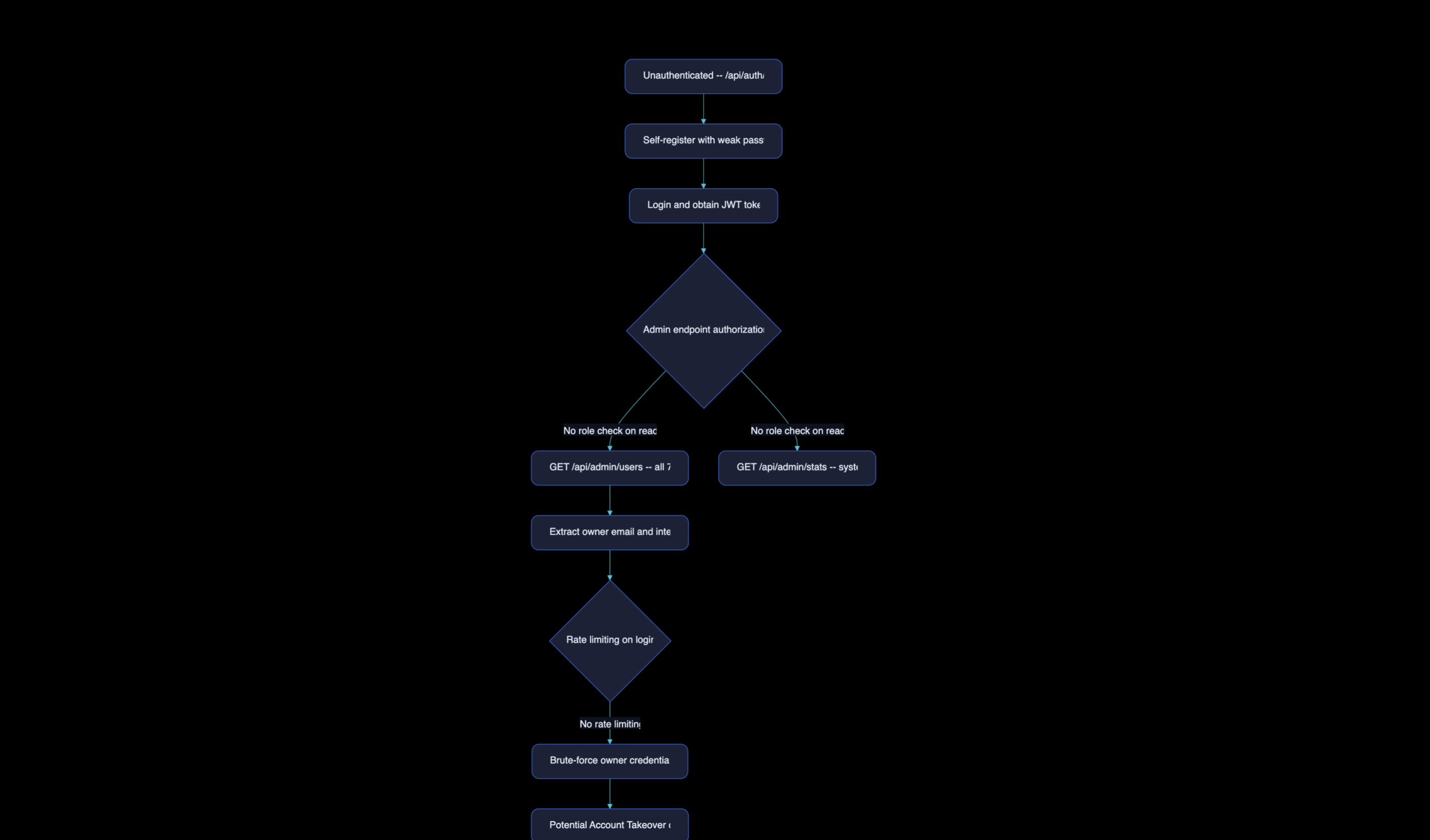
Together, they characterize a move from unseen reconnaissance to a full administrative compromise. A scanner returns three medium-severity findings, and none of them will survive a triage queue. The autonomous pentester then reports the chain.
The Vulnerability Classes Scanners Systematically Miss
Some vulnerabilities aren’t missed by accident; they fall outside what signature-based tools are built to see. These are the classes that show up in breach reports far more often than on scanner dashboards.
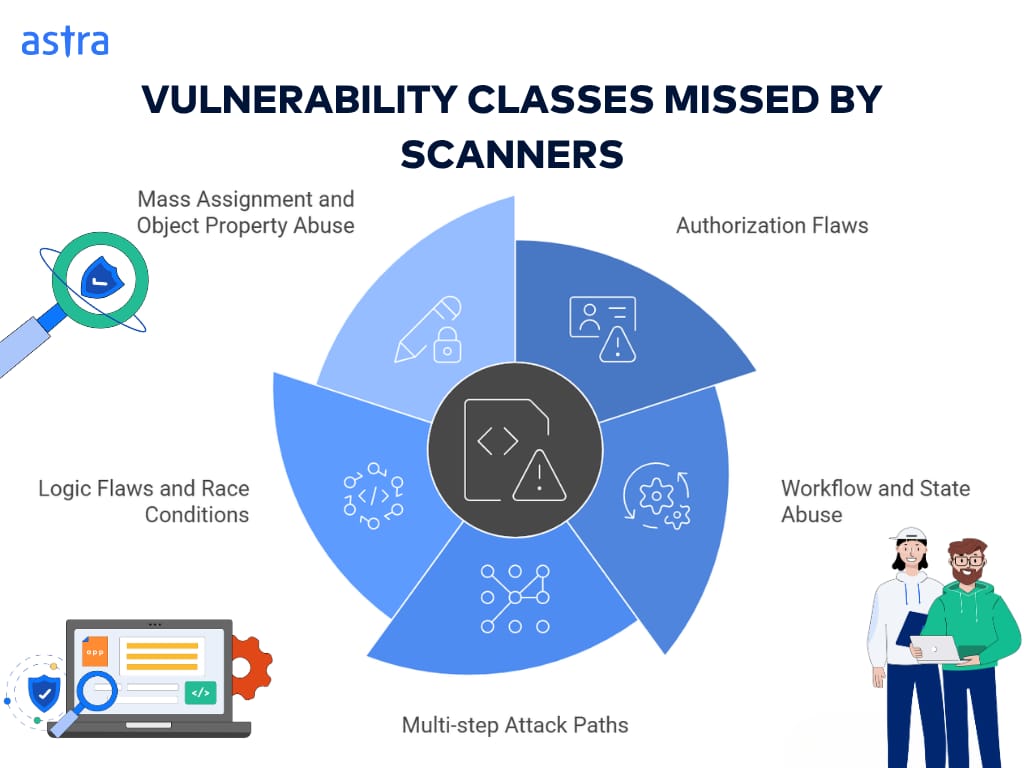
Authorization Flaws (BOLA and BFLA)
An authenticated user can access an object/function that should be restricted. The flaw exists at the intersection of identity and resource, which needs a multi-account context; scanners miss these. An autonomous agent can run parallel sessions in different roles and empirically test the access boundary.
For example, a low-privileged user executes an admin-only route by guessing a username, or a customer reads another customer’s order by changing an ID parameter.
Workflow and State Abuse
Skipping, repeating, or reordering steps in a multi-stage process to achieve a state that the application should not allow. Scanners do not catch these because each individual request is valid; the abuse is in the sequence. Autonomous agents reason about the intended flow and probe deviations. Example: completing a purchase without paying, or redeeming a one-time token twice.
Multi-step Attack Paths
A compromise that requires chaining several individually benign actions into a sequence that produces impact. Scanners do not catch these because they report findings rather than connect them. Path-finding is the core capability of an autonomous agent.
Example: using a low-severity information disclosure to seed identifiers, then using those identifiers against a weakly protected endpoint.
Logic Flaws and Race Conditions
Application behavior that violates business rules in ways developers did not anticipate. Scanners do not catch these because there is no signature for “this is not supposed to happen.” Autonomous agents can hypothesize about intent and test for deviations.
Example: race conditions in withdrawal endpoints that allow double spending, or integer manipulation that results in negative charges.
Mass Assignment and Object Property Abuse (BOPLA)
Clients setting fields they should not, such as promoting an account to admin or modifying read-only metadata. Scanners miss these because the request is syntactically valid; the flaw is in which fields the server accepts. Autonomous agents can compare what clients are supposed to send against what the server will accept, and probe the difference.
Where Scanners Still Help
It would be dishonest to frame autonomous pentesting as a replacement. Scanners do real work, and the AppSec programs that get the most out of autonomous testing tend to be the ones with mature scanning already in place.
Scanners are the right choice for existing vulnerabilities. For instance, when a critical CVE is published for a library that you are using, you want a scanner to identify everywhere it’s deployed within minutes.
They are also the right choice for surface-level asset discovery: knowing which endpoints exist, which assets are exposed, which dependencies are out of date, and which configurations have changed. They are fast, relatively cheap, and provide broad coverage, a key success factor when you have a huge attack surface.
Scanners are also excellent at finding a long tail of easy-to-discover bugs: SQL injection in an obviously enumerated parameter, reflected XSS in a clearly unvalidated sink, missing security headers, out-of-date certificates, etc. These are all signature-based problems, and signature-based tools are good at finding them.
The mental model you should have is a layered one. Scanners give you the breadth you need: every asset, every dependency, every known bug. Pentesting gives you depth: the more challenging, context-dependent issues that require human reasoning. The two approaches are synergistic, and the best AppSec programs use both.
Why This Matters to AppSec Teams
If you are anywhere close to incident response, you will see a recurring trend. The vulnerabilities identified through post-incident analysis are seldom the ones illuminated on your scanner dashboard. Instead, they are BOLAs that expose customer data, exploit process vulnerabilities to enable fraudulent transactions, or chain weaknesses that escalate a low-severity information disclosure into a full account takeover.
This is why autonomous pentesting is so critical. It is not about identifying more vulnerabilities. You likely already have more than you can handle as an application security team. It is about identifying vulnerabilities that correlate to real risk.
This is important for prioritization. A list of vulnerabilities ordered by the CVSS base score yields a certain result. A list ordered by exploitability, or the likelihood that an attacker can combine multiple vulnerabilities to achieve their goal, is markedly different. Looking at the second case, the right autonomous pentesting vendor establishes the order, as every vulnerability is accompanied by the exact path the tool takes to exploit it.
This is also important for executive management. Saying “We have 4,200 open vulnerabilities” isn’t actionable. Saying “An attacker with an internet connection is six steps away from the customer payments, and three controls will block that path” gives the CISO something tangible to discuss with their board.
How can Astra Autonomous Pentesting Platform Help?
Astra’s Autonomous Pentesting platform was built to find the vulnerable behavior that scanners overlook. It deploys an army of AI agents, built on insights and patterns from 5,000+ real-world pentests, to discover, chain, exploit, and validate vulnerabilities in hours instead of weeks.
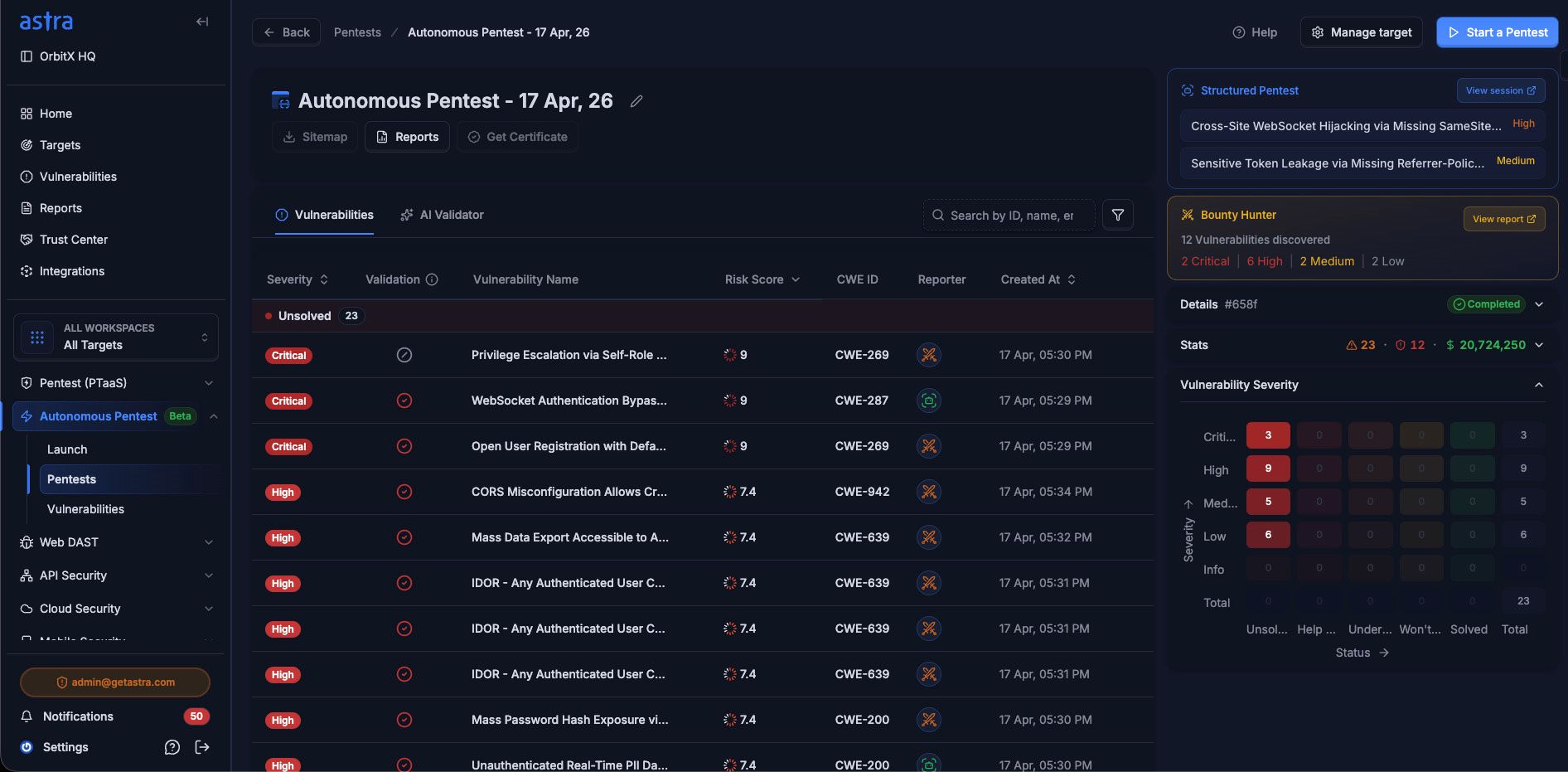
Unlike human testers who go deep on a single route at a time, or scanners that check endpoints in isolation, Astra’s agents operate in parallel across all attack vectors. You get the breadth of full coverage and the depth of actual exploitation on each path, with every finding mapped into the attack chain an attacker would follow.
Key features:
- A separate AI validator agent confirms each vulnerability is real and exploitable before it reaches your report, so you only chase risks, not false alarms.
- Findings are connected into sequences, with guidance on which link to break to collapse the entire attack chain or path.
- Breadth and depth together: Parallel agents (structured pentest and bug bounty) cover every angle while actually exploiting each one, not just flagging it.
- A complete, validated PDF report is ready within hours of test completion.
- Zero-friction workflow with CI/CD, GitHub, and Jira integrations work from day one, pushing findings straight to developers with no new silo to manage.
The payoff is what post-incident analysis keeps asking for: fewer blind spots in the bug classes that cause real breaches, findings ordered by exploitability rather than raw CVSS score, and a clear view of the routes a real attacker could actually take.
Final Thoughts
The myth about autonomous pentesting is that it’s a faster, more intelligent scanner. The truth is that it’s a different type of tool.
Scanners are really good at locating vulnerable inputs: recognizable patterns, signatures, and surface-level vulnerabilities. Autonomous pentesting, on the other hand, is designed to detect vulnerable behavior: gaps in authorization, misuse of workflows, logical errors, and step sequences that scanners overlook because they require a specific state, context, and adaptability to identify.
The advantage for businesses is clear. Better verification, fewer unknown areas of the types of bugs that cause real incidents, and assurance that the exploited attack routes are the ones being evaluated. Use scanners to get a broad view. Use autonomous pentesting to get a detailed view. Prioritize what you discover based on the routes a real attacker could take, not based on the number of alerts they create.
That is the missing link in most AppSec programs today, and it is the level where the most difficult and serious bugs are typically found.
Explore Our Autonomous Penetration Testing Series
This post is part of a series on autonomous penetration testing. You can also check out other articles below.
- Chapter 1: Autonomous Pentesting: How it Works, Benefits, Tools (2026)
- Chapter 2: Autonomous vs Traditional Pentesting: What’s More Secure in 2026?
- Chapter 3: Top 10 Autonomous Pentesting Tools in 2026
- Chapter 4: How to Evaluate Autonomous Penetration Testing Security Vendors in 2026
- Chapter 5: OWASP APTS: A Complete Guide to Autonomous Penetration Testing Standard
- Chapter 6: Agentic AI in Cybersecurity: The Complete Guide for Security Teams
- Chapter 7: Autonomous Penetration Testing as a Growth Lever for Startups
- Chapter 8: 5 High-Impact Autonomous Pentesting Capabilities That Traditional Scanners Ignore
- Chapter 9: Autonomous Pentesting vs. Red Teaming: Do You Still Need Both?
- Chapter 10: How Autonomous Penetration Testing Kills False Positives
- Chapter 11: How a Modern Autonomous Penetration Testing Framework Differs from Legacy DAST
- Chapter 12: Autonomous AI Agents for Penetration Testing: A Complete Guide
- Chapter 13: Autonomous Pentesting for Lean Security Teams: The 2026 Guide
- Chapter 14: Will an Autonomous Pentest Satisfy SOC 2, PCI, & ISO Auditors?
- Chapter 15: How Reporting with Autonomous Pentesting Reasoning Traces Eliminates Developer Friction
- Chapter 16: A Guide to Continuous Autonomous Pentesting
- Chapter 17: Autonomous Pentesting for SaaS Companies in 2026: The Complete Guide
FAQs
Can autonomous pentesting replace my vulnerability scanner?
Scanners give you breadth: every asset, dependency, and known CVE, found fast and cheap. Autonomous pentesting gives you depth: the authorization gaps, logic flaws, and chained exploits that require context and reasoning. The strongest AppSec programs run both, using scanners for coverage and autonomous pentesting for the bugs that cause real incidents.
How is autonomous pentesting different from a faster scanner?
A scanner finds vulnerable inputs; an autonomous pentester finds vulnerable behavior. It works from an objective rather than a checklist, keeps state across hundreds of requests, authenticates and pivots between accounts, and chains small flaws into a real exploit. The chain itself is the finding, which is exactly what a scanner can’t produce.