Key Takeaways
- Agentic pentesting bridges automated scanners and manual pentests: AI agents reason, chain exploits, and validate real-world impact at scale.
- Leading vendors in 2026, including Astra Security, XBOW, Horizon3.ai, Pentera, Hadrian, and Aikido, are employing this approach.
- The skills gap is structural, not cyclical: 88% of enterprises tie breaches to staffing shortages, while vulnerabilities surface every 17 minutes, and annual pentests are obsolete.
- Cost and speed are compelling but insufficient: agentic systems hallucinate, false-positive exploits, and lack transparent decision-making.
- The 2026 model is clear: autonomous agents own breadth and continuous coverage; human experts own validation, judgment, and regulatory sign-off.
Your last pentest probably took 2 weeks, cost 5 figures, and tested a fraction of your actual attack surface. Meanwhile, your team shipped 47 deployments in the same window, with each one almost completely untested for security.
That gap between how fast you ship and how slowly you test is exactly where autonomous AI agents for penetration testing come in, especially with hackers getting smarter and faster each day (They are not using AI to summarize PDFs!).
These agents aren’t just souped-up vulnerability scanners running signature checks. They’re goal-directed AI systems that reason through your application the way an attacker would by chaining vulnerabilities, exploiting them for proof, and delivering validated reports in hours.
But the vendor noise around agentic pentesting is deafening right now. Every scanner with an LLM bolted on claims to be “autonomous.” So how do you separate architectural substance from marketing fluff?
That’s why we’ve built this guide. From here, you’ll walk away understanding exactly:
- How agentic pentesting works under the hood
- Where it genuinely outperforms human testers (and where it doesn’t)
- How the leading tools, such as Astra Security, XBOW, Horizon3.ai, Pentera, Aikido, and others, stack up
- What it takes to implement this in your organization without breaking compliance
What Autonomous AI Agents in Penetration Testing Actually Are
Autonomous AI agents in penetration testing are software-driven systems that independently perform security testing activities by combining reasoning, planning, memory, and tool execution to achieve defined offensive security objectives.
Unlike traditional automation scripts, autonomous agents can dynamically adapt their actions based on target responses, retrieved context, and intermediate findings while carrying out tasks such as reconnaissance, chunk retrieval, vulnerability discovery, exploitation, validation, and reporting with limited or no human intervention.
Automated Scanning (DAST/SAST/vulnerability scanners)
Their first job is to run predefined checks against known vulnerability classes. With an output containing long lists of potential issues (often with high false-positive rates (between 60%-80%), no exploit chaining, and no business-context awareness.
LLM-based Penetration Testing
This is where the AI comes in. Large language models suggest commands, interpret tool output, or guide a human through stages. Early systems like PentestGPT (2023) demonstrated a 228.6% task-completion improvement over base GPT-3.5 with structured modules, but still, human presence is required in the loop for execution.
Autonomous Penetration Testing
This is end-to-end automated; an agent receives a target and an objective, performs reconnaissance, vulnerability analysis, exploitation, and reports without any per-step human guidance. Astra Security, NodeZero, XBOW, and academic systems like xOffense, MAPTA, HackSynth, and PentestAgent fall here
Agentic Pentesting
This is the soul: a multi-agent system in which a coordinator agent orchestrates specialized sub-agents (recon, XSS, BOLA/IDOR, validator, etc.), each operating with its own context and tool access, sharing intelligence through a shared memory layer, and bounded by guardrails.
As Escape describes its architecture, “the coordinator’s system prompt explicitly states: ‘You are a COORDINATION AGENT ONLY. You do NOT perform any security testing… yourself.'” Sub-agents call sandboxed tools to actually execute commands, write files, and send web requests. This separation is what distinguishes “agentic” from generic automation.
The practical distinction CTOs and CISOs should hold onto: automation follows a script; an agent pursues a goal. A scanner can’t notice that two low-severity findings combine into a critical account takeover. An agent can.
| Dimension | Automated scanners | LLM-assisted | Autonomous | Agentic (multi-agent) |
|---|---|---|---|---|
| What it does | Runs predefined rule checks on known vuln classes | LLM suggests commands, interprets output, and guides the tester | Agent autonomously pursues an end-to-end objective | Multi-agent system coordinates specialized agents |
| Autonomy model | None; analyst validates everything | Semi-autonomous; human validates suggestions | Full end-to-end execution without step approval | Coordinator plans; humans set guardrails |
| Exploit-chain reasoning | Minimal; isolated checks | Medium suggests chains with human validation | Medium-high; can model primitive chains | High; shared memory enables multi-step attack reasoning |
| Business-context awareness | None | Partial | Medium | High |
| False-positive rate | High | Lower than scanners, still human-reviewed | Variable | Variable, tuned with validators |
| Speed | Very fast | Fast for narrow tasks | Fast, depending on the scope | Fast and continuous |
| Cost model | Fixed scan + analyst overhead | Tool cost + tester time | API-driven marginal cost | API + governance overhead |
| Coverage model | Baseline + point-in-time | Point-in-time with faster iteration | Continuous/always-on | Continuous + multi-layer |
| Governance burden | Low | Medium | Medium-high | High |
| Best deployment context | CI/CD regression and baseline sweeps | Assisting human pentesters | Continuous red-team or large-system testing | Enterprise-scale continuous security |
| Typical vendors | Acunetix, Burp Suite, Checkmarx, Snyk | PentestGPT, Burp Copilot | NodeZero, XBOW | Astra Security, Horizon3.ai, Pentera |
Why Penetration Testing Needs Autonomous AI Agents
The structural pressures forcing this category into existence are well documented:
- Workforce reality. Cybersecurity faces a ~4.8-million workforce gap. Its 2025 study (16,029 professionals surveyed) shifted emphasis from headcount to skills, but the underlying tension worsened: 95% of respondents reported at least one skills gap, 59% described those gaps as “critical or significant” (up from 44% in 2024), and 88% had experienced >1 significant security event tied to skills shortages.
- Vulnerability velocity. Skybox Security tracked roughly 30,000 new vulnerabilities published in the prior year; 1 every 17 minutes. Just annual or biannual manual pentests here can’t keep up.
- Coverage limits in manual testing. Horizon3.ai customer data indicates traditional manual pentests typically test under 1% of a large enterprise network; in one media company POC, NodeZero assessed 3,600 hosts in three days at 98% coverage versus ~600 hosts under a traditional engagement.
- Speed mismatch with CI/CD. Modern applications ship multiple times per day. Stanford’s ARTEMIS study acknowledges “most penetration tests span 1–2 weeks”—a cadence incompatible with daily deployment.
- Cost. A typical external pentest engagement runs $5,000–$50,000 per scope and locks the buyer into a fixed window. Whereas Autonomous Pentesting offers continuous validation at flat subscription pricing.
- Human bias toward familiar attack paths. Experienced testers naturally gravitate to vectors they’ve succeeded with before, whereas AI agents systematically list paths that humans are prone to skip due to fatigue or boredom. This is a strength which the ARTEMIS study explicitly highlights, calling out AI’s advantage in “systematic enumeration, parallel exploitation, and cost.”
How Autonomous AI Agents Work in Pentesting
A typical agentic pentest follows a 5-phase cycle mirroring the OSSTMM/PTES-style human workflow, but does parallel execution and at machine speed.
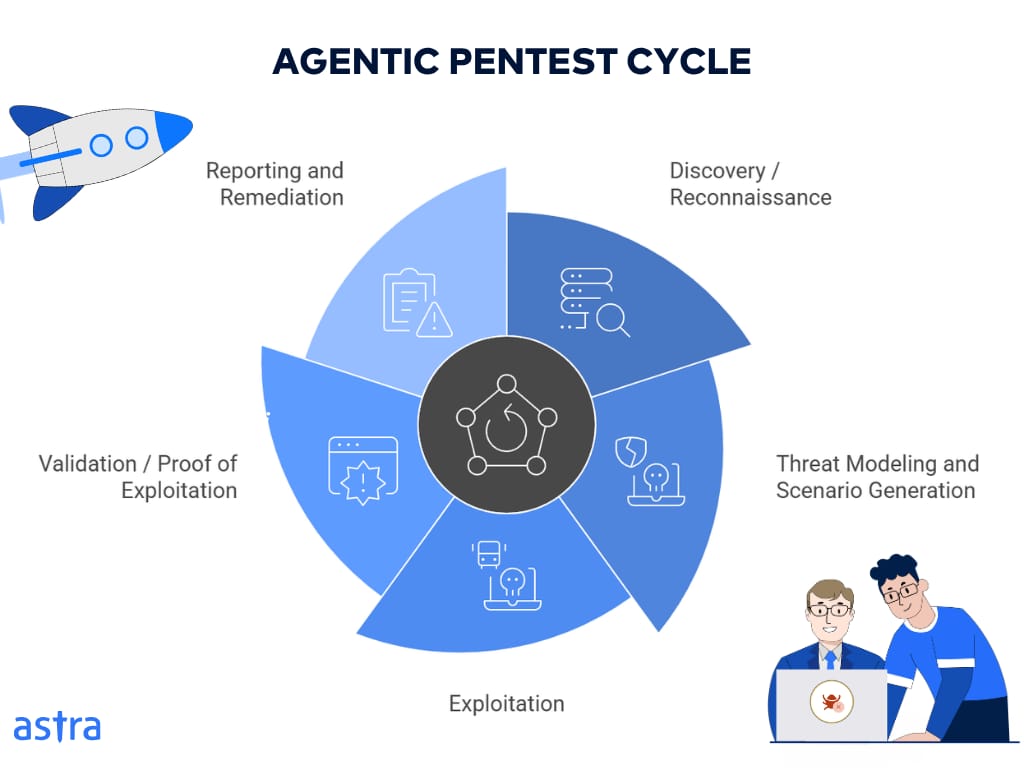
- Discovery / Reconnaissance: Mapping of the attack surface: domains, subdomains, APIs (REST and GraphQL), endpoints, authentication flows, third-party integrations, and cloud assets. The enumeration and enlisting is event-driven, bounty-hunter styled.
- Threat Modeling and Scenario Generation: The coordinator agent reasons about which vulnerability classes to test where, e.g., a checkout flow gets payment-logic and session/auth probes, an admin panel gets BOLA/IDOR and privilege escalation. Astra Security reports its agents are trained on 4,000+ real pentests and 10M+ vulnerabilities to generate context-aware test plans.
- Exploitation: Specialized sub-agents execute payloads against running targets via sandboxed tools. They chain findings: a recon agent’s discovery of an authenticated API endpoint signals the BOLA agent to probe authorization. XBOW reports executing 48-step attack paths to remote code execution and 1,060 autonomous attacks per engagement.
- Validation / Proof of Exploitation: This is the differentiator. Rather than reporting theoretical CVE matches, agents attempt the exploit non-destructively and capture reproducible evidence. XBOW frames this as deterministic logic: “AI discovers — logic validates. If it can’t be proven, it doesn’t ship.” Aikido, Escape, and NodeZero produce video, request/response captures, or chain-of-custody artifacts.
- Reporting and Remediation: Reports map findings to MITRE ATT&CK, OWASP Top 10, compliance frameworks (SOC 2, ISO 27001, PCI DSS, HIPAA), and increasingly includes developer-ready code-level fixes.
Multi-agent coordination, on the other hand, typically involves 3 architectural layers:
- A coordinator/supervisor who decomposes the goal and delegates
- A team of specialized sub-agents with focused prompts and tools
- A sandbox/tool layer enforcing safety boundaries.
Model Context Protocol (MCP) is now being used to let agents incorporate new tools at runtime, as described in the academic system PentestMCP (October 2025).
Agentic vs. Merely Automated: What the “Agentic” Label Buys You?
Agentic AI differs from traditional automation by utilizing independent planning, reasoning, and adaptability to achieve goals, whereas automation relies on rigid, predefined scripts and deterministic workflows.
Escape’s R&D team offers a clean cautionary tale for why this distinction is operationally important.
They built a specialized XSS sub-agent that, when misconfigured, “would log itself into the browser console, execute a script directly, and report ‘XSS vulnerability found here!’—hallucinating exploits that didn’t exist by faking the exploitation process itself.” The lesson, for every serious vendor, is that agents need guardrails, specialization, and orchestration. Goal-directed autonomy has architectural discipline as its spine, the absence of which produces slithering nonsense.
Genuine agentic systems, by contrast:
- Reason adaptively across multi-step interactions, maintaining context.
- Chain vulnerabilities into kill paths rather than reporting them in isolation.
- Validate before reporting, dropping unproven candidates.
- Operate continuously and respond to changes in the target environment.
Here, the arXiv ARTEMIS paper (2512.09882) provides a rigorous technical reference by presenting a multi-agent framework powered with dynamic prompt generation, arbitrary sub-agent spawning (peak of 8 concurrent, average 2.82 per supervisor iteration), and automatic vulnerability triage.
Notably, ARTEMIS did not refuse tasks that other autonomous systems (Claude Code, MAPTA) declined. Providing evidence that scaffolding and prompt design act as levers for the safety/capability tradeoff.
Key Capabilities of Autonomous AI Agents in Pentesting
Autonomous AI agents in penetration testing provide scalable, continuously adaptive security testing through attack chaining, validated exploitation, parallel execution, false-positive reduction, and deep integration into modern development workflows.
- Attack chaining: Agents combine low/medium-severity findings into high-impact paths. Astra reports cases where a weak Content Security Policy plus an XSS vector on a secondary endpoint were chained into a complete account takeover.
- Proof of exploitation: Validated findings come with reproducible artifacts. NodeZero claims “zero hallucinations” via its validation layer; Aikido and XBOW use deterministic post-discovery validators.
- Parallel testing: XBOW deploys “thousands of parallel agents”; Hadrian and Aikido deploy hundreds. ARTEMIS spawned up to 8 concurrent sub-agents.
- Breadth + depth: A media company POC of NodeZero covered 3,600 hosts in 3 days with 98% coverage; a manual engagement covered ~600 hosts. Aikido’s head-to-head against a senior manual team on a document-signing application surfaced a critical signature-forgery flaw and 12 XSS instances vs. 1 XSS found by humans over two weeks.
- False-positive validation: Hadrian reports eliminating 99.5% of alert noise via reliable validation; Pentera and Aikido make zero-finding-zero-cost guarantees.
- Continuous testing & CI/CD integration: Aikido Infinite triggers a full pentest on every code change. Escape, Astra, and NodeZero integrate with Jira, GitHub, Slack, and Wiz for closed-loop remediation.
Comparison: Agentic Pentesting vs. Automated Scanning vs. Manual Pentesting
Agentic pentesting bridges the gap between traditional automated scanning and manual pentesting by combining the scalability and continuous operation of automation with the adaptive reasoning, exploit chaining, and contextual analysis traditionally associated with human testers.
| Dimension | Automated Scanning (DAST/Vuln Scanners) | Agentic Pentesting | Manual Pentesting |
|---|---|---|---|
| Coverage | Broad but shallow; rule-based | Broad and deep; adapts to target | Deep on selected scope; <1% of large networks |
| Depth / chaining | None; finds isolated issues | Multi-step exploit chains | Excellent for creative chaining |
| Speed | Hours | Hours; continuous | 1–2 weeks per engagement |
| False positives | High (60–80% in legacy tools) | Low when validators are deterministic; risk of hallucinated PoCs without guardrails | Very low; human-verified |
| Scalability | High in volume; not in depth | High in both | Limited by tester availability |
| Cost | Low per scan, high in triage time | Subscription / flat fee; ~$18/hr in academic measurement | $5K–$50K+ per engagement |
| Compliance readiness | Partial (PCI ASV scans) | Increasingly accepted; auditors still require methodology and human attestation | Gold standard for SOC 2, ISO 27001, PCI DSS 11.4 |
| Business-logic flaws | Rarely detected | Detectable when agents have application context | Excellent |
| Continuous operation | Yes | Yes | No |
As a security leader, you need to understand that agentic pentesting is by and by replacing automated scanning as the default continuous-validation layer while complementing manual pentests that provide assurance and compliance attestation against threat actors’ creativity.
Challenges and Risks of Autonomous AI Agents in Penetration Testing
While autonomous AI agents significantly expand the scale, speed, and adaptability of penetration testing, they also introduce risks related to hallucinated reasoning, operational safety, regulatory compliance, data privacy, and over-reliance on opaque decision-making systems.
Hallucination and false reasoning
LLM-driven agents can invent vulnerabilities, fabricate exploit outputs, or fall into “hallucinated compliance,” a documented pattern in agentic AI security research where models pretend to comply with safety constraints while actually fabricating outputs. Mitigations are layered guardrails, deterministic validators, and human review before publication.
Scope control and blast radius
Autonomous agents acting in production can disrupt services, exfiltrate sensitive data, or trigger detection pipelines. Reputable vendors implement panic buttons, rate limits, network proxy enforcement, and preflight scope checks; XBOW emphasizes “non-destructive validation” with “controlled challenges.”
Ethical and dual-use concerns
Again, while we present the Blue Team side of things here, there is an actual red team salivating at the capabilities this new advancement offers them. A Dec’25 research from Palo Alto Networks Unit 42 showed that ChatGPT-4o deployed as an autonomous agent successfully executed SQL injection, SSRF, and data-exfiltration attacks that its chat-only counterpart consistently refused.
Regulatory uncertainty
PCI DSS 4.0 (Mar’25) requires documented penetration testing methodology and qualified testers (Section 11.4). SOC 2 Trust Services Criteria CC4.1 and CC7.1 mandate presenting pentest evidence of whether an agentic pentest report alone, without a human signatory, satisfies a QSA or SOC 2 auditor varies by assessor. Most vendors today produce reports specifically structured for human-attested compliance use.
Over-reliance and skills atrophy
If junior security teams outsource judgment to AI agents, internal capability decays. The Cloud Security Alliance’s stance is explicit: “Agentic AI is a crucial accelerator, not a replacement. The gold standard is AI-accelerated testing with human-in-the-loop for assurance.”
Black-box decision making
Without comprehensive logging of agent prompts, tool calls, and decision rationale, neither incident response nor audit defense is feasible. ARTEMIS researchers explicitly designed their system to capture reasoning traces.
Data privacy
Source code, API specs, and exploitation traces flowing to third-party LLM providers raise serious confidentiality questions. Pentera publishes that it operates under an ISO/IEC 42001-aligned governance framework and “data is never used for model training.” Buyers should demand equivalent contractual commitments.
Top Agentic Pentesting Tools (2025–2026)
The agentic pentesting market grew fast in 2025. What was a handful of research projects two years ago is now a category with billion-dollar valuations, FedRAMP authorizations, and AI agents that have outranked almost every human bug-hunter on HackerOne.
Below, we present to you the leading agentic penetesting platforms on six things that actually matter once you stop reading marketing pages:
- Autonomy level: How much of the pentest lifecycle (recon → exploitation → validation → remediation) does the agent actually run end-to-end?
- Coverage: Web, API, network, identity, cloud, AD — or only one of those?
- Integration: Jira, Slack, GitHub, CI/CD, ServiceNow, Sentinel, the developer’s PR.
- Exploit validation: Does it prove the bug, or just flag it like a fancier scanner?
- False-positive control: Because every false positive is engineering time you don’t get back.
- Remediation verification: Find–fix–verify, not just find.
Top 3 at a Glance
| Astra Security | XBOW | Horizon3.ai NodeZero | |
|---|---|---|---|
| Best for | Mid-market and growth-stage teams that need continuous, hybrid (AI + human) pentesting with audit-ready reports across web, API, mobile, and cloud | Application-security teams (especially in the Microsoft ecosystem) that want adversary-grade web/API testing on demand, with deterministic exploit proof | Enterprises and federal agencies validating internal networks, Active Directory, and hybrid cloud at scale |
| Coverage | Web apps, APIs, mobile apps, cloud (AWS/Azure/GCP), networks, blockchain | Web applications and APIs (and Azure-hosted workloads via Microsoft Marketplace) | Internal & external networks, AD, hybrid cloud (AWS/Azure), phishing impact, AD password audits |
| Agent model | Dual-mode: structured "Pentest Agents" + a "Bounty Hunter" agent running in parallel, Astra Security with an independent Validator AI layer | Thousands of short-lived parallel agents coordinated by a global attack-surface manager; AI explores, deterministic engine validates | Single self-directed agent (Docker container) that pivots through the network like a human attacker, no pre-staged credentials |
| Validation | Validator AI + human pentester sign-off (CREST/OSCP/CEH) for near-zero false positives | Deterministic exploit verification separate from the AI exploration loop | Real-attack execution in production, no simulation; "proven attack paths" with proof-of-exploit |
| Compliance/certifications | CREST, CERT-In, PCI ASV; reports map to SOC 2, ISO 27001, PCI DSS, HIPAA, GDPR | Customer-authorized testing; credit-pack and Private Offer enterprise plans on Microsoft & AWS Marketplaces | FedRAMP High Authorization (May 2025); NSA CAPT program; available on DoD's Platform One marketplace |
| Key integrations | Jira, Slack, GitHub, GitLab, Jenkins, Azure DevOps, Circle CI | Microsoft Security Copilot, Microsoft Sentinel, Azure, AWS Marketplace | Native API + ITSM connectors; large MSSP partner ecosystem; Vanguard Partner Program |
| Pricing | Scanner from $1,999/yr (or $199/mo); Pentest plan from $5,999/yr per target; Enterprise from $9,999/yr | From ~$4,000 per pentest (AWS Marketplace listing); tiered Lightspeed / Standard / Advanced plans matched to 2-/4-week-equivalent manual depth; enterprise via Private Offer | Custom quote: unlimited-pentest IP-based subscription; reported third-party deal sizes around $35,000+/yr |
| Notable validation | Co-authors of the OWASP Autonomous Penetration Testing Standard (APTS); Techstars-backed; G2 4.6/5 | First autonomous system to reach #1 on HackerOne US (2025); $1B+ valuation; $237M raised | 3,000+ organizations, ~1/3 of Fortune 10; 170,000+ autonomous pentests run; first AI to fully solve the GOAD Active Directory benchmark MindFort |
| Low | Medium | Medium-high |
Astra Security: Hybrid Agentic Pentesting with Human Sign-off
G2 rating: 4.6/ 5 (182 reviews)
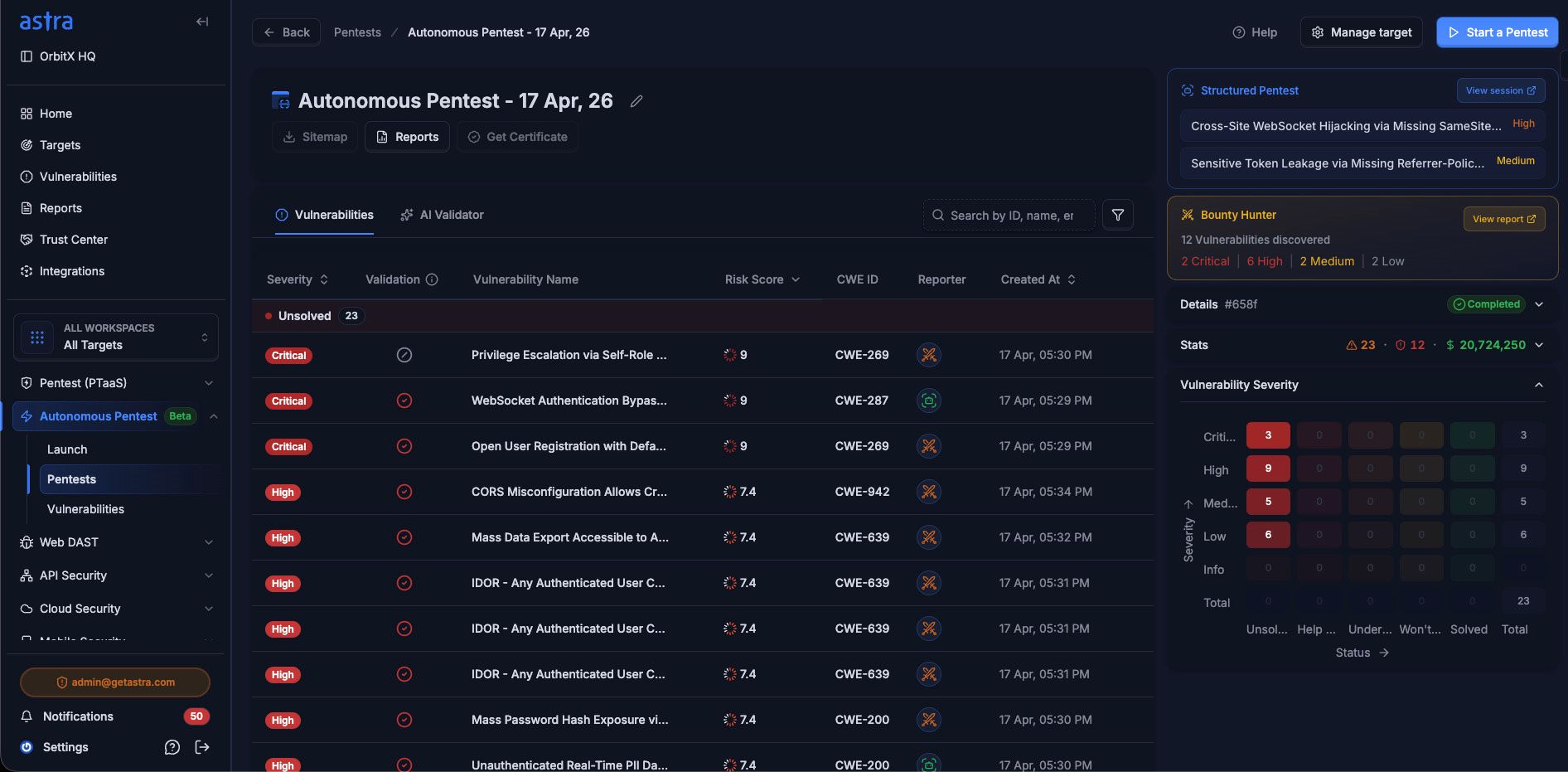
We’re a CREST-accredited PTaaS company that has been doing offensive security since 2018, and our autonomous pentesting engine is built on insights from more than 5,000 real-world pentests and 10 million validated vulnerabilities surfaced for our 1,000+ customers across 70+ countries.
We’re also the team behind the OWASP Autonomous Penetration Testing Standard (APTS), the first governance standard for autonomous pentesting platforms.
What makes our approach different from the rest of this list is that we don’t try to remove humans from the loop; rather, we deploy an army of AI agents across various layers alongside them. Two pentesting modes run in parallel against the same target:
- Structured Pentest Agents: a coordinated swarm that methodically covers the entire attack surface, the way a planned engagement would. Reconnaissance, threat modeling, dynamic test-case generation, exploit chaining, and validation, all executed without human babysitting.
- Bounty Hunter Agent: a single autonomous agent with full freedom to explore the way a bug-bounty hunter or offensive researcher would. It follows instincts, chases promising paths, and assembles a task force of tools and exploits on demand.
Together, they catch what each approach alone would miss: systematic coverage plus adversarial creativity. Every finding then passes through an independent Validator AI that confirms exploitability before anything reaches your dashboard, and Astra’s in-house pentesters (with credentials including OSCP, CEH, eWPTXv2, and 100+ CVEs collectively to their name) sign off on the report.
The result is the same human-readable, compliance-grade pentest letter you’d get from a manual engagement; produced in hours, not weeks, and re-runnable on every deployment.
Key features
- Two-mode agent architecture: Structured Pentest + Bounty Hunter, running in parallel against the same scope.
- Full autonomous lifecycle: recon → threat modeling → dynamic test-case generation → exploitation → exploit chaining → validation → remediation guidance → re-test.
- Validator AI: an independent verification layer that proves exploitability and filters noise before findings hit your dashboard.
- Attack-graph and attack-chain reasoning
- 15,000+ test cases, weekly rule updates, and OWASP Top 10 / SANS 25 / CVE coverage out of the box.
- Compliance-mapped reports for SOC 2, ISO 27001, PCI DSS, HIPAA, GDPR, and the EU AI Act, with a publicly verifiable pentest certificate.
- Certifications: CREST-accredited, CERT-In empanelled, PCI ASV.
- Native integrations: Jira, Slack, GitHub, GitLab, Jenkins, Azure DevOps, Circle CI, plus a developer-focused Gen-AI bot for contextual remediation in PRs.
Pros
- The hybrid model (autonomous AI + human-vetted findings) keeps false positives close to zero, which is important for compliance-driven teams.
- Transparent, public pricing, which is rare in this category.
- Audit-ready, publicly verifiable pentest certificates.
- Tight developer experience: results land in Jira, GitHub, and Slack rather than in a separate console.
- Active R&D presence. Astra’s team co-authors the OWASP APTS standard and continues to publish CVEs.
Limitations
- Time-zone differences between the US and India can occasionally add a day to back-and-forth on complex tickets.
Best for: Engineering-led security teams at SaaS, fintech, healthcare, and AI companies that want continuous agentic pentesting with the human sign-off and compliance evidence their auditors and customers ask for.
Pricing: Join our waitlist for launch pricing and continuous coverage at a fraction of the cost.
XBOW
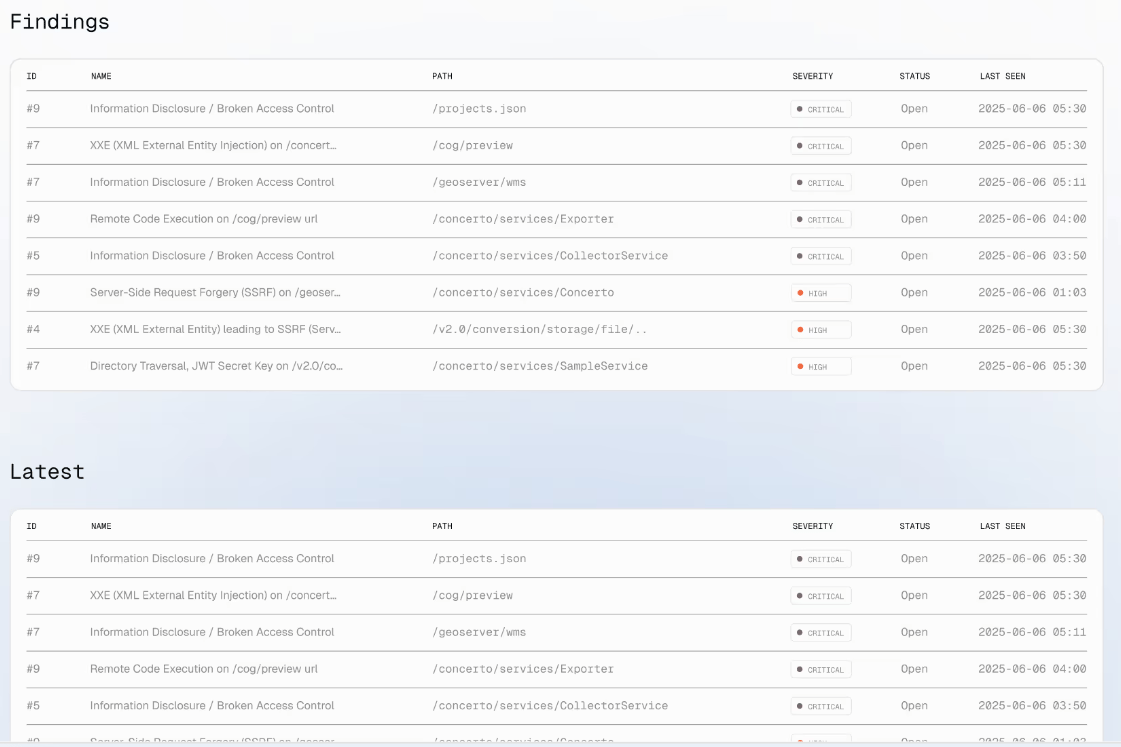
XBOW put autonomous offensive security on the front page of Bloomberg. Founded in January 2024 by Oege de Moor, XBOW set out to prove that an AI could match top human pentesters.
Key features
- Massively parallel multi-agent execution across web applications and APIs.
- Deterministic exploit verification separate from the AI agents — only validated findings.
- Reproduction steps and proof-of-exploit on every reported issue.
- Native integrations with Microsoft Security Copilot and Microsoft Sentinel (announced March 2026); listings on Azure Marketplace and AWS Marketplace.
- Customer-authorized testing across web apps, APIs, and Azure-hosted workloads.
- Source-code context, optionally combined with headless browsing and runtime exploitation for zero-day-class findings.
Pros
- The most public benchmark of any agentic pentest platform
- Low false positives thanks to the deterministic validation layer.
- Strong fit for organizations standardizing on Microsoft Sentinel / Defender / Copilot for security operations.
- “Zero Day / Zero Pay” guarantee on the Lightspeed plan: no exploit-validated finding, no charge.
Limitations
- Scope is web applications and APIs
- No automated remediation workflow; findings are surfaced for the customer to act on.
- Public customer case studies are still relatively limited compared with longer-established platforms.
Best for: Application-security teams running on Microsoft’s security stack, that need on-demand, exploit-validated web and API pentesting at machine speed.
Pricing: From ~$4,000 per pentest on AWS Marketplace; tiered Lightspeed / Standard / Advanced plans on xbow.com that map to 2-week- and 4-week-equivalent manual pentest depths.
Horizon3.ai NodeZero
G2 rating: 4.7 / 5
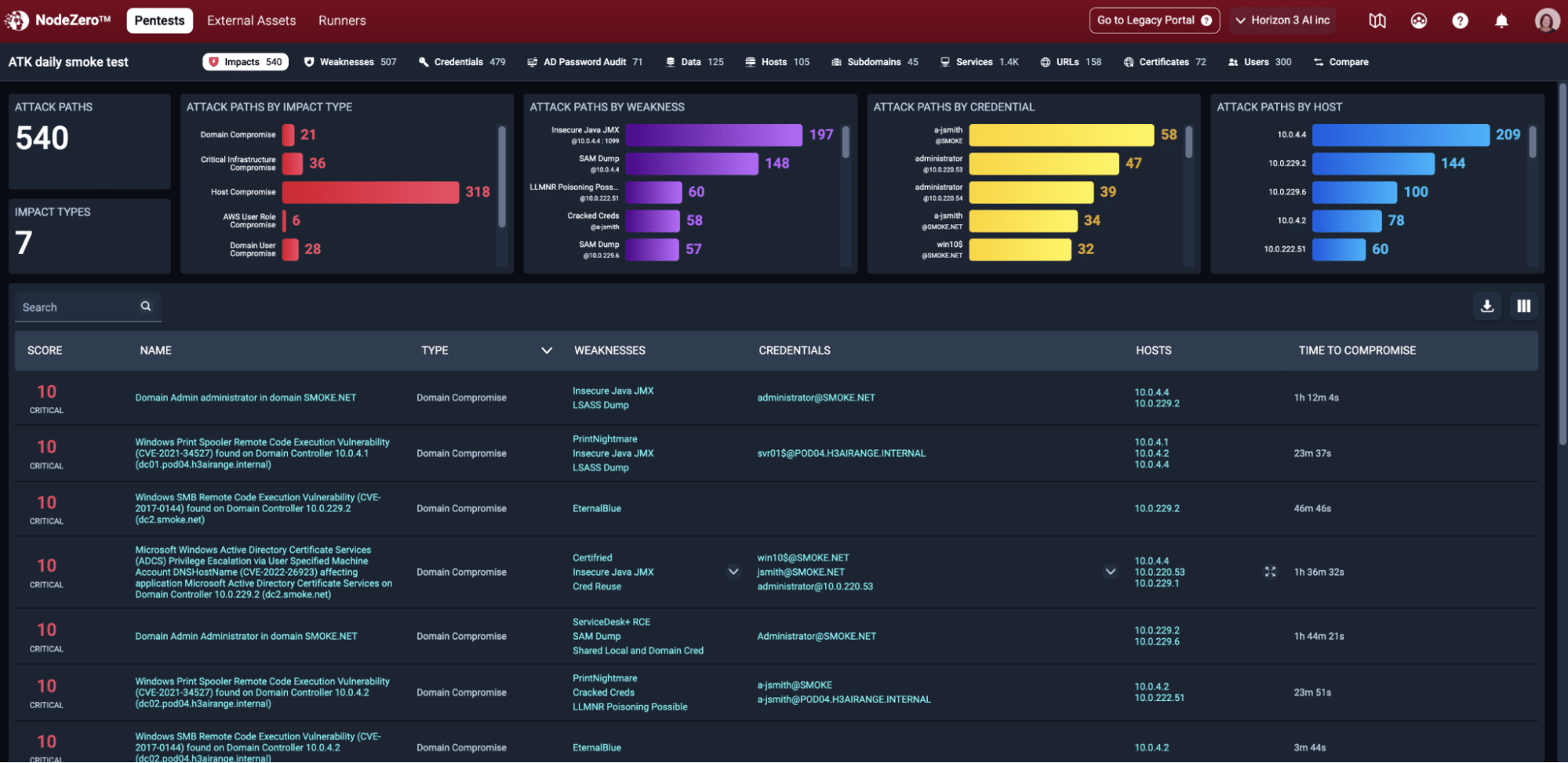
If your concern is “what would actually happen if a nation-state-grade attacker landed on our internal network?”, NodeZero is the platform most enterprises turn to. It runs as a self-directed agent (a single lightweight Docker container, no persistent agents) that launches simulated cyberattacks inside your network without pre-staged credentials.
It chains misconfigurations, weak credentials, exposed services, and CVEs into multi-step attack paths the same way an attacker would, and it does it safely in production.
Key features
- Autonomous pentests across internal networks, external attack surface, hybrid cloud (AWS, Azure), and Active Directory.
- Real exploitation with proof-of-exploit, not simulation — production-safe by design.
- Find-Fix-Verify workflow with one-click remediation re-tests.
- AD password audits, phishing impact assessments, and CISA KEV-driven validation of emerging exploits.
Pros
- Only autonomous pentesting platform with FedRAMP High and active U.S. government deployments.
- Deep network and Active Directory exploitation — areas where most “agentic” tools are thin.
- Unlimited pentests under the SaaS subscription, encouraging continuous testing rather than annual events.
Limitations
- Application-layer (web/API) testing is less developed than dedicated AppSec platforms; teams often pair NodeZero with Astra or XBOW for full-stack coverage.
- Pricing is custom and quote-based, with no self-service tier — third-party reporting suggests deal sizes around $35K+/yr.
- Cloud-based deployment can be a compliance discussion for organizations with strict data-residency requirements.
Best for: Large enterprises, federal agencies, and critical-infrastructure operators
Pricing: Contact sales.
Pentera
G2 rating: 4.7 / 5
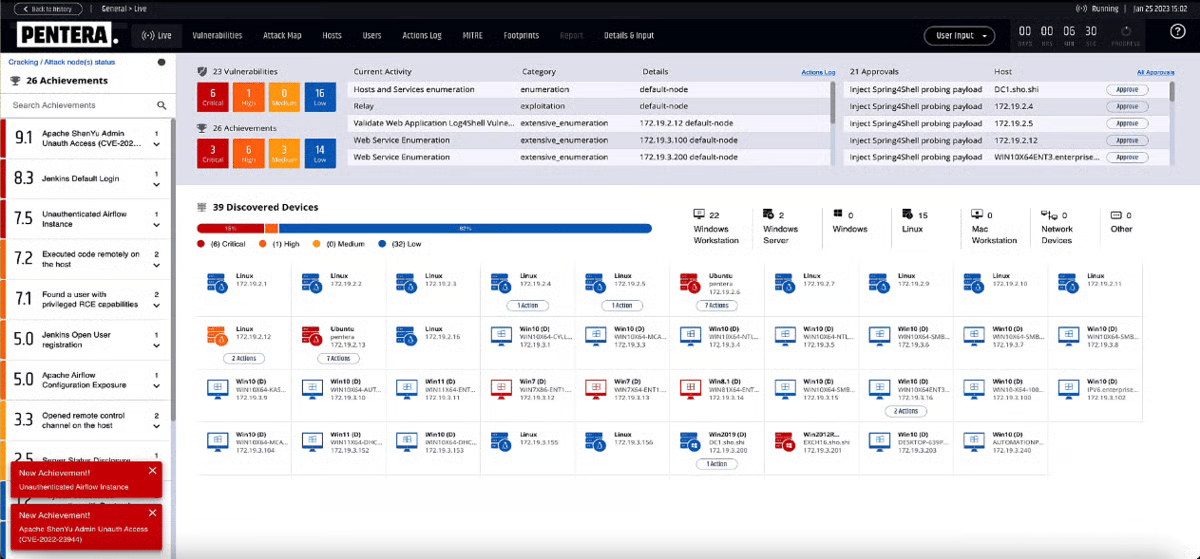
Pentera (originally Pcysys, founded in 2015 in Israel and rebranded in 2021) defined the “automated security validation” category before “agentic” was a marketing word. Gartner names Pentera a Representative Vendor in its Market Guide for Adversarial Exposure Validation.
In 2025, Pentera leaned hard into agentic AI: it introduced AI-based automated attack execution and complex attack-path analysis across the Pentera Core (internal network), Pentera Surface (external), Pentera Cloud, and the new Pentera Resolve remediation product.
Key features
- Full kill-chain emulation: reconnaissance, sniffing, credential cracking, lateral movement, privilege escalation, ransomware simulation, data exfiltration.
- Coverage across internal networks, external attack surface, cloud (incl. cloud-native attack paths), and identity/AD.
- Agentless architecture — no endpoint software to deploy.
- Pentera Resolve automates remediation orchestration through Jira, ServiceNow, and SLA-tracked workflows.
- Pentera Labs research feeds the engine with current attacker TTPs (Fortinet, VMware vCenter, lateral-movement techniques, etc.).
- Aligns directly with the CTEM (Continuous Threat Exposure Management) framework.
Pros
- Strongest analyst recognition in the category
- Mature enterprise-grade reporting and audit trails.
- Newly added remediation orchestration closes the find-fix-verify loop natively.
Limitations
- Enterprise pricing, third-party reports cite annual licensing around $120K, making it less accessible for SMBs and mid-market teams.
- Historically network-/infrastructure-centric; web-app and modern API depth still trails specialist tools.
- Some advanced configurations and broader MITRE ATT&CK targeting take time to master.
Best for: Large enterprises building a CTEM program
Pricing: Custom, contact sales. (Third-party reporting cites typical enterprise deals around $100K+/yr.)
Aikido Security
G2 rating: 4.6–4.7 / 5
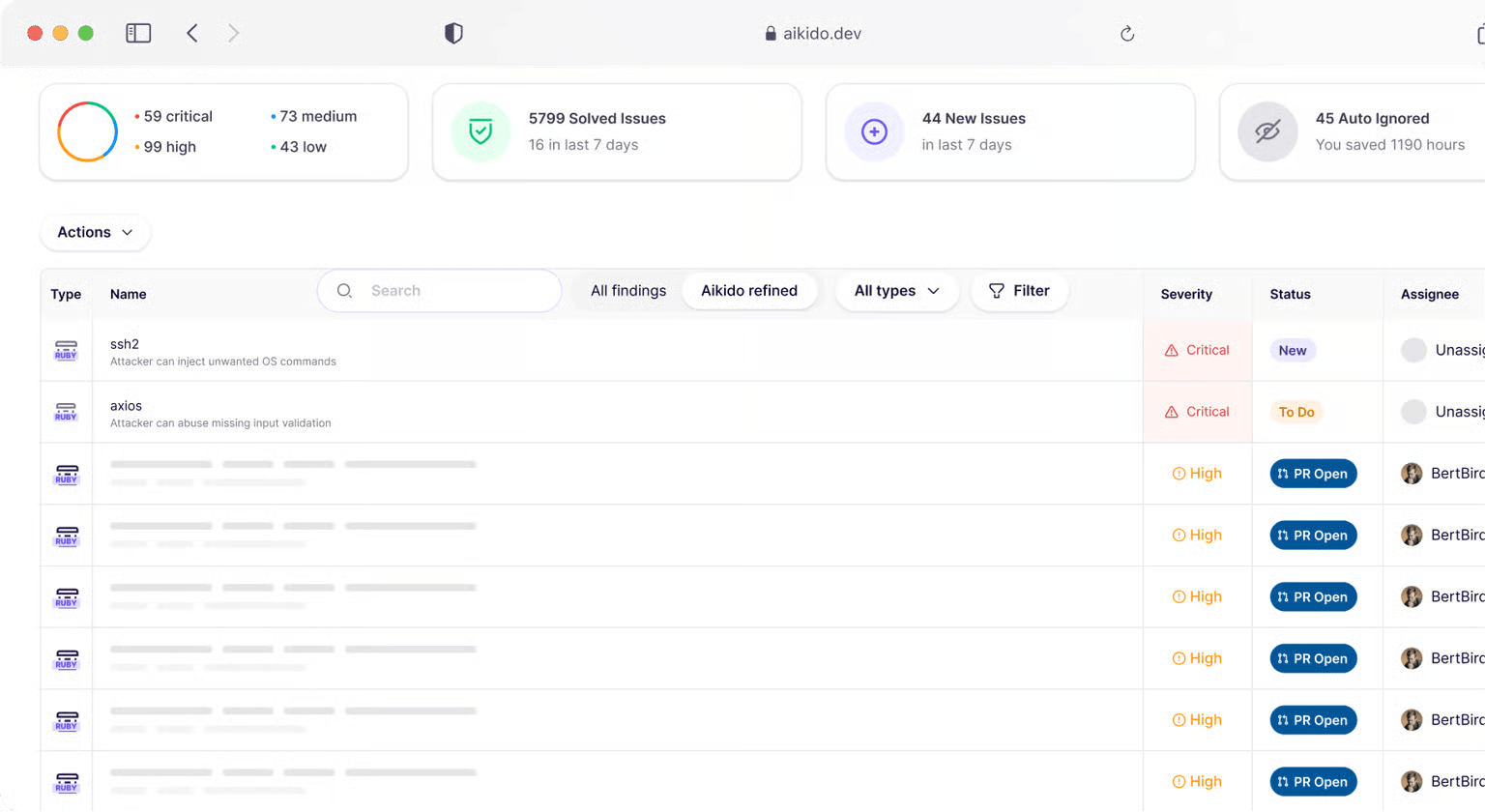
Aikido Security is the developer-first European entrant and the fastest cybersecurity company in Europe ever to reach unicorn status.
Aikido’s bet is that agentic pentesting belongs inside the developer platform that already covers code, dependencies, containers, IaC, cloud, and runtime and not as a separate enterprise-priced tool.
In February 2026, the company announced Aikido Infinite, which triggers agentic pentesting on every release, opens pull requests with fixes, and re-tests after merge, a move Aikido calls “self-securing software.”
Key features
- Aikido Infinite: continuous agentic pentesting tied to every deployment, with auto-generated PR fixes (AI AutoFix) and post-merge re-testing.
- Unified platform that combines AI pentesting with SAST, DAST (OWASP ZAP), SCA, secrets scanning, IaC, CSPM, container scanning, malware/supply-chain monitoring, and a runtime WAF.
- Free re-tests of findings for 90 days; results in hours, not weeks.
- Hosting in the US or EU for data-residency control.
- 100+ integrations across GitHub, GitLab, Jira, Slack, IDEs, and CI/CD systems.
Pros
- Easiest onboarding in the category, minutes to first results, with a real free tier.
- Tight developer experience: findings land in PRs with one-click AI fixes.
- A single platform for code, cloud, runtime, and AI pentesting reduces tool sprawl.
Limitations
- Aikido Attack and Infinite are newer than the offerings from Pentera or NodeZero. Track record in heavily regulated environments is still being built.
- Not designed as a standalone network/AD pentesting tool
- Pricing for the AI pentest product is less transparent than Aikido’s core platform tiers.
Best for: Engineering-led teams and modern SaaS companies that want autonomous AI pentesting embedded directly into their developer workflow
Pricing: Aikido offers a free tier and published paid tiers starting from the low hundreds per month for the core platform.
How to Implement Autonomous AI Agents for Penetration Testing
Drawing on patterns from Astra Security, Escape, and Cloud Security Alliance recommendations:
- Readiness assessment. Inventory apps, APIs, infrastructure, and current testing cadence. Identify where DAST/scanners are generating noise without value, where critical issues are reaching production, and where compliance mandates testing of every release.
- Define scope and scope-control mechanisms. Start with a non-critical environment—staging, a single product line, or an external attack surface. Document explicitly which assets are in/out of scope, what time windows are permitted, and what destructive actions are forbidden. Confirm panic-button and rate-limit configuration before first run.
- Tool selection. Match tooling to use case: NodeZero/Pentera for network and identity; XBOW/Escape/Aikido for web apps and APIs; Hadrian for external attack surface management; Astra/Penti for compliance-led startup buyers. Insist on demos against your own assets, not vendor-controlled demos.
- Pilot and benchmark. Run a baseline against the last manual pentest’s report. Compare findings, validate exploitability, measure time-to-detect, and false-positive rate.
- Integrate into CI/CD and ticketing. Connect to Jira/GitHub Issues for findings, Slack/Teams for alerting, and your CSPM/SIEM (e.g., Wiz) for unified visibility. Trigger tests on deployment, infra change, or new CVE publication.
- Establish a human-in-the-loop policy. Define which finding severities or asset categories require human review before remediation work begins. Reserve senior researchers for business-impact judgment, complex logic flaws, novel/zero-day exploration, and compliance attestation.
- Compliance alignment. Engage your QSA and SOC 2 auditor before relying on agentic output as evidence. Most frameworks today still expect human attestation; agentic reports become supporting evidence that strengthens, rather than replaces, formal pentest documentation.
- Governance and audit logging. Require tamper-resistant logs of every agent prompt, tool call, and finding. Without this, neither incident response nor regulator response is defensible.
Final Thoughts
Agentic pentesting has become essential for anyone shipping code faster than they can test it. The skills gap is real, vulnerabilities surface every 17 minutes, and your annual pentest can’t keep pace with your deployment cadence. Instead of replacing humans with AI, the winning teams are using agents to cover breadth and speed while keeping humans in the seat for judgment calls and compliance sign-off.
The platforms outlined each take a different approach, but they all work. The real question is whether your organization moves this year or waits another cycle.
P.S. If you want to see how agentic pentesting works in practice, try Astra Security to continuously identify, validate, and prioritize exploitable vulnerabilities before attackers do.
Frequently Asked Questions
1. What is agentic pentesting?
Agentic pentesting uses goal-directed AI agents that autonomously plan, execute, and validate attacks on your applications or networks. These agents reason adaptively, chain vulnerabilities together, and prove exploitability, operating like an army of AI bug hunters working in parallel against your attack surface.
2. How is agentic pentesting different from automated scanning?
Automated scanners follow predefined signature checks and produce long lists of potential issues. Agentic pentesting deploys reasoning AI agents that pursue exploitation goals, chain weaknesses into kill paths, and validate every finding with proof.
3. Can autonomous AI agents replace human pentesters?
Not yet. Autonomous agents excel at breadth, speed, and continuous coverage, but human pentesters still outperform on creative business-logic flaws, novel zero-day discovery, and audit-grade attestation.
4. What phases of a pentest can AI agents handle autonomously?
AI agents now handle the full lifecycle: reconnaissance, threat modeling, scenario generation, exploitation, attack chaining, validation, and report generation. Re-testing after fixes is also increasingly automated.
5. What are the risks of agentic pentesting?
The main risks include AI hallucinations producing fake exploits, scope-control failures that disrupt production, opaque agent decision-making that complicates audit defense, and unsettled regulatory treatment under PCI DSS and SOC 2.
6. Which tools offer agentic pentesting capabilities?
The leading agentic pentesting platforms in 2026 include Astra Security (hybrid AI + human-validated), XBOW, Horizon3.ai NodeZero, Pentera, and Aikido Security.
7. How do agentic pentesting tools handle compliance requirements?
Most platforms map findings to SOC 2, ISO 27001, PCI DSS, HIPAA, and GDPR controls, generating audit-ready reports. However, frameworks like PCI DSS 4.0 still require human-attested methodology and qualified-tester sign-off.
8. What is the difference between autonomous and agentic penetration testing?
Autonomous describes how independently the system runs; end-to-end without per-step human direction, while agentic describes the architecture, which includes multiple specialized AI agents coordinating via a goal-directed orchestration layer.
In short, all modern agentic pentesting is autonomous, but not every autonomous system uses an agentic, multi-agent design.
Explore Our Autonomous Penetration Testing Series
This post is part of a series on autonomous penetration testing. You can also check out other articles below.
- Chapter 1: Autonomous Pentesting: How it Works, Benefits, Tools (2026)
- Chapter 2: Autonomous vs Traditional Pentesting: What’s More Secure in 2026?
- Chapter 3: Top 10 Autonomous Pentesting Tools in 2026
- Chapter 4: How to Evaluate Autonomous Penetration Testing Security Vendors in 2026
- Chapter 5: OWASP APTS: A Complete Guide to Autonomous Penetration Testing Standard
- Chapter 6: Agentic AI in Cybersecurity: The Complete Guide for Security Teams
- Chapter 7: Autonomous Penetration Testing as a Growth Lever for Startups
- Chapter 8: 5 High-Impact Autonomous Pentesting Capabilities That Traditional Scanners Ignore
- Chapter 9: Autonomous Pentesting vs. Red Teaming: Do You Still Need Both?