
Key Takeaways
- API Security focuses on endpoints and data flows, while Application Security covers the full app stack from UI to backend logic.
- Attack patterns differ: APIs face BOLA and logic abuse; apps face XSS, CSRF, and injection.
- APIs evolve faster, creating more blind spots and requiring continuous discovery and monitoring.
- You need both, because securing the app without securing its APIs leaves your largest attack surface exposed.
Over the past few years, APIs have quietly become the front door to your most critical data and workflows, flipping security ownership on its head. Accountability and ownership of both API and Application security have shifted from your central infra and network teams to product, platform, and engineering squads that ship new APIs every week, and well, sometimes every day.
This is where CISOs and CTOs feel the tug strengthening from both sides.
The board wants faster digital transformation, richer customer experiences, and aggressive partner integrations. Meanwhile, attackers are hammering through your API endpoints, hunting for broken authorization, data exposure, and business-logic holes that your traditional tools can no longer intercept.
The result? What might look like a brilliant mature AppSec program on paper becomes a scary nightmare concealed behind the APIs powering your customer portals, mobile apps, and third-party integrations.
That is why we’ll try to settle the API security vs Application security debate, or rather confusion, once and for all. Moreover, we’ll summarise the key differences along multiple aspects, and suggest best practices to help you best manage both, albeit without grinding your product teams to a halt.
What is API Security?
API Security is all about protecting the APIs that run your products, mobile apps, partner connections, internal services, etc. Here, you’re defending against BOLA/IDOR, broken API keys, excessive data exposure, SSRF, etc., and a host of other attack vectors.
Your aim is to basically lock down every endpoint with solid authentication and authorization, validate every single request, encrypt data whether it’s moving or sitting still, and keep a constant vigil on API traffic for anything that even remotely smells like business-logic abuse.
What is Application Security?
Think of Application security as the bigger picture where you’re securing your entire application stack: web and mobile interfaces, business logics, and the data strata. Here you fight injection attacks, XSS, CSRF, broken access controls, misconfigurations, etc.
To do this, you ought to amalgamate security with design and code by running continuous SAST and DAST scans, penetration testing, locking down configurations, etc.
Not sure if your application stack is hardened end-to-end? We can help you validate every layer.

Head-to-Head Comparison: API Security Vs Application Security
Think of API security as a subset of your Application security, a rather foundational one, hence, and that is why the key difference lies in the scope. While API security zeroes in on specific endpoints and data exchanges, Application security looks at the bigger picture: web and mobile apps, IoT, cloud systems, etc.
Dimensions to be compared on:
| Aspect | API Security | Application Security |
|---|---|---|
| Core focus | Protects machine-to-machine interfaces, endpoints, and data exposed via APIs. | Protects entire applications, including UI, business logic, and underlying components. |
| Scope in the stack | Concentrates on REST, SOAP, GraphQL, gRPC, and internal/external service APIs. | Covers web, mobile, and desktop apps, plus servers, middleware, and databases. |
| Primary objective | Prevents abuse of API functionality, data exfiltration, and unauthorized access to services. | Prevents compromise of application integrity, availability, and confidentiality. |
| Level of granularity | Operates at object, resource, and method level (e.g., per-endpoint, per-operation). | Operates at page, feature, and component level (e.g., forms, sessions, modules). |
| Typical environment | Microservices, distributed systems, SaaS platforms, partner integrations, mobile backends. | Monolithic apps, web portals, enterprise line-of-business systems, client-server apps. |
| Security model | Strongly identity- and token-centric (OAuth2, OIDC, JWT, API keys, mTLS). | Session- and role-centric (cookies, web SSO, RBAC/ABAC within the app). |
| Common threats | BOLA/Broken object-level authorization, broken auth, mass assignment, excessive data exposure, injection. | XSS, CSRF, SQL injection, command injection, insecure deserialization, misconfigurations. |
| Typical attackers | Adversaries abusing APIs directly, bots, aggregators, malicious integrators, insider misuse via APIs. | Web attackers, script kiddies, insiders, automated scanners, targeted APT actors. |
| Design time concerns | Secure API design, schema definition, versioning, backward compatibility, least-privilege scopes. | Secure architecture, threat modeling, input validation, output encoding, session design. |
| Runtime concerns | Abuse of API business logic, abnormal call patterns, data scraping, enumeration, credential stuffing. | Abuse of application workflows, session hijacking, privilege escalation, resource exhaustion. |
| Discovery challenge | Shadow, zombie, and third-party APIs that are undocumented or forgotten. | Legacy apps, internet-exposed apps, shadow IT web assets. |
| Tooling emphasis | API gateways, API firewalls, API discovery, API-specific DAST/SAST, schema and contract testing. | WAFs, SAST/DAST, IAST, RASP, SCA, secrets scanning, configuration management. |
| Policy expression | Endpoint-level and method-level policies (rate limits, quotas, scopes, IP allow/deny, payload size). | Application-wide policies (authentication flows, session lifetime, input size, error handling). |
| Data protection | Focuses on payload-level security, field-level encryption, PII minimization, data exposure control. | Focuses on database security, data validation, secure storage, and encryption at rest/in transit. |
| Monitoring & logging | Fine-grained telemetry per endpoint, per client, per token, and per integration. | Application-wide logging of user sessions, actions, errors, and exceptions. |
| Change frequency | High: APIs evolve rapidly with new versions, endpoints, and integrations. | Medium: application releases and feature changes follow planned release cycles. |
| Testing strategy | Contract testing, API fuzzing, abuse-case testing, negative testing, auth/authorization testing. | Functional testing, UI testing, regression testing, business logic and workflow testing. |
| Primary standards | OWASP API Security Top 10, OAuth2/OIDC, mTLS, API security best practices. | OWASP Top 10, NIST 800 series, CIS Controls, secure coding standards (e.g., CERT). |
| Business impact of failure | Data leaks via APIs, account takeover, partner abuse, fraud through automated API abuse. | Full app compromise, data breaches, downtime, reputational and regulatory impact. |
| Strategic posture | Proactive: discover, inventory, and protect all APIs, including internal and third-party. | Proactive and reactive: harden applications and continuously remediate discovered flaws. |
Want a side-by-side assessment of your API and AppSec posture? We’ll benchmark both for you.
The Strategic Importance for CISOs & CTOs
Let’s be honest, modern APIs don’t just move data around, but expose business logic, customer PII, and payment information. Approximately 99% of organizations have dealt with at least one API security incident in the past year. BOLA, injection flaws, and broken authentication aren’t edge cases anymore, but they are one of the dominant reasons digital businesses fail today.
PCI DSS just made API security non-negotiable.
The PCI DSS 4.0/4.0.1 (March-April 2025) guidelines require automated and real-time protection on every public-facing payment API (Requirement 6.4.2) if you’re handling payment card data.
You’ll also need:
- Rock-solid authentication for both humans and machines, hitting those APIs
- End-to-end encryption of cardholder data
- Continuous vulnerability testing
- Patching throughout your development cycle.
That is why your API gateways, WAFs, schema validators, rate limiters, and API-focused pentests aren’t optional anymore; they’re audited controls.
NIST is taking the same stance.
NIST has also stopped lumping APIs under the generic “application security.” Their new guidance: SP 800-228 for cloud-native systems and the 800-204 microservices series treat APIs as a distinct attack surface with dedicated discovery, classification, authentication models, schema validation, rate limiting, and runtime threat detection, all mapped back to the Cybersecurity Framework 2.0 and SP 800-53 controls.
Basically, the days of “Do we have an API gateway and a WAF checked off?” are gone.
The real question now is, “Can we prove—to the board and other stakeholders—that our APIs and applications are discoverable, governed, tested, monitored, and resilient…real time?”
Application Security: Scope and Practices
In today’s day and age, Application security is not just about putting up walls around your perimeter. Your application itself needs to be tough enough to withstand attacks, whether that’s some kid with a script trying SQL injection or an insider who knows exactly where your session logic is weak.
There are 3 major layers you need to focus on: the presentation layer (UI, forms, client-side code), the business logic layer (APIs, microservices, backend processing), and the data layer (databases, file storage, caches).
The OWASP Top 10 becomes your guiding light here by offering a list of the most critical web application security risks that are derived from real data across thousands of applications.
Threat actors exploit these to run arbitrary code, steal credentials, grab data, or hijack accounts via SQL injection, XSS, CSRF, and broken session management. That is why modern-day application security lays never-before-seen emphasis on the shift-left and DevSecOps principles.
These principles are implemented when SAST & DAST work in tandem, where:
SAST (Static Application Security Testing) involves analysing source code without executing it, and best helps catch hardcoded secrets and unsafe functions early on while allowing for integration into IDEs. One caveat here is that it produces false positives that require careful and expert manual intervention.
DAST (Dynamic Application Security Testing), on the other hand, tests applications from the outside, like an attacker would, and finds runtime issues like injection flaws and authentication bypasses. But it requires a deployed app and is not capable of pinpointing the exact code lines that need work.
| S.No | OWASP TOP 10 (release candidate 1 November 2025) | Total Occurrences |
|---|---|---|
| A01 | Broken Access Control | 1,839,701 |
| A02 | Security Misconfiguration | 719,084 |
| A03 | Software Supply Chain Failures | 215,248 |
| A04 | Cryptographic Failures | 1,665,348 |
| A05 | Injection | 1,402,249 |
| A06 | Insecure Design | 729,882 |
| A07 | Authentication Failures | 1,120,673 |
| A08 | Software or Data Integrity Failures | 501,327 |
| A09 | Logging & Alerting Failures it | 260,288 |
| A010 | Mishandling of Exceptional Conditions | 769,581 |
The key here is to use both together, plus IAST and SCA for third-party components. For mature programs, the OWASP ASVS is one standard that offers comprehensive authentication, session management, access control, etc.
API Security: Unique Requirements and Modern Risks
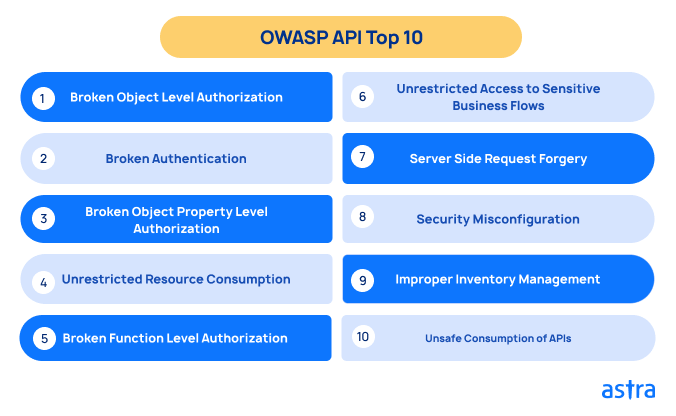
Unlike other traditional web apps with visible UIs, APIs work silently in the background which makes detecting vulnerabilities harder, rendering them easier to exploit at the same time.
Why Are APIs Uniquely Vulnerable?
- Broken Object-Level Authorization (BOLA): Via manipulation of object IDs in API requests to access other users’ data. For example, changing
/api/invoice/1234to/api/invoice/1235allows them access to someone else’s financial records. - Broken Authentication: Weak token validation, unrenewed API keys, or missing multi-factor auth allow attackers to easily impersonate legitimate users and roam laterally across your company’s tech stack.
- Excessive Data Exposure: APIs often return full objects when only a few fields are needed; this may leak sensitive data such as SSNs, account balances, or health records that create spaces for threat actors to exploit.
- Mass Assignment: When APIs accept user input without filtering, they basically allow attackers to modify internal field,s such as changing
"role": "user"to"role": "admin"in a single request.
Key Threats: The Hidden API Attack Surface
- Shadow APIs: Undocumented or forgotten APIs deployed by dev teams that mostly don’t have any security controls in place
- Zombie APIs: Old, deprecated API versions left running for “backward compatibility,” which are rarely ever patched or maintained
- Injection Risks: SQL, NoSQL, command, and SSRF injection via API parameters that don’t perform user validation for every request
- Business Logic Abuse: By automating API calls, attackers can drain inventory, scrape pricing data, or bypass payment workflows
How API Risks Vary by Industry?
In the realm of API security, threat profiles shift dramatically across sectors:
- Fintech: Payment APIs face account takeover, transaction manipulation, and rate abuse; regulatory fines (PCI DSS, PSD2)
- Healthcare: APIs exposing PHI that lead to HIPAA violations, BOLA leading to unauthorized access to patient records, etc.
- SaaS: Multi-tenant APIs are now prime targets that ease lateral movement. Moreover, shadow APIs rise as features are shipped faster than before.
Why Traditional AppSec Tools Fall Short?
Standard SAST and DAST weren’t built for API-first architectures and thus lead to:
- No API Discovery: SAST/DAST can’t inventory shadow or zombie APIs, and you can’t really secure what doesn’t even exist for your security tools
- Missing Business Logic Flaws: Traditional tools flag technical bugs like injection, but miss logic abuse, for example, using a discount API 10,000 times or automating checkout to hoard inventory.
And that is why APIs demand purpose-built security, i.e., continuous discovery, runtime abuse detection, and business-context-aware testing that traditional tools don’t.
Why You Need Both?
Application security is your first line of defense that protects everything users interact with, your business logics, backend systems, etc. But when it comes to APIs, they have risen by and by to a completely different beast that majorly handles machine-to-machine conversations that can easily skip past your traditional App security. And that’s why they need special focus and navigation.
Also, by now you must have realised, hopefully not the hard way, that no single security control is bulletproof. A layered setup that includes rate limiting, triggers unauthorized access alerts, etc., buys you time to sort out your misconfigured CORS within your APIs. And since APIs facilitate lateral movement, this entire setup has to run in parallel with your other application defences.
Moreover, compliance frameworks from HIPAA to PCI DSS now lay heavy emphasis on how you go about your API security and not just stuff it somewhere in your Application security stack.
Thus, to put it simply, your Application Programming Interfaces are a subset of your Application stack. But given the rise of APIs within a firm’s technology tech stack, it has silently morphed into a whole new attack surface itself.
You obviously need Application security to secure your web and mobile apps that are powered by not only multiple cloud systems and IoT devices but a host of different APIs that bring in their own cybersecurity caveats that need special care and attention, which starts from up-top, from CISOs and CTOs such as yourself.
Best Practices for Securing Applications and APIs
Even though the topic is API Security vs Application security, it isn’t about picking one over the rather developing layered defenses that work in tandem to create a robust and agile security posture for you.
Application Security Essentials
- Get developers thinking security-first. Train your team on OWASP guidelines since they act as battle-tested defenses against your real-world attacks. Secondly, conduct regular peer code reviews and include security checks into your SDLC from day one.
- Focus on all vulnerabilities. Implement continuous scanning with SAST and DAST tools, and prioritize your fixes based on what has the potential to create the biggest business impact
- Lock down access with smart permissions. Use RBAC when you need a clear structure, and switch to ABAC when context matters, like blocking access from unusual locations or unfamiliar devices.
- Don’t let dependencies become your weakest link. Automate their scanning, set clear SLAs to patch critical CVEs, and always test patches in staging first. Pushing untested updates straight to production is a big no-no.
- Make your logs work for you. Capture authentication attempts, authorization failures, and error events in one place. Feed everything into your SIEM so you can correlate patterns and catch attacks as they happen, not days later.
API Security Essentials
APIs need a different playbook as traditional AppSec often can’t help with its identity-first, granular controls demands.
- MFA isn’t optional anymore. Enforce it for anyone accessing your APIs, especially on admin or sensitive endpoints. Passwords just don’t cut it now.
- Verify your tokens. Implement OAuth 2.0 and short-lived JWTs, alongside signature validation.
- Throttle the bad actors. Set rate limits per client and per endpoint. Stop automated scrapers and credential-stuffing bots before they burn through your resources and compromise accounts.
- Encrypt everything, everywhere. Use TLS 1.3 for data moving between systems, and encrypt sensitive data at rest, such as PII, payment details, API keys, etc.
- Centralize control at the gateway. Your API gateway should handle authentication, rate limiting, logging, and threat detection in one place. This is your first line of defense.
- Test APIs like you mean it. Build contract testing, fuzzing, and negative-case testing right into your CI/CD pipeline, this helps you catch API-specific vulnerabilities before they ever reach production.
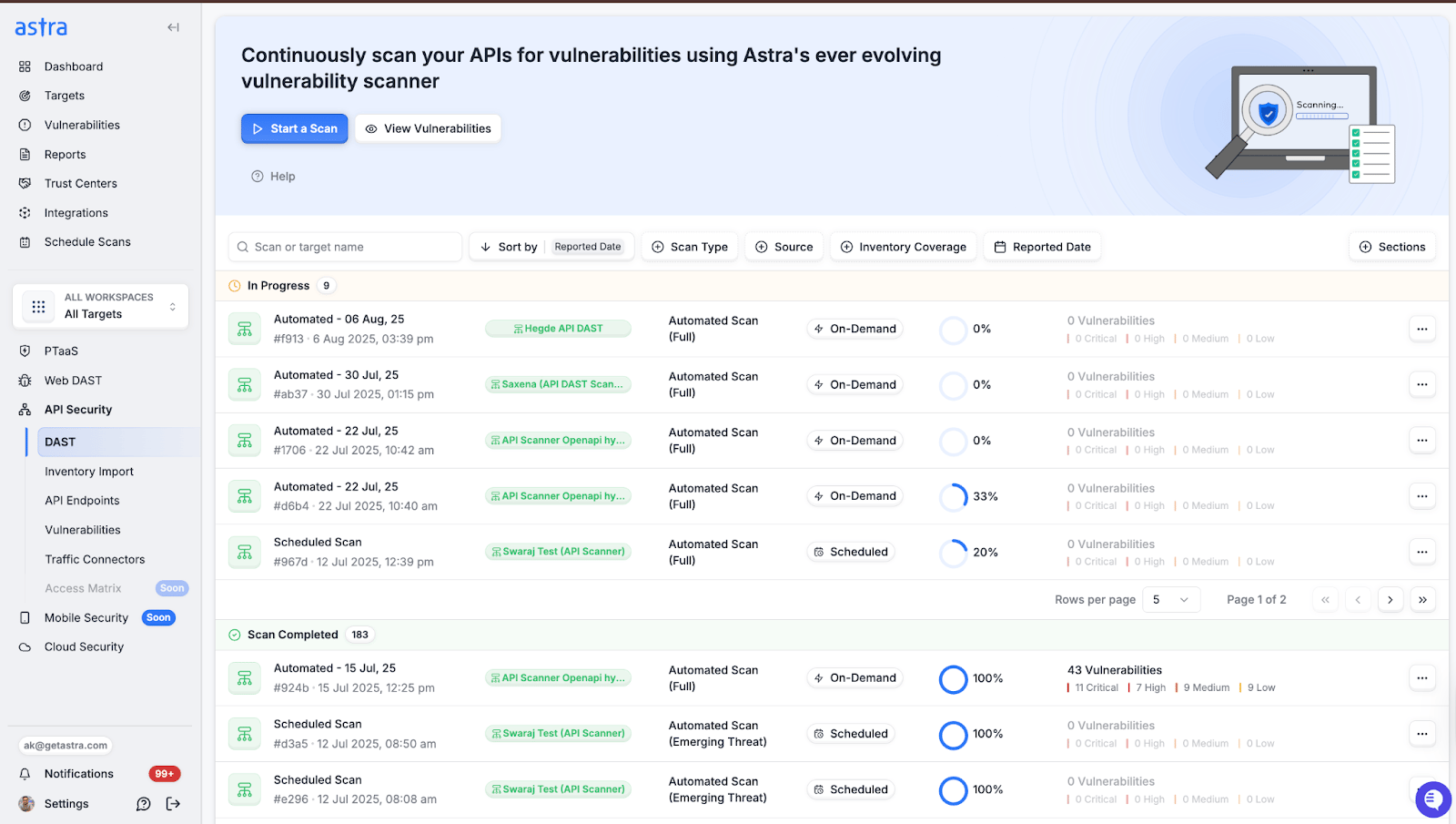
How Can Astra Security Help?

Key Features:
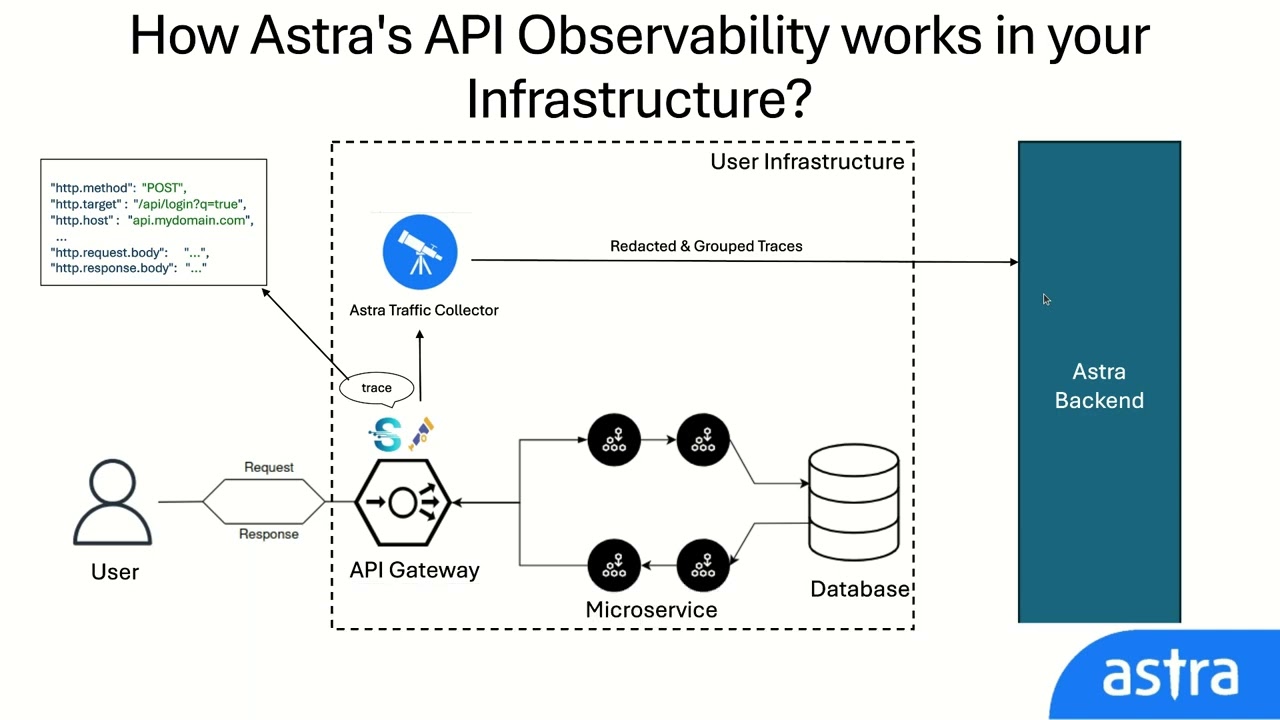
- Automated discovery, traffic monitoring, and continuous inventory of all APIs, including shadow and zombie APIs.
- Seamless integrations – Works with AWS Traffic Mirroring, Kubernetes, GCP Packet Mirroring, Azure, Apigee, NGINX, and more for real-time scanning.
- Offensive DAST scanning with over 15,000 attack scenarios and advanced vulnerability scanning
- Hacker-style API pentest – Expert-led (CREST, OSCP, and CEH-certified) penetration testing simulating real-world attacks to uncover business logic vulnerabilities. security experts
- AI-powered risk scoring and attack simulation (“Attack AI”) with zero false positives guaranteed
- Secure workflow integrations with CI/CD, GitHub, GitLab, Jira, and Slack
- Certified for ISO27001, PCI DSS ASV, and CERT-In, bolstering regulatory audits and global compliance
Astra provides an end-to-end API and Application security solutions that combine automated scanning and manual penetration testing to protect against over 15,000 vulnerabilities, including the OWASP API Top 10 and business logic flaws.
We go beyond vulnerability identification to deliver end-to-end remediation support. Unlike point tools that create security silos, Astra Security consolidates API discovery, automated testing, and expert penetration testing into one unified platform, eliminating context-switching and duplicate efforts.
Last but not least, your audit season.
Whether you’re dealing with PCI DSS 4.0, ISO 27001, CERT-in, or RBI requirements, Astra handles your heavy-lifting with ease with built-in compliance controls that track everything automatically. We strive to ensure your APIs stay compliant across the lifecycle and can be easily monitored with our CXO-ready non-TLDR reports and dashboards.
Final Thoughts
We hope that by the time you reach here, you’ve understood that API security and Application security are no longer separate concerns but interdependent pillars that support your firm’s digital robustness.
API security demands dedicated governance, continuous discovery, and real-time monitoring. Moreover, the regulatory scrutiny (PCI DSS 4.0, NIST frameworks, CERT-in) on them also strongly advocates for this integrated approach.
The right way here is to automate API discovery, enforce strict zero-trust principles on all API gateways, and imbibe security within the CI/CD pipelines.
Secondly, partner with platforms that combine monitoring, discovery, mobile and web application pentesting, and remediation into a simplified workflow, eliminating silos. In 2026, you don’t need more tools; rather, intelligent, integrated security strategies that protect both applications and APIs.
FAQs
Why is API Security Important?
APIs are now the primary attack surface for modern businesses that directly expose your business logics, PII data, and payment tech stack. A single API endpoint, if breached, can snowball into a data breach, regulatory violation, and operational disruption. To top that, unlike traditional applications, APIs operate silently in the background, which requires special vulnerability scanners to detect and halt their exploitation at scale.
What are the best API Security tools in 2026?
Some of the leading API security tools in 2026 are Astra Security’s API Security Platform, which offers Comprehensive API discovery, automated DAST scanning with 15,000+ attack scenarios, manual pentesting by certified experts, real-time threat detection, and CI/CD integration. Other tools are 42Crunch, Wallarm, Postman, Traceable API Security
What is Application Security in Cybersecurity?
Application security is a broad space within cybersecurity that basically involves securing your entire customer/client and internal-facing applications across web and mobile, including APIs and those hosted on cloud setups.
Some aspects of it include secure coding, vulnerability scanning (SAST/DAST), penetration testing, implementing access controls, encryption, and continuous monitoring so you don’t fall prey to data breaches and malicious exploitation that can disrupt your entire operations.
What are the best Application Security tools in 2025?
Some of the leading API security tools in 2025 are Astra Security DAST Scanner & PTaaS Platform, which combines offensive DAST scanning with 15,000+ attack scenarios and manual penetration testing by CREST-certified experts, real-time remediation, and compliance-ready reporting. Other tools include Snyk, Checkmarx, Veracode & HackerOne.