

Key Takeaways:
- With continuous compliance, proofs and controls naturally ship with every release. Audits turn into a check, not chaos.
- Build compliance into DevOps, and audits stop draining time and money. Engineers focus on remediation, leaders see ROI.
- DAST shows live attack resilience. VAPT confirms tricky business logic cases. Together, they create proof that auditors trust.
- Start small and practical. Tackle risky controls, add compliance-as-code, set clear owners, then automate evidence and retests.
For most CTOs, the real compliance problem is not passing audits. It is how compliance pushes releases to a halt and drains DevOps velocity. Code ships daily, deployments span clouds, and CI/CD moves fast. Quarterly or annual checks simply do not keep up, and that gap creates audit fatigue and surprise findings.
Continuous compliance reframes this by integrating controls into the delivery process. It treats compliance as code, automated monitoring, and auditable evidence pipelines that run with your CI/CD. And in this guide, we will show what continuous compliance means in 2025 and how you can implement it across cloud and hybrid stacks without slowing your teams.
What is Continuous Compliance (and What It’s Not)?
Continuous compliance is the practice of maintaining ongoing adherence to security standards and regulatory requirements through real-time monitoring, automated evidence collection, and integrated workflows.
Instead of audits that leave month‑long gaps, it gives you round‑the‑clock visibility into security and compliance.
This isn’t just about doing audits more often. It’s a fundamental shift from reactive “checkbox compliance” to proactive governance implemented in daily operations. Where traditional approaches create compliance debt that gets paid off during stressful audit seasons, continuous compliance turns governance into operational efficiency.
Here’s how the two approaches differ:
| Aspect | Continuous Compliance | Traditional Periodic Compliance |
|---|---|---|
| Monitoring Frequency | Real-time, 24/7 | Scheduled intervals (annually/semi-annually) |
| Risk Detection | Immediate and proactive | Delayed, reactive (issues surface during audits) |
| Evidence Collection | Automated, tagged, and auditable | Manual collection (silos) |
| Tech Integration | High (DevOps toolchain integration) | Present but in moderate quantity |
| Cost Structure | Higher initial investment, but lower long-term costs | Lower upfront, but higher hidden compliance costs |
| Team Ownership | Shared across engineering + security + GRC | Siloed (GRC/Security team) |
The urgency for continuous compliance in 2025 stems from three converging reasons. The rise of cloud-native systems that evolve by the day, regulations demand faster disclosures, and old compliance models simply fall behind. The pace of change leaves no room for delay.
What continuous compliance is not:
- It’s not just a tool you can purchase. It’s a shift in governance, automation, and organizational mindset.
- It’s not only about security. It takes privacy, operational risk, and data management into consideration, too. And needs IT, engineering, legal, and HR working together.

Why Continuous Compliance Matters in 2025?
1. Audit Readiness & Reduced Friction
Continuous compliance shifts audits from a panic exercise to an “always ready” situation. Automated evidence means auditors review proof in real time instead of waiting for last-minute collections. This results in shorter audit cycles, fewer questions, and relief for your teams.
This approach not only reduces audit costs but also becomes a signal of maturity for regulators and boards. You are no longer scrambling to show compliance, you are demonstrating it continuously.
2. Operational Efficiency & Cost Predictability
Non-compliance is expensive. The average penalty of non-compliance reaches $14.82 million, which is nearly three times higher than the average cost of maintaining compliance. Continuous monitoring takes these costs out of the equation by catching issues early, while reducing incidents.
This means predictable budgets and smoother operations. Teams focus on shipping features, not on fighting repetitive alerts, while leadership gets a clearer ROI from every dollar spent on compliance.
3. Stakeholder Trust & Governance Excellence
With continuous compliance, trust moves from claims to proof. Customers, partners, and auditors see real-time evidence instead of promises, which accelerates deals and improves confidence.
And regulations are raising the bar. NIS2, DORA, and SEC disclosure rules demand speed and transparency. Continuous compliance ensures you can meet those timelines without sacrificing delivery velocity.
Benefits of Continuous Compliance for CTOs & CISOs

Continuous compliance has multiple benefits, some of which include:
Always-On Audit Readiness:
Continuous compliance reduces the traditional audit preparation period. By automating evidence collection and integrating it with daily operations, your business always remains ready.
Whereas auditors receive real-time security reports instead of last-minute prepared paperwork, showcasing mature governance and often reducing audit duration and costs.
Improved Cross-Team Accountability:
The biggest cultural shift is moving compliance from a GRC or Security team’s burden to a shared organizational responsibility. Real-time monitoring and alerts ensure engineering, IT, and operations teams actively participate in maintaining security standards.
This embeds security “by design” into workflows and breaks down the traditional silos between security and development teams.
Measurable Cost Reduction:
Beyond the obvious audit savings, continuous compliance monitoring delivers monetary benefits too. It reduces compliance-related expenses by 25-40%, security incidents by 40-60% which leads to significant cost savings.
Supports Multi-Framework Compliance:
Most enterprises need to comply with multiple standards simultaneously. With continuous compliance platforms, you don’t start from scratch each time. Shared controls are mapped across all frameworks in one go.
This avoids doing the same work twice and ensures security stays uniform across multiple frameworks like SOC 2, ISO 27001, GDPR, HIPAA, and other requirements.
Key Components of a Continuous Compliance Program
| Component | Description/Function |
|---|---|
| Automated Policy Monitoring & Drift Detection | Runs regular checks against compliance baselines, providing real-time alerts when controls fail or configurations drift from compliant states. Catches issues before they escalate. |
| Evidence Collection Pipelines | Automatically generates and tags proof for controls, i.e, logs, screenshots, and tickets. Creates audit-ready documentation with minimal manual effort and maintains data integrity. |
| Risk-Based Alerting & Prioritization | Focuses on material risk and failed controls rather than every anomaly. Uses intelligent risk registers built on CVSS. This makes it easier for CISOs to prioritize threats and direct investments where they will have the max impact. |
| Real-Time Dashboards & Stakeholder Reporting | Allows leaders and auditors a clear, real-time view of compliance. Drives data-backed decisions and sharper governance discussions. |
| Integration with Security & DevOps Toolchains | Seamlessly connects with VAPT, DAST, SIEM, and ticketing systems like Jira. Streamlines tools while quietly integrating compliance into existing workflows. |
Together, they cut through fragmented tools and siloed workflows. Compliance shifts left, so governance blends into development instead of piling up later.
How to Implement Continuous Compliance Across Your Business

Step 1: Scope, Map, and Prioritize Controls
Start by cataloging your systems and data flows. Then, map the standards like SOC 2, NIS2, DORA, or HIPAA you want to be compliant with. After this, do a brief gap analysis. This will reveal exposure points and identify high-impact assets that drive your operations.
Turn that into a prioritized roadmap. High-risk services first, shared controls next, then low-risk items.
- Identify the top 10 business-critical assets.
- Map owners, data types, and control dependencies.
Step 2: Choose Compliance-as-Code Tooling
Pick platforms that let you express policies as code and hook them into CI/CD and IaC pipelines. That means failures can block deploys or open tickets automatically, not just generate emails.
Make sure tools map controls to frameworks and produce auditable data that your auditors recognize.
- Require API integrations (GitHub, AWS, Azure).
- Prefer policy libraries + prebuilt control mappings.
Step 3: Assign Clear Ownership and Include Checks in Sprints
Give every control a named owner and a remediation SLA. Add compliance tasks to sprint backlogs so they ship with delivery, not as late-night fixes.
Define lightweight runbooks for common failures and an escalation path for high-severity findings.
Step 4: Automate Evidence Pipelines and Prioritized Alerting
Automate collection of scans, config snapshots, logs, screenshots, and ticket links. They should flow directly into a single, managed dashboard that stores evidence. Tie your DAST or VAPT outputs directly to remediation tickets and retests.
Alert only on material deviations and surface enrichments like affected roles, or data scope, so engineers fix what actually matters.
- Integrate DAST/VAPT/SIEM → Jira/Issue tracker.
- Auto-tag evidence with control IDs and timestamps.
Step 5: Measure, Tune, & Organize the Feedback Loop
Track KPIs like MTTR, control pass rate, and drift frequency, and review posture quarterly. Use those numbers to sharpen thresholds, reshape controls, and win leadership buy-in for investment.
Review your posture quarterly, add new controls, and conduct training so compliance becomes a standard operating procedure, not an annual surprise.
Pro Tip: A verified user in r/sysadmin recommends choosing solutions with strong integrations with AWS, GitHub, etc., automated evidence generation capability, and the flexibility to adapt controls to real workflows.
The Role of VAPT & DAST in Continuous Compliance
Vulnerability Assessment and Penetration Testing, and DAST are not just security practices and tools. They are essential components of continuous compliance monitoring. They work as automated control tests that validate whether your security measures actually work.
DAST simulates real-world attacks on running applications, showcasing actual exploits like SQL injection and database extraction. This provides concrete evidence that auditors can verify. And when it’s integrated into CI/CD pipelines, it catches vulnerabilities before deployment.
Want to automate vulnerability checks in your CI/CD pipeline? Check out the best DAST tools built for modern DevSecOps teams.
VAPT takes a hybrid approach and combines automated scanning with human testing, catching flaws that scanners alone can’t. Beyond finding risks, it leaves behind evidence you can use. Things like scan logs, screenshots, and remediation reports, which are already aligned with GDPR, ISO 27001, and HIPAA requirements.
Continuous scans keep compliance proof fresh, not outdated between audits. Automated retesting post-remediation proves vulnerabilities were fixed, not just acknowledged. This real-time validation transforms security testing from periodic checkboxes into ongoing compliance activity.
What’s Next: AI, CTEM, & Future of Continuous Compliance
Having understood the role VAPT and DAST play in continuous compliance, it’s also important to have a look at what the future looks like:
1. AI & Predictive Compliance Monitoring
Moving forward, AI won’t replace audits. It will make them smarter. You can expect models that spot anomalous control behaviour, predict which checks are likely to fail, and surface the small signals that precede bigger incidents. That turns noisy telemetry into a prioritized to-do list.
Practically, modern platforms like ours correlate DAST/VAPT findings with config drift and user activity, assign risk scores, and auto-suggest remediation steps, while triggering retests. This combination shortens MTTR and gives you predictive, auditor-ready evidence instead of surprise findings.
2. CTEM (Continuous Threat Exposure Management) Integration
CTEM has an exposure-first approach. This means:
Asset discovery + vulnerability intel + attack-path modelling = prioritized exposures that matter to the business.
It focuses effort where an attacker actually could move, not on every low-value finding. When CTEM feeds your compliance pipeline, exposures map directly to controls and audit impact. Platforms that tie exposure scores to control status and to dashboards turn security noise into a single, ranked roadmap for both remediation and compliance proof.
How Can Astra Security Help?
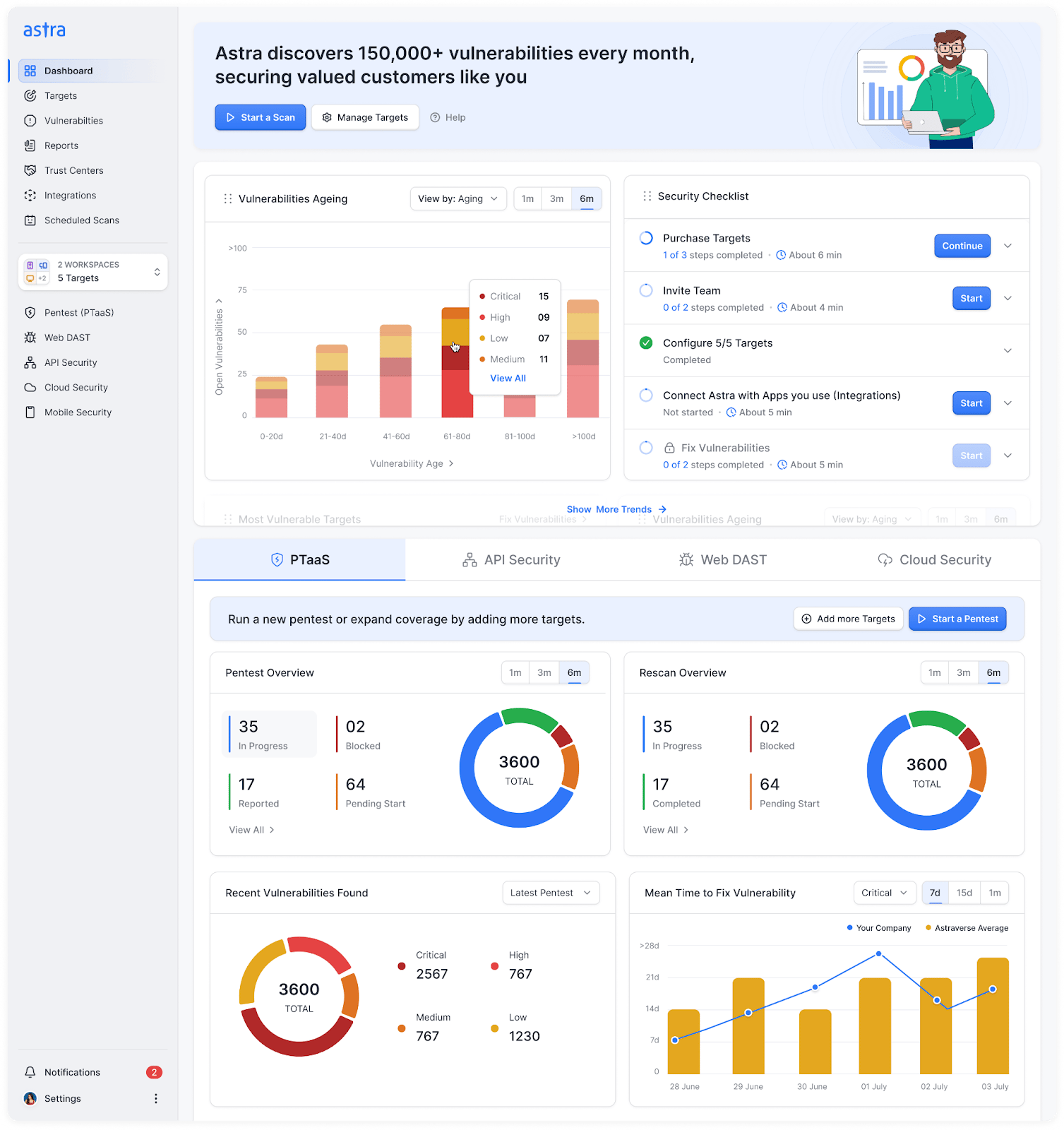
Key Features:
- Run 15,000+ unified security tests covering OWASP, SANS, ISO, SOC controls with cloud-based scanning
- Trigger scans directly from CI/CD pipelines for continuous compliance validation
- Generate audit-ready PDF reports with real-time compliance tracking for SOC 2, ISO 27001, GDPR, HIPAA
- Built-in collaboration workflows with intuitive dashboards and visual vulnerability summaries
Astra Security provides unified continuous compliance monitoring that eliminates tool sprawl while maintaining audit readiness. Our platform combines automated DAST scanning with expert-led VAPT to validate controls in real-time, generating the proof auditors need without manual effort.
The integrated approach means compliance evidence stays current across multiple frameworks simultaneously. Each deployment goes through compliance checks right in your CI/CD pipeline. The best part? Automated reporting keeps CTOs and auditors in the loop with real-time security insights.
Final Thoughts
If compliance exists just for audits, it’s already too late. Continuous compliance runs live with your cloud, pipelines, and integrations. You catch drift early, reduce manual effort, and avoid surprises before they become incidents. Auditors want proof, and this gives them traceable artifacts.
Try starting with a narrow scope. Implement controls as code, and automate evidence into tickets and dashboards. Use DAST for speed and human-led VAPT for context. The balance reduces noise and, over time, makes compliance an asset.
FAQs
What is the approach to maintain continuous compliance?
Start with automation at the core. Monitoring, evidence collection, tagging, and accountability fit right inside the pipeline. Add live dashboards and risk-focused alerts to turn compliance into a daily habit instead of a drag.
What are the three 3 C’s of compliance?
According to some frameworks, the three C’s are Communication (sharing expectations and evidence), Confirmation (recording events and validating controls), and Correction (addressing failures and adjusting policies). They form a practical backbone for effective programs.
What is continuous condition monitoring?
It’s the ongoing tracking of machine or system health, like vibration, temperature, or pressure, to spot faults before they cause failure. It’s a key part of predictive maintenance that avoids downtime.
What are examples of types of continuous compliance?
You can automate compliance mapping for frameworks like SOC 2 or GDPR across the cloud. Or stay on top of vendor risk, version control, and privacy instantly. In any type, compliance stops being a checkbox and becomes dynamic and adaptive.