
Most people start this search with “which vendor is best,” but what you need depends on the problem: a compliance deadline needs a scoped, point-in-time test, while a constantly changing attack surface needs continuous monitoring & real concern about getting breached warrants someone actively trying to break in.
Get the category wrong, and you’ll walk away with a clean report while the real risk keeps compounding, faster than most dashboards can track. Per Astra’s State of Continuous Pentesting Report 2026, critical vulnerabilities grew 14.6x faster than everything else. So how do the top network penetration testing companies and tools break down by what they’re each built for? Let’s take a look.
Top Network Pentesting Companies
What are Network Penetration Testing Companies?
Network pentesting companies help identify an organization’s infrastructure vulnerabilities by simulating real-world attacks, providing you with critical insights into misconfigurations, outdated systems, and exploitable weaknesses.
The best network pentesting companies enable proactive risk mitigation and ensure compliance with security standards across industries and geographies, protecting business-critical assets and data.
At a Glance
- Need a compliance-ready, expert-led test with broad asset coverage? Go with Astra Pentest.
- Want a proven automated scanner for known CVEs on a budget? Nessus or OpenVAS.
- Worried about insider threats and zero-days, not just known vulnerabilities? Sophos NDR.
- Need continuous, always-on PTaaS with human-validated findings at scale? NetSPI or Bishop Fox.
Top 3 Network Pentesting Companies Compared
| Features | Astra | Nessus | OpenVAS |
|---|---|---|---|
| Platform | Online | Online | Local, Docker, Cloud |
| Capabilities | Expert-led & AI-augmented pentests for networks, workspaces, & IoT devices | Automated web application & network pentesting | Automated web application & network pentesting |
| Remediation Support | Yes | Yes (at additional cost) | No |
| Compliance | HIPAA, GDPR, SOC 2, PCI-DSS, ISO 27001 | HIPAA, ISO, NIST, PCI-DSS | PCI-DSS, HIPAA, and other frameworks |
| Integrations | Slack, JIRA, GitHub, GitLab, CircleCI, Jenkins | AWS, Microsoft, Splunk | Various SIEM tools |
| Pricing | Starts at $5999/yr | Starts from $5,652.20/ year | Open-source |
| Rating on G2 | 4.6 out of 5 | 4.5 out of 5 | 4.4 out of 5 |
Why Trust This List?
We pulled this together from vendor docs, G2 reviews, pricing pages, and compliance certifications, all checked as of September 2026. Any claims about accuracy or speed that we couldn’t verify ourselves, we’ve flagged as vendor-reported. Rankings come down to real coverage, integrations, and fit, not who has the flashiest pitch deck.
Best Network Penetration Testing Companies in 2026
1. Astra Pentest

Key Features
- Platform: Online
- Capabilities: Expert-led and AI-augmented pentests for networks, workspaces, & IOT devices
- Remediation Support: Yes
- Compliance: HIPAA, GDPR, SOC 2, PCI-DSS, and ISO 27001
- Integrations: Slack, JIRA, GitHub, GitLab, CircleCI, Jenkins, etc.
- Price: Starts at $5999/ yr
- Rating on G2: 4.6 out of 5 (239 reviews)
Astra’s network penetration testing services continuously assess network infrastructure across 8,000+ vulnerabilities and hacks, covering everything from firewalls, routers, switches, and WiFi to Active Directory, printers, biometric devices, and CCTV systems. Our AI-powered test cases and manual validation catch misconfigurations, open ports, rogue services, and exploitable weaknesses others miss, while eliminating false positives.
With thousands of AI-augmented checks, Astra simulates real-world attack scenarios across your entire network perimeter, testing device patch levels, auth, logging, & protocol configurations. As one of the leading network pentesting companies, it integrates directly with CI/CD tools, offers real-time reporting, & includes post-remediation rescans to help security teams keep up against evolving threats.
Pros:
- Broad asset coverage: network perimeter, firewalls, laptops, routers, WiFi, Active Directory, printers, biometric devices, CCTV
- Publicly verifiable certifications post 2 free rescans
- Integrations with Slack, Jira, GitHub, GitLab, and Jenkins
- CXO-friendly dashboard with a dedicated CSM
- Customizable reports for management and developers, respectively
- Zero false positives (with vetted scans)
Limitations:
- No trial available for network pentest services
2. Nessus
Key Features
- Platform: Online or Installed locally
- Capabilities: Automated web application and network pentesting
- Remediation Support: Yes (at additional cost)
- Compliance: HIPAA, ISO, NIST, PCI-DSS
- Integrations: AWS, Microsoft, Splunk
- Price: Starts from $5,652.20/ year
- Rating on G2: 4.5 out of 5 (307 reviews)
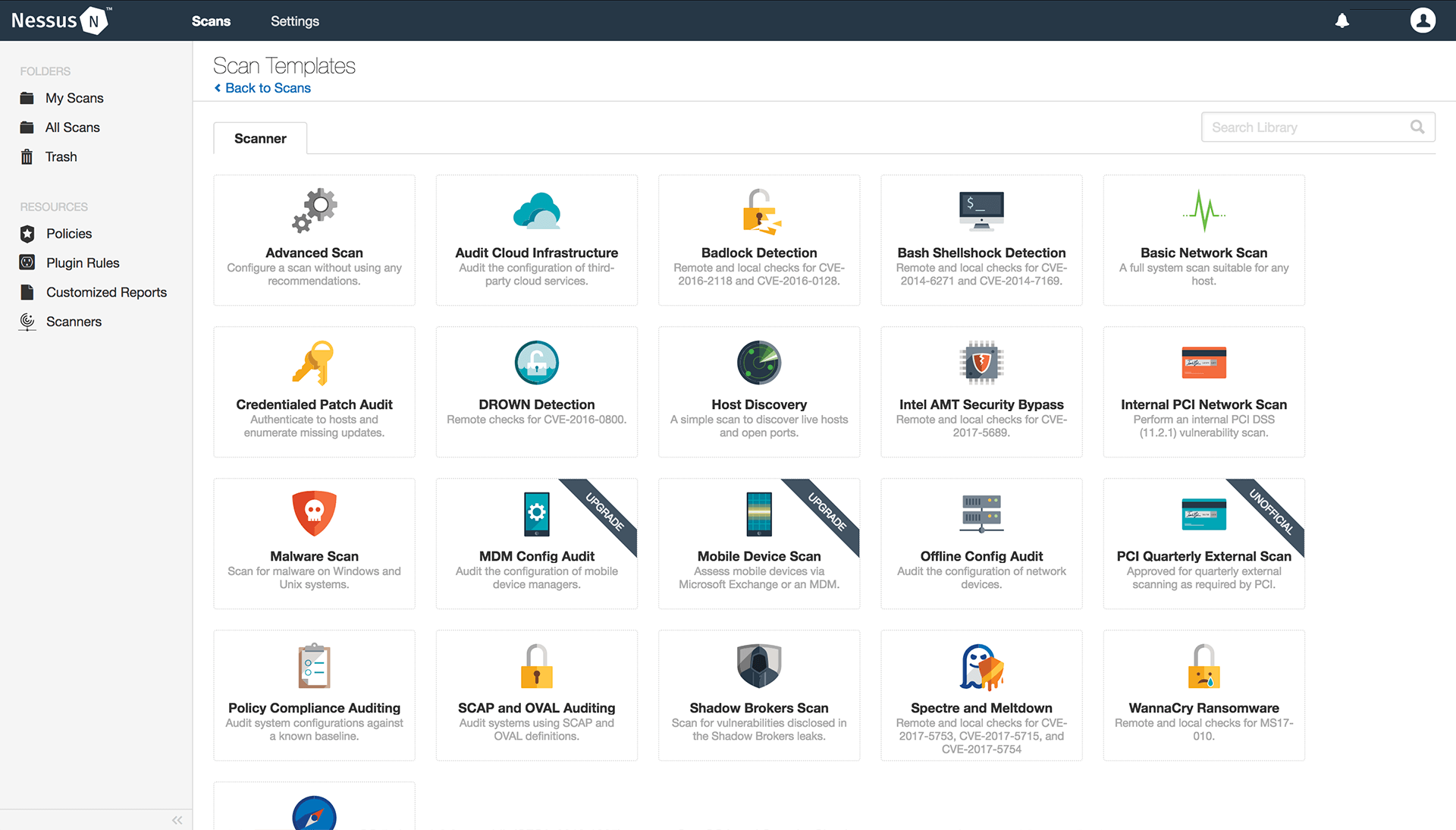
Under the Tenable umbrella, Nessus is a promising network vulnerability assessment tool that helps security teams detect, prioritize, and remediate weaknesses using automated scans for misconfigurations, missing patches, and malware across diverse environments, through CVSS v4, EPSS, and Tenable’s VPR for risk-based management.
With extensive pre-built policies, customizable reporting, and continuous threat updates, Nessus delivers high-accuracy scanning with minimal false positives, making it a trusted choice for penetration testers and security professionals worldwide. While aggressive scans can impact network performance, Nessus has “Safe Checks” enabled by default to prevent crashes.
Compare top Tenable alternatives to find the right mix of detection accuracy, automation, and pricing flexibility for your organization.
Pros:
- User-friendly interface
- Offers extensive automation and reporting capabilities
Limitations:
- Larger scans can cause downtime in operations occasionally with misconfigs.
- Can be expensive
3. OpenVAS
Key Features
- Platform: Local, Docker, and Cloud
- Capabilities: Automated web application and network pentesting
- Remediation Support: No
- Compliance: PCI-DSS, HIPAA, and other compliance frameworks
- Integrations: Limited SIEM tools (may require custom scripting or third-party connectors)
- Price: Open-source tool
- Rating on G2: 4.4 out of 5 (32 reviews)
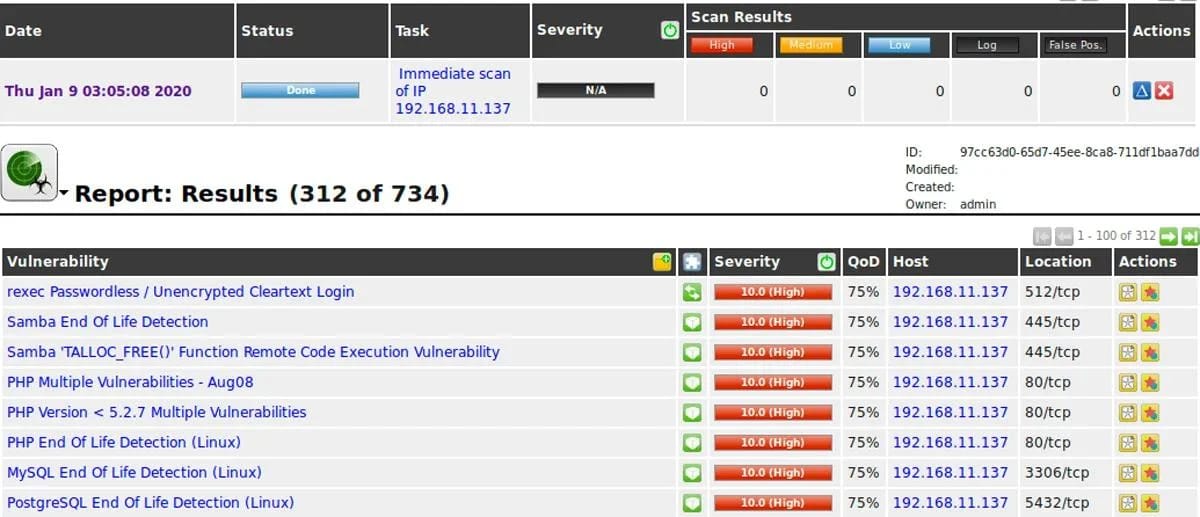
OpenVAS is an open-source scanner under the GVM framework, designed to identify security weaknesses across networks and web applications by leveraging a comprehensive CVE database to detect misconfigurations, outdated software, and exploitable flaws while streamlining security assessments with built-in automation and scheduling.
Its flexible deployment across local, containerized, and cloud environments, along with seamless integration, simplifies adoption and supports credentialed and uncredentialed scans, enabling deep analysis of internal and external threats.
Pros:
- Offers multiple deployment options
Limitations:
- It can be resource-intensive.
- Can generate compliance-oriented reports, but it cannot fulfill PCI-DSS ASV requirements
4. Nmap
Key Features
- Platform: Online & command-line tool
- Capabilities: Open-source network pentesting tools for security engineers
- Remediation Support: No
- Compliance: None
- Integrations: None
- Price: Open-source tool
- Rating on G2: 4.5 out of 5 (28 reviews)
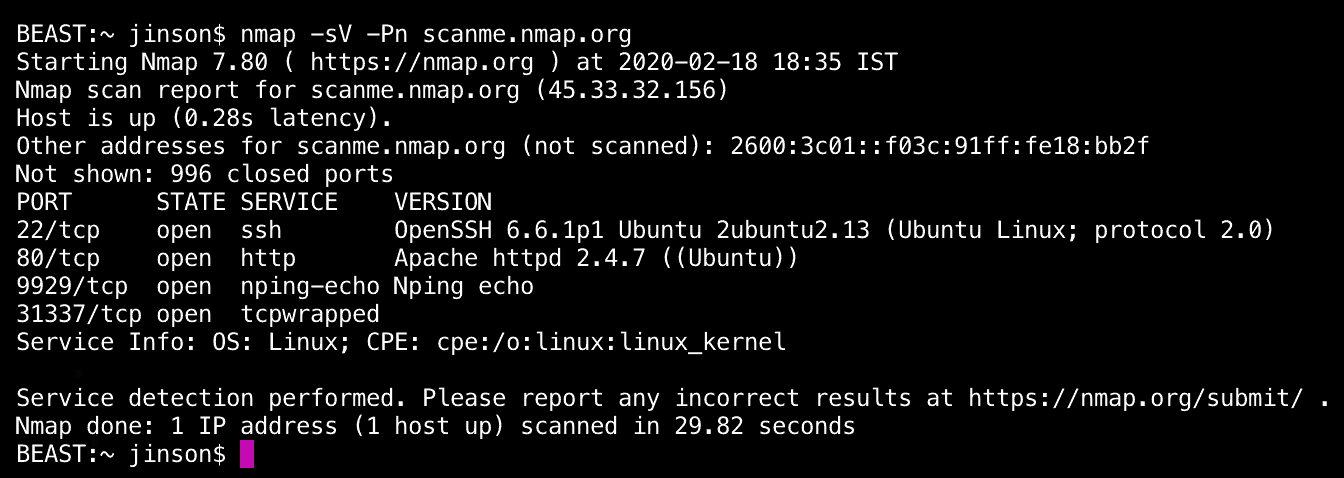
As the name suggests, Nmap, or Network Mapper, is a powerful open-source network discovery and port scanning tool that maps network structures, identifies open ports, and detects running services on target systems.
Its OS detection feature provides deeper intelligence on host environments, while version detection and the Nmap Scripting Engine (NSE) enable automated, customizable security testing.
Pros:
- Houses an active community
- Offers great versatility in application
Limitations:
- Requires some technical knowledge
- Aggressive scanning techniques can be intrusive
5. Sophos NDR
Key Features
- Platform: Online or deployed locally
- Capabilities: Automated traffic analysis to pinpoint network anomalies, insider threats, & zero-days
- Remediation Support: Yes
- Compliance: HIPAA, CIS controls, PCI-DSS, and SOX
- Integrations: Microsoft, AWS, and CrowdStrike
- Price: Available on quote
- Rating on G2: 4.8 out of 5 (18 reviews)
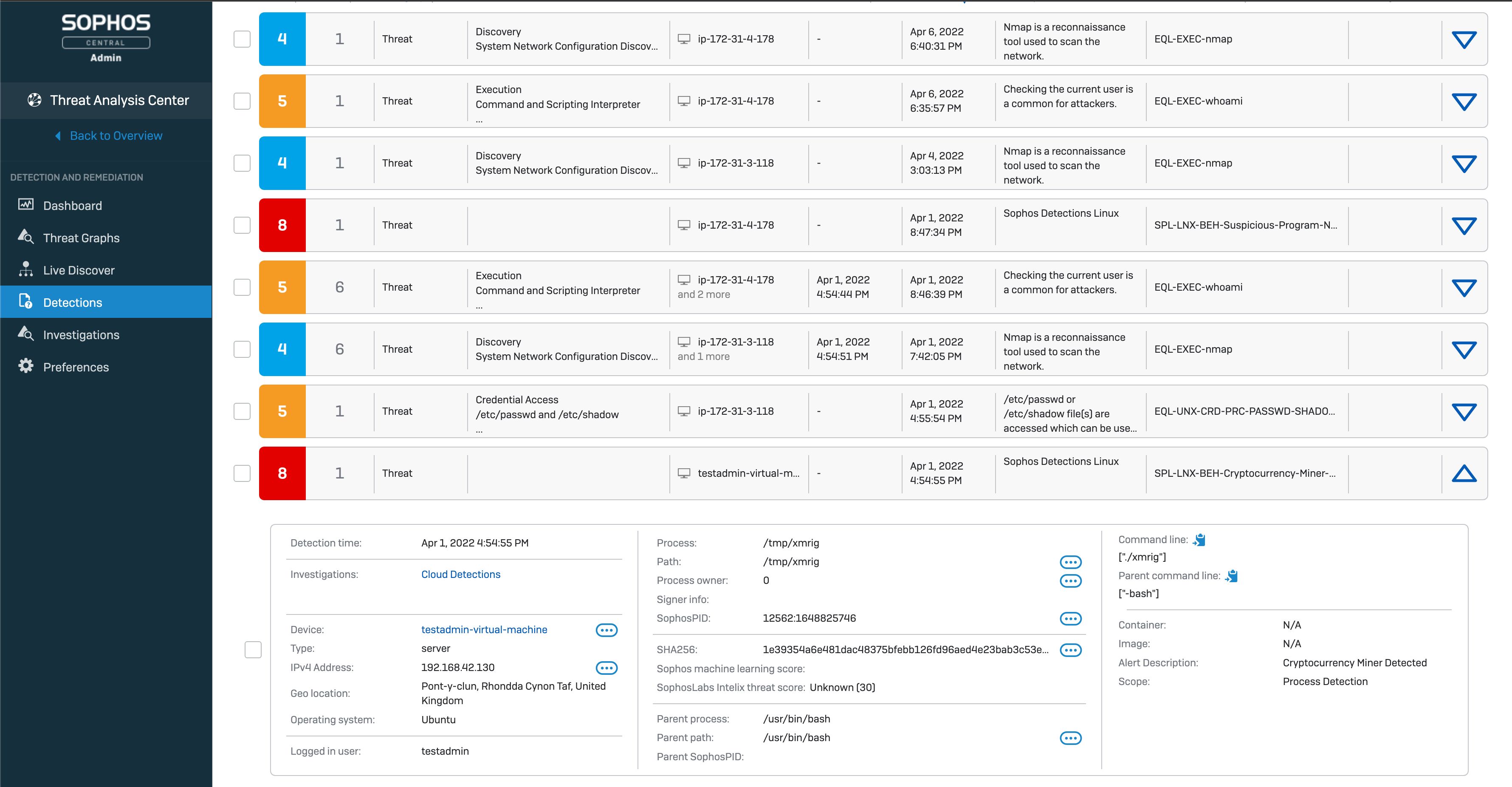
As one of the best network vulnerability & penetration testing companies, Sophos Network Detection and Response (NDR) provides continuous visibility into network activity, detecting threats beyond firewalls and endpoints. Going beyond traditional pentests, it is a cloud-managed service with on-prem sensors that identifies rogue assets, unmanaged devices, zero-day attacks, and insider threats using AI-driven detection and deep packet inspection.
Integrated with Sophos Firewall, XDR, and MDR, it enables real-time automated threat response while analyzing (un)encrypted traffic, empowering you to enhance network security and reduce reliance on manual pentesting.
Pros:
- Scan networks and connected IOT devices
- Offers continuous monitoring
Limitations:
- Can trigger periodic false positives requiring tuning
- Integration with certain network models can be at an additional cost
6. Symantec
Key Features
- Platform: Online
- Capabilities: Automated network security visibility with real-time threat detection and forensics.
- Remediation Support: Yes
- Compliance: ISO, SOC, PCI-DSS, and GDPR
- Integrations: SIEMs (Splunk, QRadar), SOARs, and ITSM tools (ServiceNow), and more
- Price: Available on quote
- Rating on G2: 4.3 out of 5
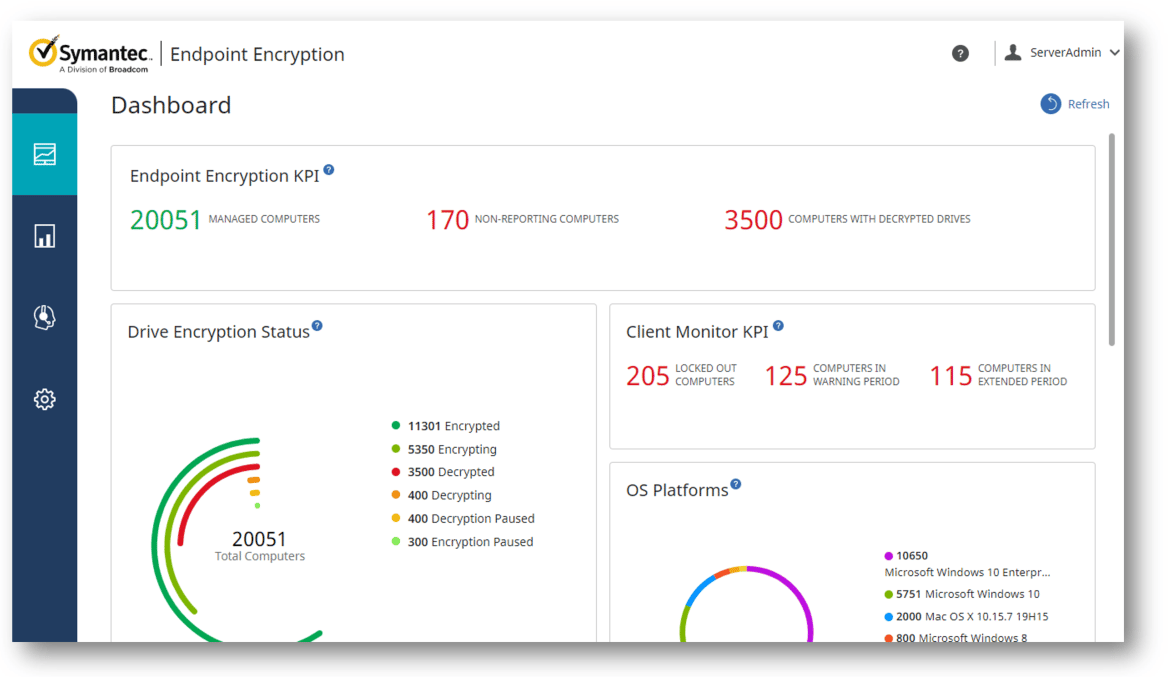
Symantec’s network penetration testing products, now operated by Broadcom, provide network security and threat protection through solutions like Secure Web Gateway (SWG), Advanced Threat Protection (ATP), and Network Threat Protection to deliver deep traffic inspection (including encrypted TLS/SSL), sandboxing for zero-day detection, threat isolation, and policy-driven access controls across cloud, on-premises, and hybrid infrastructures.
Its sandboxing and deep file inspection help detect zero-days while exposing hidden attack vectors with network forensics and encrypted traffic analysis. Most importantly, its integrated security analytics reduce the attack surface and strengthen network resilience.
Pros:
- Full packet capture and deep file inspection for zero-day detection
- Real-time threat intelligence from Broadcom’s global telemetry
- Continuous monitoring and rapid incident response capabilities
Limitations:
- Necessitates high resources that may slow down systems
- Can be expensive for SMBs
7. Bishop Fox

Key Features
- Platform: Online (client portal + Cosmos AI engine)
- Capabilities: Network, web application, API, cloud, mobile, IoT, and AI/LLM pentesting
- Remediation Support: Yes
- Compliance: SOC 2, PCI-DSS, ISO 27001, HIPAA, FedRAMP
- Integrations: JIRA, ServiceNow, Slack, GitHub, GitLab (via API and custom workflows)
- Price: Available on quote
- Rating on G2: NA
Founded in 2005, Bishop Fox pairs 20+ years of practitioner expertise with its proprietary Cosmos AI engine to accelerate attack surface discovery and validate findings at scale. In February 2026, Cosmos AI was extended to application pentesting, mapping attack paths and delivering validated findings in days rather than weeks, all still manually verified by certified pentesters (OSCP, OSCE, GPEN).
Bishop Fox’s network pentesting covers internal and external infrastructure: perimeter assessments, identity and access testing, segmentation validation, and assumed-breach scenarios. Its scope spans cloud-native environments (AWS, Azure, GCP), containerized workloads, and traditional on-premises networks.
Pros:
- Comprehensive service catalog (network, app, API, cloud, IoT, AI/LLM, red team)
- Compliance-ready reports
Limitations:
- Service-led delivery (not a self-serve SaaS platform)
- Pricing is custom and opaque
8. NetSPI
Key Features
- Platform: Online (PTaaS platform with real-time dashboard)
- Capabilities: Continuous network pentesting
- Remediation Support: Yes
- Compliance: SOC 2, PCI-DSS, ISO 27001, HIPAA, DORA, FedRAMP
- Integrations: JIRA, ServiceNow, Slack, GitHub, GitLab, CI/CD pipelines
- Price: Available on quote
- Rating on G2: 4.9 out of 5 (11 reviews)
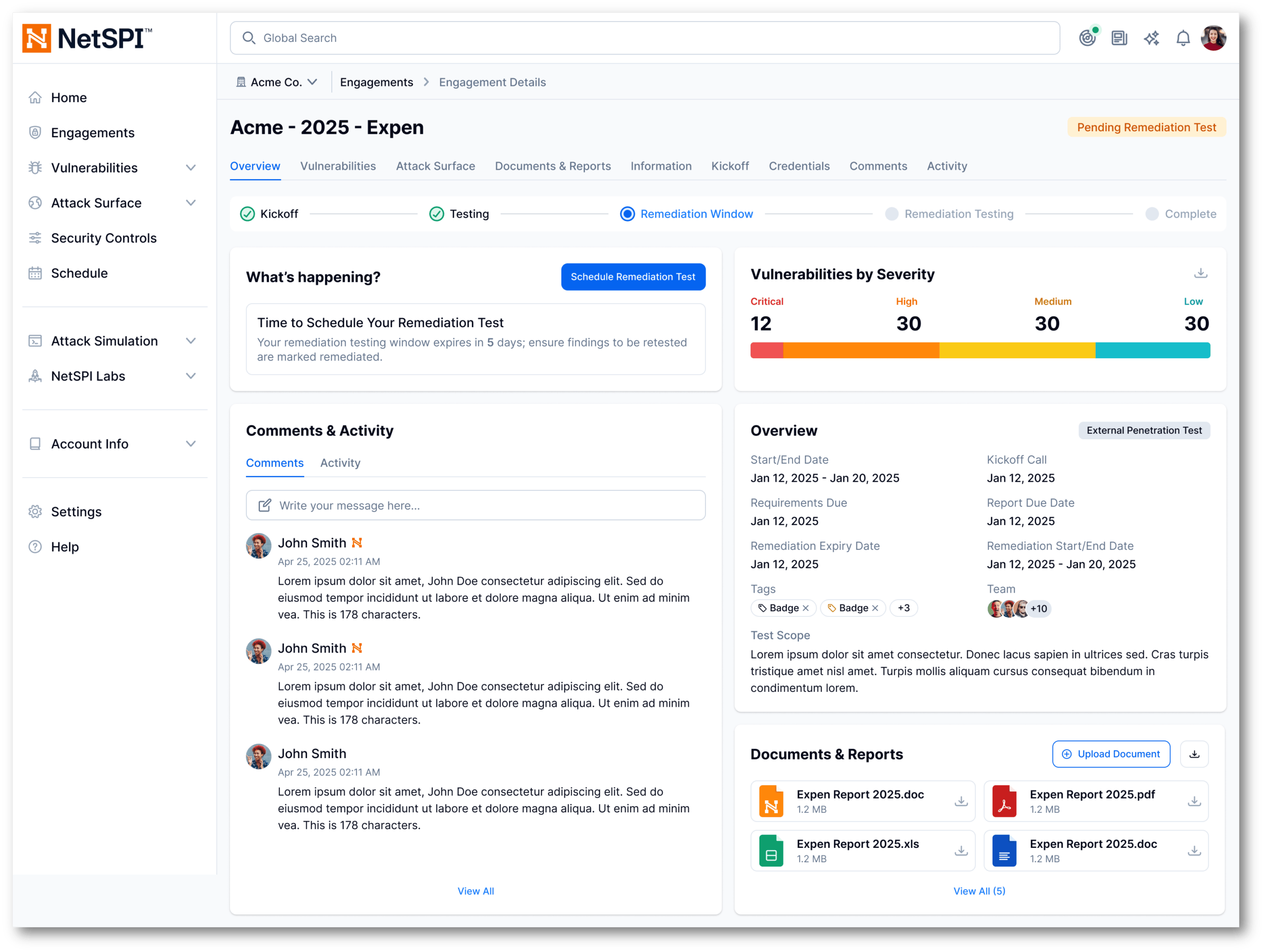
NetSPI is a global leader in Penetration Testing as a Service (PTaaS), pioneering the continuous pentesting model since 2001. With 350+ in-house certified pentesters (OSCP, OSCE, GPEN) and purpose-built AI, it delivers always-on visibility across external, internal, cloud, and hybrid attack surfaces. In 2026, NetSPI expanded this suite to cover continuous external, internal, web, cloud, and AI/LLM testing, with AI-driven mapping validated by humans to eliminate false positives.
Its internal testing simulates real attack scenarios like lateral movement and privilege escalation to expose weaknesses in firewalls, routers, and Active Directory. Findings surface in real time via the NetSPI Platform, with attack path visualization and direct ticketing integrations for faster remediation.
Pros:
- Free retesting included with every engagement
- Advanced compliance reporting
Limitations:
- Limited G2 reviews compared to larger PTaaS platforms
- Platform-led delivery requires commitment to annual PTaaS program
How to Choose Network Penetration Testing Companies
Align with Organizational Goals
Security companies should serve business objectives, not the other way around. If your company operates in a high-compliance industry, your tool should provide clear evidence for auditors and regulators.
If uptime is a priority, it should simulate real-world attacks without disrupting operations. A tool that looks great in a demo but doesn’t align with your business risks will become shelfware.
Plan for Scalability and Growth
Your infrastructure is growing, and your pentesting tool needs to keep up. Run a proof of concept against your largest environments. Check how it handles cloud, hybrid, and on-prem networks. Stress-test automation features to see if they reduce manual effort or create more work. If a tool struggles under load or locks scalability behind expensive add-ons, walk away.
Precision vs Speed
Run test scans and analyze the output. Measure how quickly the tool identifies vulnerabilities and how much noise it creates. Track the false positive rate and assess how much time security teams spend verifying results instead of fixing real issues. A tool that slows teams down with excessive triage is a liability.
Seamless Integration into Your Security Ecosystem
Look for seamless integration with SIEMs, SOAR platforms, vulnerability management systems, and developer workflows. Set up automated data transfers and verify that remediation steps can be assigned directly to engineering teams. Reject any network penetration testing companies that force security findings into static reports or standalone dashboards.
Evaluate Vendor Trustworthiness
Go beyond marketing claims. Demand transparency into how vulnerabilities are identified, validated, and updated. Scrutinize the vendor’s track record for delivering timely updates and real-world attack simulations.
Speak with current customers to assess reliability and support quality. If a vendor struggles to provide clear answers on methodology, innovation, or responsiveness, they are not the right fit.
Final Thoughts
Selecting a network penetration testing company is not just about features; rather, it is about precision, efficiency, and how well it integrates with your existing tech and workflow.
Tools such as Astra offer AI-driven validation; Nessus and OpenVAS provide robust scanning and continuous monitoring solutions like Sophos NDR; and Arctic Wolf adds an extra layer of defense beyond traditional pentesting.
Security isn’t static, and neither should your pentesting strategy be. Attackers adapt, and so must you. Invest in companies that provide real-world threat validation, actionable insights, and seamless integrations. Anything less leaves your business exposed to avoidable risk.
FAQs
What is network penetration testing?
Network penetration testing is a simulated cyberattack that evaluates security defenses by identifying vulnerabilities in networks, systems, and devices. Ethical hackers exploit weaknesses to assess risks, helping organizations strengthen security, prevent breaches, and ensure compliance with industry standards and regulations.
What is a network testing tool?
A network testing tool assesses a network’s performance, security, and reliability by identifying vulnerabilities, monitoring traffic, and analyzing protocols. It helps detect issues like latency, packet loss, or misconfigurations, ensuring optimal functionality, security compliance, and resilience against cyber threats in diverse network environments.