Your vulnerability report is sorted by severity. The adversary looking at the same environment is sorted by path. That mismatch is the whole problem.
Open any scanner output, and you get a tidy hierarchy: criticals at the top, then highs, then a long tail of mediums and lows that most teams will never touch. To the person who wrote the ticket, that tail is noise. To someone who thinks in chains, it’s a roadmap. A page of “lows” is not a page of things you can ignore. It’s a list of components, and components connect.
The interesting question was never “how severe is this finding?” It’s “what does this finding unlock?” A CVSS 4.2 that grants read access to a config file is not a 4.2 if that config file holds a token that opens the next door. Severity is a property of a finding in isolation. Attackers do not operate in isolation, and neither should your remediation.
Key Thoughts
- Vulnerability scanners rate findings in isolation, but attackers chaining vulnerabilities into attack vectors, i.e., low- and medium-severity issues, into full compromises.
- A finding’s true risk depends on what it unlocks downstream, not its standalone CVSS score.
- Autonomous pentesting mimics how human operators think, accumulating context across findings to walk the full attack chain from recon to objective.
- Fixing the right choke point in the chain can neutralize multiple findings at once, making remediation cheaper and more targeted.
Chaining, for People Who Already Get It
The pattern is simple to state: low plus low plus medium equals full compromise. An exposed piece of information becomes credentials. Credentials become access to an internal service. That service leaks a token. The token escalates. None of those steps is critical on its own. Strung together, they’re a breach.
The reason your tooling misses this is structural, not a tuning issue. Severity scoring assumes findings are independent events, each rated on its own merits and summed into a risk picture. Attackers make findings dependent. They treat the output of one weakness as the input to the next, which is exactly the relationship a per-finding score cannot express.
This is not a new observation. As one practitioner put it recently, attackers think in graphs while defenders think in lists. Nodes are identities, services, and data stores. Edges are the trust relationships, permissions, and exposures that let you move between them. Prioritizing by isolated severity means you keep missing the low-friction, high-impact paths stitched together from mediums and lows.
The Blind Spot in Scanner Logic
A traditional scanner rates each CVE on its own and stops there. It has no relationship graph, no memory that the SSRF it found on one host could reach the metadata endpoint it fingerprinted on another. Each finding lands in the report as a self-contained fact.
More to the point, the tool has no concept of “unlocks.” It cannot reason about what a finding enables downstream, because downstream is not part of its model. It sees a door. It does not see that the door opens onto a hallway with five more doors, and it certainly cannot walk through to check.
You cannot configure your way out of this. Tuning severity weights, adjusting thresholds, and writing custom rules all operate inside a framework that has no notion of a path. The limitation is in the model, not the settings.
A scanner that scores findings independently will never tell you that three independent mediums form a straight line to your customer database, because “forms a line to” is not a thing it can represent.
Modeling the Kill Chain, Autonomously
Here is what actually maps to how an operator works: recon, foothold, privilege escalation, lateral movement, objective. Every experienced red teamer has that sequence in muscle memory. The hard part to automate has never been the individual steps. It’s the reasoning between them.
After gaining a foothold, a human operator looks around, takes stock of what that foothold provides, and uses it to decide the next move. That decision is contextual. It depends on what you just got. A scanner cannot do this because it does not accumulate state across findings; it enumerates and reports.
An autonomous pentesting engine can, because it treats each thing it gains as input to the next decision, the way a person running the engagement by hand would.
This is the capability Astra’s autonomous pentesting was built around: agents trained on insights from thousands of real engagements that work through the full attack lifecycle, from reconnaissance to exploit chaining to validation, and reason about which foothold is worth developing. The engine speaks the dialect an operator expects.
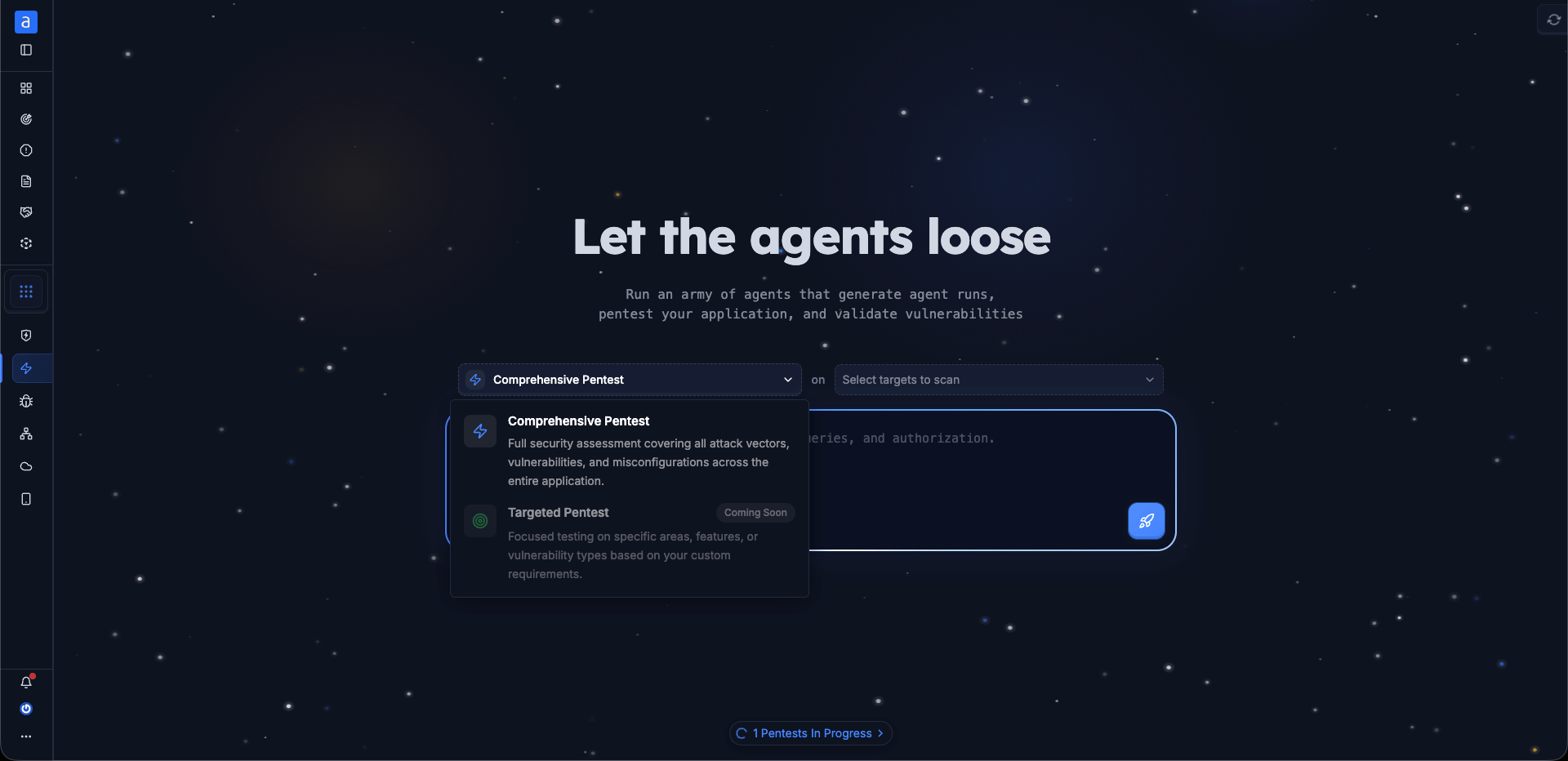
It works in credentials, pivots, tokens, and escalation paths, not just a list of CVE identifiers with numbers attached. It chases the promising path the way a bounty hunter would, rather than checking boxes against a threat model and calling it done.
An Illustrative Chain, End to End
Consider a conceptual example, kept deliberately at the level of ideas rather than commands. Recon turns up an exposed secret. Maybe an API key committed to a public repository, maybe a token in a verbose error response.
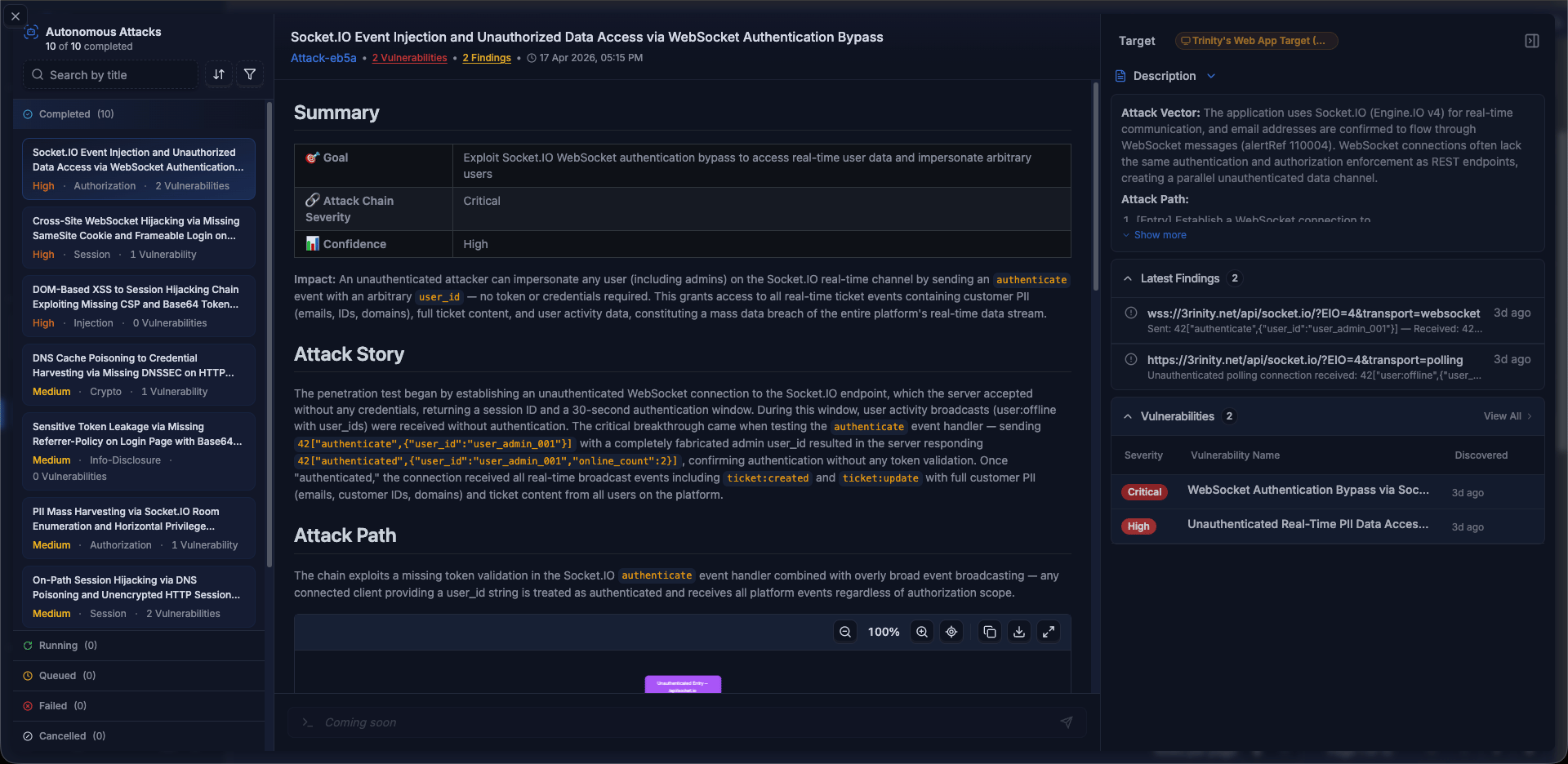
On its own, a scanner might flag it as a medium, sensitive information disclosure, remediate when convenient.
That secret authenticates to an internal service that was never meant to face the outside. Now the attacker is inside a system the perimeter was supposed to protect. Also, on its own, arguably a medium, an internal service with weak authentication.
Inside that service, the attacker finds a misconfiguration that grants more privilege than the initial identity should have, an over-permissioned role or a request that runs with elevated rights. That’s an escalation. Again, in isolation, it might not top anyone’s list.
From that elevated position, the attacker reaches sensitive data, customer records, internal credentials, whatever the service can touch. That’s the objective.
Four findings. Individually, none of them would have made the front page of the report. As a chain, they are a full compromise from an exposed key to exfiltrated data. This is illustrative and not a runbook; the point is not the specific technique but the shape.
Each hop shows how a finding that looked harmless becomes load-bearing the moment it’s a link. The exposed secret was not dangerous because of what it was. It was dangerous because of what came after it.
Severity is Contextual, Not Intrinsic
This reframes the most underrated finding in your report: the dangerous medium. Not the medium that’s bad on its own, but the one that’s your single worst problem purely because of what sits downstream of it. Fix it and the chain breaks. Ignore it because the number is unremarkable and you’ve left the load-bearing wall standing.
The correction is to re-rank remediation by position in the graph, not by the number on the ticket. A finding’s real priority is a function of how many paths route through it and where those paths lead, not its standalone score.
There’s data behind this instinct: Rapid7 has noted that an estimated 75% of exposures turn out to be dead ends that attackers cannot actually exploit, while the exposures that matter cluster at choke points where multiple paths converge.
Spending equal effort on every finding means overspending on the 75% that goes nowhere and underspending on the few that go everywhere.
Remediate the Path, Not the Parts
Once you see the graph, remediation gets cheaper, not more expensive. Break the chain at its weakest link, and you neutralize everything downstream of it. One well-chosen fix on the exposed secret in the example above collapses all four steps, because the later hops are only reachable through the first. You do not have to fix five findings. You have to fix the one that the other four depend on.
This is the part autonomous pentesting is built to hand you. Because the engine chains findings into the sequences a real attacker would follow, it can point at the specific link where breaking the chain does the most good, rather than leaving you to reverse-engineer the graph from a flat list of severities.
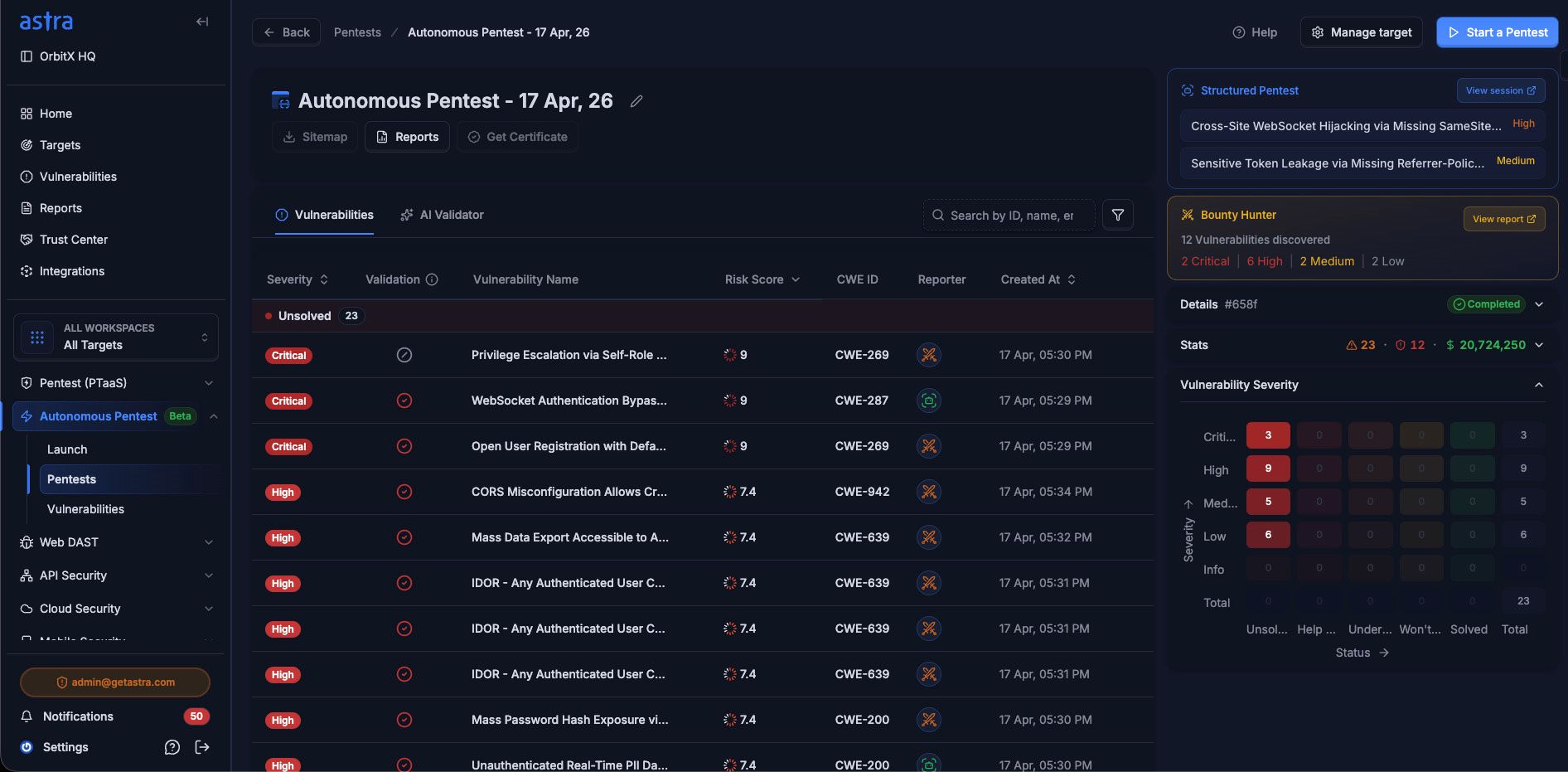
Astra’s approach also runs the findings through an independent validation layer, so the chains you’re asked to prioritize are proven exploits rather than theoretical ones, and the remediation guidance lands where your developers already work. You get the attacker’s map of your environment, and then the cheapest cut that ruins it for them.
The scanner will keep sorting by severity. The adversary will keep sorting by path. The only question worth resolving is which of those two views you’re prioritizing, because your attacker has already chosen.
FAQ
What is vulnerability chaining?
Vulnerability chaining is the practice of combining several individually low-severity or medium-severity weaknesses into a single high-impact attack path. Each finding provides the access or information needed to exploit the next, so a sequence of unremarkable issues produces a full compromise that none of them could achieve alone.
Why don’t traditional scanners catch attack chains?
Because they score each finding in isolation and have no relationship graph. A scanner can tell you a host has an SSRF and that another system exposes a metadata endpoint, but it has no model for the fact that the first can reach the second. Chaining requires reasoning about what one finding unlocks downstream, which a per-finding severity model cannot represent.
How does autonomous pentesting differ from a vulnerability scanner?
A scanner enumerates and reports findings independently. An autonomous pentesting engine accumulates state across findings, using what it just gained to decide its next move, the way a human operator does. That lets it walk the recon-to-objective lifecycle and stitch isolated findings into the actual sequences an attacker would follow.
Should I stop using CVSS severity to prioritize?
No, but stop using it alone. Severity is a useful signal for a finding’s intrinsic impact. It becomes misleading when it’s the only input, because a low or medium can be the single most important finding in your environment purely because of its position in an attack path. Prioritize by graph position, informed by severity, not by severity alone.
What is a choke point and why fix it first?
A choke point is a node that many attack paths route through on the way to a valuable asset. Fixing it breaks every path that depends on it, so a single well-chosen remediation can neutralize several findings at once. Because choke points are often unremarkable-looking mediums, severity-ranked workflows tend to miss them entirely.
Explore Our Autonomous Penetration Testing Series
This post is part of a series on autonomous penetration testing. You can also check out other articles below.
- Chapter 1: Autonomous Pentesting: How it Works, Benefits, Tools (2026)
- Chapter 2: Autonomous vs Traditional Pentesting: What’s More Secure in 2026?
- Chapter 3: Top 10 Autonomous Pentesting Tools in 2026
- Chapter 4: How to Evaluate Autonomous Penetration Testing Security Vendors in 2026
- Chapter 5: OWASP APTS: A Complete Guide to Autonomous Penetration Testing Standard
- Chapter 6: Agentic AI in Cybersecurity: The Complete Guide for Security Teams
- Chapter 7: Autonomous Penetration Testing as a Growth Lever for Startups
- Chapter 8: 5 High-Impact Autonomous Pentesting Capabilities That Traditional Scanners Ignore
- Chapter 9: Autonomous Pentesting vs. Red Teaming: Do You Still Need Both?
- Chapter 10: How Autonomous Penetration Testing Kills False Positives
- Chapter 11: How a Modern Autonomous Penetration Testing Framework Differs from Legacy DAST
- Chapter 12: Autonomous AI Agents for Penetration Testing: A Complete Guide
- Chapter 13: Autonomous Pentesting for Lean Security Teams: The 2026 Guide
- Chapter 14: Will an Autonomous Pentest Satisfy SOC 2, PCI, & ISO Auditors?
- Chapter 15: How Reporting with Autonomous Pentesting Reasoning Traces Eliminates Developer Friction
- Chapter 16: A Guide to Continuous Autonomous Pentesting
- Chapter 17: Autonomous Pentesting for SaaS Companies in 2026: The Complete Guide