

Key Takeaways
- Most security vulnerabilities now exist at the application layer rather than network infrastructure, requiring code-level security controls.
- Web application attacks span multiple major categories, from injection flaws to API exploits, each requiring specific detection and prevention techniques.
- Defense requires layered security control, including input validation, authentication hardening, access control enforcement, and secure configuration management.
Web applications process billions of transactions every day, handling everything from user credentials to financial records. This constant exchange of data makes them prime targets for attackers who are looking to gain access for data theft or service disruption.
Web application security vulnerabilities are highly sophisticated attack vectors that can exploit authentication flows, business logic, and API integrations.
In this blog, we will cover the most common types of web app attacks, explain how each exploitation technique works, and provide technical security strategies to secure your web applications.
What are Web Application Attacks?
A web application attack can compromise the confidentiality, integrity, or availability of a web application’s components by exploiting its code, configuration, or logic. They focus on the software components that handle user requests, authentication, business rules, and database calls.
A network service, such as SSH or FTP, exposes only very specific functionality over a single protocol, whereas web applications expose many endpoints with complex input parameters, state management, and data-processing logic. There are many opportunities for web application exploitation as each endpoint accepts different data types, authentication tokens, and HTTP methods.
The reality of the security threat landscape has changed considerably. Firewalls and intrusion detection systems are great network-level protections that protect perimeter infrastructure, but these days, the majority of vulnerabilities are in application code.
Application-layer flaws like logic errors, data-handling problems, and access controls cannot be detected or blocked by network security and must be protected with application-layer controls.

Why are Web Apps Prime Targets?
Web applications pack multiple features that make them appealing to attackers. They are internet-facing and accessible to the rest of the world without a VPN or network access. As a result, attackers can remotely scan for vulnerabilities in those applications, slipping past the perimeter defenses.
Data concentration amplifies attack impact. The credit card records, user profiles, and trade secrets carefully stored in databases can all be compromised by a single breached application. One compromise gets more data than hundreds of isolated systems.
This security gap is rooted in modern development practices. Security testing and reviews run on longer cycles compared to CI/CD pipelines that deploy code to production several times a day. At the same time, feature pressure from business stakeholders prioritizes delivering features faster than associated vulnerabilities can be detected and remediated through scanning or manual code review.
What are the Various Types of Web App Attacks?
Web application security attacks exploit weaknesses across multiple layers—from injection flaws and authentication bypasses to API vulnerabilities and configuration errors—each requiring specific detection and mitigation strategies.
Injection Attacks
An injection attack occurs when an application passes untrusted data as part of a command or query and executes the injected code. This event happens when the attacker changes the frontend input fields to force the backend to act in a different and unexpected manner.
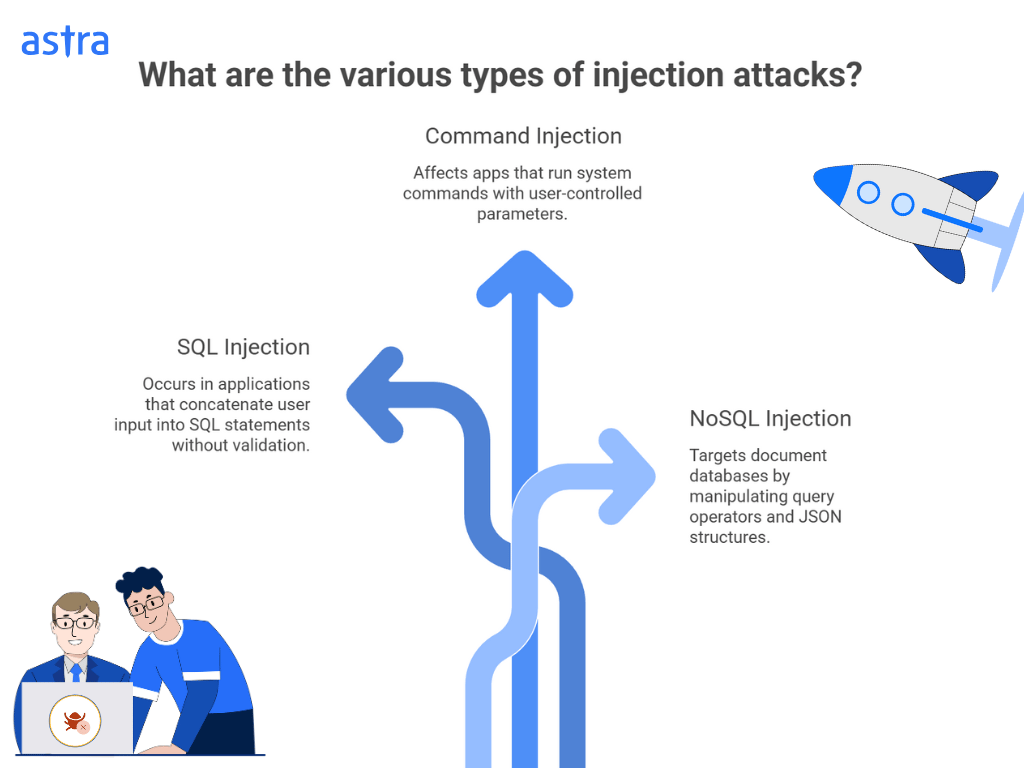
SQL injection occurs in applications that create queries based on direct user input without adequate input validation. When user-supplied data is concatenated directly to SQL statements, attackers can inject SQL code to bypass authentication or dump database contents.
Command injection affects apps that run system commands with user-controlled parameters. Command separators are injected by attackers to run arbitrary code on servers. NoSQL injection targets document databases such as MongoDB by manipulating query operators and JSON structures.
Client-Side and Cross-Site Attacks
Client-side attacks do not target servers; rather, they exploit the trust between browsers and legitimate websites.
In XSS, an attacker can inject their JavaScript payload into web pages loaded by potential victims. Cross-site scripting (XSS) occurs when applications do not properly encode user input, allowing attackers to inject scripts that read and access session cookies, redirect users to phishing sites, or replace page content.
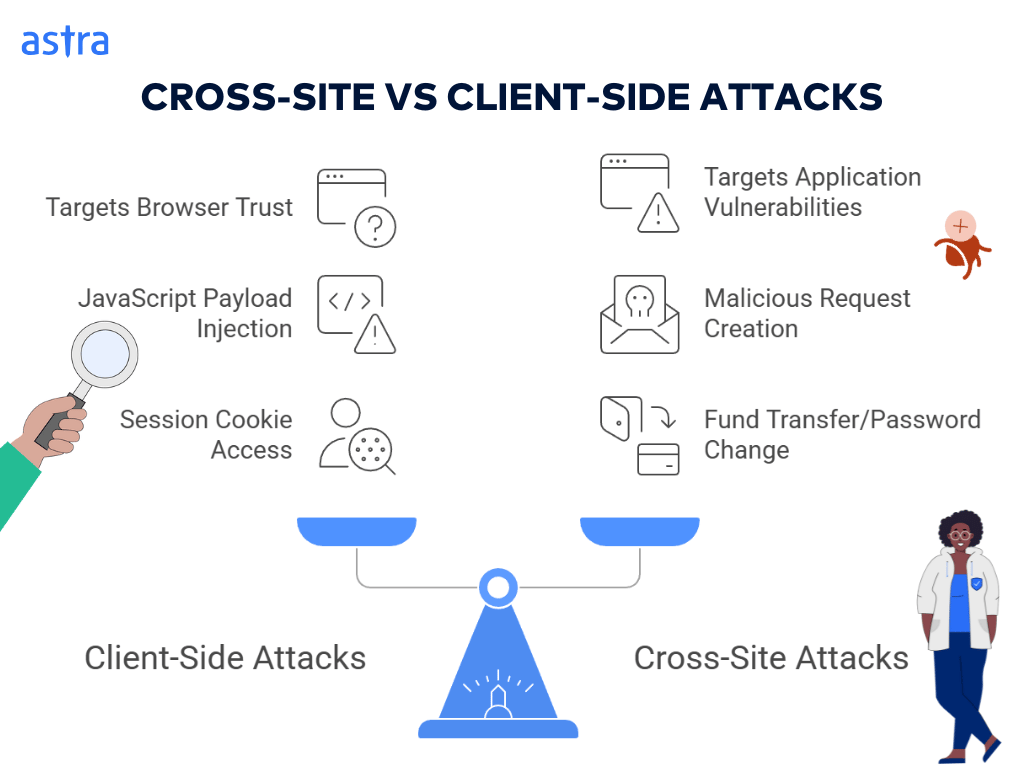
Attackers create malicious requests within emails or on websites that instruct the application to transfer funds or change passwords, since the authentication cookies are automatically included in requests made while someone is logged into the site.
Authentication Attacks
Authentication attacks compromise credential verification processes to gain unauthorized access. These kinds of attacks focus on components that authenticate (or verify) user identity before users can log in to a system.
Attackers use dictionaries of the most commonly used passwords against any login endpoint that lacks rate limiting or account lockout. Automated tools check thousands of password combinations each minute using listings of usernames.

Dumped credentials are one way credential stuffing exploits password reuse across services. Attackers find username-password pairs from earlier breaches and try them on different accounts.
If they succeed, the attacker gains access and then makes automated login attempts using stolen credentials across various platforms. Often, users reuse the same credentials across services, which makes this attack effective.
Session and Cookie Attacks
Session attacks, as a type of web-based attack, focus on the tokens and cookies that keep a user logged in between requests. After logging in successfully, session identifiers are issued to remember which user is authenticated, so the user does not need to enter their credentials again with every request to the application.
Session hijacking occurs when a valid session token is intercepted through network sniffing, a cross-site scripting (XSS) attack, or malware. Once an attacker obtains the session cookie, they can impersonate a valid user without knowing the password. The application cannot distinguish the attacker from the legitimate user.
Session fixation targets users who reuse the same session, such as when an attacker steals session IDs. The attacker creates a session ID he knows in advance and hijacks the victim’s session by taking control of the session the victim establishes upon login.
Access Control and Authorization Attacks
Access control attacks exploit weaknesses in the application’s enforcement of permissions and resource access. These vulnerabilities provide unauthorized access to data or functionality.
Insecure Direct Object References (IDOR) occur when an application exposes mappings to internal object identifiers, such as file names, serial numbers, or database record IDs, in URLs or parameters without verifying that the user is authorized to use them.
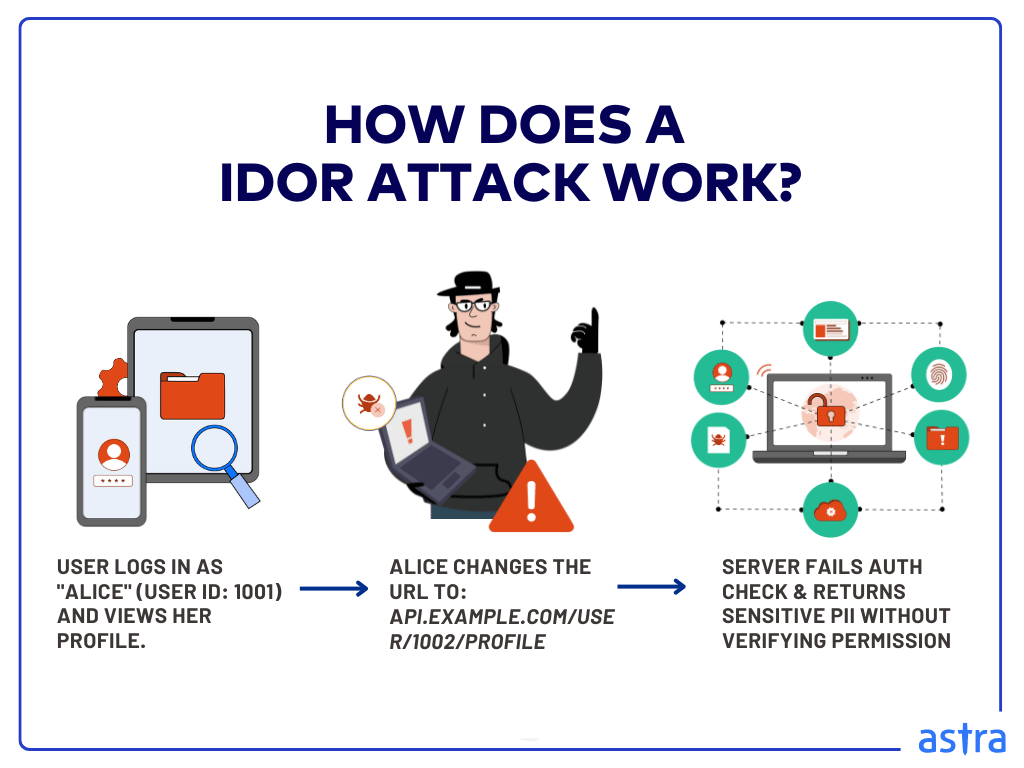
The attackers change these references and get access to other users’ data. For example, if an attacker modifies a URL parameter from user_id=123 to user_id=124, it can leak another user’s private information.
Privilege escalation enables abuse within the gaps in role-based access control. Horizontal escalation targets resources used by users with the same level of privilege, and in contrast, vertical escalation provides administrative privileges from standard user accounts.
File and Path Attacks
File and path attacks exploit file system operations to read or write to unauthorized files, or to execute malicious code.
Local File Inclusion (LFI) tricks applications into including files on the server file system. Attackers use file path parameters to execute a web server attack, often to read sensitive configuration files, source code, or system files. For example, an app that takes user input as file paths could process an input such as "../../../../etc/passwd" to reveal password hashes.
Directory Traversal is an attack that leverages path manipulation to read files outside of a web application’s intended directory structure. Applications that build file paths without adequate validation may enable an attacker to traverse the file system using relative path sequences.
API-Specific Attacks
API attacks exploit weaknesses unique to similar programmatic interfaces that connect applications and services. APIs are the foundation of data exchange and functionality in almost every modern application.
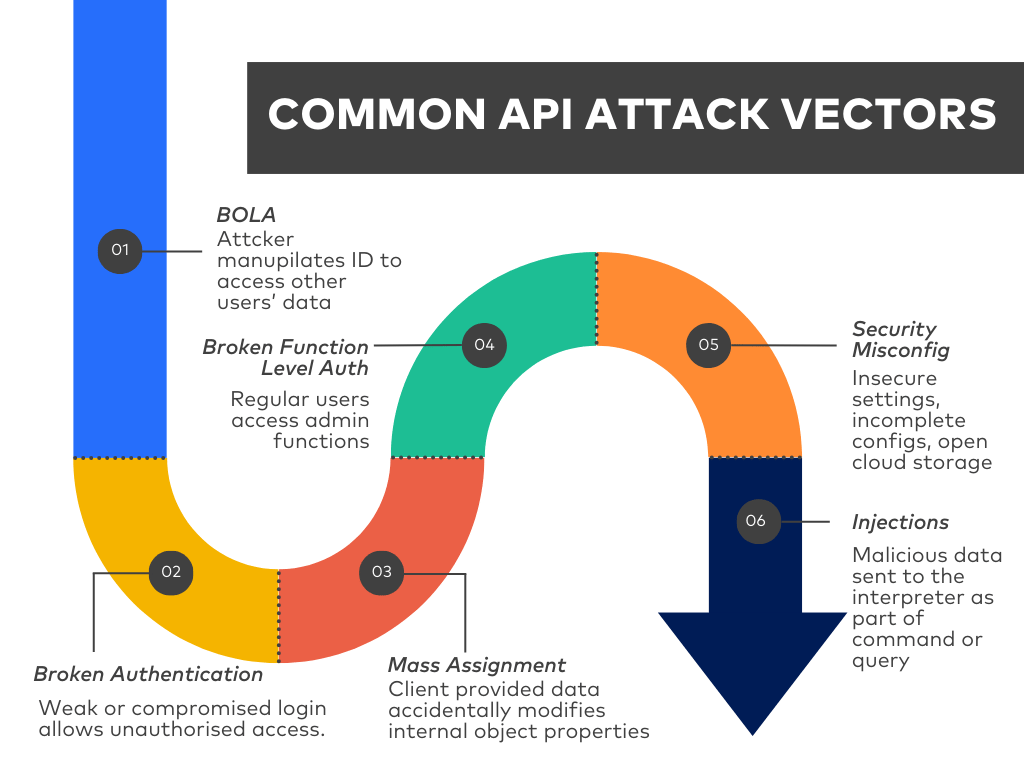
Broken Object Level Authorization (BOLA) occurs when an attacker can access objects associated with other users by modifying object identifiers in endpoint requests. For example, an API endpoint that returns user profiles might not ensure that the user making the request actually owns the requested profile ID.
Mass assignment is when APIs automatically map request parameters to internal object properties without any filtering. In this approach, the attacker supplies unexpected parameters and then modifies fields in limited (non-user-controllable) requests, such as user roles or account balances.
Misconfigurations
Security misconfigurations lead to vulnerabilities due to improper security settings, unused HTTP headers, default configurations, and default accounts. These problems are usually caused by deployment mistakes rather than issues with the code itself.
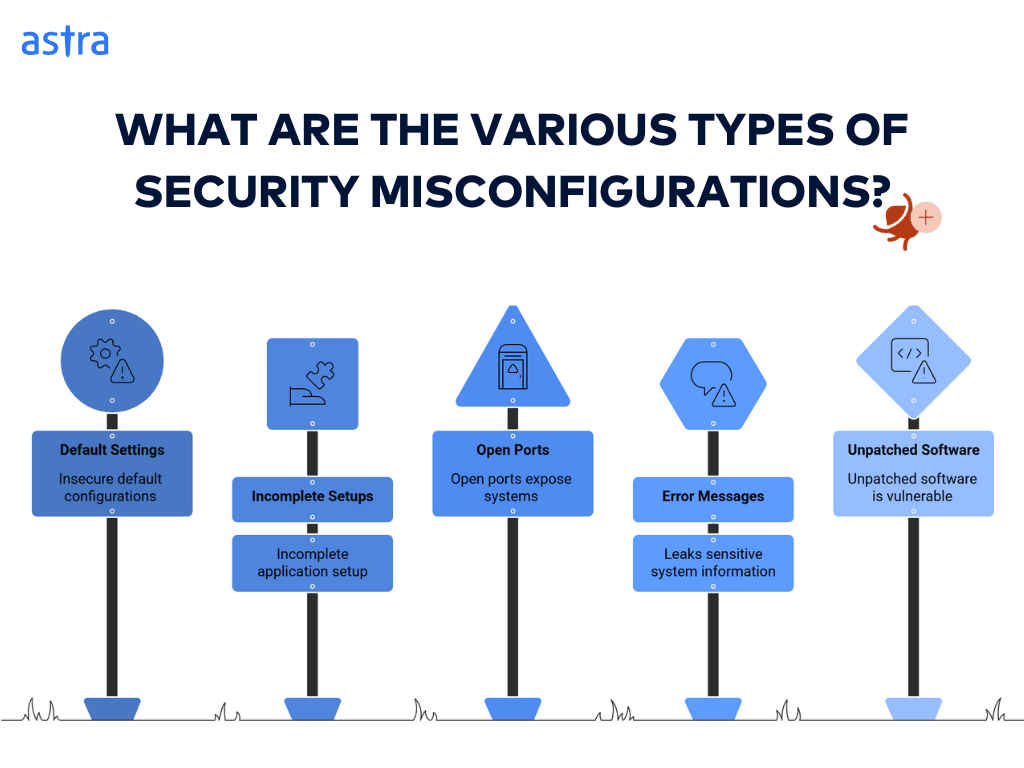
This makes applications vulnerable to attacks such as protocol downgrade and injection attacks, due to missing security headers such as HSTS (HTTP Strict Transport Security) and CSP (Content Security Policy).
Verbose error messages leak system data or file paths and provide attackers with valuable clues about how your database is structured. Production applications should log detailed errors internally while displaying generic error messages to users.
Which Best Practices Help Defend Against Web App Attacks?
Organizations need to follow security practices that prevent vulnerable applications from reaching production while maintaining detection mechanisms to detect threats that manage to get through preventive measures.
Secure-by-Design and Threat Modeling
Security needs to be built into the application architecture from the ground up, not as an afterthought. Threat modeling examines data flows, trust boundaries, and entry points before writing any code to identify potential attack vectors.
Development teams need to visualize the complete attack surface of how an attacker can abuse all authentication flows, discover attack paths through API endpoints, and even abuse data processing logic and design control over the identified risks.
Input Validation
Validate all user-supplied data against strict allowlists that define acceptable formats, lengths, and character sets. Instead of sanitizing bad data, applications should reject data that contains unexpected characters or patterns.
Although the browser can perform many client-side checks, the attacker can always bypass them, so server-side validation is unavoidable. Using parameterized queries and prepared statements can prevent injection attacks by separating the code from the data.
Strong Authentication
Authentication systems should require complex passwords, require multi-factor authentication for sensitive operations, and use strong hashing mechanisms such as bcrypt or Argon2 to protect credentials.
Brute force attacks are stopped by account lockout and rate-limiting features. Session tokens should be cryptographically random, sent over HTTPS, and invalidated on logout (or expired after a period of time).
Principle of Least Privilege
Applications and users should work with the least privilege. Databases that your applications use must be limited at the account level to appropriate tables and operations. Role-based access control (RBAC) performs authorization checks at every access point and ensures that users have access only to resources allowed by their permission set.
Secure Configuration Baselines
Setting secure headers, changing default credentials, disabling unnecessary services, and suppressing verbose error messages are all features of a hardened configuration needed in production environments. Configuration audits help you ensure that security settings are preserved between deployments and updates.
How Can Astra Security Help?
Astra Security offers end-to-end web application security testing that identifies various vulnerabilities before attackers do. Our platform uses automated scanning, paired with manual penetration testing, with our in-house Attack AI engine to identify injection flaws, authentication bypasses, access-control issues, and configuration issues in your web applications and APIs.
We continuously monitor code changes as they’re deployed to ensure new features don’t introduce vulnerabilities, offering actionable remediation guidance along with code-level fixes to empower development teams to remediate quickly.
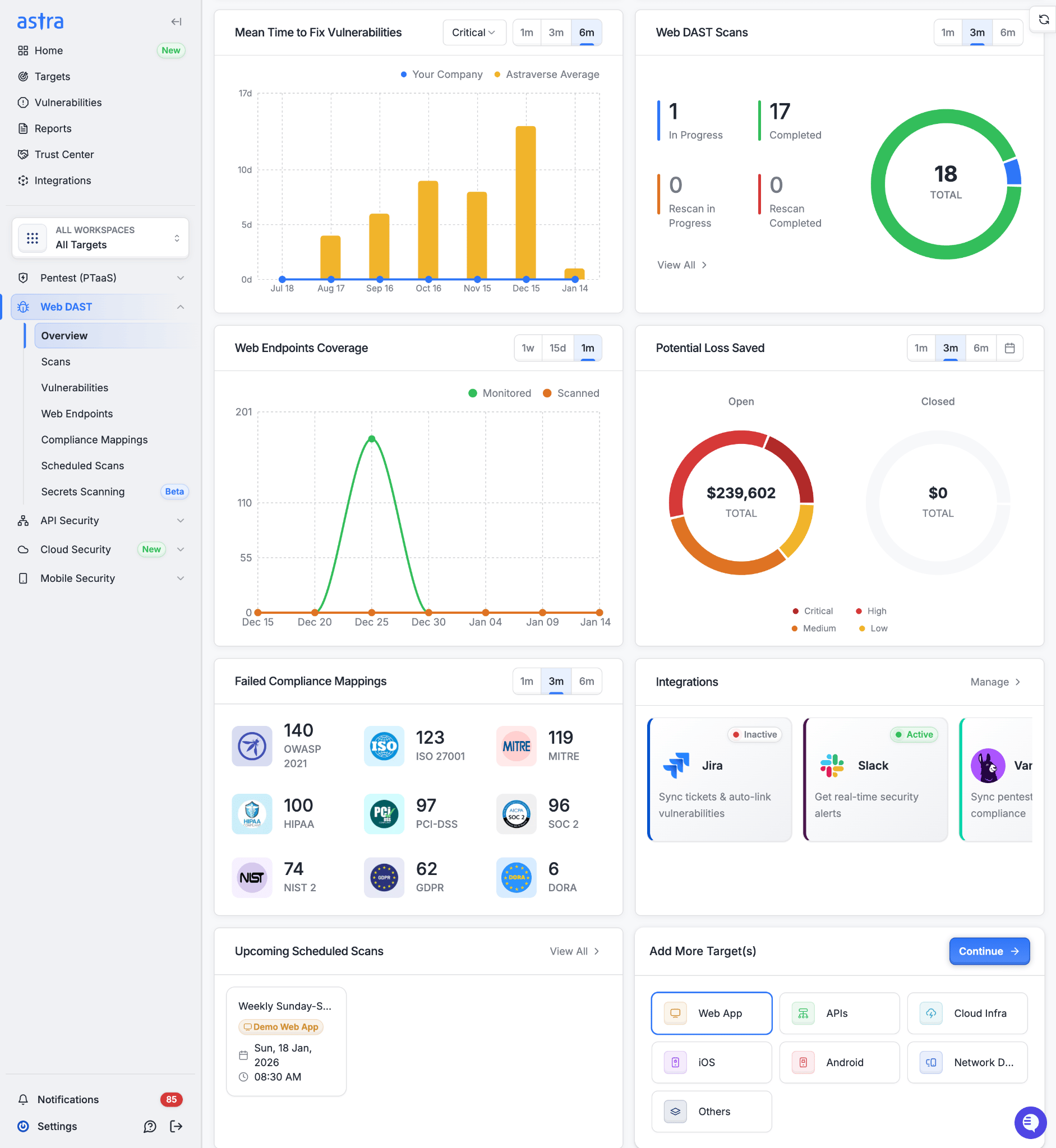
Moreover, seamless integration with CI/CD pipelines allows teams to run penetration tests early and often, where they will get the most value. In this way, the PTaaS Platform Astra not only addresses technical aspects but also business-logic vulnerabilities that automated tooling may miss.
Final Thoughts
As applications become more complex and interconnected, web application attacks remain a moving target. Learning about attack patterns across everything from injection flaws to API exploits helps teams apply the right security defenses through secure design, input validation, and proper access controls.
Secure your applications today with in-depth testing and persistent monitoring with Astra Security. Sign up today to discover your weak spots and repair them before they become a breach.