Key Takeaways
- Implement OAuth 2.0 with RBAC and verify JWT signatures properly to prevent token forgery and unauthorized access escalation
- Enforce TLS 1.3 encryption with mTLS for service-to-service APIs and drop legacy protocols immediately
- Deploy API gateways with WAF integration to centralize rate limiting and block BOLA, credential stuffing, and DDoS attacks
- Combine automated vulnerability scanning + manual penetration testing to catch both known exploits and business logic flaws
- Maintain real-time API documentation through OpenAPI/Swagger specs and shift security left into CI/CD pipelines
99% of organizations faced API security issues in the past 12 months. Yet only 10% have an API posture governance strategy in place to actually defend against them.
What makes this worse is that 95% of API attacks now come from authenticated sources. Traditional defenses built around authentication are failing. Shadow APIs and zombie APIs operate undetected while businesses manage an average of 660 endpoints with little visibility.
This guide in a comprehensive manner covers the 7 best practices that will help you secure and future-proof your API security posture.
What is API Posture Management?
API Security Posture Management’s (ASPM) simple aim is to help you best monitor and manage security across your entire API stack or ecosystem, with the aim of securing your APIs by design. This involves evaluating authentication strength, data sensitivity, exposure levels, etc.
Overall. It thrives on offering unified visibility, so you discover each endpoint, adhering to latest compliance standards and security guidelines and being agile as per your risk tolerances.
Core Components of API Posture Management Process
The API posture management process follows four core steps that together create a complete security framework. Each component builds on the previous one to give you continuous protection. This includes:
| Component | What It Does | Why It Matters |
|---|---|---|
| API Discovery and Inventory | Documents all APIs across your infrastructure, including shadow APIs and zombie APIs that traditional tools miss | Hidden APIs are exploited first. You can't secure what you don't know exists |
| API Risk Assessment | Evaluates each API against OWASP API Top 10 for broken authentication, data leaks, injection flaws, and BOLA | Prioritizes which vulnerabilities need immediate fixes based on actual threat patterns |
| API Monitoring and Scoring | Tags risk scores based on exposure, authentication strength, data sensitivity, and change frequency with real-time monitoring | Detects configuration drift and policy violations before they become breaches |
| Remediation and Governance | Automates remediation workflows, assigns ownership, and enforces compliance across dev and prod | Turns findings into action without slowing development velocity |

The Real Cost of Ignoring API Security
Between 2023 and 2024, global threat actors executed 150+ billion API-related attacks, costing businesses anywhere from $35 to $87 billion each year.
In today’s day and age, no company is secure. Take for example, Twitter’s API vulnerability that exposed 5.4 million user accounts and T-Mobile’s misconfigured endpoint that compromised 37 million customers. These are some of the most known names in their respective industries that are falling prey to API vulnerabilities left, right and center.
Multiple attack types such as broken authentication, credential stuffing, authorization bypass, injection attacks, DDoS, etc., all sprout from unmanaged APIs and are exploited to steal data, disrupt operations and demand ransoms, critically hampering your customer’s trust.
Thus, nurturing a resilient API posture via API security platforms and AI-infused penetration testing becomes rather necessary—helping you bring down your breach probability and achieving better outcomes.
Best Practice #1: Implement Secure Authentication & Authorization
OAuth 2.0 and OpenID Connect form the foundation of centralized user verification. OAuth 2.0 controls what systems or data users access while OpenID Connect verifies identity through SSO, eliminating password storage headaches.
RBAC adds role-level granularity like “finance_manager” or “support_representative” to limit access on a need-to-know basis. For dynamic or multi-tenant setups, scope permissions further or deploy Attribute-Based Access Control.
JSON Web Tokens travel with each request, encoding user roles and expiry. Signed by your authentication server, they enable stateless, scalable authorization. Every API verifies tokens instantly without database checks. Use strong signing keys and store JWTs in HTTPOnly cookies.
Here’s a code snippet that explains when developers validate tokens using simple string comparison or ignore the signature verification step, giving threat actors access to forge ‘admin’ tokens.
Vulnerable:
import jwt
def get_user_data(token):
    #DANGEROUS: verify=False allows anyone to modify the payload (e.g., change role to 'admin')
    payload = jwt.decode(token, options={"verify_signature": False})
    if payload['role'] == 'admin':
        return db.get_all_users() #attacker wins
Secure:
import jwt
def get_user_data(token):
    try:
        #securely verify signature using the secret key and enforce expiration
        payload = jwt.decode(token, "MY_SECRET_KEY", algorithms=["HS256"])
        return payload
    except jwt.ExpiredSignatureError:
        return "Token expired", 401
    except jwt.InvalidTokenError:
        return "Invalid token", 401
Best Practice #2: Enforce Transport Layer Security (TLS) – Level Encryption
Every API request carries tokens, credentials, and sensitive business data. Without TLS encryption, attackers intercept this anywhere on the network. GDPR, PCI DSS, and HIPAA all require TLS-level encryption for sensitive API traffic.
TLS 1.3 offers the best security with the quickest handshake and strongest cipher suites. Use 1.2 as baseline but migrate to 1.3 starting with critical deployments. Drop SSL, TLS 1.0/1.1, and older protocols immediately.
Deploy automated certificate renewals, rotate keys regularly, enable perfect forward secrecy, and manage certificate authorities carefully. For service-to-service APIs, enable mutual TLS. By authenticating both ends, it blocks rogue connections.
Below is an example where without a HSTS header set in the API, an HTTPS client or browser connection is being downgraded to HTTP (SSL Stripping):
Vulnerable:
app = Flask(__name__)
@app.route('/login', methods=['POST'])
def login():
    # If accessed via http://, credentials are sent in plain text
    return login_user(request.json)
Secure:
@app.after_request
def apply_hsts(response):
    #"Never talk to me over HTTP again for the next year (31536000 seconds)"
    response.headers["Strict-Transport-Security"] = "max-age=31536000; includeSubDomains"
return responseBest Practice #3: Deploy API Gateways with WAF Integration
Your API gateway manages access, authentication, policy enforcement, and rate limits all in one place. A WAF screens out SQL injection, XSS, and business logic abuse at the gate.
Together they inspect traffic, authenticate routes, and centralize rate limits. This eliminates inconsistency across microservices and blocks credential stuffing plus DDoS attacks.
Without gateways or WAFs, your backend sits exposed. A common exploit is Broken Object Level Authorization where attackers enumerate IDs. Gateways secure this through rate limiting.
Vulnerable:
@app.route('/api/users/<user_id>')
def get_user(user_id):
    user = db.query(f"SELECT * FROM users WHERE id = {user_id}")
    return jsonify(user)
Secure:
http {
    #Define a limit zone: 10 requests per second per IP address
    limit_req_zone $binary_remote_addr zone=api_limit:10m rate=10r/s;
    server {
        location /api/ {
            #Apply the limit. If exceeded, reject with 503 error immediately.
            #This protects the backend database from being overwhelmed.
            limit_req zone=api_limit burst=20 nodelay;
            proxy_pass http://backend_service;
        }
    }
}
Best Practice #4: Conduct Regular Audits & Penetration Testing
Prevention beats reaction every time. You need three things working together for this: automated vulnerability scanning, manual penetration testing, and security audits.
Automated scanning catches OWASP Top 10 vulnerabilities across known databases quickly. But it misses business logic exploits. That’s where manual pentesting comes in. Experts simulate real attacks, test for BOLA, and probe authorization bypass flaws.
Security audits assess your entire API ecosystem from design through governance against frameworks like GDPR and HIPAA. Together, these three layers catch what others miss.
Best Practice #5: Sensitive Data Classification & Monitoring
You can’t secure APIs without knowing what flows through them. Data makes your APIs critical. Take full inventory of everything your APIs handle from PII and financial transactions to medical histories.
Classify data by sensitivity. Public data can live unencrypted but restricted data needs encryption and access controls. Implement content-based and metadata-based DLP with real-time monitoring that flags suspicious access patterns like when a support rep suddenly queries 10,000 financial records.
GDPR requires control over personal data access. HIPAA mandates encryption and audit trails for health information. PCI DSS demands payment card encryption. Proper data classification lets you govern and visualize data flows easily instead of panicking during audits.
Best Practice #6: Implement Comprehensive Logging & Monitoring
Log every request’s method, user, endpoint, timestamp, error trace, and authentication attempt. The volume and sensitivity of data you handle demands this level of detail.
Centralize logs in SIEM systems. They correlate activities across sources by setting baselines for average volumes, expected user actions, and typical logic patterns.
Set thresholds for authentication spikes with automated alerts. For example, trigger action if 5+ failed logins occur within 5 minutes. Have well-defined incident response workflows backed by a ticketing system. This contains breaches before data gets compromised and brings your MTTD down from hours to minutes.
Best Practice #7: Maintain Updated API Documentation (OpenAPI/Swagger)
Shadow APIs mostly exist because documentation is outdated or incomplete. Your documentation is the source of truth for what each endpoint does, who accesses it, what data it handles, and what authentication it requires.
Without this clarity, developers guess. Injection vulnerabilities become common as manual JSON bypasses validated schemas.
OpenAPI/Swagger specs provide machine-readable standards. Tools auto-generate documentation and keep it fresh without much human effort. They validate requests against schemas and create SDKs.
Auto-generation reduces effort but needs runtime inspection. Manual documentation brings focus and control over details. A hybrid approach works best. Auto-generate the base then add layers manually.
Bonus: Take a Shift-Left Approach in DevOps
Integrate security into CI/CD pipelines early. Automate SAST and DAST to identify API vulnerabilities before production deployment catches them.
Conduct threat modeling during the design phase. This identifies potential abuse cases for new APIs before they are built. Regularly scan for and patch vulnerable open-source dependencies.
Shifting left means catching issues when they’re cheapest to fix. It embeds API lifecycle security into your development workflow instead of treating it as an afterthought.
How Astra Security Makes Your API Posture Management Easier?
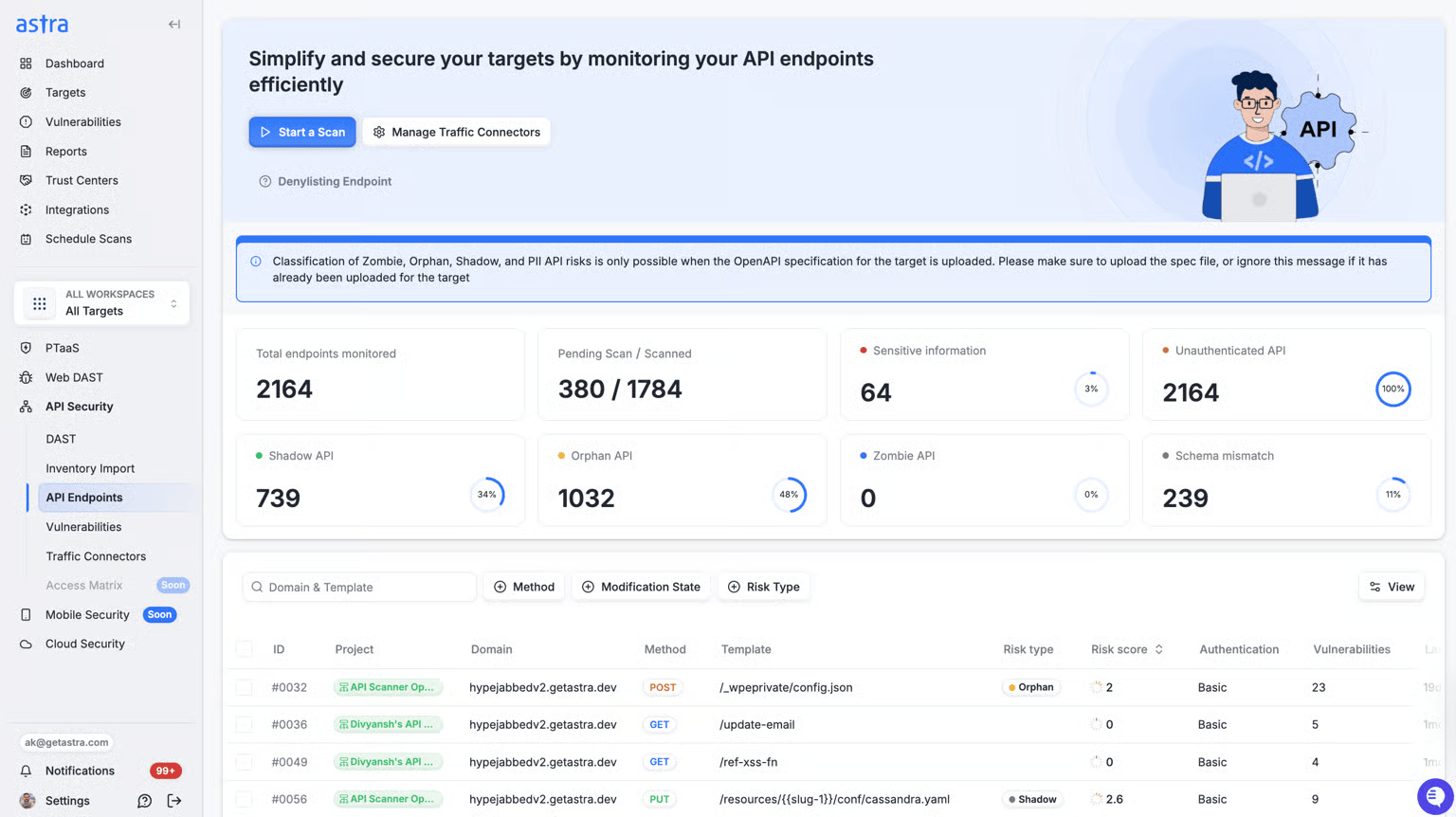
Key Features:
- Discover shadow and zombie API endpoints that evade traditional inventory tools
- Modern DAST scanner built for APIs with 15,000+ test cases including OWASP API Top 10, BOLA, and IDOR
- Live API traffic capture through connectors for AWS, GCP, Nginx, Azure for continuous API threat visibility
- Deep integrations with Postman and Burp Suite for continuous API discovery and inventory building
- AI-powered logic testing that catches real-world risks beyond spec violations
Astra Security’s API Security Platform tackles the above challenges via continuous API posture monitoring and risk scoring. We help you implement the best practices by automating discovery, running authenticated security testing, and providing human-verified findings that your team can act on immediately. Our platform integrates directly into your CI/CD workflows so security becomes part of development instead of a bottleneck.
Results flow into your resolution center with video PoCs, focused rescans to validate fixes, and audit-ready reports for compliance frameworks like GDPR and HIPAA. Deep integrations with Slack, Jira, and existing tools reduce your MTTR while maintaining development velocity across REST, GraphQL, internal, and mobile APIs.
Final Thoughts
API security posture is not about checking boxes. It’s about building connected systems that stay gated, authorized, encrypted, and continuously validated against real threats.
Start by auditing your current APIs and prioritizing the highest-risk endpoints. Document them through automation but keep manual oversight alive. Implement strong authentication and encryption. Scan and test continuously for vulnerabilities and update everything including your API documentation as you go.
FAQs
Which are the three components of API security posture?
The 3 major components include:
– Discovery and Inventory – Identifying all internal, external, shadow, and zombie APIs
– Risk Assessment & Configuration – Evaluating vulnerabilities against frameworks like OWASP API Top 10
– Continuous Monitoring and Remediation – Detecting divergences from the normal, sensitive data situation, and managing security controls.
How do you measure the security posture of your APIs?
Measuring the security of your API posture involves quite a few variables:
– Vulnerability severity
– Authentication levels
– Data sensitivity classification
– Exposure levels (public/internal)
– Encryption compliance
– Rate limiting
– Monitoring, remediation and compliance via OWASP API Top 10, NIST, ISO 27001, etc.
What factors influence an organization’s API security posture?
Key factors include:
– API discovery completeness (known vs. shadow APIs)
– Authentication and authorization mechanisms
– Encryption standards
– Rate limiting, monitoring and logging capabilities
– Data sensitivity classification
– Compliance requirements and documentation quality
– Vulnerability remediation speed, and regulatory mandates (GDPR, HIPAA, PCI DSS)
How often should API security posture be evaluated?
How frequently you need to evaluate your API security depends on the risk levels involved:
– High-risk APIs: Monthly automated scans and quarterly pentesting
– Medium-risk APIs: Quarterly automated scans and bi-annual pentesting
– Low-risk APIs Bi-annual automated scans and annual manual testing
Who is responsible for managing API security posture?
From the top:
1. CISO (Chief Information Security Officer) drives the vision and sets corresponding strategies along with handling resource allocation
2. Head of Enterprise Architecture ensures that API design standards are secure., compliant and well-documented
3. Head of Product & Application Security manages operations, including cybersecurity ones and manages testing
4. Development teams implement secure practices. Cross-functional collaboration here is what ensures your API security posture thrives in real and not just looks pretty in theory
What tools help improve API security posture?
While there are multiple firms that offer API security platforms, penetration testing tools, vulnerability scanners, and API gateways, Astra Security offers a comprehensive API Security solution combining AI-infused hybrid penetration testing with automated and continuous vulnerability scanning. It also offers real-time monitoring, CXO-friendly reporting and posture assessment.
Our umbrella approach enables you to discover shadow, zombie and orphan APIs, assess risk, execute remediation, and maintain compliance effortlessly, making it an ideal API security posture maintenance as well as enhancement tool.