Key Takeaways:
- Strategically segmenting your network is the most effective way to isolate the Cardholder Data Environment (CDE) and dramatically reduce the scope of a PCI DSS audit.
- This isolation also serves as a critical security control, preventing breaches by containing attackers and preventing them from moving laterally into your sensitive systems.
- PCI DSS Requirement 11.4.5 mandates that these controls be tested at least every six months and after any network changes.
- Success requires rigorous testing and thorough documentation to provide auditors with clear proof that the CDE remains securely isolated.
PCI DSS compliance isn’t just about ticking off controls, but it’s more about how your infrastructure is architected and enforced. Few decisions influence the scope of compliance as directly as the implementation of network segmentation.
Every additional system brought into the PCI scope adds operational friction: more logs to review, more systems to harden, more controls to audit. One misconfigured firewall rule or a forgotten DNS server can quietly pull half your network into scope.
This is where network segmentation testing comes in: not as a technical suggestion, but as a strategic boundary that dictates where compliance begins and ends. Done right, it creates a tightly scoped, auditable Cardholder Data Environment (CDE) and keeps everything else out.
What Is Network Segmentation Testing?
Network segmentation testing is the process of verifying that your controls (such as ACLs, firewalls, cloud-native rules, etc.) are effectively isolating systems in the Cardholder Data Environment (CDE) from the rest of your network. While a quarterly PCI ASV scan checks for external vulnerabilities, segmentation testing verifies the internal boundaries are secure. It’s about ensuring that no unauthorized or unintended communication paths exist, especially between CDE and non-CDE systems.

Why is Astra Vulnerability Scanner the Best Scanner?
- We’re the only company that combines automated & manual pentest to create a one-of-a-kind pentest platform.
- Vetted scans ensure zero false positives.
- Our intelligent vulnerability scanner emulates hacker behavior & evolves with every pentest.
- Astra’s scanner helps you shift left by integrating with your CI/CD.
- Our platform helps you uncover, manage & fix vulnerabilities in one place.
- Trusted by the brands you trust like Agora, Spicejet, Muthoot, Dream11, etc.

Why Should You Test Network Segmentation?
1. Actively Shrinks Your PCI Audit Surface
Network segmentation is one of the few levers that allows you to reshape the PCI scope at the architectural level. By drawing precise, enforced boundaries around the Cardholder Data Environment (CDE), you reduce the systems subject to audit, evidence collection, and hardening.
In large-scale or hybrid deployments, this reduction translates into real savings across compliance time, operational friction, and engineering overhead. This is a significant win for sprawling environments, especially for organizations navigating the rigorous demands of PCI DSS Level 1 Compliance, where audit complexity and resource costs are at their peak.
2. Strategically Slows Down Attackers
Flat networks give attackers freedom. Segmented networks don’t. With well-placed choke points and traffic restrictions, segmentation turns lateral movement into a visibility trigger or a dead end.
If segmentation validation is part of your ongoing security posture, breaches outside the CDE don’t have to escalate into PCI incidents. Think of it as pre-breach containment, codified into your infrastructure. For any PCI DSS Service Provider, this is a critical component of demonstrating a mature security posture to clients and auditors.
3. Enforces Least Privilege at the Network Level
Segmentation is one of the last lines of defense that works independently of identity sprawl. Even if credentials are compromised or roles are misconfigured, a properly segmented network ensures that systems can only communicate with one another where explicitly allowed.
It operationalizes zero trust across VLANs, security groups, and routes, and provides a physical audit trail that you can show to PCI assessors. It provides a physical audit trail that top PCI QSA companies expect to see during an assessment.
Network Segmentation Checklist
Before initiating a PCI segmentation test or bringing in a QSA, ensure that:
- CDE boundaries mapped and documented
- ACLs and segmentation rules reviewed
- Sample systems identified for each zone
- Testing tools prepared (nmap, traceroute, etc.)
- Test results logged and captured
- Evidence mapped to Requirement 11.4.5
How to Conduct Network Segmentation Testing?
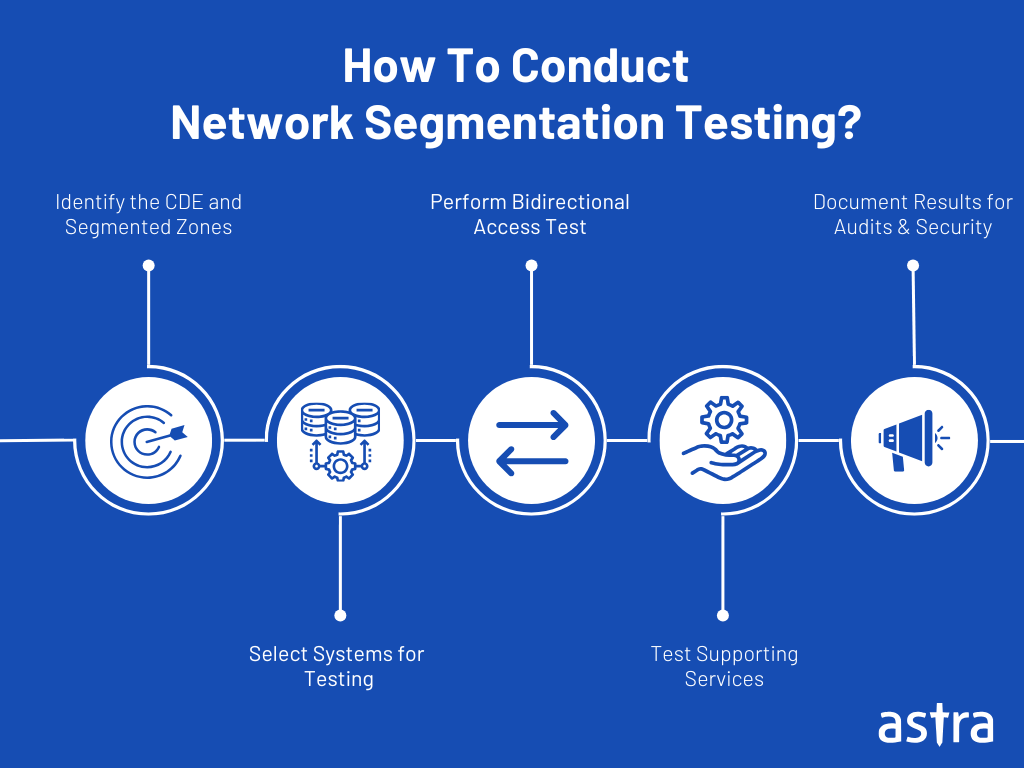
1. Define CDE and Segmented Zones
Start by identifying the areas that handle all cardholder data and how it is processed. From there, identify and map out adjacent systems, including databases, servers, support tools, or the DNS.
Understand your requirements and define which systems are in scope and which require segmentation to stay out of scope.
2. Select Systems for Testing
The next step is to choose sample systems that represent both in-scope and out-of-scope environments for testing.
This includes systems in various networks, data centers, and the cloud, especially those that handle authentication and system management.
3. Perform Bidirectional Access Test
Once the segments are set up, you can use various tools, such as nmap, netcat, and traceroute, to check whether the systems in the CDE environments can initiate communication with those outside and vice versa.
This test should ensure that communication between the CDE and non-CDE is strictly controlled and only occurs when necessary.
4. Test Supporting Services
Segmentation validation isn’t complete without accounting for supporting infrastructure services that, while not part of the CDE, can act as conduits into it.
Services like DNS, NTP, syslog, Active Directory, and even backup servers often have broad network access and can unintentionally bridge segmented zones. These services must be tested to ensure they do not introduce indirect paths into the CDE.
5. Document Results for Audit and Security
Complete documentation is critical for satisfying both compliance and internal security teams. During each test, capture detailed evidence such as screenshots of denied connections, terminal outputs of commands, and network logs showing blocked traffic.
Record IP addresses, hostnames, zones, and the segmentation rule under test. Organize your results in a structured format by system group or segmentation boundary. Documentation should be aligned with PCI DSS Requirement 11.4.5 and mapped directly to your CDE inventory.
What are Some Common Testing Scenarios?
With different environments in use, each with its own set of risks and challenges, come different segmentation strategies.
1. Cloud-Native Environments:
Cloud platforms like AWS and Azure use constructs such as Security Groups, Network ACLs, and NSGs to enforce segmentation. While flexible, these controls are highly dynamic and prone to drift. Frequent rule changes, autoscaling, and misconfigured IAM roles can inadvertently break isolation. It’s crucial to perform regular validation of both ingress and egress rules, especially across VPCs or resource groups.
2. VLAN-Only Segmentation:
Relying solely on VLANs for segmentation is no longer considered sufficient under PCI DSS. VLANs must be enforced with ACLs, firewall rules, or similar Layer 3 controls to prevent unauthorized access. Auditors frequently flag VLAN-only setups that lack proper traffic enforcement or documentation, pulling more systems into the PCI scope.
3. Hybrid Architectures:
In environments that span on-prem and cloud or multiple data centers, VPN tunnels and private links can unintentionally bridge isolated zones. Without proper segmentation enforcement at tunnel endpoints, previously out-of-scope systems may gain unintended access to the CDE. Hybrid environments require special attention to traffic flows and interconnect routing policies.
How To Choose a Partner for Segmentation Validation?
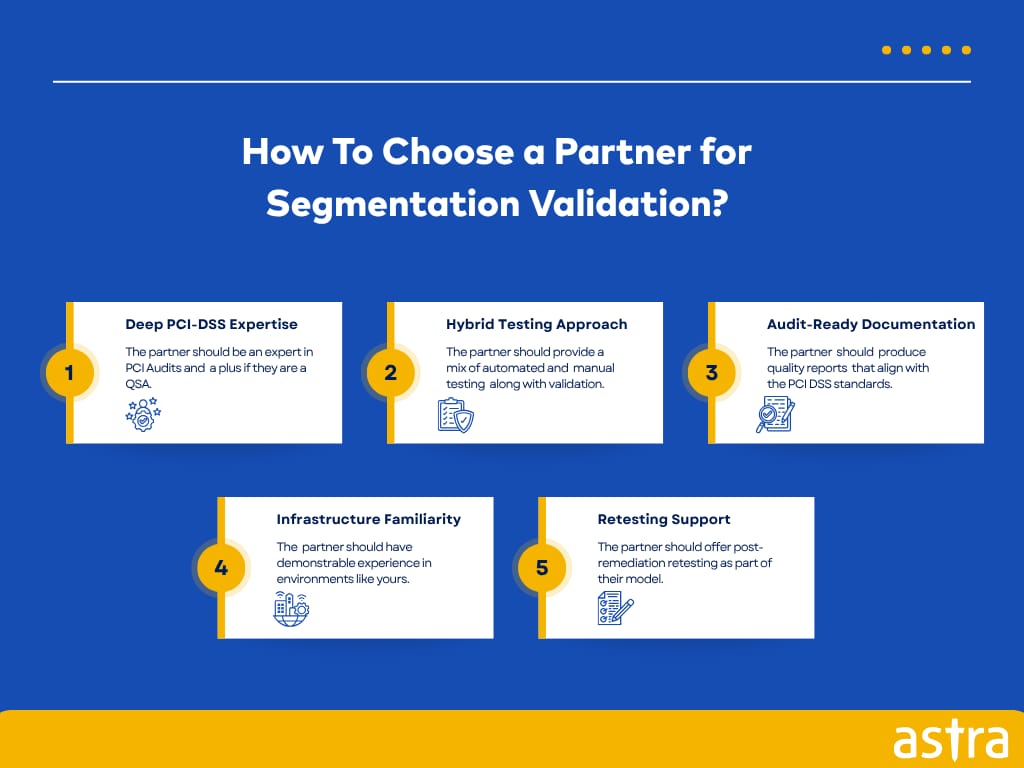
Validating segmentation controls is a nuanced task that sits at the intersection of compliance, security engineering, and infrastructure awareness. As Requirement 11.4.5 brings segmentation into sharper audit focus, the question becomes: Who do you trust to test your blast doors?
Here’s what to look for in a validation partner, beyond surface-level checklists:
1. Deep PCI DSS Expertise, Not Just Generic Security Testing
Anyone can run Nmap. Few understand the strategic implications of scope definition under PCI. Your partner should demonstrate fluency in PCI DSS v4.0, particularly in how segmentation ties back to scope reduction, audit defensibility, and the evolving interpretation of 11.4.5.
Bonus points if they’ve supported actual QSA-led assessments or collaborated with auditors.
2. Hybrid Testing Approach Backed by Engineering Rigor
Segmentation gaps rarely exist in plain sight. They often hide in implicit trust paths, DNS fallbacks, or legacy firewall rules that are no longer maintained.
A credible partner will mix automated tools with manual validation and know when to discard scanner output in favor of traceroutes, access logs, or protocol-level sniffing. Their test should reflect your actual traffic flows, not just architectural intent, providing deeper insights than a simple PCI compliance scan.
3. Audit-Ready Documentation That Tells a Story
You’re not just testing segmentation, you’re preparing for scrutiny. The right partner provides layered, structured documentation that covers not just what was tested, but why.
Expect evidence that aligns with PCI DSS controls, including command outputs, screenshots, timestamps, zone definitions, and risk justification. When a QSA opens your report, it should feel like the narrative was written for them.
4. Infrastructure Familiarity That Matches Your Reality
Cloud-native? Multi-region hybrid? Flat VLAN-based enterprise? Your validation partner should have demonstrable experience in environments like yours; not theoretical, but hands-on.
This ensures they’ll understand where segmentation tends to erode (e.g., over-permissive security groups, VPN sprawl, or overlooked BGP routes) and tailor their testing accordingly.
5. Built-In Retesting Support – Because Fixes Are Inevitable
Every segmentation validation uncovers something. The question is, can you prove it’s fixed without restarting the engagement? Look for partners who bake in post-remediation retesting as part of their model.
It signals confidence in their process and helps you close the audit loop efficiently.
How Can Astra Help?
Key Features:
- Platform: SaaS
- Pentest Capabilities: Cloud-native manual pentests + automated scans for web apps, APIs, and infrastructure
- Accuracy: Zero false positives with validated findings
- Compliance Scanning: PCI DSS, ISO27001, SOC2, HIPAA, and OWASP
- PCI Readiness Toolkit: Gap analysis, scoping guidance, and auditor-ready reports
- Workflow Integration: Slack, JIRA, GitHub, GitLab, and CI/CD pipelines
- Price: Starting at $1999/yr
Astra’s security testing solution is designed to support organizations working toward PCI DSS compliance, with a specific focus on high-impact controls, such as network segmentation.
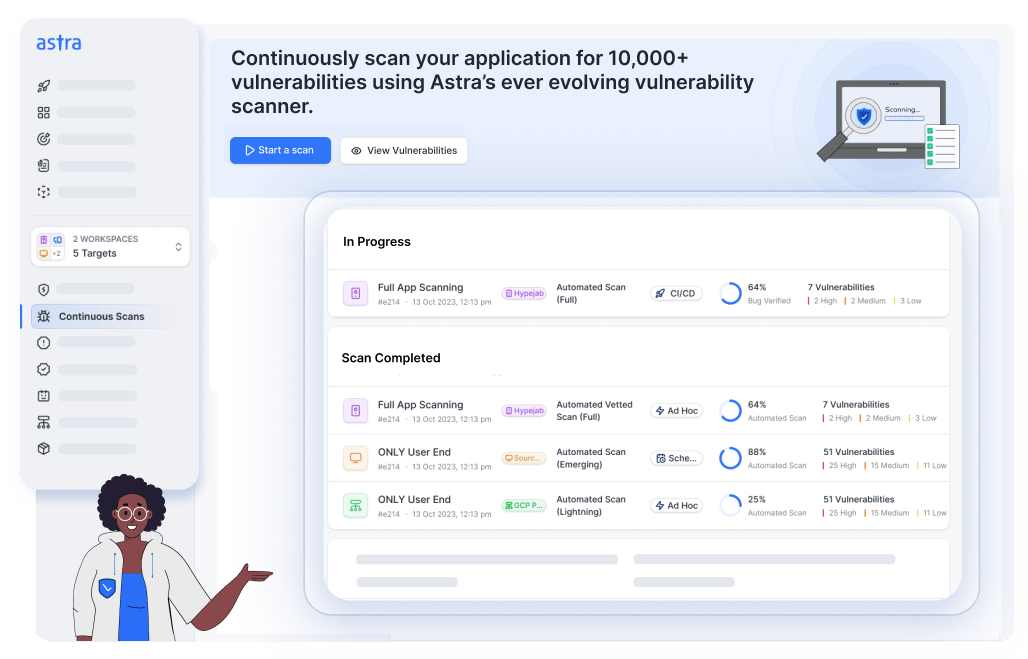
We begin by mapping your infrastructure to understand how the Cardholder Data Environment (CDE) is segmented, which assets fall within scope, and how data flows between systems. Using both automated tools and manual techniques, we simulate real-world attack paths to uncover misconfigurations, undocumented routes, and edge cases that typical scanners overlook.
Next, we validate your segmentation controls through packet-level testing, traffic flow analysis, and targeted exploitation across routers, ACLs, firewalls, and cloud security groups. Our approach aligns with industry benchmarks, including CIS, NIST, and MITRE ATT&CK, ensuring your validation meets PCI DSS requirements, particularly 11.4.5.
Our Deliverables Include:
- Connection test results showing blocked traffic paths
- Annotated network boundaries and rule maps
- Terminal outputs and evidence screenshots
- PCI DSS control mapping
- Actionable remediation insights for security, network, and compliance teams
& get started today!

What Are the PCI DSS Network Segmentation Requirements?
1. Is Reducing Audit Scope the Real Driver for Segmentation?
Segmentation may not be mandatory under PCI DSS, but without it, everything is in scope: every development box, every endpoint, every printer with a heartbeat. Effective segmentation enables you to draw a clear line around what truly needs to be audited, thereby reducing your compliance overhead and focusing security efforts where they matter most.
2. Why ‘Logical’ Isolation Isn’t Enough for PCI DSS
The CDE can’t just be conceptually separated; it needs to be technically isolated. Whether it’s via firewalls, ACLs, VLANs, or cloud-native controls (such as AWS Security Groups or Azure NSGs), enforcement must be verifiable. Auditors won’t accept intent; they need evidence.
3. Requirement 11.4.5 Brings Segmentation Into the Spotlight
With v4.0, PCI DSS introduced Requirement 11.4.5, which mandates that segmentation controls must be verified at least every six months and after any network changes, if they’re being used to reduce scope. The language here matters. Validation isn’t optional; it’s a formal expectation tied to scope defensibility.
4. Testing Frequency Mirrors Your Rate of Change
You’re not just testing twice a year, you’re testing every time your environment shifts. That includes firewall updates, new integrations, decommissioned zones, or cloud resource restructuring. The compliance clock resets with every change.
5. Prohibiting CDE ↔ Non-CDE Communication
The most considerable risk isn’t what attackers can reach; it’s what your systems can reach without you realizing it. Segmentation testing must confirm that there are no unintended paths between CDE and non-CDE systems. This includes backdoor access through shared services such as DNS, NTP, syslog, and management networks.
Validation Methodologies for PCI Network Segmentation Audits
- Network Diagrams: Visually represent segmented zones, their boundaries, and permitted communication paths. Diagrams should reflect real-world routing, not just architectural intent.
- Port Scans: Tools like nmap should show definitive results where communication is explicitly denied between non-CDE and CDE systems. Screenshots or scan logs must clearly illustrate blocked ports and protocols.
- Access Logs: Wherever possible, include system logs showing denied access attempts. This reinforces the test evidence and validates live traffic controls.
- Methodology Documentation: Clearly describe the tools used, commands run, IPs tested, the logic behind test cases, and when each test was executed. This ensures repeatability and audit confidence.
- Traceability to PCI DSS 11.4.5: Your entire testing and documentation process must directly map back to Requirement 11.4.5. Auditors must be able to trace each piece of evidence to a control and understand its relevance to scope reduction.
Final Thoughts
Network segmentation is often treated as a checkbox item in PCI compliance software. Yet, in reality, it’s one of the most strategic controls you have, both for reducing audit scope and strengthening real-world security.
When segmentation is done right, it creates a clear boundary around your most sensitive systems. But when it’s not continuously validated, that boundary can become porous, quietly expanding your risk surface and pulling more systems into scope without warning.
Requirement 11.4.5 isn’t just about compliance cadence, but it’s a reminder that scope reduction is a moving target. Infrastructure evolves. Access paths shift. Supporting services get overlooked. Segmentation testing ensures that your intent aligns with your implementation.
The takeaway? Treat segmentation validation not as an obligation, but as an opportunity to tighten control, reduce operational load during audits, and reinforce the trust placed in your systems to handle cardholder data. Explore our transparent pricing plans to find the right fit for your security and compliance needs.
It is one small security loophole v/s your entire website or web application.
Get your web app audited with
Astra’s Continuous Pentest Solution.

FAQs
1. Is network segmentation mandatory for PCI DSS compliance?
No, segmentation isn’t mandatory, but without it, your entire network becomes in-scope for PCI DSS. Effective segmentation significantly reduces audit scope, effort, and cost by isolating the Cardholder Data Environment (CDE) from the rest of your infrastructure.
2. How often should segmentation testing be performed under PCI DSS v4.0?
Under Requirement 11.4.5, segmentation testing must be conducted at least every six months and after any network changes. This ensures segmentation controls are actively enforced and continue to meet scope reduction expectations.
3. What tools are commonly used for segmentation validation?
Typical tools include Nmap for port scanning, netcat for connectivity tests, and traceroute to analyze network paths. Manual tests and access log reviews often supplement these to ensure no unintended communication paths exist between CDE and non-CDE systems.