According to the Stanford Institute for Human‑Centered Artificial Intelligence 2025 AI Index Report, 78% of organizations reported using AI in at least one business function (up from 55% the previous year). (HAI Index Report, 2025)
With the increasing usage of AI systems in critical infrastructure and business operations, there is an inevitable need to secure these systems. Artificial intelligence penetration testing (AI pentesting) is a domain-specific security assessment designed to identify and remediate vulnerabilities unique to AI systems, including machine learning models, retraining pipelines, and their underlying infrastructure.
This write-up will look at the key concepts of AI pentesting and why it is critical for organizations building and deploying AI solutions to make testing an integral part of their security strategy.
What is AI Penetration Testing
AI pentesting is a comprehensive security assessment methodology specifically designed for AI and machine learning systems. It’s about methodically poking and prodding AI parts such as models, datasets, training, and deployment infrastructure to find security flaws before threat actors can exploit them.
While traditional security testing primarily focuses on network and application-level vulnerabilities, AI pentesting examines how the fundamental features of machine learning systems can be exploited.
Classic penetration testing involves the testing of an environment that is fully known to the testers before the testing process.
It encompasses knowledge of network topology, software products, and their configuration.
Continuous AI pentesting extends this methodology by integrating ML-specific testing vectors, including model inversion attacks, data poisoning assessments, and adversarial example generation.
Why AI Pentesting is Important
AI Systems bring in new security threats. Organizations that develop and deploy AI technologies must secure these new systems to protect both their investments and the customers who rely on AI.
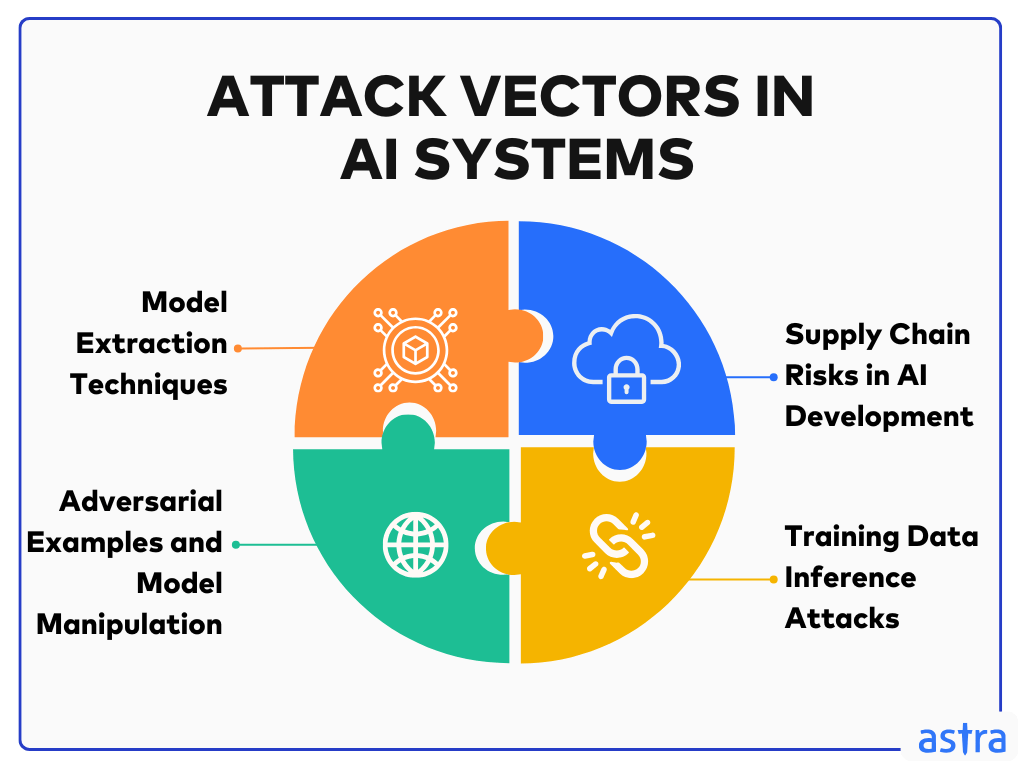
AI systems have unique weaknesses that traditional security assessments may miss entirely. Data-driven systems can be vulnerable to privacy attacks, including membership inference, which leaks information about data included in the training set; model inversion, which reveals sensitive training data; and adversarial examples, which trigger misinformation.
From what we’ve observed across client engagements, teams deploying AI models often underestimate how exposed their model endpoints and prompt interfaces can become once integrated into production environments.
Complete Scope of AI Security Testing
Effective penetration testing of AI systems requires a broad, multifaceted approach. Astra’s methodology covers every critical domain that modern AI architectures rely on.
1. Model & Endpoint Security
ML pentesting includes testing endpoints, APIs, and data pipelines specific to machine learning components. Assessments include extraction attacks, adversarial manipulation, and prompt injections across proprietary and integrated models, ensuring endpoints are robust against input/output abuse.
2. Data, Training & Pipeline Integrity
Focuses on training data poisoning, secure data pipelines, retraining/CI-CD workflows, and provenance. Evaluates the integrity of stored datasets, injection risks in data flows, and the resilience of automated retraining mechanisms against attacker interference.
3. Infrastructure & Orchestration
Examines threats across containers, orchestration platforms (K8s, GPU nodes), and the underlying compute/storage stack. This encompasses resource isolation, exploits targeting model serving infrastructure, and security gaps in orchestration or runtime environments.
4. API, Integration & Extension Risks
Assesses exposed APIs, integrations with plugins/connectors, model control planes and model registries, and RAG stacks/vector databases. Pentesting ensures authentication strength, evaluates the risk in connectors/extensions, and reviews the safety of cross-component data retrieval and storage.
5. Monitoring, Access & UI Controls
Includes access control systems, monitoring/telemetry, prompt stores, and user-facing UIs. Tests for privilege escalation, session mismanagement, sensitive telemetry leakage, and interface-driven security flaws that attackers could exploit to manipulate outputs or bypass controls.
Vulnerabilities & Threats in AI/LLM Security
1. Prompt Injection
Attackers can trick AI models by sending cleverly crafted prompts that lead the system to share information it shouldn’t or behave in unexpected ways. These prompt‑based attacks are growing concerns, especially for AI tools that interact directly with users.
In one of our early audits, a seemingly harmless prompt manipulation bypassed an enterprise chatbot’s content-filter logic, something that wouldn’t have been caught in a standard web application test. Situations like this are exactly why AI-specific pentests are crucial.
2. RAG/Vector DB Retrieval Leakage (Document Exfiltration)
If someone asks the right questions, they might pull private or sensitive documents from systems that use vector databases or retrieval-augmented generation setups. This means personal or confidential data could accidentally get shared outside the organization.
3. Model Extraction/Theft
There’s a risk that someone could copy your AI model just by observing its answers over time. If they’re successful, your unique AI work and all the effort put into building it could end up being used by someone else without permission.
4. Model Inversion/Membership Inference
By studying how the model responds, it’s possible for outsiders to guess whether certain information or people were included in the original training data. This could expose details you expected to keep private.
5. Training Data Poisoning/Backdoors
If an attacker slips certain data into your training set, they can secretly influence how the model behaves, sometimes leaving behind “hidden” ways to control it later. These tricks might not show up until the model encounters their specific trigger.
6. Adversarial Perturbations
Even small, almost invisible changes to input data can sometimes confuse an AI model, making it give the wrong answer. These kinds of tricks, which might seem harmless on the surface, can cause the system to make serious mistakes. Teams may use AI red-teaming methodologies to simulate real attack attempts and find hidden issues.
7. Insecure Output Handling (RCE/XSS Analogues)
Failure to carefully check what the AI sends out as a result, could include harmful code or links. This could lead to problems for users or other connected systems that process these outputs without extra safety checks.
8. API Abuse/Broken Auth & Excessive Privilege
When someone finds a way around weak API passwords or permission settings, they may get access to features they’re not supposed to use. This kind of problem can lead to data leaks or unwanted changes in the system.
9. Excessive Agency, Tool/Plugin Abuse
Sometimes, third-party tools and plugins have more access or control than they really need. If not kept in check, a user or attacker could use these features to do things the system shouldn’t allow.
10. Supply Chain & Third-Party Model Risks
Bringing in pre-trained models or code from other companies can sometimes introduce hidden problems. If a supplier doesn’t follow good security practices, you might inherit their issues or even pick up harmful software by accident.
11. Unauthorized Model Fine-Tuning
If someone makes changes to your AI model without proper supervision, they might weaken its performance or intentionally cause it to act in a way that’s not intended. Monitoring changes is key to keeping your system trustworthy.
12. Denial of Service & Resource Exhaustion
People can sometimes overload AI systems by sending too many requests at once, using up all the available computing power. When this happens, regular users might find that the service is slow or completely unavailable.
13. Metadata & Side-Channel Leakage (Logs/Embeddings)
Information that’s meant to help you track how your AI works, like logs or data summaries, can sometimes reveal more than you expect. If these details fall into the wrong hands, they could be used to learn about your system’s secrets or behavior.
How to Perform AI Penetration Testing: Methodology & Tools
At Astra, our AI pentesting process grew out of lessons from dozens of real-world engagements. Each step reflects patterns we’ve seen in live environments rather than lab setups.

1. Scoping & Rules of Engagement
Before starting any AI penetration test, the team should clearly outline exactly what will be included in the assessment and create a detailed list of everything that makes up the system, like LLMs, APIs, data stores, plugins, and user interfaces.
This way, everyone knows which parts will be checked and which will not, while also getting an understanding of how testers will handle sensitive or private data, and what kinds of testing are acceptable, especially if the work could expose confidential information. A thorough AI/ML pentesting program maps all integrations and reviews how different modules interact.
2. Recon & Threat Modeling
Successful AI penetration testing starts with building an inventory of every component: models, APIs, vector databases, orchestration layers, plugins, and related integrations. From here, you map the entire attack surface: understanding how data flows, where inputs connect to core logic, and how third parties interact with the system.
This step helps find even the most camouflaged vulnerabilities and prioritize areas that need the most attention. AI vulnerability testing requires in-depth analysis of model logic and input handling. During this phase, our testers often experiment with prompt variations and malformed API inputs to map out how the model reacts to ambiguous or manipulated data.
3. Intelligence Gathering
Investigators gather insights into how the AI system behaves in real-world conditions, including testing with example prompts, examining how the model responds to unusual or unexpected input, and exploring any quirks in the system’s retriever or context-building logic.
Reviewing training data sources and any accessible API endpoints provides a deeper understanding of where weaknesses may exist and helps set up more targeted testing scenarios later in the process.
4. Adversarial Testing
Here, testers actively try to break the system, running campaigns that probe for weaknesses using crafted prompts and fuzzing techniques. This can mean thousands of slightly altered inputs meant to trick the model, as well as building adversarial examples: inputs designed to trigger failure cases or bypass filters.
Testers also look for ways to make the model behave in unsafe or unintended ways (prompt injection), as well as exploring how it handles input it’s never seen before. Model fuzzing helps find stability issues, and the goal is always to uncover attacks that could happen in a real-world scenario, from data leaks to unwanted behaviors.
In our controlled exploit attempts, we’ve found that AI systems can leak sensitive training data even without explicit queries, often through indirect prompt chaining or memory recall functions.
This simple Fast Gradient Sign Method (FGSM) script shows how AI pentesters simulate adversarial attacks to test a model’s resilience against crafted perturbations:
# Example: Generating Adversarial Inputs for Model Robustness Testing
import torch
import torchattacks
from torchvision import models, transforms

model = models.resnet50(pretrained=True).eval()
attack = torchattacks.FGSM(model, eps=0.007)

# Generate adversarial example
adv_images = attack(images, labels)
predictions = model(adv_images)

print("Adversarial test completed. Misclassified samples:", (predictions != labels).sum().item())
5. API, RAG & Infrastructure Testing
Testing doesn’t end at the prompt or model level, but rather, pentesters should also dig into how APIs are secured. Are authentication and permissions set up correctly? For AI systems using retrieval-augmented generation (RAG), testers review vector database permissions, making sure attackers can’t pull documents they shouldn’t see.
Plugins and extensions are tested for loopholes, and the underlying infrastructure: containers, orchestration platforms, GPU nodes, is checked for ways someone might escalate privileges or access restricted data or processes.
6. Defensive Validation & Monitoring
A strong AI security program is about making sure defenses work. Pentesters validate that rate limits are enforced to stop abuse and check if outputs going to users or downstream systems are sanitized to prevent accidental leaks or injections.
Logging and alerting mechanisms are checked for proper coverage and clarity, and then confirm that there are systems in place for detecting data drift and other behavior changes in the model that could signal new attacks or misuse.
We validate each finding manually, because in our experience, even a single misclassified AI output can have a cascading business impact. Our reports include reproduction steps we’ve actually tested, not theoretical assumptions.
7. Reporting & Remediation
After testing is done, clear and actionable reporting is of utmost importance, and so, testers document every finding, mapping issues to well-understood vulnerability types, with clear severity ratings. Clear deliverables make sure that penetration testing AI results can be acted on swiftly by development and security teams.
Reports include the evidence needed to understand and fix each problem, and often suggest prioritized remediation steps tailored to the specific system. Some teams run targeted retests after fixes are applied, making sure that vulnerabilities are truly closed and the risk is minimized.
8. Tools & Frameworks
Expert teams rely on a combination of industry frameworks and practical tools. The OWASP LLM Top 10 list serves as a foundational checklist, making sure all common risk areas are covered. MITRE ATLAS and CSA’s security guidance provide additional context for attack techniques and best practices.
Typical toolsets include prompt fuzzers for input analysis, extraction detectors, adversarial testing libraries, scanners for vector databases and APIs, and auditing plugins for access control or permission issues. Having a well-rounded toolkit ensures that no major vulnerability is overlooked during testing.
Tools Commonly Used in AI Pentesting
| Category | Tool / Framework | Purpose |
|---|---|---|
| Adversarial Testing | CleverHans, TextAttack | Generate adversarial samples & fuzz prompts |
| API & Model Testing | Astra Vulnerability Scanner, Burp Suite, OWASP ZAP | Identify injection & output handling risks |
| RAG Stack Security | LangChain Debugger, Astra RAG Inspector | Analyze retrieval pipelines & document exposure |
| Infrastructure | K8s Bench, Trivy, Astra Cloud Scanner | Test GPU nodes, containers, orchestration flaws |
Challenges Associated with Pentesting for AI
1. Limited Standardization in AI Security
AI security lacks the established standards and best practices that guide traditional cybersecurity efforts. While frameworks like MITRE ATLAS (Adversarial Threat Landscape for Artificial Intelligence Systems) are emerging, they remain less developed than their counterparts in conventional IT security.
2. Technical Complexity of AI Systems
AI systems are more complex in a mathematical sense, and they integrate traditional IT systems in a manner that makes security evaluation challenging. Evaluating state-of-the-art deep learning solutions often involves an in-depth understanding of statistical principles, linear algebra, optimization theory, and domain-specific concepts.
3. Finding Qualified Testers with AI Expertise
AI security is a relatively rare intersection of two distinct skill sets that are not widely prevalent in the workforce at large, namely, machine learning expertise and security testing. Typically, people who are experts in AI lack expertise in security, and those who have expertise in security often lack a deep understanding of the mathematics required for pentesting AI models / LLMs.
This skills gap prevents most companies from developing internal penetration testing for AI capabilities or properly evaluating external AI testing services. Taking a relevant testing course can be a good starting point to build foundational skills in this area.
4. Balancing Security with Model Performance
Several AI security features compromise performance, and companies are forced to weigh the performance trade-offs against the security benefits. Adversarial training can increase model robustness but at the expense of accuracy on clean inputs.
Privacy-enhancing technologies, such as differential privacy, can introduce noise into the model learning process, resulting in reduced model quality.
5. Addressing Proprietary AI Systems
Most institutions rely on in-house or licensed AI tools that lack complete visibility into the model architecture, training data process, or code foundation. This opacity makes security testing difficult, as many successful methods involve some access to model internals.
In testing commercial AI systems, you have to treat them as black boxes and develop special tests on the observable behavior and output, not the internal logic.
How Astra Security Can Help
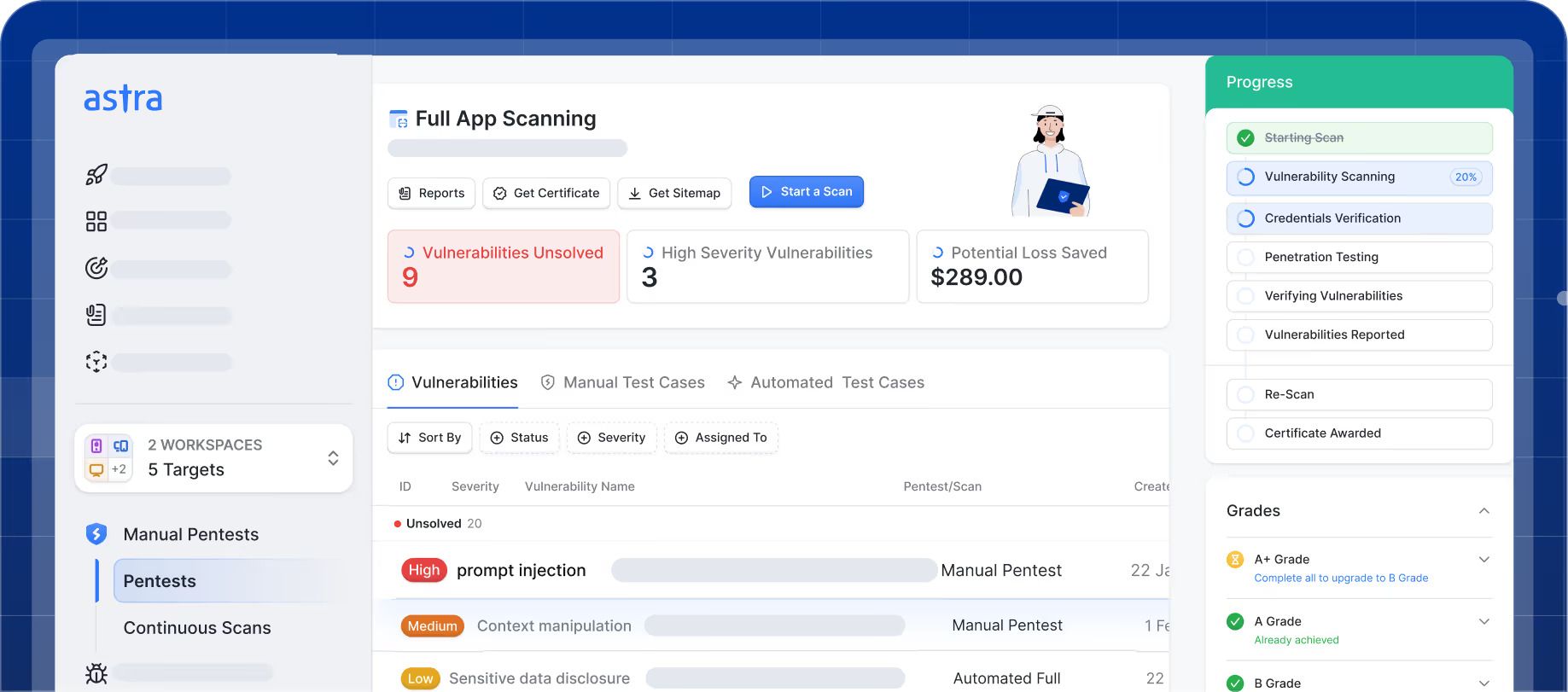
Astra’s AI pentesting services give organizations everything they need to understand and fix risks in their artificial intelligence systems. The process provides thorough assessments, detailed guidance, and practical tools to help teams build safer, more reliable solutions.
Our pentesters have spent years breaking and securing real AI-enabled applications, from fintech scoring engines to GenAI chat platforms, which helps us anticipate attack patterns others overlook.
Astra’s assessments are delivered through an easy-to-use online dashboard. Clients can:
- Monitor findings, track progress, and download reports in real time.
- Integrate security checks into their CI/CD workflows for faster, ongoing protection.
- Schedule retesting to ensure that patches work, with clear service-level agreements so follow-ups happen on time.
Teams can also visualize results or share summaries with leadership using interactive charts and screenshots from the platform.
Final Thoughts
After performing multiple AI-specific pentests over the past year, one consistent takeaway stands out: even well-secured systems behave unpredictably once AI components are introduced. AI pentesting is a crucial cybersecurity frontier as companies increasingly delegate tasks to machine learning.
The special vulnerabilities in AI (ranging from model extraction and adversarial examples to data poisoning and privacy leaks) demand a distinct strategy for testing that goes beyond security analysis.
Indeed, standardization, technical complexity, and the availability of expertise remain challenges, but organizations that apply thorough AI security testing can mitigate these risks while building stakeholder trust in their AI systems and ensuring long-term security resilience.
These real-world lessons shape how we design every new test engagement at Astra, because defending AI demands experience earned in the field.
FAQs
1. What are the 5 stages of pentesting?
The five stages of penetration testing are: Reconnaissance, Scanning, Gaining Access, Maintaining Access, and Covering Tracks. These steps help identify vulnerabilities, exploit them, assess risk, and avoid detection. Each stage builds on the previous to simulate real-world cyberattacks for security evaluation.
2. How to pentest artificial intelligence?
To pentest AI, assess model vulnerabilities via adversarial inputs, data poisoning, model extraction, inference attacks, and access control. Evaluate security, robustness, and ethical safeguards across training data, APIs, and deployment environments.
3. How is AI pentesting different from traditional pentesting?
AI pentesting examines model inputs, outputs, training data, and logic for unique risks like prompt injections and data leakage, unlike traditional pentesting, which focuses on network, code, and application vulnerabilities. AI systems need specialized methods to uncover adversarial and data-centric threats.
4. What are the critical components of a secure AI pentest?
A secure AI pentest assesses model endpoints, training data, APIs, plugins, pipelines, access controls, and deployment infrastructure. The scope includes data privacy, prompt handling, and reviewing integrations for leakage risks, unauthorized use, and resilience against targeted manipulations or attacks.
5. What tools are best for AI pentesting?
Categories include prompt fuzzers, adversarial libraries, model extraction detectors, vector database scanners, and API auditors. Leading tools (2025) are: LLM Guard, ThreatModeler, Adversarial Robustness Toolbox, Octoparse, OWASP AMASS, Daggerboard, MITRE Atlas, and Deepchecks.
6. How often should AI models undergo pentesting?
Critical or public-facing AI models need pentesting every quarter. Production and internal models should be tested biannually. Event-based triggers, such as major updates or new integrations, also require assessments to ensure continued security and compliance with best practices.
7. Are there industry regulations governing AI security testing?
Yes. Regulations like the EU AI Act and GDPR implications emphasize data privacy and model transparency. Standards from OWASP and CSA offer testing guidance. Organizations using AI must follow these frameworks to protect sensitive data and meet compliance requirements.
8. Can AI pentesting be automated?
Many AI pentesting tasks, like prompt fuzzing or basic vulnerability scans, can be automated, saving time and catching routine threats. Hands-on testing remains necessary for complex scenarios, custom attacks, and interpreting unusual model behavior that automation alone may miss.
9. Who should conduct AI pentesting?
AI pentesting should be led by a cross-functional team combining security experts, data scientists, and developers. For unbiased, thorough coverage, organizations often hire specialized third-party vendors with experience in AI systems and model-specific testing techniques.
10. How often should I conduct AI pentesting?
AI pentesting should happen quarterly for public or critical models and every six months for internal production models. Additional assessments are recommended after major changes, new features, or when compliance requirements evolve.