
Key Takeaways
- Web application security is a multi-layered approach to protecting confidentiality, integrity, and availability, covering everything from code-level protections to network security.
- Most successful attacks on web applications can be attributed to a small number of exploits or vulnerabilities, such as SQL injection, broken authentication, and access control failures.
- Regular use of both automated security testing tools and manual penetration testing uncovers threats and security gaps while they can still be fixed, before attackers get to them.
Web application security is the prevention and protection of web applications through protocols and processes implemented to ensure a cyber threat and vulnerability-free web environment. Modern applications need to handle sensitive customer data, financial transactions, and proprietary business data, as most of the world has transitioned to digital business. As a result, these systems have been prime targets for various attackers seeking to exfiltrate data, disable services, or gain access to the systems.
There is an ongoing increase in the sophistication of methods used to launch attacks. One of the incidents in 2024 exposed the protected health information of tens of millions of patients by a healthcare provider. An incident driven by threat actors exploiting a vulnerability in the organization’s infrastructure, specifically an unpatched part of its patient portal.
At the core of the breach was a SQL injection vulnerability that went unrecognised for months. This incident is an eye-opening example of how seemingly simple vulnerabilities can lead to disastrous outcomes when organizations fail to implement appropriate security measures.
What is Web Application Security?
Web application security is the collection of measures and tools used to protect applications accessed through internet browsers from malicious threats. This includes protection against injection attacks, cross-site scripting, authentication failures, and data exposure. There are multiple layers of security, from code-level to network, and when combined, they protect against vulnerabilities.
The shared responsibility model outlines how security responsibilities are divided between cloud providers and application owners. It is the cloud providers who are responsible for the security of the infrastructure, including servers, storage, and networking components.
However, application owners are still responsible for securing their code, data, user authentication, access controls, and configuration settings. This clear ownership division helps avoid security gaps by removing ambiguity about a specific vulnerability.
Scan, Discover, and Secure your web apps from evolving threats with Astra Security’s comprehensive security platform.

Why Web App Security Matters
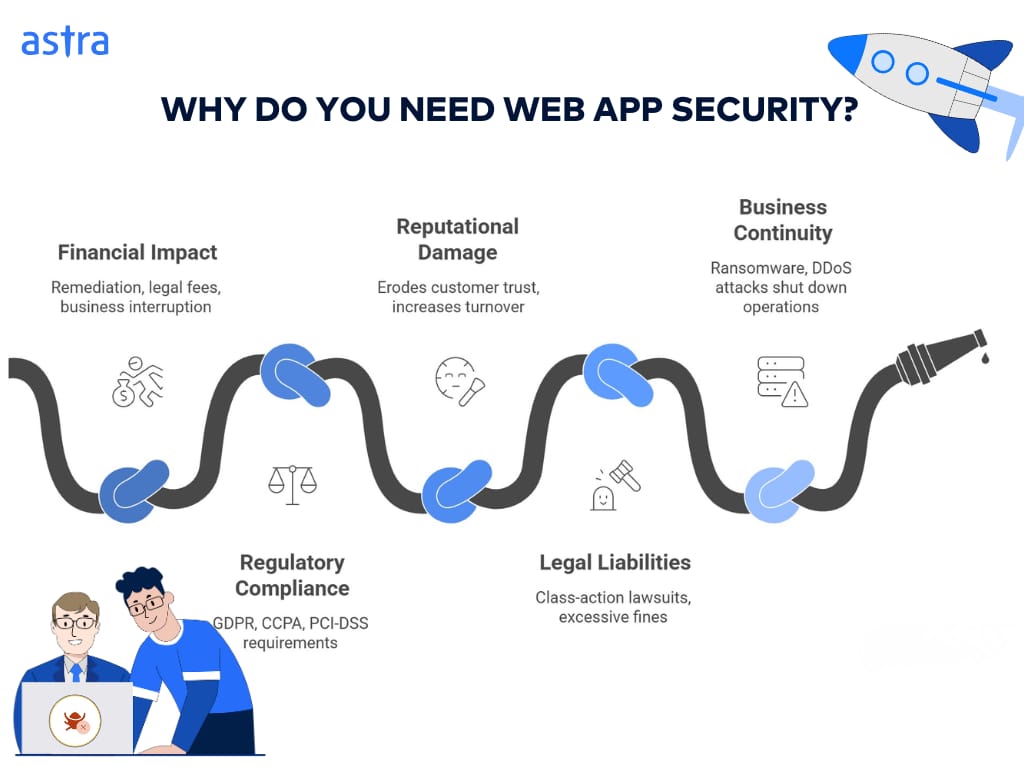
Web applications process financial transactions and store sensitive customer data. Security failures trigger immediate costs, regulatory penalties, and reputational damage that extends beyond technical remediation to affect business operations and competitive position.
Financial Impact of Data Breaches
Financial repercussions of data breaches go beyond the cost of immediate remediation. Forensic investigations, legal fees, notifying customers, and paying for credit monitoring services all cost organizations money. Business interruption during incident response can freeze revenue streams.
Regulatory Compliance Requirements
Various industries and countries have different data protection regulations that organizations must comply with. GDPR demands the strictest data-handling practices for European customer data. CCPA gives California residents more rights with their personal information and establishes disclosure requirements.
Security standards are defined by PCI-DSS (Payment Card Industry Data Security Standards), which applies to any business that processes credit card transactions and requires routine application security assessment and vulnerability scans.
Reputational Damage and Customer Trust
Confidence in an organization’s ability to protect sensitive information quickly erodes after a security incident. Social media and news coverage spread information about an issue, greatly increasing the impact of any reputational damage and speeding the decline in organizational credibility. When a data breach occurs, customer turnover declines as customers switch to competitors’ service providers.
Legal Liabilities
Organizations are legally liable for failing to protect customer data. The affected parties can file a class-action lawsuit that can cost companies millions in settlements and legal bills. Secondly, if organizations fail to remain compliant with data protection standards and regulations, authorities can impose excessive fines.
Business Continuity Concerns
Security incidents pose a risk to the continued operation and existence of organisations. Ransomware that is deployed to encrypt critical systems can cause infrastructure to cease operation until ransom demands are met or systems are restored in some other way. In a similar way, a Distributed Denial of Service (DDoS) attack saturates the server infrastructure with excessive traffic, shutting down servers and preventing legitimate users from accessing critical applications and services.
Common Web Application Vulnerabilities
Awareness of exploitative vulnerabilities enables organizations to strengthen their security landscape. The OWASP Top 10 is a list of the 10 most critical web application security risks that attackers commonly target, often using simple, effective methods.
Injection Attacks
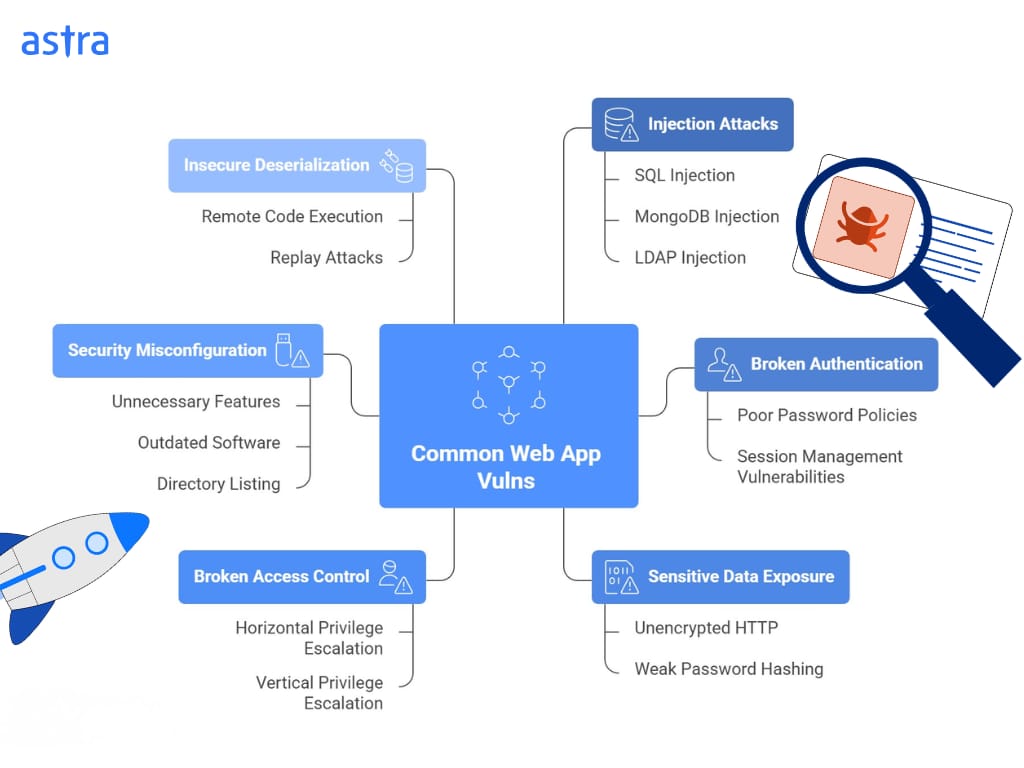
Injection attacks occur when data supplied by an attacker is not properly sanitized by the application and gets passed to an interpreter as part of a command or query. SQL injection is one of the most common attacks that target application input validation by inserting SQL code into input fields used to form a database query. Similar vulnerabilities can be found in other database technologies, such as MongoDB and NoSQL injection attacks that target non-relational database systems, and LDAP injection attacks that exploit vulnerabilities in Lightweight Directory Access Protocol (LDAP) directory services.
Broken Authentication
Broken authentication allows an attacker to break passwords, cryptographic keys, or session tokens and impersonate unwanted users. Poor password policies can leave systems vulnerable to brute-force attacks, in which attackers simply try all possible combinations of credentials until they succeed in authenticating. Common session management vulnerabilities include session identifiers being visible from a URL parameter and session tokens not being invalidated properly after a user logs out.
Sensitive Data Exposure
Many applications do not protect sensitive information, especially credit card numbers, Social Security numbers, and medical records. Transmitting data over unencrypted HTTP connections can expose the information to interception. Weak password hashing algorithms allow simple plaintext credential recovery.
Broken Access Control
Access control failures allow users to perform actions or access data beyond their authorized permissions. Horizontal privilege escalation allows someone to access another user’s account or data. Vertical privilege escalation occurs when a user with a normal account can perform actions that only an administrator can.
Security Misconfiguration
Most system default configurations enable unnecessary features, accounts, or permissions that cause security risks. Threat actors exploit vulnerabilities in outdated, unpatched software. Unintended directory-listing can also reveal the file structures of the server, as well as vulnerable documentation.
Insecure Deserialization
Deserialization attacks target applications that receive serialized objects from untrusted sources and do not have proper validation mechanisms in place. In these types of attacks, the threat actors create malicious serialized objects that invoke arbitrary code when the target application deserializes them. This vulnerability could allow remote code execution, replay attacks, and also privilege escalation.
This security risk has the broadest reach as it affects any application developed in languages that support object serialization, such as Java, Python, and PHP.
Web Application Security Testing Tools
Choosing the right tools to use enables organizations to efficiently identify the vulnerabilities they need to protect against and maintain continuous protection. Below are four essential tools that offer both automated scanning and manual testing functionalities.
Astra Security [Get Started]
Astra Security is a continuous penetration testing service that pairs automated scanning with manual security tests. It carries out more than 15,000 security tests for OWASP Top 10 vulnerabilities, CVEs, logic flaws, and configuration issues. The Attack AI engine replicates the actual behavior of hackers to find vulnerabilities that traditional scanners often miss. CI/CD pipeline integration guarantees that detailed security checks are automatically distributed across the development lifecycle.
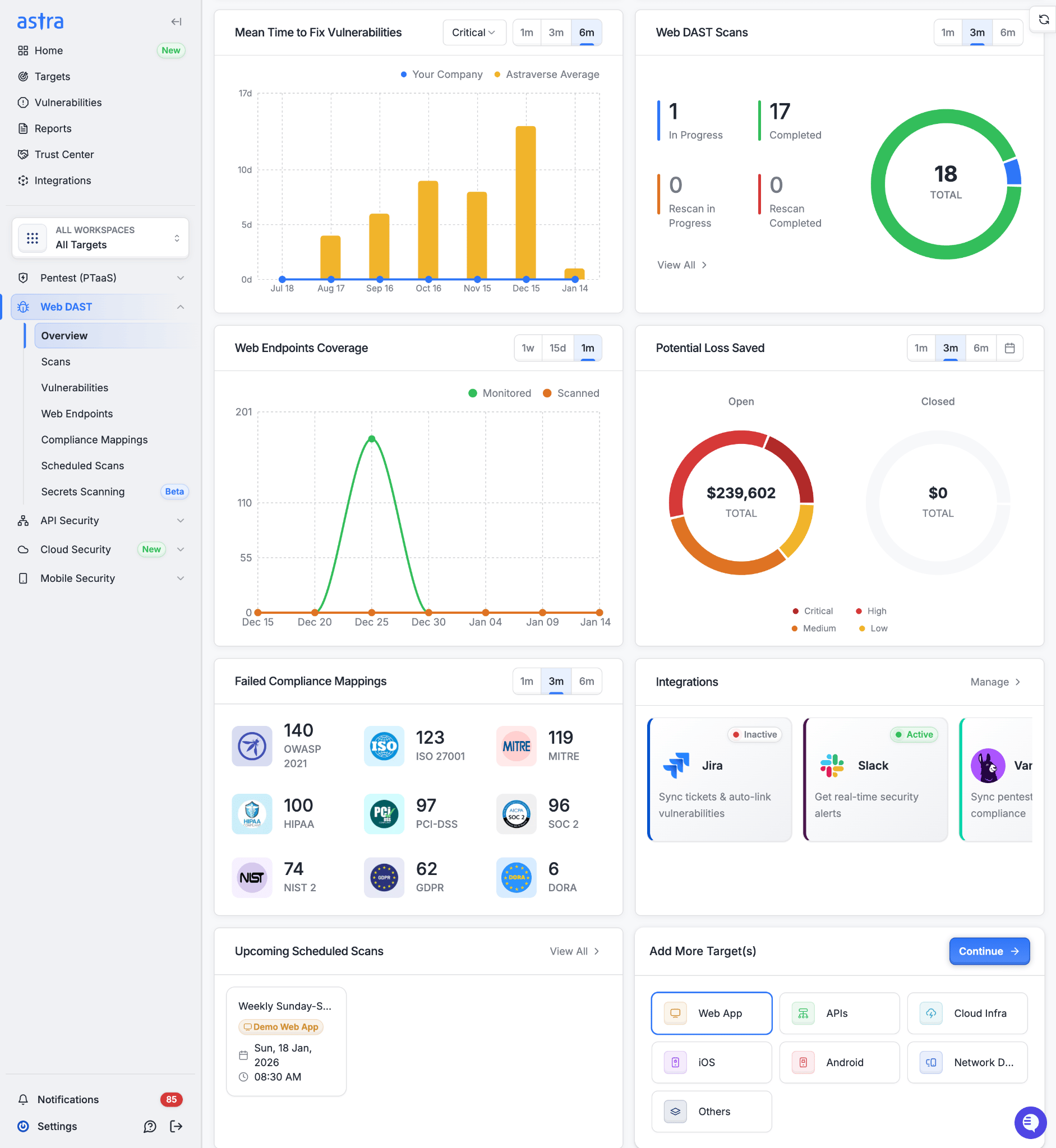
Astra is trusted by over 1,000 companies in 70 countries and offers end-to-end testing for web applications, APIs, cloud infrastructure, and mobile apps. It features precompliance mapping for PCI DSS, ISO 27001, SOC 2, GDPR, and HIPAA standards. With access to Astra’s vulnerability management dashboard, teams can easily track, assign, and remediate security issues via Slack and Jira.
OWASP ZAP
OWASP Zed Attack Proxy is an excellent open-source security scanner, which is used for finding vulnerabilities in applications during the development and testing phase. ZAP (Zed Attack Proxy) acts as an intermediary between the browser and the web application, intercepting and analyzing traffic to identify vulnerabilities. The tool contains automated scanners and manual testing tools to find common vulnerabilities like XSS, SQL injection, and authentication issues.
Burp Suite Community Edition
The basic tools of manual security testing of web applications are included in Burp Suite Community Edition. It has a proxy server to intercept requests, a repeater to modify and resend requests, and a decoder to convert data. Burp is used by security professionals in mapping the structure of the application, finding the input vectors, and testing for vulnerabilities that the automated scanners might miss.
Metasploit Framework
The Metasploit Framework is an open-source penetration testing platform that security teams use to find and validate vulnerabilities. The Metasploit framework has thousands of exploits, payloads, and auxiliary modules for testing a range of security vulnerabilities. Metasploit is a penetration testing tool that helps penetration testers simulate real-world attacks to determine the risk vulnerabilities pose to the organisation.
Best Practices for Web Application Security
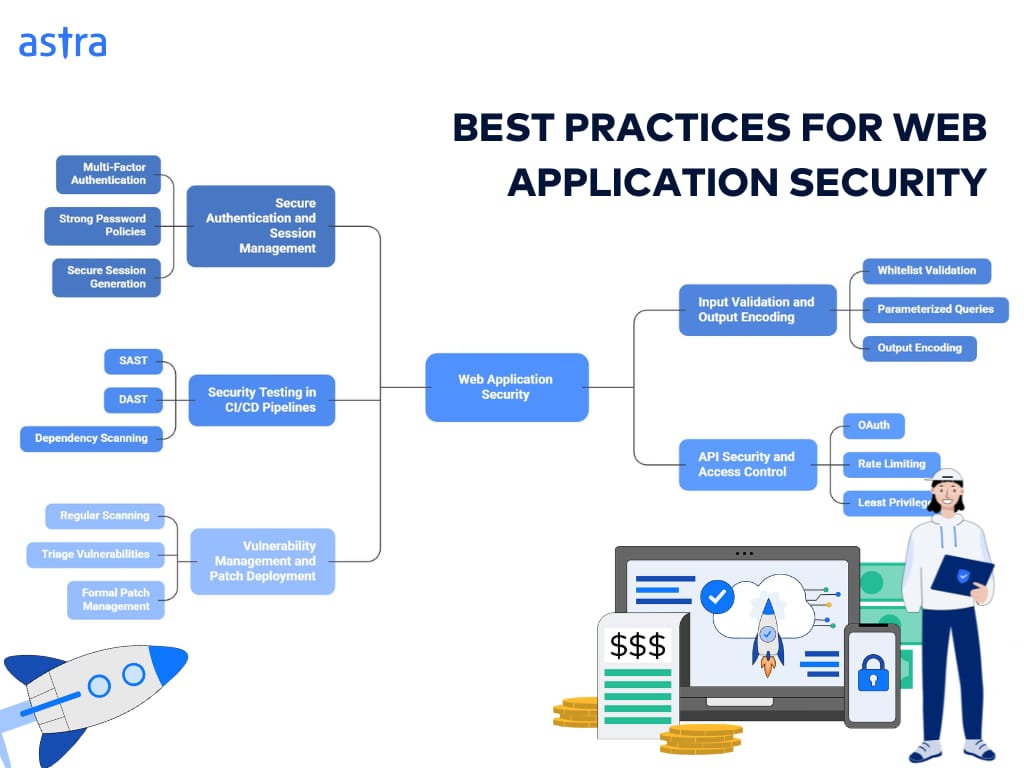
Adopting established security practices minimizes the attack surface of an organization. These basic practices work as baseline protections for web application security.
Implement Secure Authentication and Session Management
Organizations should use multi-factor authentication (MFA) to verify the identity of the user prior to granting access. Strong password policies should be implemented along with password rotation in regular intervals. Organizations must use a cryptographically secure random number generator to generate sessions. Session tokens must be saved using more secure strategies.
Input Validation and Output Encoding
Input data shall be validated against pre-defined formats, data types, and ranges before it can be processed. Use whitelist validation rather than the blacklist method, and only permit input patterns that have been authorized.
Output data needs to be encoded correctly before being inserted into web pages, to avoid any injection attack vector. To mitigate SQL injection vulnerabilities, all database interactions should use parameterized queries or prepared statements.
Security Testing in CI/CD Pipelines
Use automated security scanning tools as part of CI/CD pipelines for early identification of vulnerabilities during the software development life cycle. Static Application Security Testing (SAST) can be used to identify weaknesses in the source code during code commit activities. Dynamic application security testing (DAST) needs to be done on apps in production at the time of deployment. Dependency scanning tooling must be used to scan third-party libraries and components for vulnerabilities.
API Security and Access Control
All API endpoints must be protected by strict authentication mechanisms such as OAuth, API key, or token-based authentication. Denial-of-service and resource exhaustion attacks must be prevented to protect API resources by using rate limiting. All the APIs should use appropriate HTTP methods and follow the principle of least privilege for access control.
Maintaining complete documentation of all the API endpoints helps build backward compatibility for existing integrations and enables secure deprecation of legacy endpoints with API versioning strategies.
Vulnerability Management and Patch Deployment
For organizations, a broader vulnerability management program needs to be set up that includes regular systematic scanning of the infrastructure and applications for security weaknesses. Vulnerabilities that are identified must be triaged against severity ratings, exploitability assessments, and business impact.
There should be a formalized patch-management process, which will enable security updates to be applied on time.
Final Thoughts
Web application security requires constant attention as sophisticated, frequent threats continue to emerge. Organizations should implement secure coding practices, regular security testing, and vulnerability management to establish multiple layers of defence. Due to the financial, legal, and reputational consequences of security breaches, investment in application security is critical to business survival.
Success requires the right tools, processes, and expertise to identify and mitigate vulnerabilities before attackers can exploit them. Get a head start at fortifying the security of your web application. Check out Astra Security to see how their AI-powered platform can protect your applications with comprehensive penetration testing and continuous monitoring.
FAQs
How often should organizations conduct penetration testing on their web applications?
Organizations should conduct penetration testing quarterly at a minimum, with additional tests after major updates or changes. High-risk applications handling sensitive data may require monthly testing. Continuous automated scanning should supplement periodic manual penetration tests for comprehensive coverage.
What’s the difference between SAST and DAST security testing tools?
SAST (Static Application Security Testing) analyzes source code without executing it, identifying vulnerabilities during development. DAST (Dynamic Application Security Testing) tests running applications from the outside, simulating real attacks. Both approaches complement each other for comprehensive security coverage.
Can small businesses afford enterprise-level web application security?
Yes, small businesses can implement effective security through open-source tools like OWASP ZAP, cloud-based security services with flexible pricing, and managed security providers. Prioritizing critical vulnerabilities and leveraging free resources makes robust protection achievable regardless of budget.