
Key Takeaways:
- NIST CSF 2.0 provides a structured framework for proactively managing cybersecurity risks across all industries.
- It simplifies compliance by consolidating multiple regulatory requirements into a single, universal framework.
- Aligning with CSF builds stakeholder confidence and creates a competitive market advantage.
- The framework supports integration with modern DevSecOps and cloud-native practices, enhancing security workflows.
- Penetration testing plays a critical role in validating security controls within the CSF framework.
- Astra’s AI-powered, continuous pentesting solution aligns perfectly with CSF’s focus on ongoing risk management and improvement.
Released in February 2024, the NIST Cybersecurity Framework (NIST CSF) 2.0 represents a significant advancement in cybersecurity risk management guidance. There is no direct NIST certification issued by the National Institute of Standards and Technology; instead, organizations self-attest or utilize a third-party validation service, such as HITRUST, to demonstrate alignment with CSF 2.0.
Obtaining the NIST CSF certification provides a structured approach to understanding, assessing, prioritizing, and communicating cybersecurity risks applicable across industries for any organization type, with six core functions: Govern, Identify, Protect, Detect, Respond, and Recover.
Why Pursue NIST CSF Certification?
1. Risk Management Excellence
Organizations use the CSF 2.0 to understand their cybersecurity risks, assess and prioritize those risks, and communicate risk management activities between IT departments and decision-makers. This systematic methodology effectively transitions cybersecurity from a reactive practice to a proactive strategy, enabling better-informed security investment decisions.
For example, financial institutions can devote more attention to maintaining the security of customer transaction data, while manufacturers can focus more on the operational technology used for controlling production lines.
2. Regulatory Alignment and Compliance
NIST CSF 2.0 also bridges multiple regulatory requirements, such as CMMC for defense contractors and HIPAA for healthcare organizations. This universal appeal simplifies the management of numerous compliance frameworks simultaneously.
This CSF alignment provides healthcare systems with an advantage in HIPAA compliance, energy companies with an advantage in meeting NERC CIP requirements, and retail organizations with a better foundation for PCI DSS compliance, among other benefits.
3. Stakeholder Trust and Market Advantage
NIST CSF helps prove that your company has committed to achieving extraordinary growth in cybersecurity, impressing customers, partners, and investors alike. This truly sets organizations apart in a fiercely competitive environment.
Promoting these credentials can make one stand out from others and open up new business opportunities. SaaS providers view CSF alignment as a competitive differentiator in the enterprise space, while government contractors consider it a necessary component for winning contracts that require demonstrated cybersecurity maturity.
4. DevSecOps Integration Support
The framework itself is well-suited for DevSecOps practices, as it incorporates security throughout development and operational processes. Technology companies can integrate CSF principles into their CI/CD pipelines.
At the same time, cloud-native organizations recognize that CSF structure and governance support infrastructure-as-code practices, delivering security oversight across an expanding footprint.
Ready to align with NIST CSF? Get expert guidance to simplify your certification journey.

Step-by-Step Guide to NIST CSF Certification
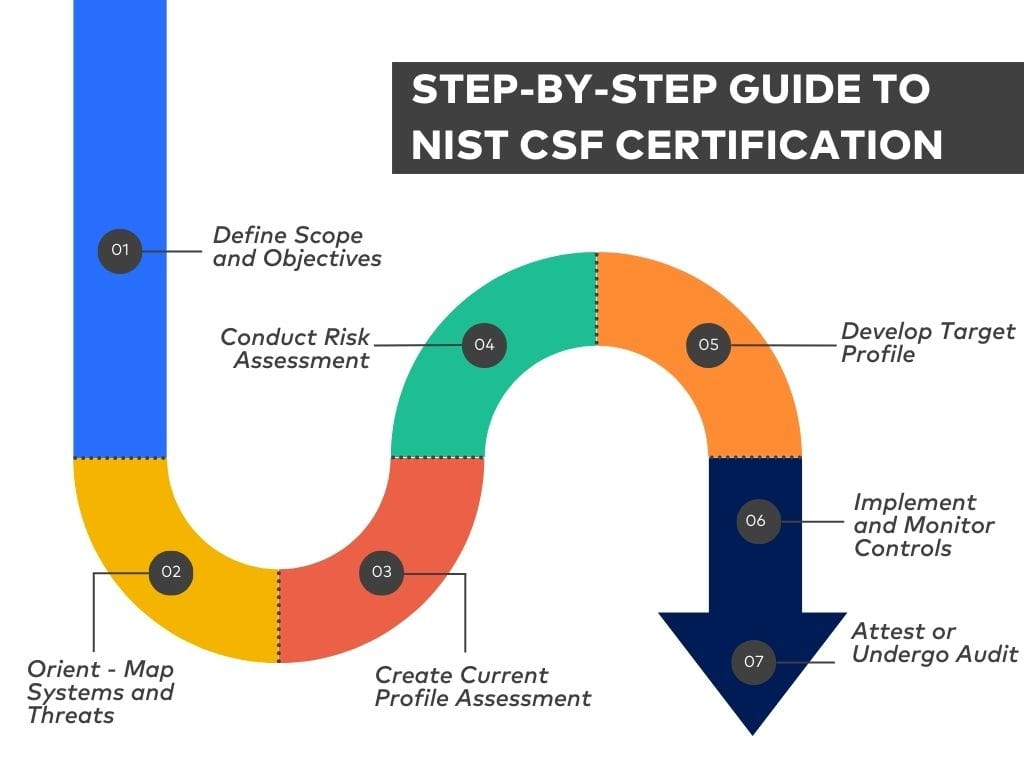
Step 1: Define Scope and Objectives
To get started, first define the assets, systems, and processes that will be brought under the scope of your CSF implementation: applications, APIs, cloud, data stores, everything. Define clear goals that align with your IT risk assessment and the business requirements.
Consider the regulatory requirements that may influence scope decisions and frame them to ensure stakeholder buy-in for the outlined boundaries.
Step 2: Orient – Map Systems and Threats
Map your current cybersecurity landscape on a broader level. This includes identifying all IT systems, mapping data flows, determining the owners of critical components, and assessing the existing security controls in place.
The Identify function provides comprehensive guidance on how to identify key risk areas, understand the business landscape, establish governance structures, and assess risks to develop a Risk Profile.
Step 3: Create Current Profile Assessment
Assess your organization against the CSF 2.0 subcategories and evaluate its performance about its cybersecurity posture. There are 22 categories and 106 subcategories in NIST CSF 2.0.
The assessment should be a candid, comprehensive review of current practices in comparison to what the framework requires. Utilize standard assessment methodologies to guarantee consistency and repeatability.
Step 4: Conduct Risk Assessment
Conduct extensive risk assessments, including vulnerability scans, penetration tests, and analysis of threat intelligence. This just reinforces the profile assessment you’ve already taken and highlights areas where you need to improve.
Address technical and operational risks, as well as critical program elements, considering human factors, process vulnerabilities, and technical controls.
Step 5: Develop Target Profile
Based on risk assessment findings and business objectives, establish target maturity levels for each CSF subcategory. Set realistic timelines for achieving target states, taking into account resource constraints and business priorities.
Include testing and validation requirements in the target profile to ensure implemented controls function as intended.
Step 6: Implement and Monitor Controls
Implement the security controls based on the target profile and maintain a record of the choices, including the rationale behind specific configurations.
Continuously monitor control performance over time. Deploy metrics and key performance indicators that provide insights into adherence to security posture.
Step 7: Attest or Undergo Audit
Complete the certification process by either formally documenting alignment with the CSF or using another third-party audit. Create comprehensive evidence packages for the implementation and efficacy of control measures.
Qualified assessors who are familiar with both the CSF framework and the specific requirements of your industry can also provide valuable assistance.
NIST CSF Areas Recommending Penetration Testing
Simulated attacks or penetration testing provide control validation, which plays a vital role in proving the effectiveness of implementing security controls. Penetration testing is a method of exploiting application vulnerabilities, and this critical validation mechanism is identified across multiple functional areas in the CSF 2.0 framework.
Penetration testing simulates the steps that attackers follow to execute offensive attacks against enterprises, providing an in-depth review of security vulnerabilities.
Key Subcategories Requiring Penetration Testing
1. ID.RA-01: Vulnerability Identification: Identifying the vulnerabilities that could be targeted and exploited by an attacker. Unlike automated vulnerability scanning, penetration testing provides a dynamic assessment approach that confirms vulnerabilities have the potential to be exploited in real-world attack scenarios.
2. ID.IM-02: Improvements from Testing require organizations to provide evidence that the results of testing are used to justify security improvements. Penetration tests provide us with practical information on the security gaps that exist and which are the most critical to address, giving us an idea of how easily they could be exploited.
3. PR.PS-06: Software Security Verification focuses on verifying security built into software applications over their lifecycle. Penetration testing verifies the functionality of application security controls in place (for example, authentication mechanisms, input validation, and authorization controls).
4. DE.CM-09: Runtime Monitoring Validation: Companies should use penetration testing to validate the effectiveness of detection and monitoring systems by generating realistic attack patterns. The exercises are used to determine if security operations teams can detect, analyze, and respond to real attack techniques being used in their environment.
Note: These refer to specific NIST CSF 2.0 subcategory identifiers, as indicated by ID.RA-01 represents the first subcategory under Risk Assessment (RA) within the Identify (ID) function.
Aligning Your Pentest Process with NIST CSF
1. Planning and Preparation Phase
The planning phase serves as a one-to-one relationship to the Governance function, establishing testing objectives, scope, and rules of engagement. Before initiating penetration testing scenarios, all parties agree to the rules of engagement.
This phase consists of asset identification (Identify function) and ensuring that the testing activities reflect organizational risk management strategies.
2. Reconnaissance and Scanning Activities
Testers gather data and information on systems that threat actors would gather in the initial stages of an attack.
This phase tests information protection controls by using a wide array of intelligence collection techniques (Protect function) and scanning operations test network segmentation, access controls, and observability to ensure optimal performance.
3. Exploitation and Lateral Movement Testing
The exploitation phase essentially tests protective controls by attempting to bypass security mechanisms and gain unauthorized access to information.
A successful exploitation will reveal weaknesses in Protect, while lateral movement attempts will test network segmentation and privilege management controls. These exercises create real IoCs to test detection mechanisms.
Don’t just prepare; prove compliance. Let our experts fast-track your NIST CSF readiness.
Why Astra Security?

- Test Cases: 15,000+, with new ones added every fortnight or so
- AI: AI-powered test cases for improved manual pentesting
- Integrations: Slack, Jira, GitHub, GitLab, and Jenkins
- Trusted Certification: Publicly verifiable certifications post two free rescans
- Scans: Unlimited automated scans for existing and emerging CVEs
- Dashboard: CXO-friendly dashboard with a dedicated CSM
- Compliance: ISO 27001, HIPAA, SOC2, GDPR & other compliances
Modern penetration testing approaches, such as Astra Security’s, recognize the complexity of contemporary IT environments, incorporating hybrid methodologies that address applications, APIs, and cloud infrastructure simultaneously.
Discovery phases identify previously unknown assets that may introduce risk, while comprehensive testing validates security controls across multiple attack vectors. Detailed reporting provides actionable remediation guidance, and retest services validate the effectiveness of implemented fixes.
Our penetration testing programs operate as continuous processes rather than point-in-time assessments, aligning with the CSF’s emphasis on ongoing risk management and continuous improvement. Regular testing cycles enable trend analysis and demonstrate the evolution of security posture over time, supporting data-driven security investment decisions.
Astra Pentest is built by the team of experts that helped secure Microsoft, Adobe, Facebook, and Buffer

Final Thoughts
NIST Cybersecurity Framework (CSF) 2.0 certification is a valuable investment in your organization’s overall cybersecurity maturity as it offers an organized approach to improved risk management, regulatory adherence, and building trust among stakeholders. The focus on governance, continuous improvement, and the tactical dimension of a cybersecurity strategy makes this framework the perfect basis for any contemporary cybersecurity program.
Organizations that work towards systematically implementing the system and incorporating penetration testing as a validation can develop a steadfast security stance that accommodates the latest threats. Whether working toward self-attestation or third-party validation, the path to alignment with CSF 2.0 presents an opportunity for organizations to enhance their security posture and ensure their readiness to respond effectively in today’s rapidly evolving threat landscape.
FAQs
1. What is NIST CSF 2.0 certification?
NIST CSF 2.0 certification involves aligning your organization’s cybersecurity practices with the framework’s guidance. While NIST issues no direct certification, organizations self-attest or use third-party audits to demonstrate compliance.
2. How does NIST CSF help with regulatory compliance?
The framework bridges multiple regulations (e.g., HIPAA, CMMC, PCI DSS), making it easier for organizations to manage compliance requirements through one unified cybersecurity approach.
3. Why is penetration testing necessary in NIST CSF?
Penetration testing validates the effectiveness of security controls by simulating real-world attacks, identifying vulnerabilities, and confirming whether detection and protection mechanisms work as intended.
4. Can NIST CSF be applied to all organization types?
Yes, CSF 2.0 is designed to be flexible and applicable across industries and organizations of all sizes, providing a universal cybersecurity risk management approach.