Key Takeaways
- Security posture is a fundraising variable.
- Many VCs and investors conduct technical due diligence, including API security reviews and architectural analyses.
- Weak security posture can shrink rounds and add remediation covenants.
- Autonomous pentesting detects BOLA, IDOR, and business-logic vulnerabilities, delivering better ROI for startups.
- The compliance and security programs can be the same if autonomous pentesting is in place.
- Enterprise sales cycles can be easily compressed using autonomous pentesting
- The average cost of a data breach is $4.88 million, which could end the company immediately.
- Breach probability matters less than context cost
Assuming security is a post-revenue problem is the most expensive strategic mistake a founding team can make. Most founders discover this in the worst possible context: a Series A due diligence call, where a prospective investor’s technical team has spent three days stress-testing the product and found that user IDs are sequential integers, the admin panel has no rate limiting, and the staging environment is reachable from the public internet. The round gets smaller and arrives with a remediation covenant attached.
Autonomous penetration testing (autonomous pentesting) changes the calculus. It compresses the time between vulnerability introduction and discovery, eliminates the per-engagement cost model that made frequent testing prohibitive for small teams, and produces the audit trail that compliance frameworks and investors require.
For a startup with limited engineering headcount and an attack surface that expands with every sprint, it is one of the few security investments that directly accelerates both the product roadmap and the fundraising process.
What is Autonomous Penetration Testing?
Autonomous penetration testing is the use of AI agents to simulate the decision-making, chaining, and contextual reasoning of a human attacker, with minimal human input.
Unlike automated scanners, which run predefined rule sets against known CVE signatures and configuration checklists, autonomous pentesting systems construct attack sequences dynamically. They identify an entry point, assess what can be reached from it, attempt to chain access across trust boundaries, and surface multi-step vulnerabilities that no single-rule scanner would catch.
Why Startups Cannot Afford to Skip This
The economics of pentesting have historically been structured against startups. A traditional penetration test costs between $10,000 and $20,000 per engagement.
The market has noticed and started offering solutions. According to MarketsandMarkets, the global penetration testing market was valued at $1.7 billion in 2024 and is projected to reach $4.39 billion by 2031, with autonomous and AI-assisted pentesting driving the majority of new adoption.
IBM’s Cost of a Data Breach Report 2024 puts the average breach cost at $4.88 million for companies under 1,000 employees, a figure that would end most seed-stage companies outright.
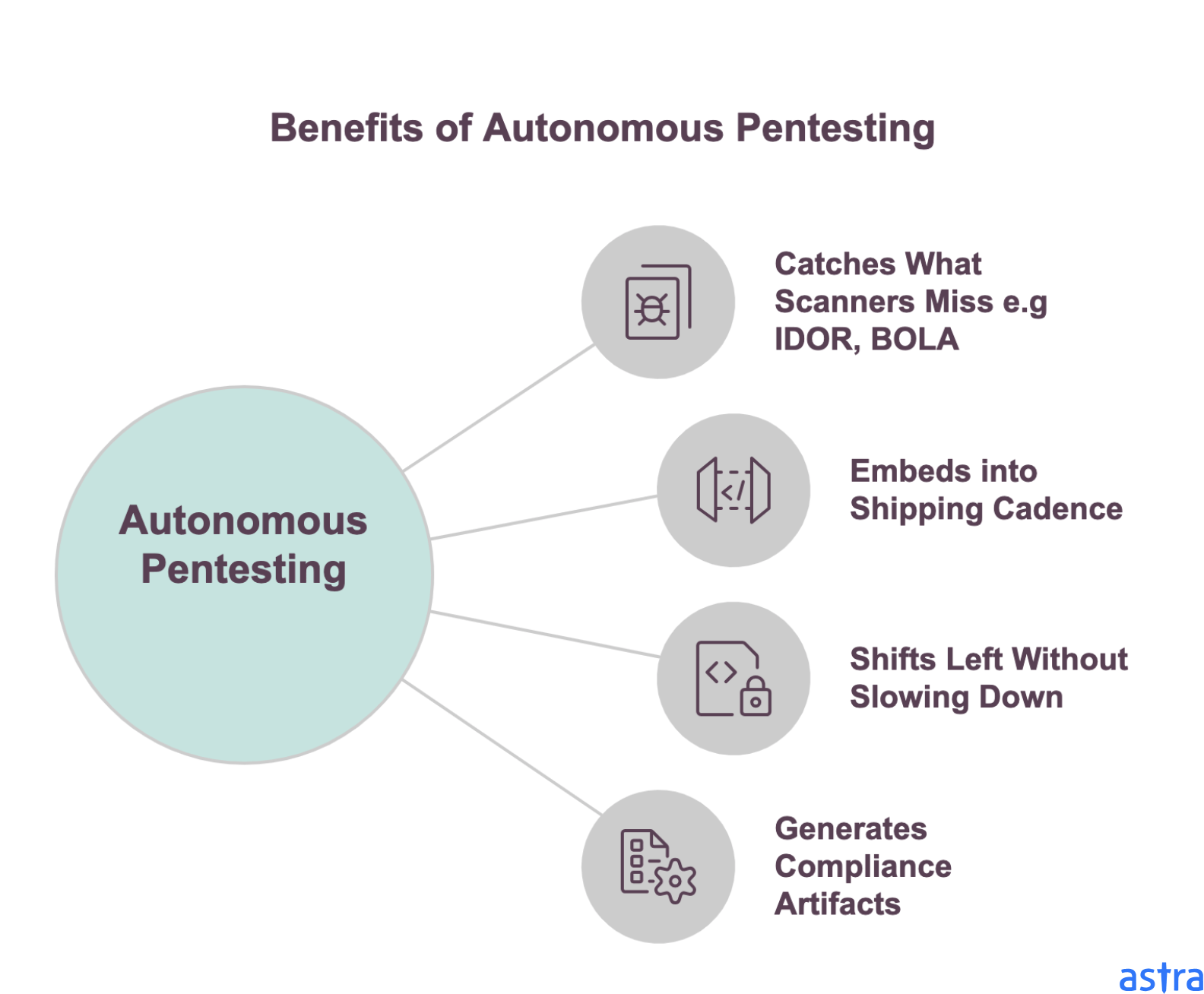
Four specific reasons autonomous pentesting is a structural fit for startups.
- Catches what automated scanners can’t: Detects BOLA, IDOR, and business logic flaws that scanners miss.
- Embeds into the shipping cadence: Operates continuously across CI/CD pipelines, so every deployment is tested against the attack surface it actually introduces.
- Shifts left without slowing down: Reduces remediation cost by catching vulnerabilities at development time rather than post-production, where the blast radius of a finding expands exponentially.
- Generates compliance artifacts in parallel: Produces structured, audit-ready reports that satisfy SOC 2, ISO 27001, and GDPR Article 32 evidentiary requirements, converting security spend into compliance evidence.
Taken together, these four properties mean autonomous pentesting is an operational capability that pays dividends across compliance, sales, and fundraising simultaneously. No other security investment at this cost level touches all three.
What are the Three Compounding Advantages It unlocks?
Autonomous pentesting unlocks three compounding advantages: it compresses enterprise sales cycles, replaces the security team you cannot yet afford, and locks in compliance before it becomes a forcing function.
Security is almost always framed as a cost center. That framing is wrong for startups, and particularly wrong for startups using autonomous pentesting. Each security investment either opens or closes future commercial and financial doors.
Autonomous pentesting opens 3 of them simultaneously.
Lever 1: Compressing Enterprise Sales Cycles
Enterprise buyers run security questionnaires. Larger ones run vendor security assessments that include penetration testing evidence requirements. A startup without a continuous pentesting program fails these assessments.
Failing them means the deal sits in procurement limbo for three to six months while the buyer’s security team waits for evidence the startup does not have.
A startup running autonomous pentesting can produce a current penetration testing report, a remediation log, and evidence of continuous testing cadence on demand. That package reduces a typical enterprise security assessment from a multi-month gate to a two-week review.
At an average enterprise contract value of $200,000 to $500,000, compressing that timeline by even 60 days has a direct revenue impact that dwarfs the annual cost of the testing tool.
Lever 2: Making the Security Team You Don’t Have Yet
Most Series A companies have zero to one security engineers. The function is covered by a senior developer who also owns infrastructure, a CTO who reviews pull requests when the sprint allows, and a compliance consultant engaged during the SOC 2 readiness project.
Autonomous pentesting acts as a force multiplier for that thin bench. It runs attack simulations that would otherwise require a skilled red team, produces prioritized findings that allow a generalist engineer to triage effectively, and integrates with existing CI/CD pipelines so that security gates are enforced without requiring someone to remember to enforce them.
For the one security engineer who does exist, this changes the nature of the work entirely. Instead of manually crafting test cases, chasing shadow APIs, and triaging low-severity noise, they can focus on the high-context findings the autonomous system surfaces and the remediation decisions that genuinely require human judgment.
Lever 3: Locking in Compliance Before It Becomes a Forcing Function
SOC 2 Type II, ISO 27001, and PCI-DSS are appearing as contract requirements at the seed stage in fintech, healthtech, legaltech, and any vertical where personally identifiable information is involved. Founders who engage compliance frameworks reactively, triggered by a lost deal or a failed procurement review, face a six to twelve-month remediation runway that actively blocks revenue while it runs.
Startups with a continuous pentesting program already in place can produce evidence on demand, while their competitors are still scheduling their first external audit.
Is Your CFO Modeling the Right Risk?
The standard objection from a growth-stage CFO runs like this: Autonomous pentesting costs $30,000 to $60,000 annually. The probability of a breach in our current stage is low. Therefore, the expected value of the spend is negative. This is a coherent argument that uses the wrong inputs.
The error is treating breach probability as the primary variable. The primary variable is context cost, the total organizational disruption, revenue impact, and remediation spend triggered by a single security incident at the wrong moment in the company’s lifecycle.
A breach during Series B fundraising does not produce a $4.88 million loss in isolation. It produces a withdrawn term sheet, a six-month fundraising reset, an emergency board response, a public disclosure requirement, and a legal review of every customer contract with breach notification clauses. Depending on the timing and the sector, it ends the company entirely.
The second error is treating autonomous pentesting spend as pure cost. It is partially a compliance spend (generating audit artifacts), partially a sales enablement spend (shortening enterprise sales cycles), and partially an insurance premium (reducing the probability of the worst-case timing scenario).
When those three components are modeled separately and aggregated, the ROI calculation changes substantially.
The correct CFO question is whether the combined return across compliance, sales cycle compression, and breach risk reduction exceeds the cost. For any startup handling user data, operating in a regulated vertical, or targeting enterprise customers, the answer is structurally yes.
When to Adopt Autonomous Pentesting
Security debt compounds faster than financial debt and surfaces at the worst moments. A seed-stage team running manual pentest on a two-endpoint prototype is solving a problem that does not exist yet. The wrong pentesting type at the wrong stage creates a false sense of coverage that is arguably more dangerous than no coverage at all.
| Criterion | Pre-Seed | Seed | Series A | Series B+ |
|---|---|---|---|---|
| When to start pentesting | After the first working API, before any external user data is collected | Before the beta launch or the first paying customer | Immediately, investors demand due diligence | Mandatory compliance frameworks require it |
| Pentesting type | Autonomous pentesting | Automated scanning + one manual pentest cycle | Autonomous pentesting plus quarterly manual cycles | Continuous autonomous pentesting plus formal red team exercises |
| Trigger to shift to autonomous | First revenue or first external API consumer | Business logic implemented, user authentication live | Handling PII, financial data, or regulated workloads | Any expansion into new markets, verticals, or product lines |
| Key vulns to catch | Open ports, exposed secrets, missing auth on admin endpoints | IDOR, BOLA, broken authentication flows | Business logic flaws, privilege escalation, API rate-limiting gaps | Multi-tenant data leakage, supply chain exposure, third-party API trust issues |
| Compliance relevance | None required, good hygiene | SOC 2 Type I prep, ISO 27001 gap analysis | SOC 2 Type II, GDPR Article 32, PCI-DSS if applicable | Full compliance posture |
The table below maps the appropriate pentesting posture to each funding stage, including the specific trigger conditions that should prompt a shift from automated scanning to autonomous pentesting.
The right answer is combining all three, but most startups cannot afford that from day one. Run what your stage demands, then layer in the rest as budget allows.
- Automated scanning: Catches CVEs, misconfigurations, and known vulnerability patterns continuously across every commit, at a scale no human team can match.
- Autonomous pentesting: Catches what scanning was never designed to find: BOLA, IDOR, business logic flaws, and vulnerabilities that only surface when an agent reasons about how your application actually behaves rather than what signatures it matches.
- Manual pentesting: Earns its place before major product changes, infrastructure shifts, or compliance audits, where documented human judgment is what the evidence requires.
Every dollar invested here compounds. It lowers the cost of compliance, reduces the friction of regulatory audits, and keeps the attack surface free from vulnerabilities.
How Astra Security’s Autonomous Pentesting Helps Startups
Astra’s autonomous pentesting engine deploys parallel AI agents, built on patterns extracted from over 5,000 real-world pentests, to discover entry points, chain them into attack sequences, exploit each path, and validate the finding before it reaches your engineering queue.
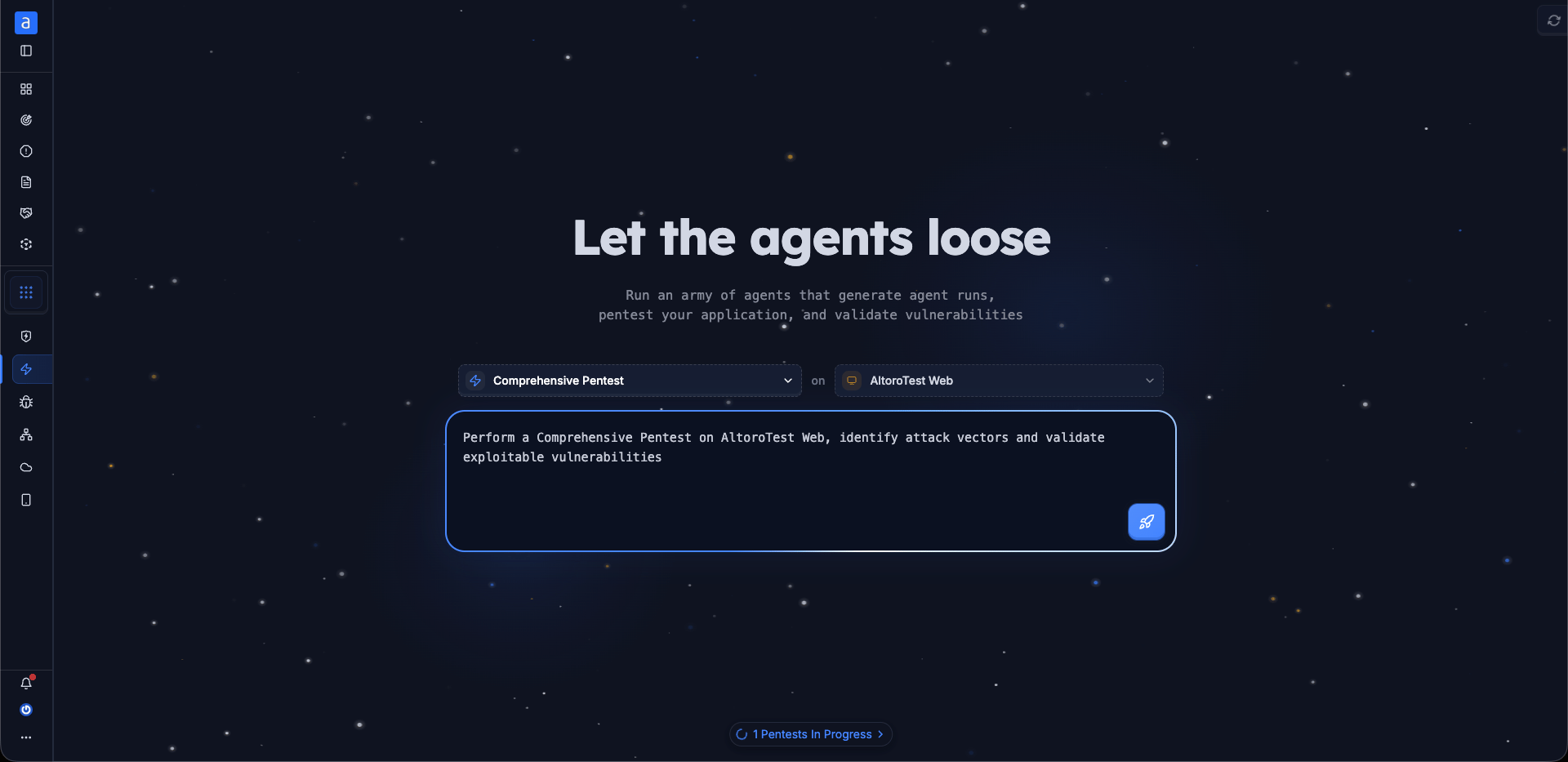
A five-person engineering team shipping ten times a day generates an attack surface that expands faster than any quarterly pentest can track. Astra’s agents run continuously, across all attack vectors in parallel, so coverage moves at the same pace as the codebase.
Key features
- Attack Chain Mapping: Findings are connected into the full sequence an attacker would follow, with guidance on which link to break to collapse the entire path. Fixing one node can neutralize five downstream findings.
- Parallel Agent Coverage: Structured pentest agents and bug-bounty-style pentesting agents run simultaneously across every attack vector, covering angles that sequential testing misses and that a lean security bench would never have the cycles to reach manually.
- Exploitability-First Prioritization: Findings are ordered by how exploitable they are in practice.
- BOLA and IDOR Detection at the Semantic Layer: The autonomous engine identifies BOLA vulnerabilities by reasoning about object ownership and access patterns.
- Compliance-Ready Reporting Infrastructure: Every testing cycle generates structured, auditor-ready reports with finding descriptions, severity ratings, remediation guidance, and retesting confirmation, formatted to satisfy SOC 2 Type II, ISO 27001, and GDPR Article 32 evidentiary requirements.
- Native Developer Toolchain Integration: Astra integrates natively with Slack, Jira, GitHub, and major CI/CD platforms, so findings are routed to the right team members in the tools they already use, with remediation tracked to closure without requiring a separate security workflow.
For a founding team without a dedicated AppSec function, this changes what security operations actually look like. Astra accelerates remediation too, with step-by-step fix guidance built directly into every report. The entire security cycle, from discovery to remediation, gets covered with a lean security bench.
Pro Tip: Autonomous pentesting generates the evidence artifacts that compliance auditors require under NIST SP 800-115 and ISO 27001 Annex A.12. Each pentesting cycle produces a structured finding log, remediation timestamps, and retesting confirmation. That artifact set satisfies the evidentiary requirements of most major frameworks without requiring a separate compliance engagement.
Final Thoughts
Security is the infrastructure that determines whether your features can be trusted with user data, your enterprise contracts can survive procurement review, and your capital raise reflects your actual risk profile. Startups that treat security as a launch-week checkbox are commercially fragile.
Autonomous penetration testing is the mechanism that closes that fragility gap without requiring a security team you cannot yet afford. It finds the vulnerabilities that matter, generates the evidence that investors and compliance frameworks require, and compresses the attack surface continuously rather than quarterly.
For a startup choosing where to allocate limited engineering and capital resources, few investments produce returns across as many dimensions simultaneously.
The founders who will lead their category in three years are the ones who recognized, early, that security posture is a growth input. Everything else being equal, the company that cannot be breached closes the enterprise contract. The company that can demonstrate it closes it faster.
Explore Our Autonomous Penetration Testing Series
This post is part of a series on autonomous penetration testing. You can also check out other articles below.
- Chapter 1: Autonomous Pentesting: How it Works, Benefits, Tools (2026)
- Chapter 2: Autonomous vs Traditional Pentesting: What’s More Secure in 2026?
- Chapter 3: Top 10 Autonomous Pentesting Tools in 2026
- Chapter 4: How to Evaluate Autonomous Penetration Testing Security Vendors in 2026
- Chapter 5: OWASP APTS: A Complete Guide to Autonomous Penetration Testing Standard
- Chapter 6: Agentic AI in Cybersecurity: The Complete Guide for Security Teams
- Chapter 7: Autonomous Penetration Testing as a Growth Lever for Startups
- Chapter 8: 5 High-Impact Autonomous Pentesting Capabilities That Traditional Scanners Ignore
- Chapter 9: Autonomous Pentesting vs. Red Teaming: Do You Still Need Both?
- Chapter 10: How Autonomous Penetration Testing Kills False Positives
- Chapter 11: How a Modern Autonomous Penetration Testing Framework Differs from Legacy DAST
- Chapter 12: Autonomous AI Agents for Penetration Testing: A Complete Guide
- Chapter 13: Autonomous Pentesting for Lean Security Teams: The 2026 Guide
- Chapter 14: Will an Autonomous Pentest Satisfy SOC 2, PCI, & ISO Auditors?
- Chapter 15: How Reporting with Autonomous Pentesting Reasoning Traces Eliminates Developer Friction
- Chapter 16: A Guide to Continuous Autonomous Pentesting
- Chapter 17: Autonomous Pentesting for SaaS Companies in 2026: The Complete Guide