
Key Takeaways:
- Most modern data breaches originate at the API layer, where direct access to data and business logic allows small authorization gaps to scale into large exposures.
- As enterprises grow, API sprawl becomes inevitable, quietly eroding visibility and eliminating any single source of truth about what is actually in production.
- Security blind spots emerge not from missing tools, but from fragmented ownership and undocumented APIs that evolve faster than governance can keep up.
- Perimeter controls like gateways and WAFs reduce noise but fail to detect misuse that relies on valid requests and flawed authorization assumptions.
- The highest-risk API failures are design-level issues, broken object and function-level authorization, that only appear when APIs are exercised in real user context.
- Without accurate inventory, ownership, and documentation, security teams cannot reason about intent, enforce standards, or scope testing effectively.
- Enterprise API security holds up at scale only when visibility and documentation are treated as core security controls and API behavior is validated continuously.
In the last few years, many of the largest data exposures haven’t come from broken pages or leaked databases. They’ve come from APIs. Public reports around large-scale scraping incidents at companies like Meta and LinkedIn showed how exposed APIs, not traditional web flaws, were used to pull massive volumes of user data at scale.
This isn’t an edge case anymore. APIs now sit at the center of how enterprises move data between applications, partners, and customers. They carry authentication context, business logic, and sensitive records, often with far less friction than traditional web interfaces.
That ease of access is also what makes API breaches so damaging. When an API is abused, attackers are not navigating screens. They are directly interacting with data objects and actions. A single authorization gap can expose entire datasets, not just a page or a feature.
Yet API security is still treated as an extension of web security. Add a gateway, tune a WAF, run a scan, and move on. This tool-first mindset creates a false sense of safety, especially in large environments where APIs evolve faster than controls.
Why Enterprise API Security Breaks at Scale
1. API Sprawl and the Loss of a Single Source of Truth
In large enterprises, API sprawl is not a failure of discipline; it is a byproduct of how modern software is built. Teams work in parallel, services are decomposed into smaller units, and APIs are created to move fast rather than to be centrally governed.
Over time, versions accumulate, internal APIs get reused externally, and older endpoints are kept alive to avoid breaking dependencies.
This is not theoretical. In large API assessments, it is common for security teams to uncover endpoints that were never formally documented or assigned clear ownership.
A 2025 research overview shows that API-related breaches have surged by over 400% in the past three years, and 94% of organizations have experienced API security incidents. The takeaway is not the exact numbers, but that teams are often exposed through APIs they didn’t realize were in scope.
2. Fragmented Ownership Creates Security Blind Spots
With the ever-growing API surfaces, there is an ownership division between the engineering, platform, and security teams. Engineers focus on functionality, platform teams handle infrastructure and performance, and security teams are tasked with managing risk without having direct control over design or implementation decisions.
This fragmentation makes systemic issues hard to catch. Authorization models are often implemented locally within services, without a shared standard or review process.
3. Why Tooling Alone Fails to Contain the Risk
Most enterprises respond to scale by adding tools. API gateways, WAFs, and automated scanners become the primary line of defense, and in many cases, they do reduce noise and block obvious abuse.
High-impact API incidents tend to involve legitimate-looking requests that exploit gaps in authorization or object-level access. Public reporting around large-scale data scraping incidents at consumer platforms has repeatedly shown that attackers did not bypass controls in dramatic ways; they simply used APIs as designed, at scale, against assumptions that were never validated.
At enterprise scale, API security breaks not because controls are missing, but because no one is continuously testing whether those controls actually enforce the rules the business believes are in place. An effective API security platform provides continuous visibility across the API lifecycle, helping teams understand not just what APIs exist, but how they behave in production.
Are your APIs protected or just gated? Most breaches happen when valid requests expose data your business never intended to share.

Visibility First: API Inventory, Documentation, and Ownership
1. Visibility Is the First Failure Point
Most enterprise API security issues do not originate in exploitation. They begin much earlier, with incomplete visibility. In large organizations, security teams often cannot state how many APIs exist in production, which teams own them, or which versions are still active.
This happens because APIs are created incrementally and distributed across teams that operate with a high degree of autonomy. Over time, APIs are extended, reused, and exposed to new consumers, while documentation and ownership models fail to keep pace with production reality.
2. Shadow and Zombie APIs Are a Structural Outcome
Shadow and zombie APIs are not anomalies; they are a natural result of scale. Internal endpoints become externally reachable, deprecated versions continue serving traffic, and APIs that are no longer actively maintained still process live data.
In enterprise testing environments, it is common to discover APIs that engineering teams did not account for during scoping. These APIs are rarely maliciously hidden. They persist because removing or refactoring them feels operationally risky, especially when downstream dependencies are poorly understood.
3. Why Inventory Gaps Translate Directly Into Risk
Lack of dependable inventory leaves blind spots that cannot be fully addressed by downstream control. Security teams are unable to determine exposure, implement standards, or determine whether controls are consistently enforced when they are unaware of what is present.
This is reflected in industry data. According to multiple State of API Security reports published over the last few years, a majority of organizations that experienced API incidents were unaware of the vulnerable API until after exploitation. The failure was not detection, but visibility.
4. Documentation and Ownership as Security Controls
At enterprise scale, documentation is not about clarity for developers; it is about enforceability. Without clear ownership, there is no accountability for authorization models, versioning decisions, or exposure changes.
API documentation, when accurate and current, allows security teams to reason about intent rather than just behavior. Without it, every assessment becomes reactive, and every fix addresses only the symptom that was discovered, not the surface that enabled it.
The Real API Threat Landscape Enterprises Face
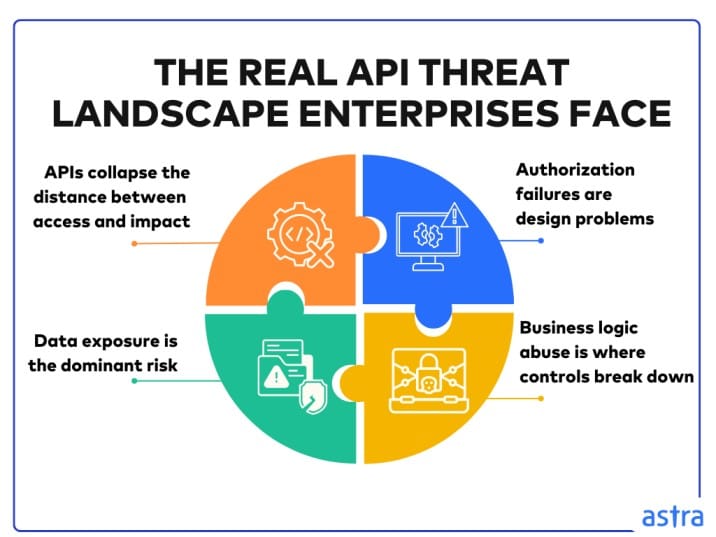
1. APIs Collapse the Distance Between Access and Impact
APIs fail differently than traditional web applications because they collapse multiple layers of interaction into a single request. Where web applications often require navigation through UI flows, APIs expose data objects and actions directly.
This makes exploitation more deterministic. Attackers do not need to guess how a feature behaves; they can observe responses, modify parameters, and scale access with automation. As a result, mistakes at the API layer translate faster into material impact.
2. Data Exposure Is the Dominant Risk
Most serious API incidents lead first to loss of confidentiality. APIs are designed to return data, and when authorization checks are incomplete, that data is exposed immediately and at scale.
This aligns with public reporting. API breach analyses always indicate that authorization failures are the cause of the majority of high-impact breaches, a lot more so than injection vulnerabilities or infrastructure misconfigurations. It is not that APIs are not available, but that they are provided in the wrong context.
3. Authorization Failures Are Design Problems
Broken object-level authorization and broken function-level authorization persist because they are design-level issues. An API may authenticate users correctly while failing to enforce whether a specific object, record, or action should be accessible to that user.
These failures are often enabled by predictable identifiers and assumptions about client behavior. When APIs return data outside the intended user scope, the breach is complete regardless of how well perimeter controls are configured.
4. Business Logic Abuse Is Where Controls Break Down
Business logic abuse emerges when APIs behave correctly in isolation but fail under real usage patterns. Attackers use the API exactly as it behaves, chaining together valid requests in ways the original designers did not expect.
This kind of abuse is hard to surface through automated scans because nothing looks obviously malformed. The API responds as designed, and that is why many high-impact API issues only become visible during hands-on testing or after someone has already demonstrated a real path to data exposure.
Do you know which APIs in production actually enforce object-level authorization correctly?
Building an Enterprise API Security Strategy That Holds Up
1. Stop Treating APIs as Implicitly Trusted
Most enterprises do not consciously decide to trust their APIs. It happens gradually, as APIs move behind internal networks, service meshes, and gateways. Over time, “internal” comes to be treated as “safe.”
That assumption breaks as soon as APIs are reused across services or exposed to new clients. Zero trust matters here in a very practical sense. Each request needs to be authenticated, and every object/action needs to be authorized right at the API layer. Anything less eventually shows up as a BOLA or BFLA issue in production.
2. Documentation Is Not Hygiene, It’s Control
API security conversations often skip past documentation because it feels operational, not strategic. In practice, weak documentation is one of the fastest ways to lose control of authorization and exposure.
When teams don’t know which APIs exist, who owns them, or what data they return, security becomes reactive by default. Standards get applied unevenly, deprecated endpoints stay live, and testing scopes are built on partial visibility. At enterprise scale, documentation is what allows security decisions to be made deliberately rather than after something breaks.
Continuous Validation Beats One-Time Confidence
1. One-Time Testing Doesn’t Survive Continuous Change
Penetration testing is useful, but it is still a snapshot. APIs change too frequently for point-in-time assurance to hold. New features, new consumers, and incremental fixes regularly introduce regressions, particularly in authorization logic.
This is why mature programs move toward continuous security assessments. Automated scanning helps track known patterns across large API surfaces, while periodic manual testing validates real attack paths.
Frameworks like SEBI’s CSCRF make this expectation known, requiring organizations to assess security on a recurring basis rather than treating testing as a one-time activity.
2. Coverage Is Not the Same as Risk Reduction
Scanning more APIs more frequently can create the illusion of progress, but it rarely answers the question that actually matters: whether or not those APIs can be misused in practice.
Enterprise API security improves when testing is used to validate assumptions. Can users access only the objects they should? Do internal APIs remain safe when reused externally? Are runtime controls masking design flaws or actually compensating for them? These answers matter far more than raw scan counts.
How Astra Helps Enterprises Secure APIs

Key Features:
- AI-powered test cases for improved manual pentesting
- 150+ test cases based on OWASP Testing methodologies
- Business-logic testing to uncover logical vulnerabilities like broken authentication & authorization
- Integrations with Slack, Jira, GitHub, GitLab, and Jenkins
- Publically verifiable certifications post two free rescans
- CXO-friendly dashboard with a dedicated CSM
- Customizable reports for management and developers, respectively
- Security professionals with various certifications & CVEs [OSCP, CEH, eJPT, eWPTXv2, and CCSP (AWS)]
Astra is typically brought in when teams realize that existing controls are not answering practical questions about API risk. Gateways and scanners can confirm that traffic is filtered and endpoints exist, but they do not show whether authorization rules hold up once APIs are exercised with real user context.
API security best practices start with complete visibility into your API ecosystem, followed by strong authentication, precise authorization, and continuous validation of how APIs behave in real-world usage.
The platform focuses on testing APIs the way they are actually consumed. That includes authenticated flows, role-based access, object-level permissions, and multi-step logic that spans endpoints. These are the areas where enterprise APIs most often fail, and where teams usually have the least visibility.
Astra is frequently applied to APIs that are considered low risk because they are internal or gateway-protected. Testing these APIs in context often reveals that authorization behaves differently in practice than it was originally designed, particularly as APIs evolve and get reused across systems.
When was the last time your APIs were tested in real user context? Point-in-time scans don’t catch authorization regressions at scale.
Final Thoughts
Enterprise API security fails most often not because teams lack tools, but because they operate on assumptions. Assumptions about which APIs exist, who uses them, and how authorization is enforced tend to accumulate quietly as systems grow.
A durable API security strategy starts by removing those assumptions. That means treating visibility and documentation as security primitives, designing APIs with explicit authorization rather than inherited trust, and validating behavior continuously instead of relying on point-in-time assurance.
As API surfaces continue to expand, the organizations that manage risk well will be the ones that focus less on coverage and more on evidence. Not whether an API is scanned or gated, but whether it can be misused in ways the business did not intend.
FAQs
1. Why are APIs responsible for so many large-scale data breaches today?
APIs expose data and actions directly, bypassing UI constraints. When authorization logic fails, attackers can systematically extract entire datasets through legitimate-looking requests. Unlike web flaws, API abuse scales quickly, making even small design gaps lead to massive data exposure.
2. Why don’t API gateways and WAFs prevent high-impact API attacks?
Gateways and WAFs are effective at blocking malformed or abusive traffic, but most serious API breaches involve valid requests exploiting authorization assumptions. These tools validate structure and rate, not whether users should access specific objects or actions at scale.
3. How do shadow and zombie APIs increase enterprise risk?
Shadow and zombie APIs persist due to versioning, reuse, and unclear ownership. Because they’re undocumented or forgotten, security controls aren’t consistently applied. Attackers exploit these blind spots, often accessing sensitive data through APIs teams didn’t realize were still active.
4. What does a resilient enterprise API security strategy require?
It requires visibility-first thinking: accurate inventory, clear ownership, and current documentation. APIs must enforce authorization explicitly, not rely on inherited trust. Continuous validation, combining automated coverage with manual logic testing, ensures APIs behave as intended as systems evolve.